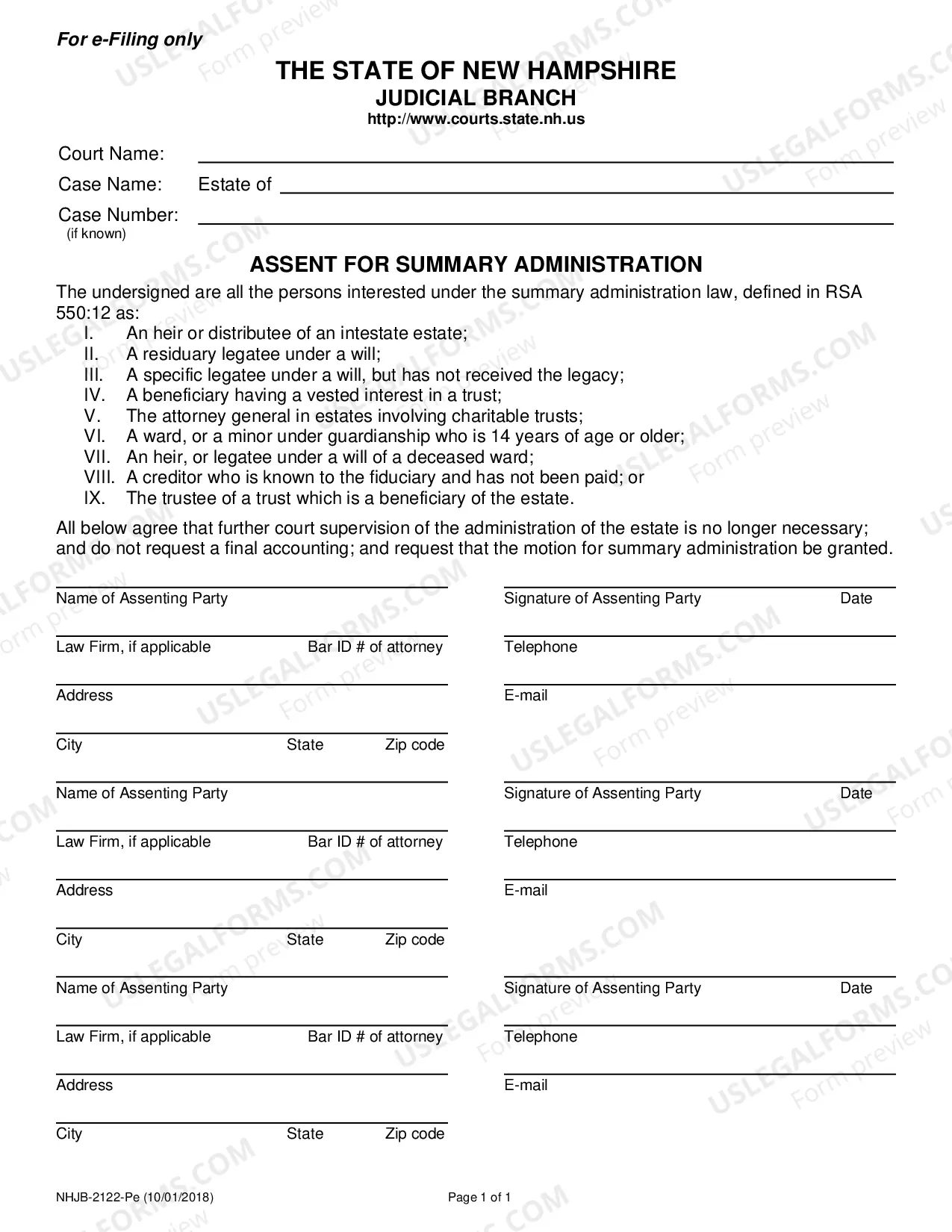
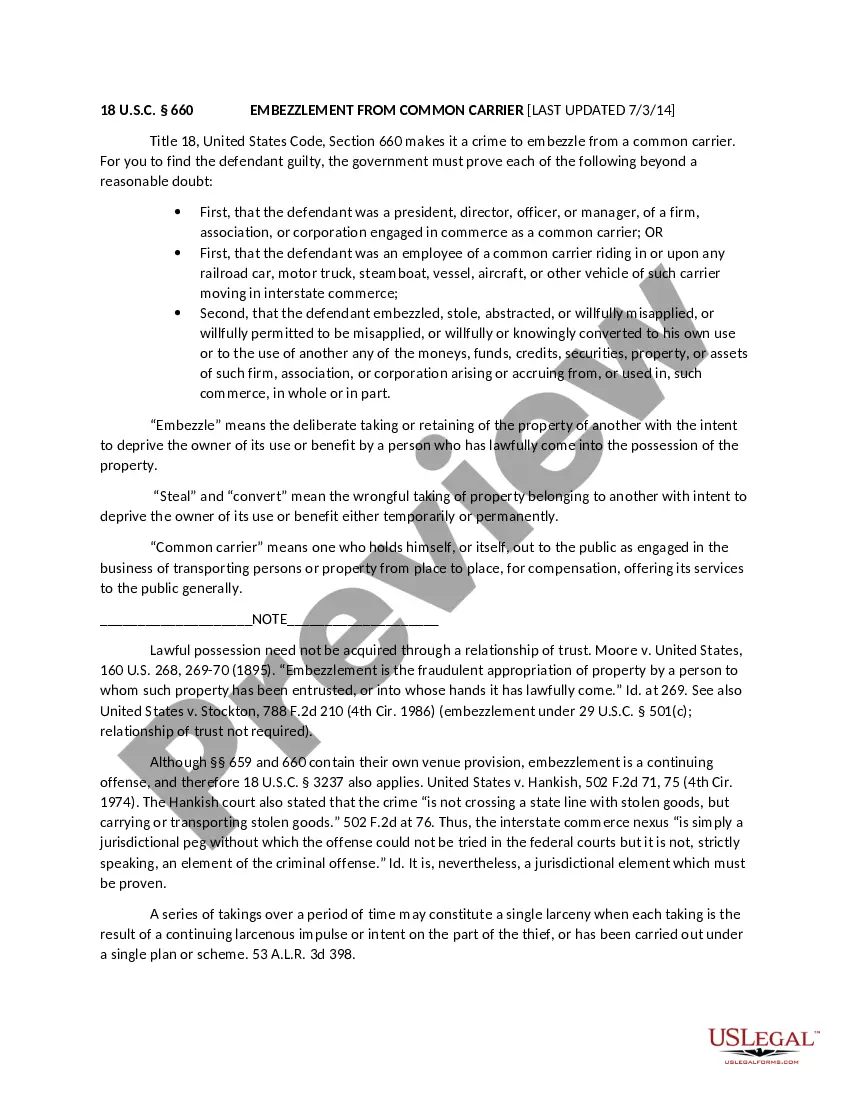
South Carolina EMBEZZLEMENT FROM COMMON CARRIER
Overview of this form
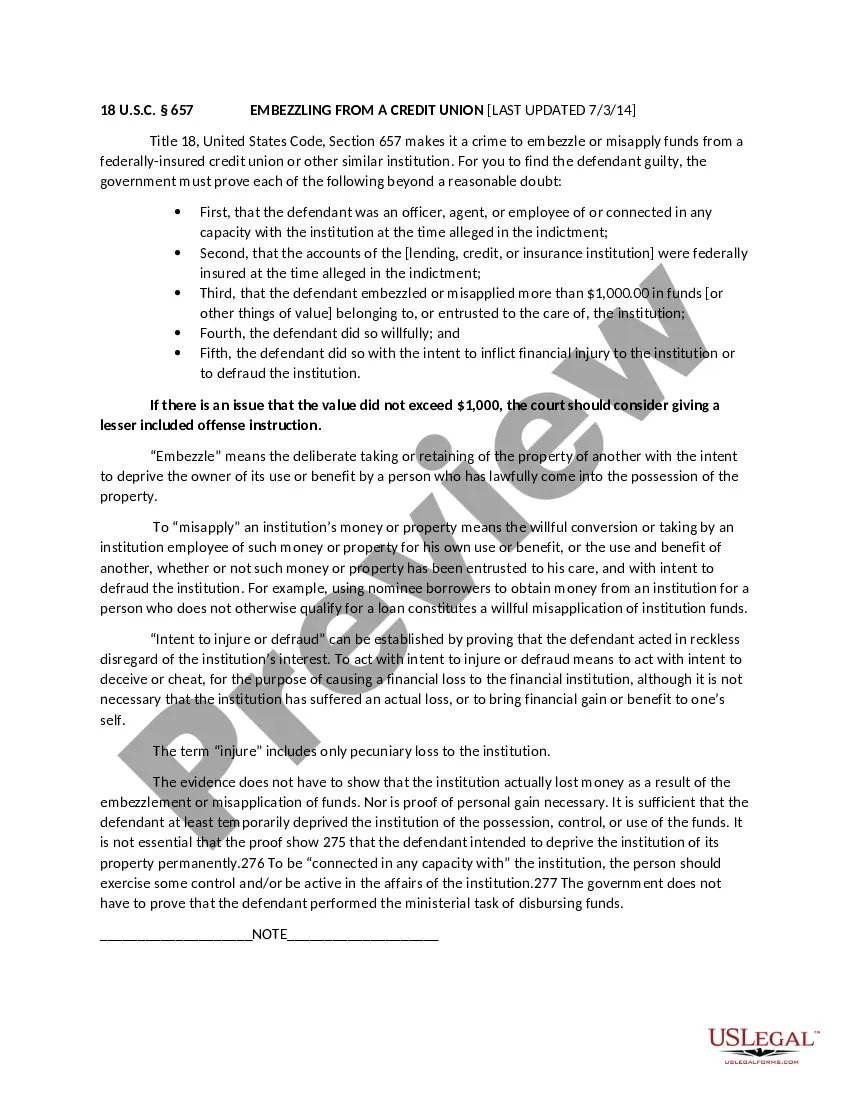
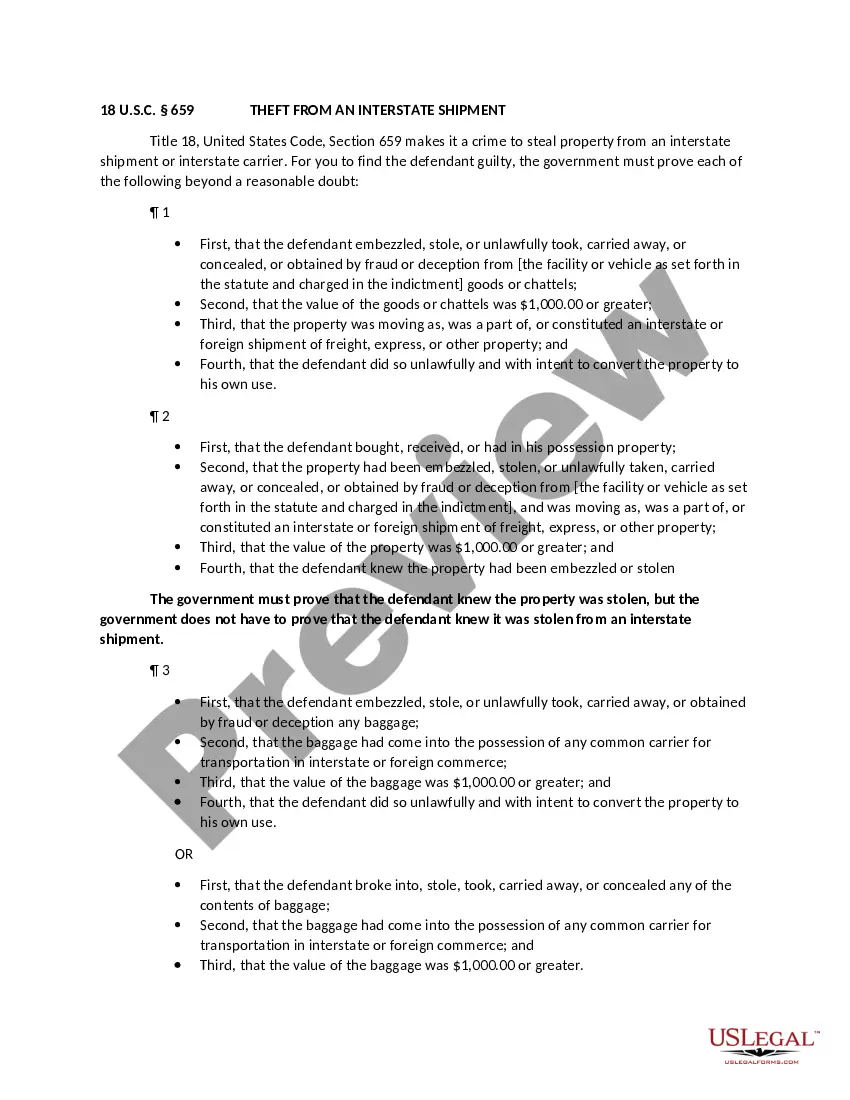
The Embezzlement from Common Carrier form provides official jury instructions for cases involving the embezzlement of funds or property from businesses engaged in transporting goods or individuals. This form is specifically tailored for federal criminal cases in South Carolina and outlines the legal definitions and requirements for prosecuting embezzlement crimes within the jurisdiction, differentiating it from similar legal instructions for other theft-related offenses.
Form components explained
- Definitions of key legal terms such as embezzle, steal, and common carrier.
- Criteria for establishing the defendant's role as a president, director, officer, or employee of a common carrier.
- Elements required for the government to prove guilt beyond a reasonable doubt.
- Clarification that lawful possession of property does not require a relationship of trust.
- Specific legal citation from Title 18, United States Code, Section 660 outlining the embezzlement offense.
Common use cases
This form should be used in situations involving allegations of embezzlement from a common carrier, such as when an employee or manager unlawfully appropriates funds or property belonging to a transportation company. It is particularly relevant in federal criminal cases where the defendant's actions have interstate implications, as the common carrier operates across state lines.
Who should use this form
This form is applicable for:
- Legal professionals handling cases of embezzlement involving common carriers.
- Prosecutors aiming to present jury instructions in federal court.
- Defendants seeking to understand the legal definitions and requirements related to their charges.
- Anyone involved in federal criminal litigation regarding embezzlement matters within South Carolina.
Steps to complete this form
- Review the definitions and legal terms provided to understand the charges.
- Identify the role of the defendant (e.g., president, employee) relevant to the case.
- Gather evidence to establish connections to interstate commerce if applicable.
- Prepare to demonstrate how the defendant unlawfully took or misapplied property.
- Follow the legal requirements as set forth in Title 18, United States Code, Section 660.
Does this form need to be notarized?
Notarization is generally not required for this form. However, certain states or situations might demand it. You can complete notarization online through US Legal Forms, powered by Notarize, using a verified video call available anytime.
Get your form ready online
Our built-in tools help you complete, sign, share, and store your documents in one place.
Make edits, fill in missing information, and update formatting in US Legal Forms—just like you would in MS Word.
Download a copy, print it, send it by email, or mail it via USPS—whatever works best for your next step.
Sign and collect signatures with our SignNow integration. Send to multiple recipients, set reminders, and more. Go Premium to unlock E-Sign.
If this form requires notarization, complete it online through a secure video call—no need to meet a notary in person or wait for an appointment.
We protect your documents and personal data by following strict security and privacy standards.

Make edits, fill in missing information, and update formatting in US Legal Forms—just like you would in MS Word.

Download a copy, print it, send it by email, or mail it via USPS—whatever works best for your next step.

Sign and collect signatures with our SignNow integration. Send to multiple recipients, set reminders, and more. Go Premium to unlock E-Sign.

If this form requires notarization, complete it online through a secure video call—no need to meet a notary in person or wait for an appointment.

We protect your documents and personal data by following strict security and privacy standards.
Common mistakes
- Failing to adequately define the role of the defendant within the common carrier.
- Neglecting to establish a link to interstate commerce.
- Misunderstanding the definitions of embezzle and steal, leading to incorrect charges.
- Overlooking the need for substantial evidence to prove intent in embezzlement cases.
Why use this form online
- Convenient download in a Word format, allowing for easy editing.
- Reliable access to officially sanctioned jury instructions.
- Simple customization for specific case details.
- Streamlined preparation for attorneys and legal professionals.
Looking for another form?
Form popularity
FAQ
Under South Carolina law, there is no statute of limitations for any crime. There is no criminal statute of limitations in South Carolina.
In South Carolina, the embezzlement of public funds can result in a prison sentence of up to ten years. Smaller embezzlement cases may be charged as misdemeanors, but can still leave a black mark on your criminal record if you are convicted.
Under Section 16-13-210 (A) of the South Carolina Code of Laws, it is unlawful for any officer or other person entrusted with the ?safekeeping, transfer, and disbursement of public funds to embezzle said funds.? This simply means that any party who is entrusted with funds by another party must act in a reasonably
A person commits grand larceny, a felony, when the value of the stolen property is over $2,000. South Carolina divides grand larceny into two categories, depending on the value of the taken property. Class F felony.
SECTION 16-13-210. Embezzlement of public funds. (A) It is unlawful for an officer or other person charged with the safekeeping, transfer, and disbursement of public funds to embezzle these funds.
In South Carolina, the embezzlement of public funds can result in a prison sentence of up to ten years. Smaller embezzlement cases may be charged as misdemeanors, but can still leave a black mark on your criminal record if you are convicted.
Under South Carolina law, there is no statute of limitations for any crime. There is no criminal statute of limitations in South Carolina.