South Carolina PROCURING CITIZENSHIP OR NATURALIZATION UNLAWFULLY
About this form
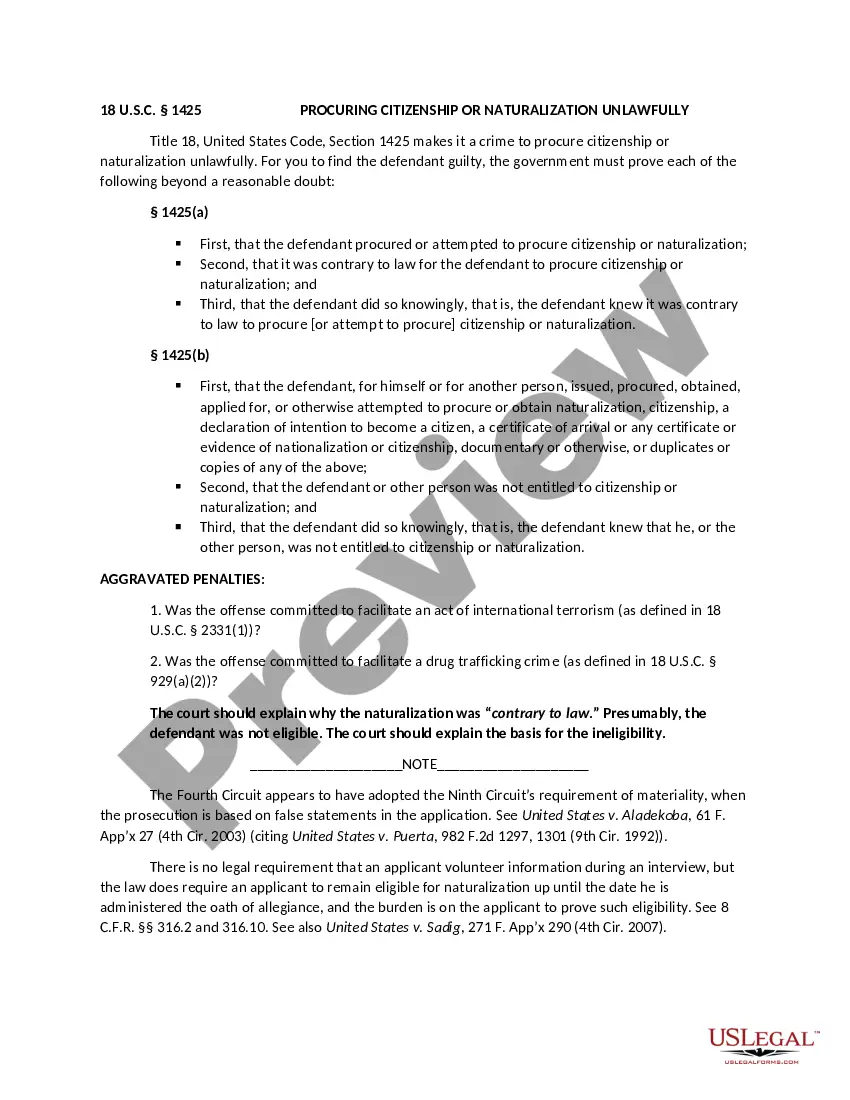
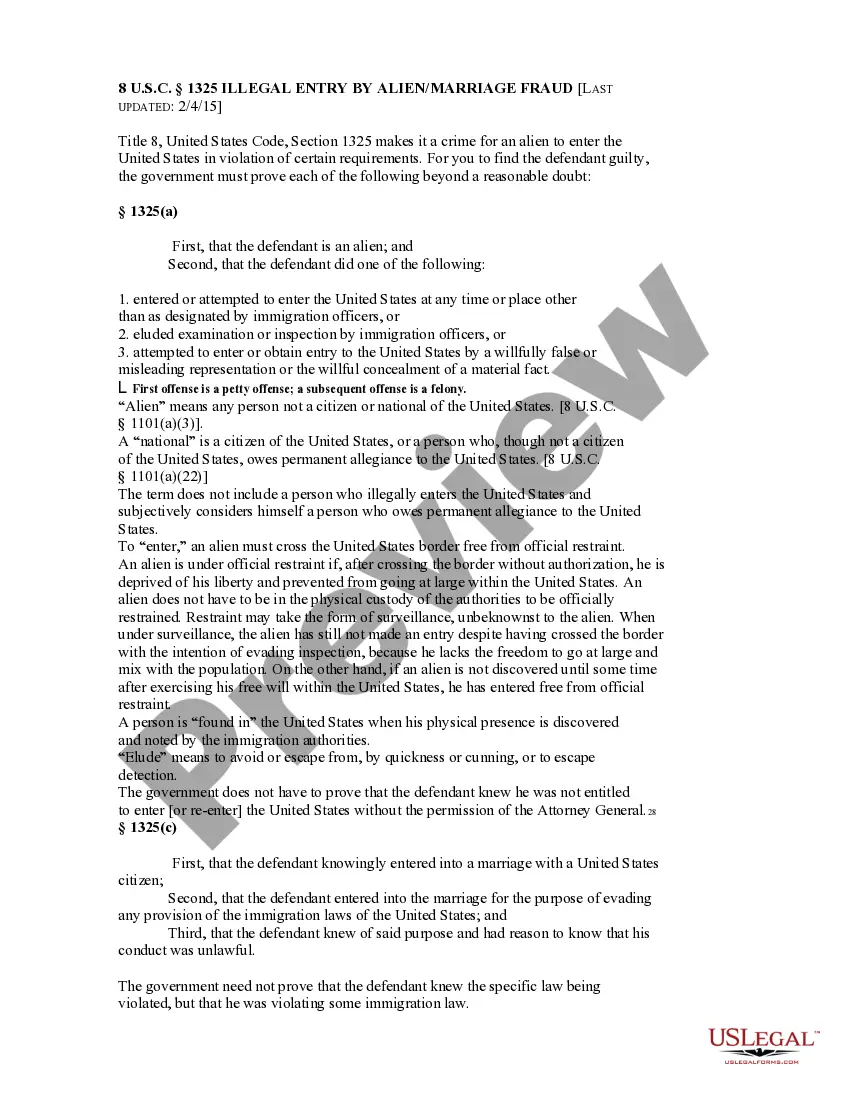
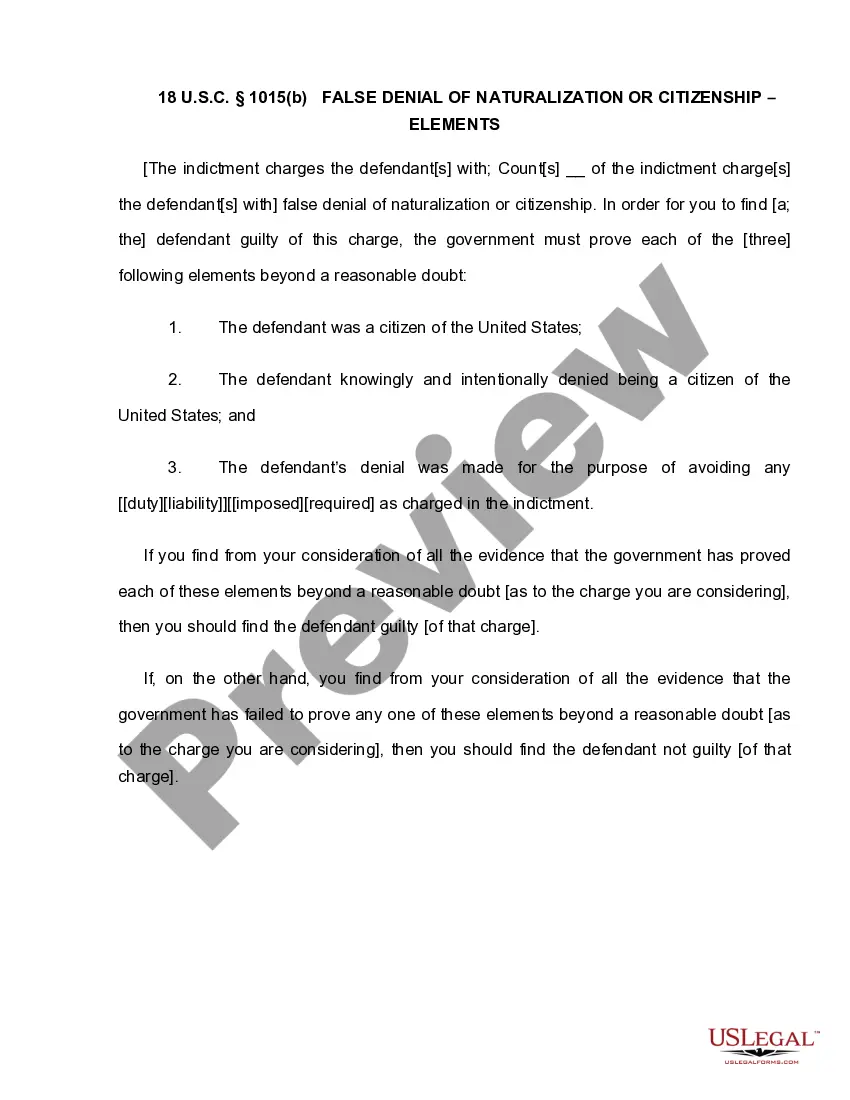
The form titled "Procuring Citizenship or Naturalization Unlawfully" outlines the legal framework surrounding the unlawful procurement of citizenship and naturalization in the United States. It is a legal document used in criminal cases to prove that an individual knowingly engaged in actions that resulted in fraudulent citizenship or naturalization, in violation of Title 18, United States Code, Section 1425. This form serves as a crucial tool for prosecutors in federal district courts, distinguishing it from other immigration-related forms by its focus on unlawful actions specifically related to citizenship and naturalization processes.
Main sections of this form
- Definition of unlawful procurement of citizenship or naturalization actions.
- Criteria for proving guilt, including knowledge of ineligibility.
- Outline of aggravated penalties for facilitating crimes such as terrorism or drug trafficking.
- Requirement for the court to explain eligibility and the basis for ineligibility.
- References to legal precedents regarding false statements in applications.
When to use this document
This form is used in criminal proceedings when an individual is accused of unlawfully procuring citizenship or naturalization. Situations may include instances where someone knowingly provides false information during the naturalization process or where they attempt to obtain citizenship despite being ineligible due to legal restrictions. The form is essential for prosecutors in establishing the elements of the crime as defined by federal law.
Who this form is for
Eligibility and intended audience:
- Prosecutors involved in federal criminal cases related to immigration.
- Lawsuits involving the unlawful actions of individuals seeking citizenship.
- Legal professionals advocating for clients accused of immigration-related offenses.
How to complete this form
- Identify and outline the unlawful actions taken by the defendant.
- Specify that the actions were contrary to immigration law.
- Demonstrate the defendant's knowledge of the ineligibility for citizenship or naturalization.
- Detail any aggravating factors, such as involvement in terrorism or drug trafficking.
- Cite relevant legal precedents to support the case.
Notarization guidance
Notarization is not commonly needed for this form. However, certain documents or local rules may make it necessary. Our notarization service, powered by Notarize, allows you to finalize it securely online anytime, day or night.
Get your form ready online
Our built-in tools help you complete, sign, share, and store your documents in one place.
Make edits, fill in missing information, and update formatting in US Legal Forms—just like you would in MS Word.
Download a copy, print it, send it by email, or mail it via USPS—whatever works best for your next step.
Sign and collect signatures with our SignNow integration. Send to multiple recipients, set reminders, and more. Go Premium to unlock E-Sign.
If this form requires notarization, complete it online through a secure video call—no need to meet a notary in person or wait for an appointment.
We protect your documents and personal data by following strict security and privacy standards.

Make edits, fill in missing information, and update formatting in US Legal Forms—just like you would in MS Word.

Download a copy, print it, send it by email, or mail it via USPS—whatever works best for your next step.

Sign and collect signatures with our SignNow integration. Send to multiple recipients, set reminders, and more. Go Premium to unlock E-Sign.

If this form requires notarization, complete it online through a secure video call—no need to meet a notary in person or wait for an appointment.

We protect your documents and personal data by following strict security and privacy standards.
Avoid these common issues
- Failing to establish the defendant's knowledge of their ineligibility.
- Not providing sufficient evidence or details regarding unlawful actions.
- Ignoring the requirement to explain the basis for ineligibility in court.
- Overlooking relevant legal precedents that could impact case outcomes.
Why use this form online
- Convenient access to legal templates drafted by licensed attorneys.
- Easy download and editability for specific case requirements.
- Immediate availability without the need for travel to a legal office.
- Reliable format ensuring compliance with federal legal standards.
Looking for another form?

Form popularity
FAQ
The South Carolina Illegal Immigration Reform Act (S. C. Code Ann. §59-101-430 (Westlaw 2008)) prohibits those unlawfully present in the United States from attending a public institution of higher education in South Carolina and from receiving a public higher education benefit.
Ing to the New York Times, ?denaturalizations have ramped up under the Trump administration: Of the 228 denaturalization cases that the department has filed since 2008, about 40 percent of them were filed since 2017, ing to official department numbers.
Ing to the New York Times, ?denaturalizations have ramped up under the Trump administration: Of the 228 denaturalization cases that the department has filed since 2008, about 40 percent of them were filed since 2017, ing to official department numbers.
Denaturalization for Convictions for Naturalization Fraud (Criminal Revocation) (18 U.S.C. § 1425): Naturalization may be revoked by conviction for procuring or attempting to procure the naturalization of anyone contrary to the law.
Renunciations Are On The Rise? Renunciations of U.S. citizenship are on the rise. Between 2005 and 2009, less than 2,500 people renounced. Between 2010 and 2020, this number went up to 36,840.
Congress has also addressed the concept of denaturalization, which refers to the revocation of citizenship from a naturalized U.S. citizen. Fedorenko v. United States, 449 U.S. 490, 506 (1981). Id.
Yes, a naturalized citizen can be deported and have their citizenship revoked when denaturalization has occurred. This process is rare, but does occur. Usually, when you obtain your United States citizenship, it is a status that you will keep forever.
Denaturalization Isn't Common In the last three years, DOJ attorneys have filed 94 denaturalization cases. In comparison, over 830,000 people obtained citizenship through naturalization in 2019 alone. Just because a denaturalization case is filed does not mean that someone will be stripped of citizenship.