South Carolina HOSTAGE TAKING
About this form
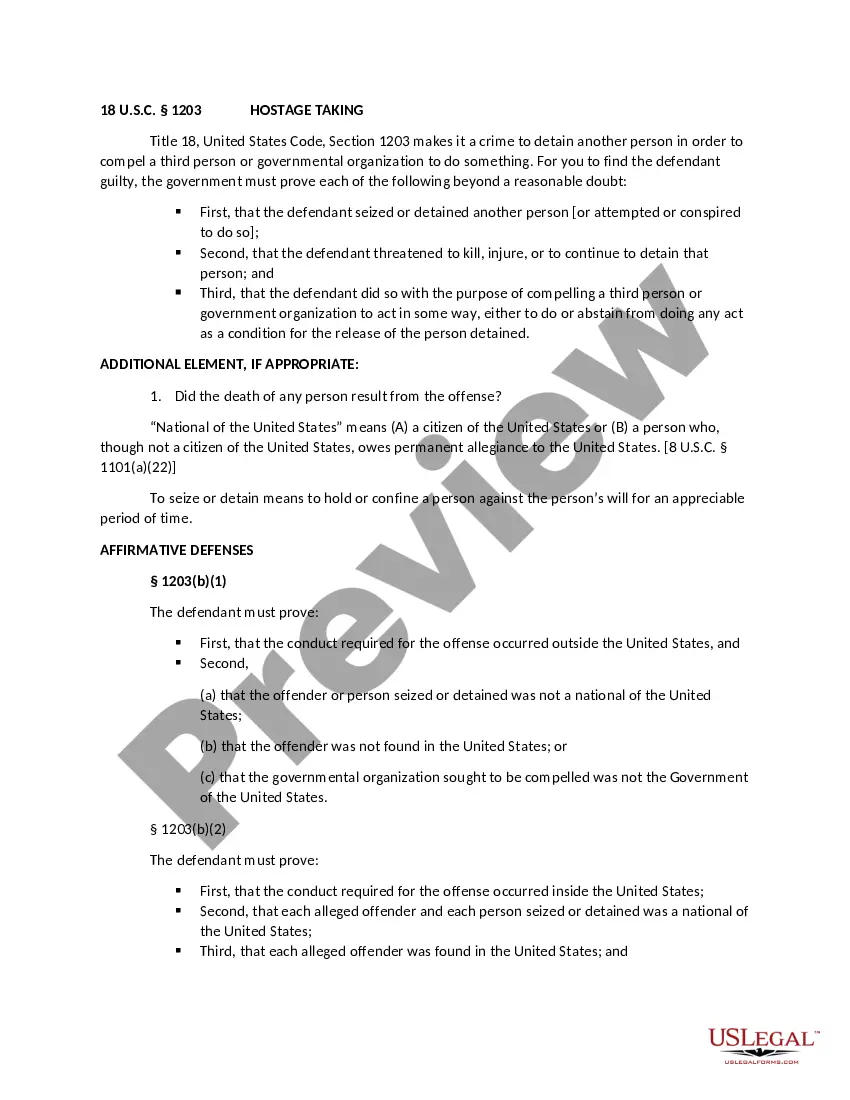
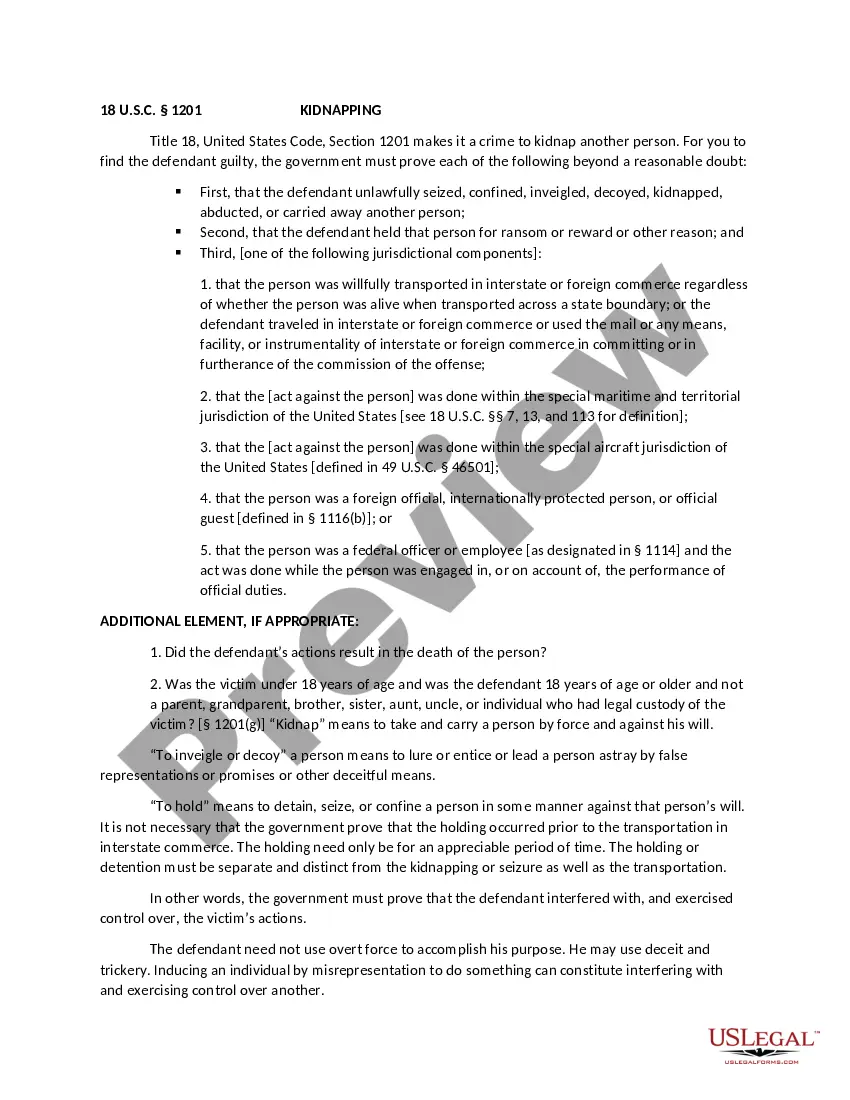
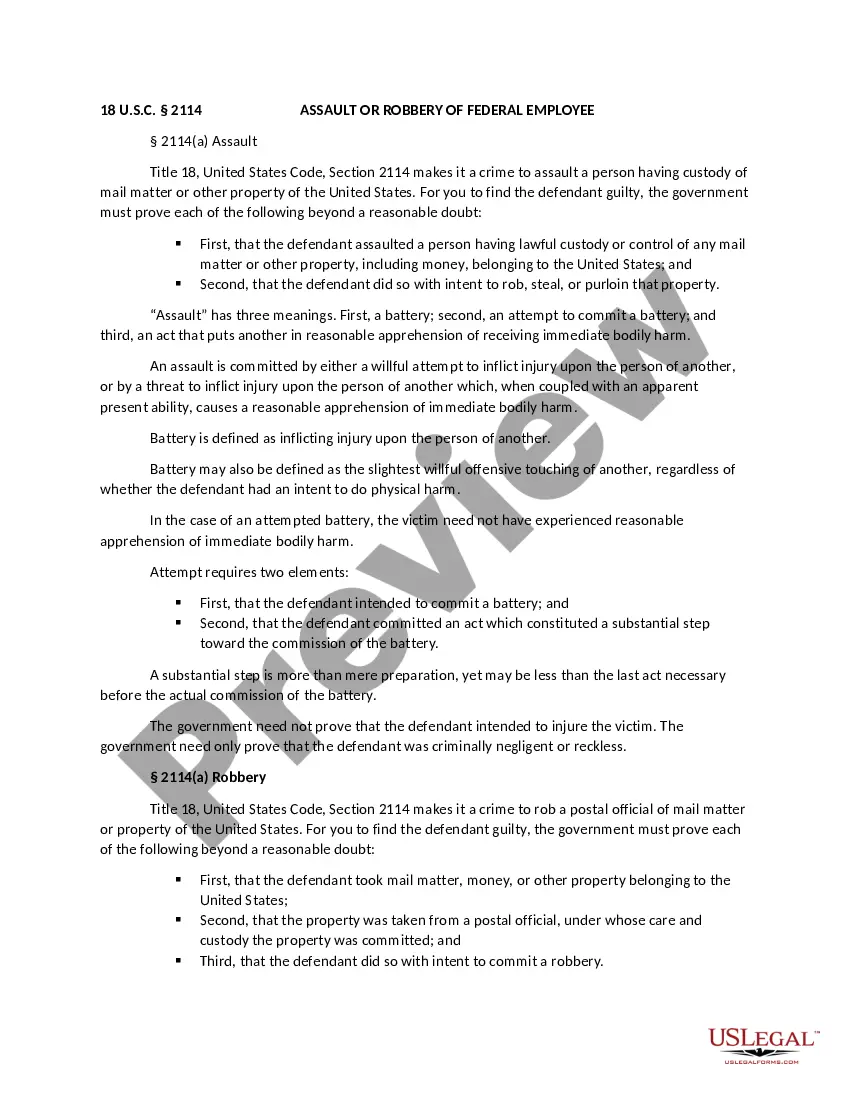
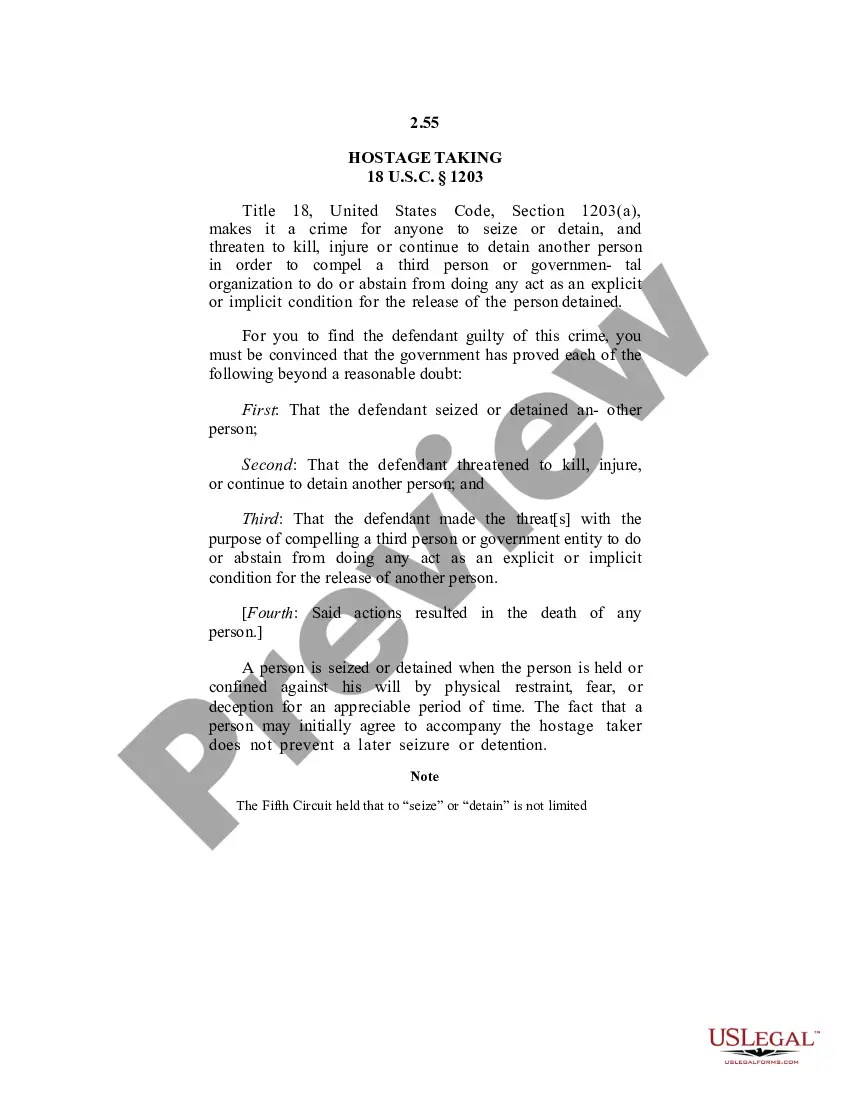
The Hostage Taking form is a legal document used to understand the charges related to the crime of hostage-taking as defined by Title 18, United States Code, Section 1203. This form outlines the specific elements that the government must prove in court to establish guilt, differentiating it from other criminal forms related to kidnapping and unlawful detention. It serves as guidance for federal prosecutions in the U.S. and is essential for legal professionals working within this jurisdiction.
Key parts of this document
- The definition of the crime and necessary elements for conviction.
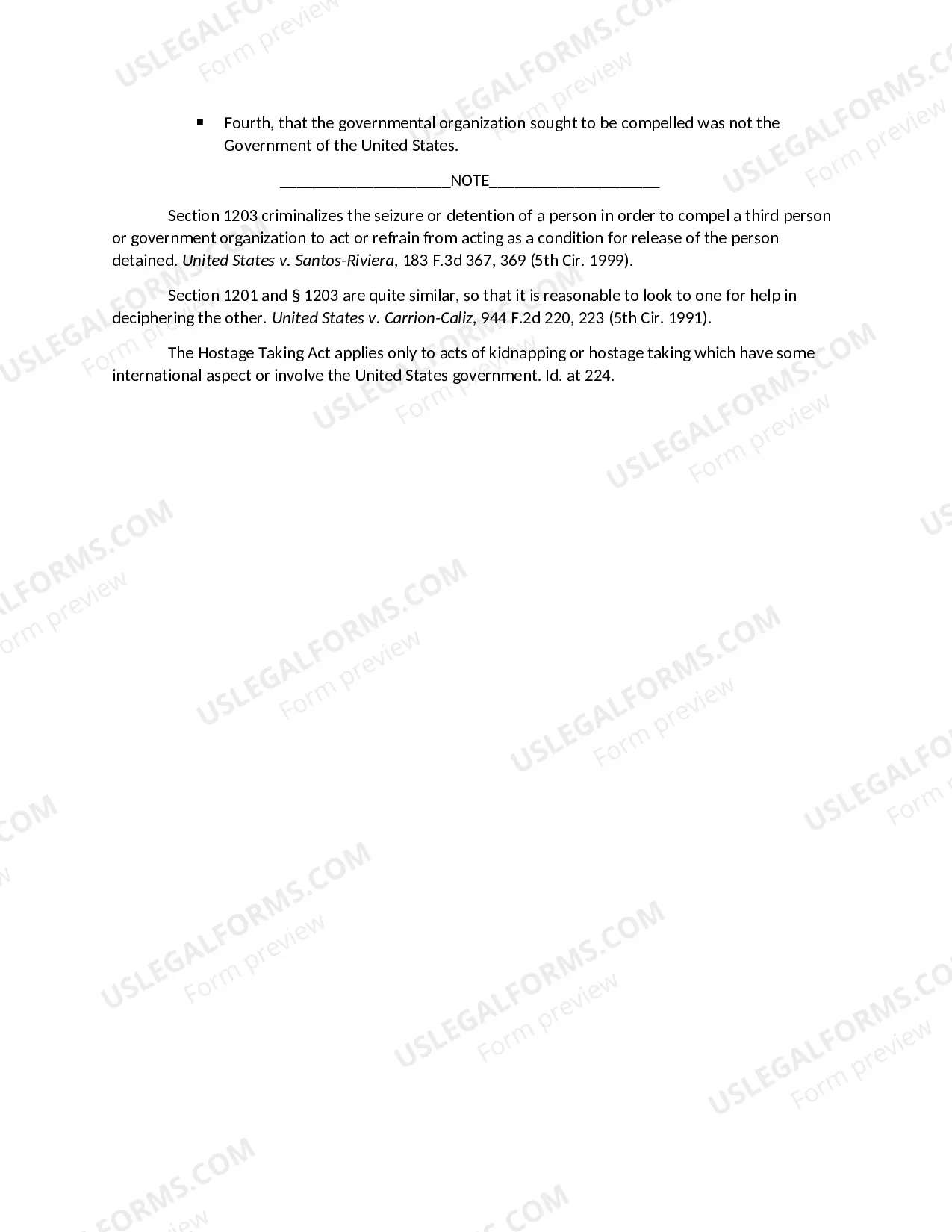
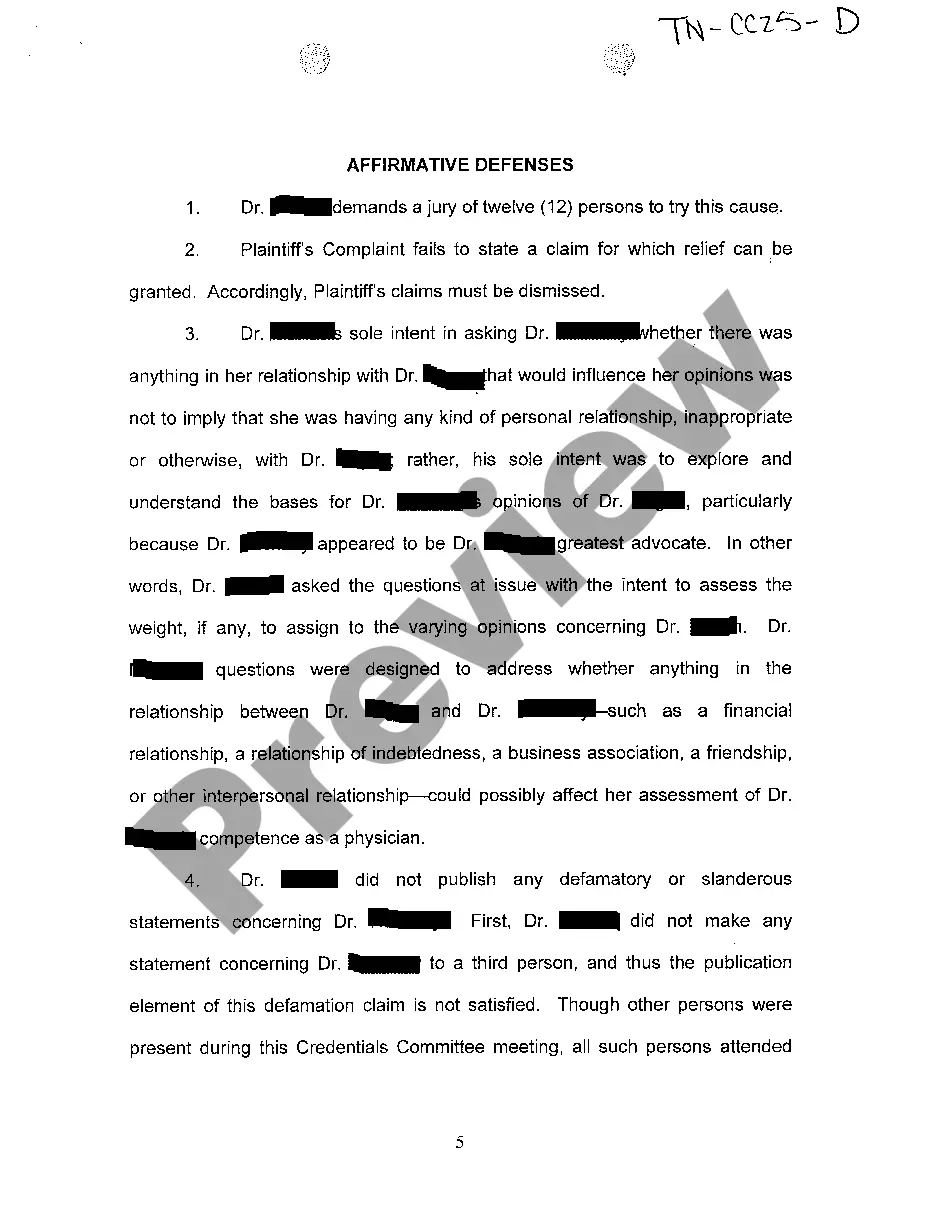
- The affirmative defenses that a defendant may present.
- The distinction between nationalities involved in the offense.
- Instructions on potential outcomes related to the crime.
When to use this form
This form is necessary in legal proceedings involving allegations of hostage-taking or unlawful detention. It is utilized when defining the legal requirements for convicting someone under federal law, particularly in cases where a suspect has been charged with seizing or detaining another individual to compel action by a third party.
Who can use this document
- Legal professionals representing defendants in hostage-taking cases.
- Prosecutors involved in federal criminal cases regarding hostage situations.
- Students and scholars studying criminal law and federal statutes.
- Individuals seeking to understand their rights if accused of such a crime.
Steps to complete this form
- Review Title 18, United States Code, Section 1203 for understanding key legal terms.
- Identify the parties involved, particularly the defendant and any alleged victims.
- Detail the specific actions taken by the defendant that constitute hostage-taking.
- Outline any affirmative defenses applicable to the situation.
- Consult with legal counsel to ensure accurate and complete information is filled out.
Notarization requirements for this form
Notarization is not commonly needed for this form. However, certain documents or local rules may make it necessary. Our notarization service, powered by Notarize, allows you to finalize it securely online anytime, day or night.
Get your form ready online
Our built-in tools help you complete, sign, share, and store your documents in one place.
Make edits, fill in missing information, and update formatting in US Legal Forms—just like you would in MS Word.
Download a copy, print it, send it by email, or mail it via USPS—whatever works best for your next step.
Sign and collect signatures with our SignNow integration. Send to multiple recipients, set reminders, and more. Go Premium to unlock E-Sign.
If this form requires notarization, complete it online through a secure video call—no need to meet a notary in person or wait for an appointment.
We protect your documents and personal data by following strict security and privacy standards.

Make edits, fill in missing information, and update formatting in US Legal Forms—just like you would in MS Word.

Download a copy, print it, send it by email, or mail it via USPS—whatever works best for your next step.

Sign and collect signatures with our SignNow integration. Send to multiple recipients, set reminders, and more. Go Premium to unlock E-Sign.

If this form requires notarization, complete it online through a secure video call—no need to meet a notary in person or wait for an appointment.

We protect your documents and personal data by following strict security and privacy standards.
Mistakes to watch out for
- Failing to establish that the conduct occurred within U.S. jurisdiction.
- Confusing the definitions of hostage-taking with general kidnapping.
- Neglecting to mention potential affirmative defenses.
- Not providing complete evidence for the charges presented.
Advantages of online completion
- Easy access to legal standards operates 24/7.
- Editable format allows for customization based on specific cases.
- Reliable templates drafted by licensed attorneys ensure compliance with legal standards.
Legal use & context
- This form is essential for navigating federal law regarding hostage situations.
- It serves as a foundational document in federal criminal proceedings.
- The information shared can also aid in legal education and understanding of federal crimes.
Looking for another form?


Form popularity
FAQ
Remain calm, be polite, and cooperate with your captors. DO NOT attempt escape unless there is an extremely good chance of survival. It is safer to be submissive and obey your captors. Speak normally.
If a hostage situation develops, call 911 Identify yourself, give the location, nature of the situation, and any other pertinent information. Attempt to evacuate everyone from the immediate area. Do not attempt to evacuate everyone if it would create an even more dangerous situation or enhance the chance of injury.
I. California Penal Code 210.5: Hostage Taking Legal Definition: Every person who commits the offense of false imprisonment, as defined in Section 236, against a person for purposes of protection from arrest, which substantially increases the risk of harm to the victim, or for purposes of using the person as a shield.
The hostage taking act is a subsection of the 1979 United Nations General Assembly Sixth Committee's treaty, International Convention Against the Taking of Hostages. It became enforceable in the United States on January 6, 1985.
Penalties. Hostage Taking is a felony-only offense in California. If you are convicted under this section, you could be sentenced to upwards of three, five, or eight years in State Prison.
Noun. /?h?st?d? te?k?(r)/ /?h??st?d? te?k?r/ ?a person, often one of a group, who captures somebody and holds them prisoner, and who may injure or kill them if people do not do what the person or group is asking.
'Hostage' is a noun. kidnapping means that you do not know where the person is, in a hostage situation the police always knows where the victims are, like in a bank heist. Kidnap means to carry off by force for ransom, and hostage means a person held as a pledge until certain demands are met.
§ 1203(a). Both of these crimes are extremely serious: the crime of Receiving or Transmitting Ransom is punishable by up to 10 years imprisonment; Hostage Taking is punishable by life imprisonment and, if the death of any person occurs during the commission of the crime, the death penalty.