South Carolina KIDNAPPING
What is this form?
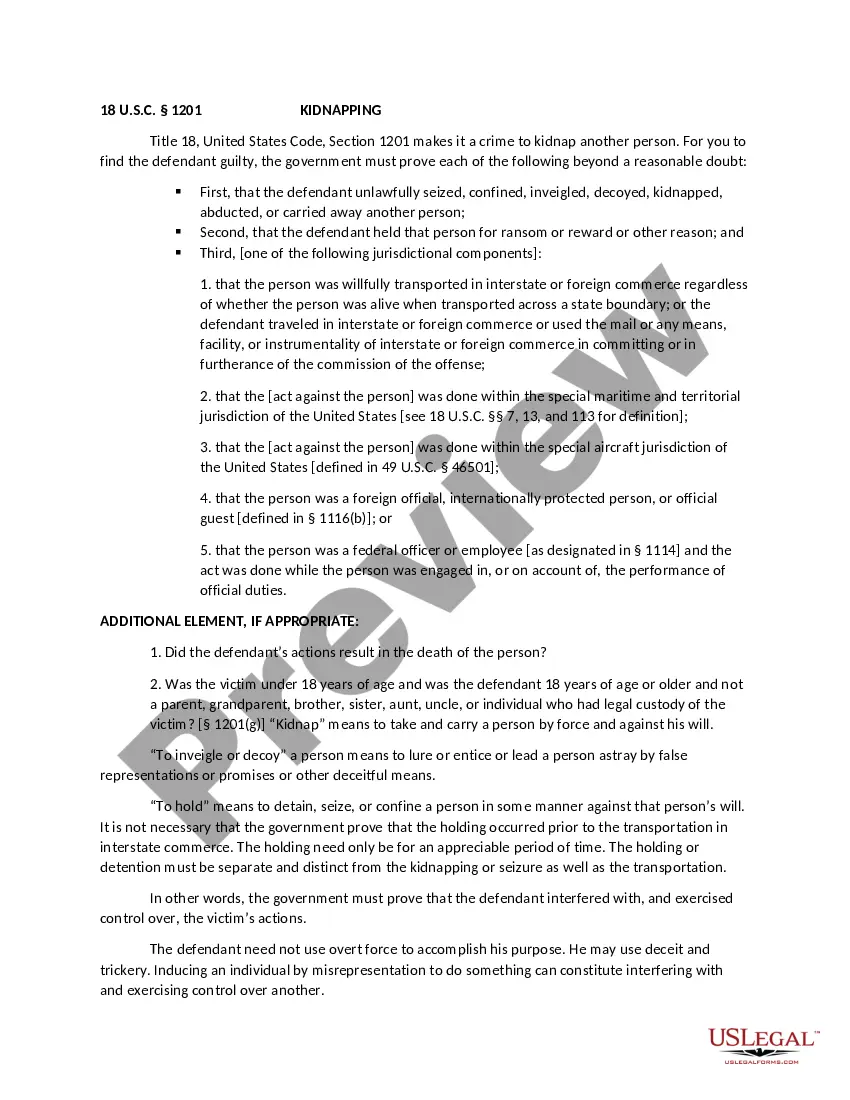
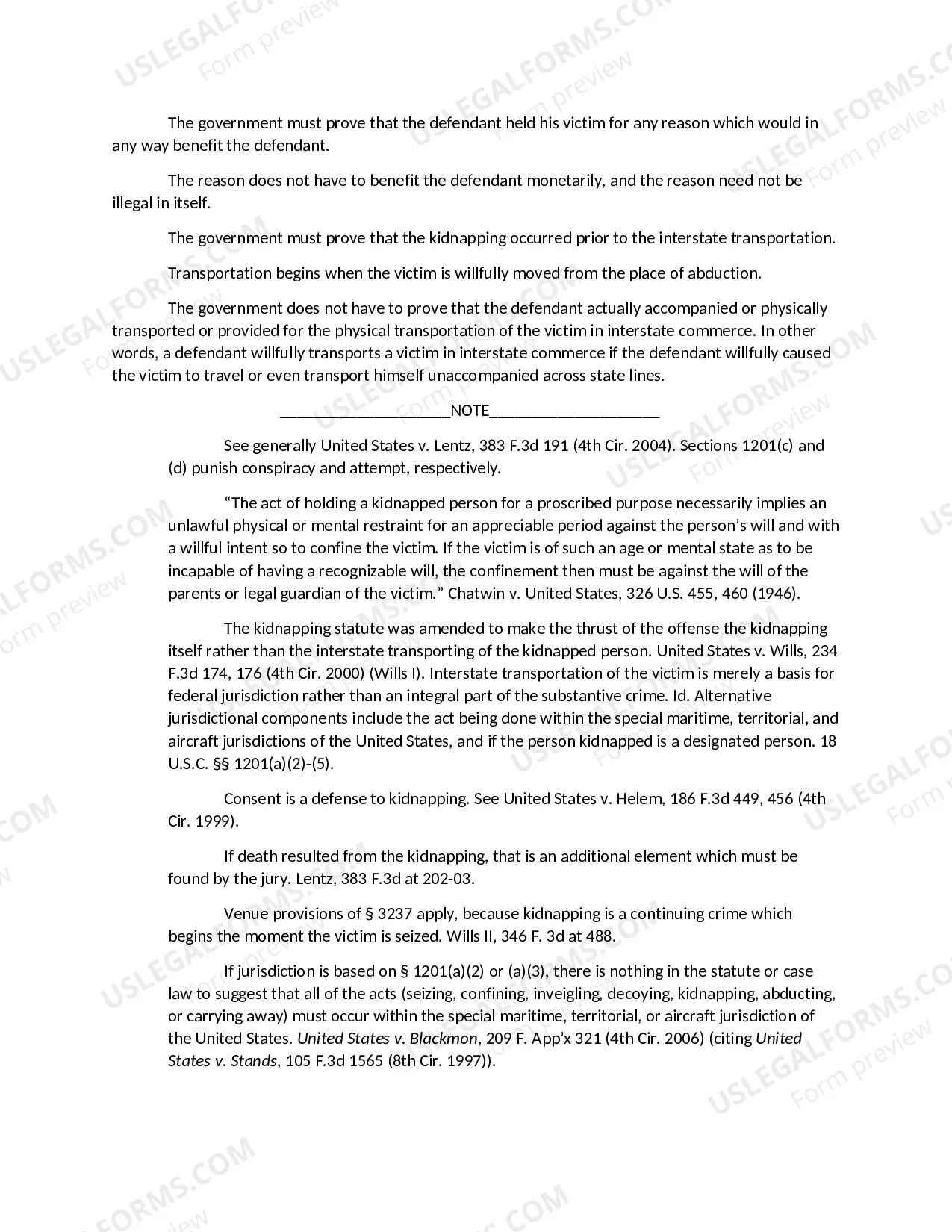
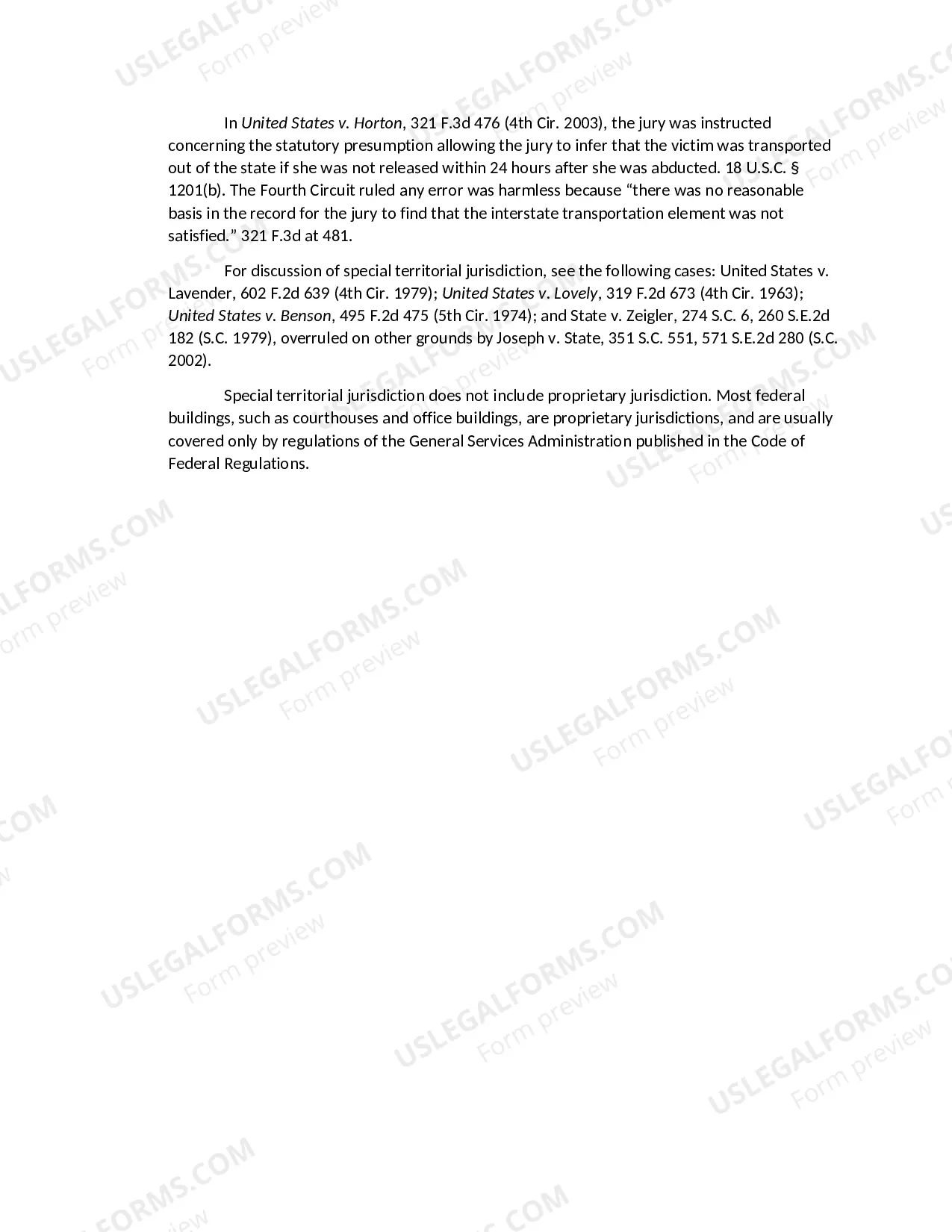
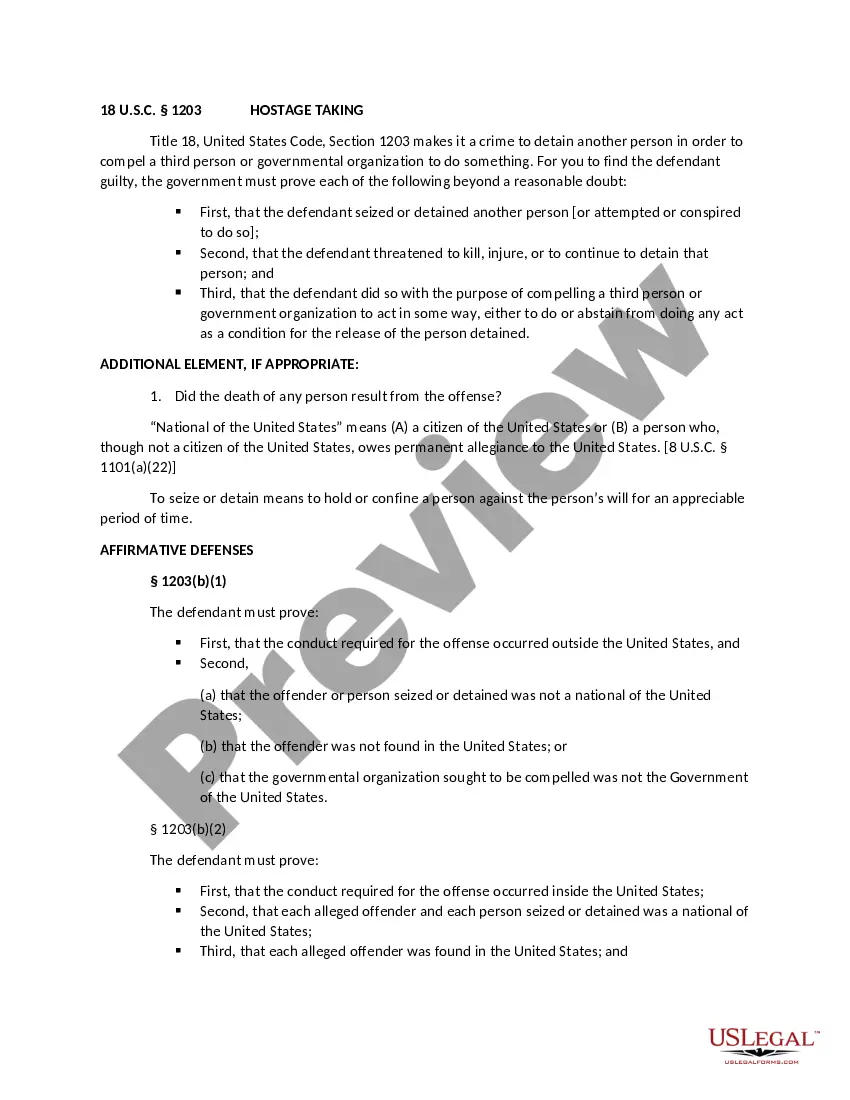
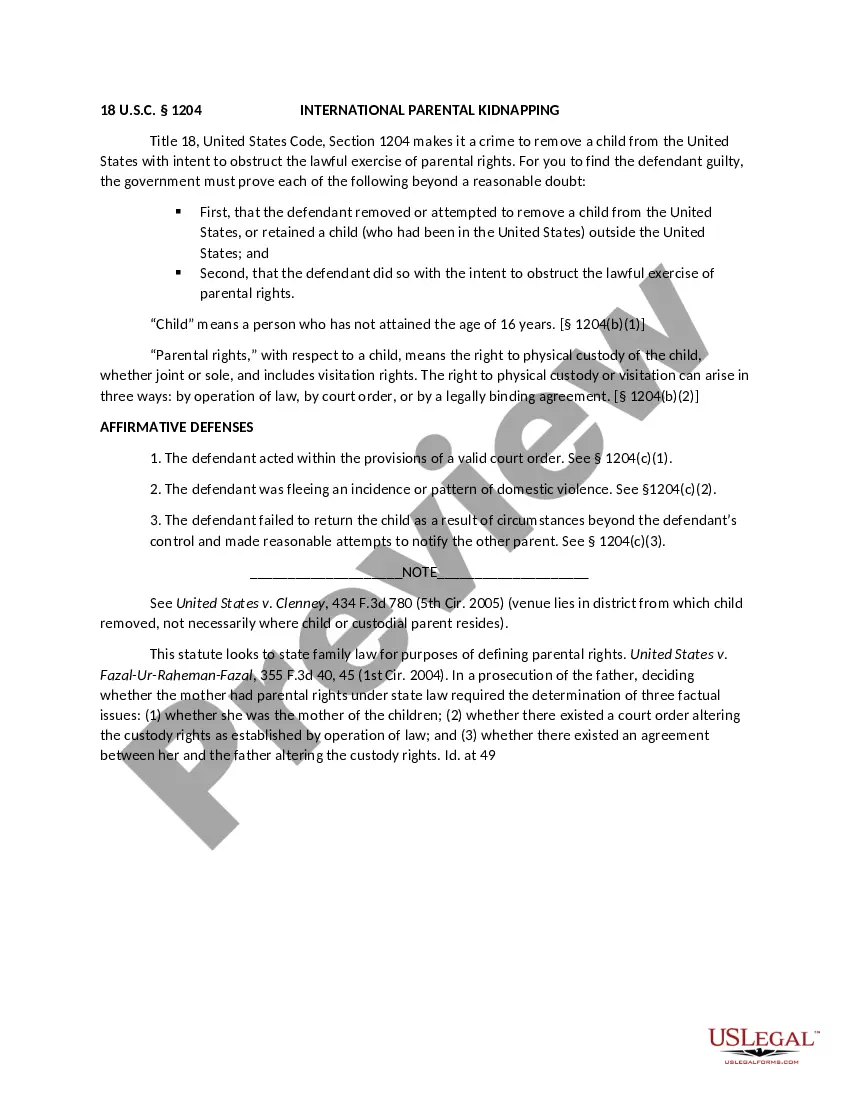
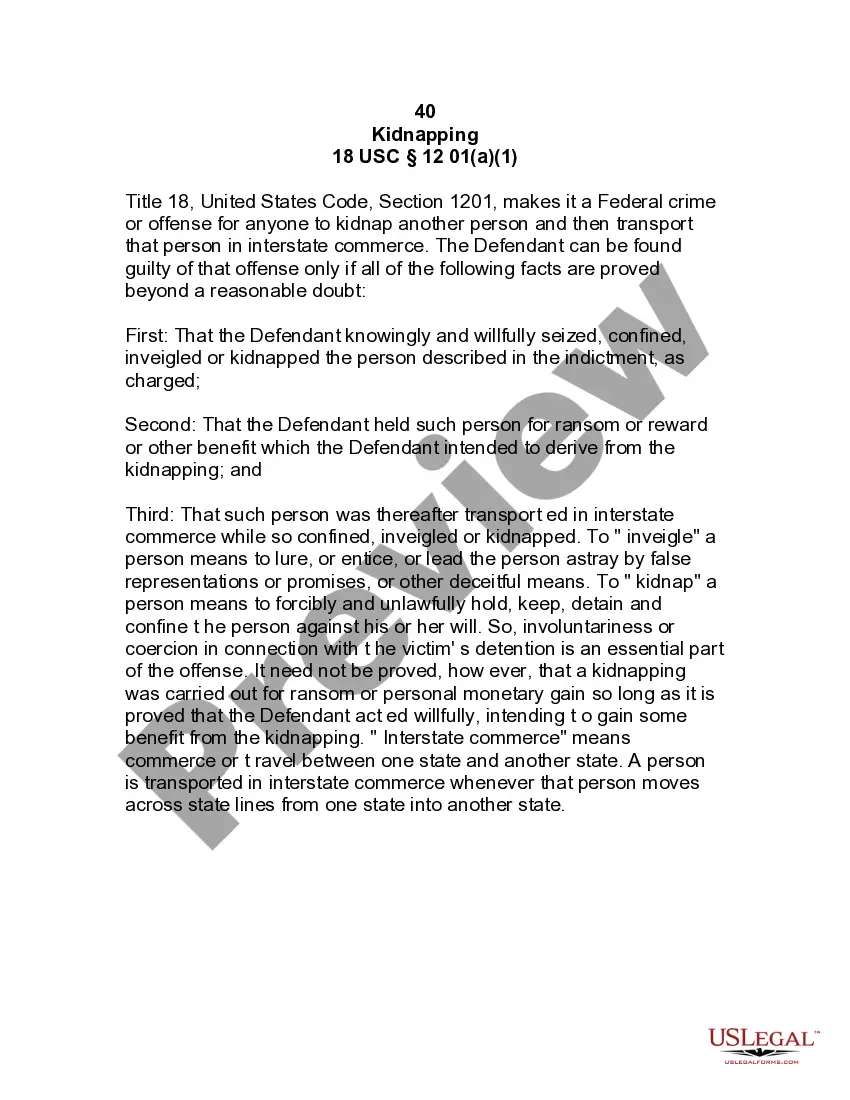
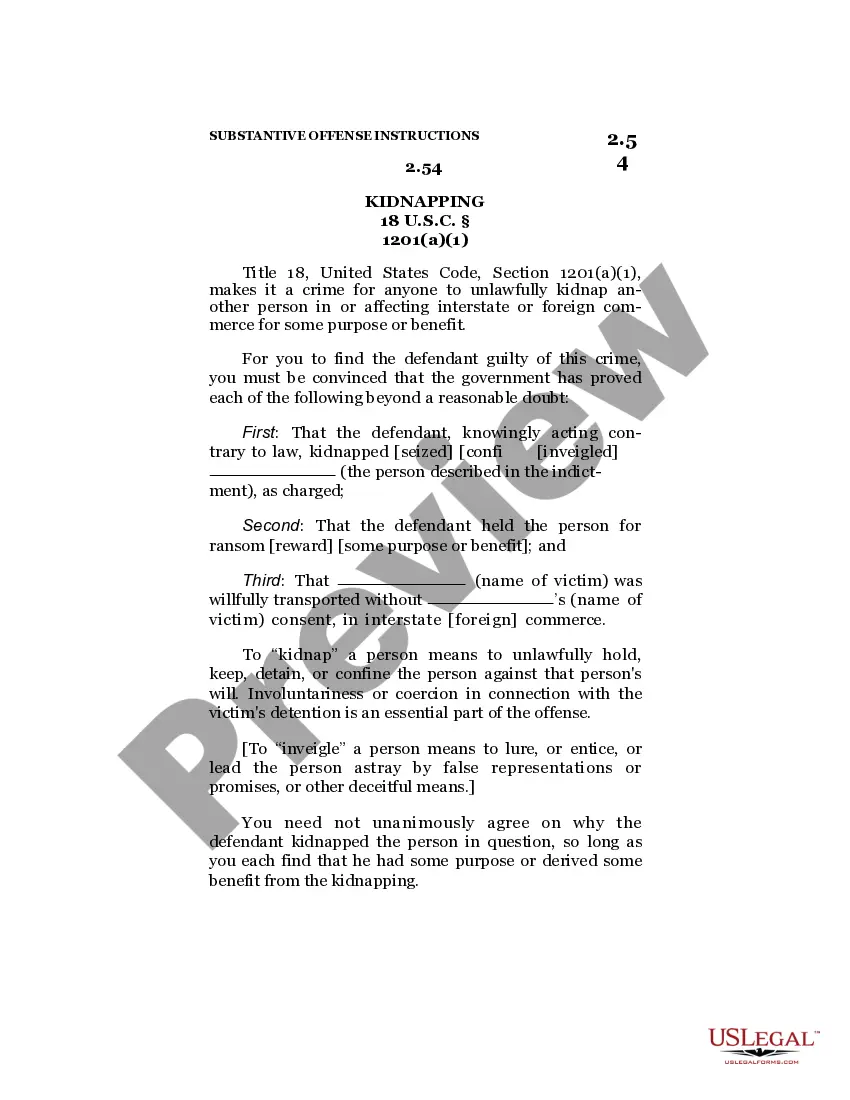
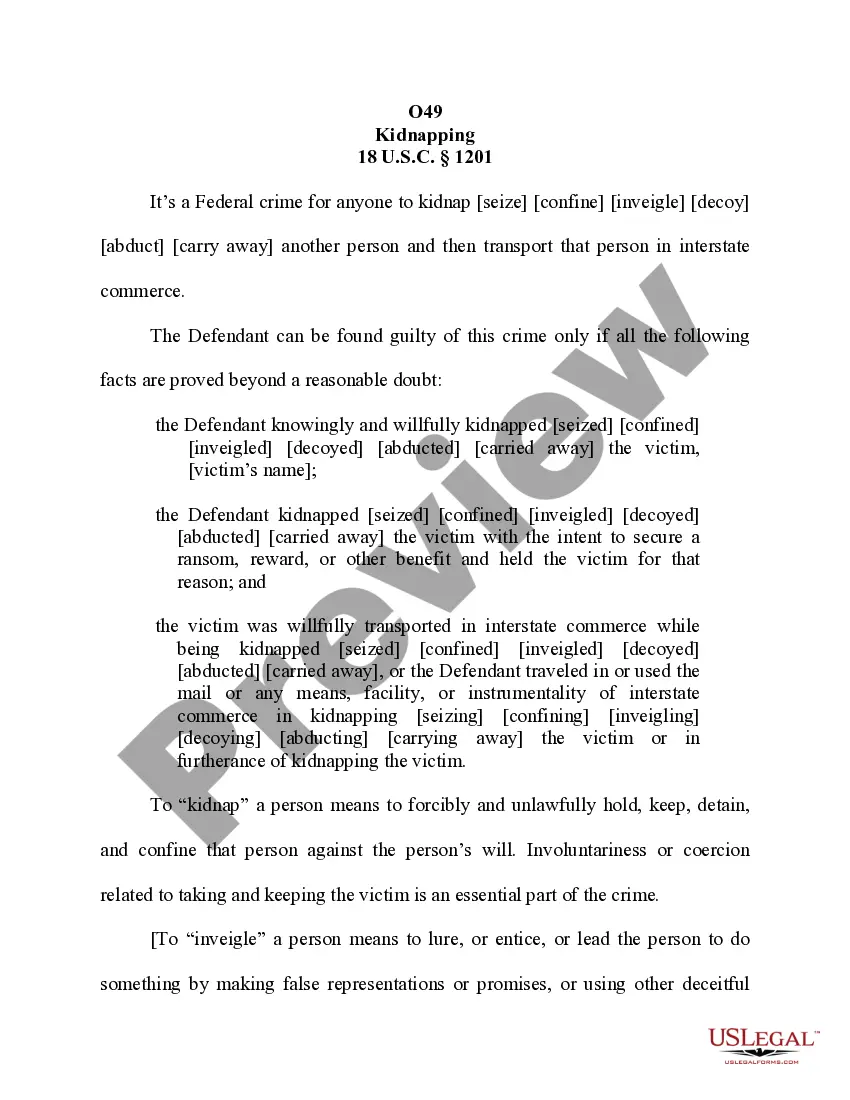
This form provides the Official Pattern Jury Instructions for Criminal Cases related to kidnapping, specifically under Title 18, United States Code, Section 1201. It is a critical legal document outlining the elements of the crime of kidnapping, defining key terms and concepts necessary for establishing guilt or innocence in a federal court setting. Unlike similar forms that may address different crimes, this form focuses exclusively on the intricacies of federal kidnapping laws.
Form components explained
- Definition of kidnapping as unlawful seizure or confinement.
- Assessment of the defendant's actions and jurisdictional elements.
- Criteria for ransom or other motives for holding the victim.
- Clarification of interstate transport or special territorial jurisdiction.
- Additional elements if the victim is a minor or if death results from the act.
Common use cases
This form is utilized during criminal proceedings involving accusations of kidnapping at the federal level. It becomes necessary when a jury needs to understand the legal definitions and implications of kidnapping under federal law, especially in cases where jurisdictional specifics, such as interstate transportation, play a crucial role in the trial.
Who should use this form
- Judges presiding over kidnapping trials in federal court.
- Jurors who require instruction on the law surrounding kidnapping offenses.
- Federal attorneys involved in prosecuting or defending kidnapping cases.
- Legal professionals seeking to understand federal jury instructions related to kidnapping.
Completing this form step by step
- Review the key definitions and elements outlined in the instructions.
- Ensure clarity on the elements the prosecution must prove beyond a reasonable doubt.
- Draft jury instructions that adhere to the legal definitions provided.
- Double-check the applicability of jurisdictional elements relevant to the case.
- Prepare the final instructions to share with the jury during deliberation.
Is notarization required?
This form usually doesn’t need to be notarized. However, local laws or specific transactions may require it. Our online notarization service, powered by Notarize, lets you complete it remotely through a secure video session, available 24/7.
Get your form ready online
Our built-in tools help you complete, sign, share, and store your documents in one place.
Make edits, fill in missing information, and update formatting in US Legal Forms—just like you would in MS Word.
Download a copy, print it, send it by email, or mail it via USPS—whatever works best for your next step.
Sign and collect signatures with our SignNow integration. Send to multiple recipients, set reminders, and more. Go Premium to unlock E-Sign.
If this form requires notarization, complete it online through a secure video call—no need to meet a notary in person or wait for an appointment.
We protect your documents and personal data by following strict security and privacy standards.

Make edits, fill in missing information, and update formatting in US Legal Forms—just like you would in MS Word.

Download a copy, print it, send it by email, or mail it via USPS—whatever works best for your next step.

Sign and collect signatures with our SignNow integration. Send to multiple recipients, set reminders, and more. Go Premium to unlock E-Sign.

If this form requires notarization, complete it online through a secure video call—no need to meet a notary in person or wait for an appointment.

We protect your documents and personal data by following strict security and privacy standards.
Common mistakes
- Failing to clearly establish the jurisdictional element of interstate transport.
- Misunderstanding the definition of "holding" versus "seizing" a victim.
- Neglecting to differentiate between motives for kidnapping, such as ransom versus other benefits.
- Not properly addressing the age or status of the victim as it pertains to additional legal requirements.
Why complete this form online
- Immediate access to official jury instructions tailored for federal cases.
- Edit and customize the instructions as needed for specific cases.
- Secure downloads ensuring sensitive legal information is protected.
- Time-saving convenience, allowing users to prepare without extensive legal research.
Legal use & context
- This form is legally valid in federal court and must be adhered to during jury trials for kidnapping.
- The instructions are crucial for jury understanding and decision-making in complex legal matters.
- Failure to provide accurate instructions may result in legal challenges or appeals.
Looking for another form?

Form popularity
FAQ
Kidnapping under §207(a) is punishable by a term of up to eight years in a state prison, a fine of up to $10,000, or both imprisonment and a fine. In addition, since Kidnapping is considered a ?serious felony,? conviction is counted as a ?strike? on your criminal record.
Parental kidnapping is a Class D felony unless the child is kept for more than 60 days, at which point it becomes a Class C felony. The crime becomes a class B felony after 120 days.
In order to determine the most appropriate defense for your specific case, you should consult with an experienced criminal lawyer in South Carolina. Under South Carolina Criminal Code 16-3-910, Kidnapping is a Felony, allowing for a maximum period of incarceration of up to 30 years.
Ing to South Carolina Code of Laws §16-3-910, a person may face criminal charges of kidnapping if they unlawfully abduct, confine, or carry away any person, unless that person is a minor and the alleged kidnapper is that minor's lawful parent or guardian.
U.S. officials identified the victims as Latavia ?Tay? McGee, Shaeed Woodard, Zindell Brown and Eric James Williams. Woodard and Brown were the ones killed in the attack. The FBI said after the group drove a white minivan, with North Carolina plates, from Brownsville, Texas across the border, gunmen opened fire.
Ing to South Carolina Code of Laws §16-3-910, a person may face criminal charges of kidnapping if they unlawfully abduct, confine, or carry away any person, unless that person is a minor and the alleged kidnapper is that minor's lawful parent or guardian.
States treat all kidnapping offenses as serious crimes. At the minimum, people convicted of this offense will likely face custody in state prison for up to five years. Aggravated kidnapping convictions can result in a prison sentence of between 20 years to life.
South Carolina's kidnapping law is contained in S.C. Code § 16-3-910. Kidnapping is a felony punishable by up to thirty years in prison and entrance on the Sex Offender Registry.