South Carolina Release of Liability Parent Minor - Horse Equine Forms
What is this form?
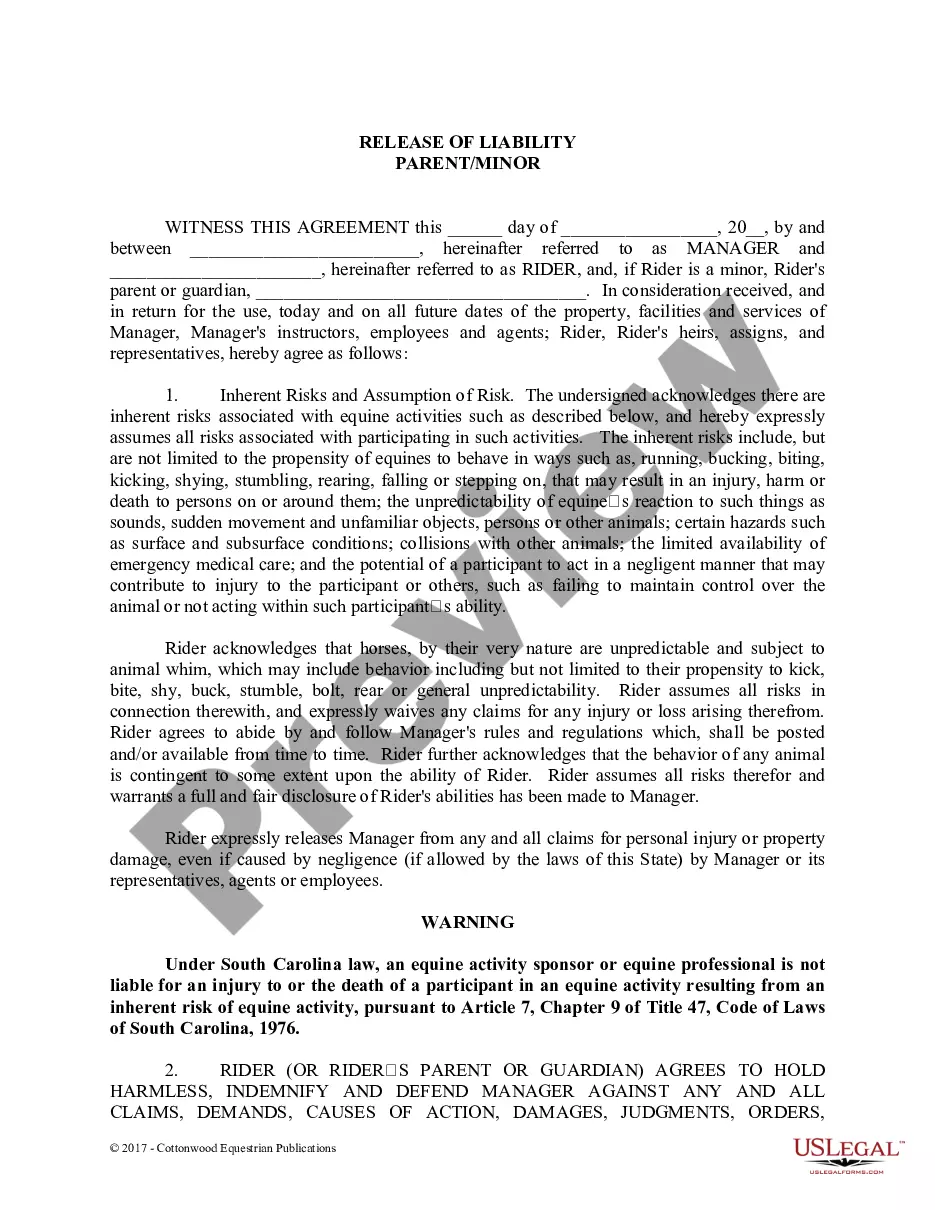
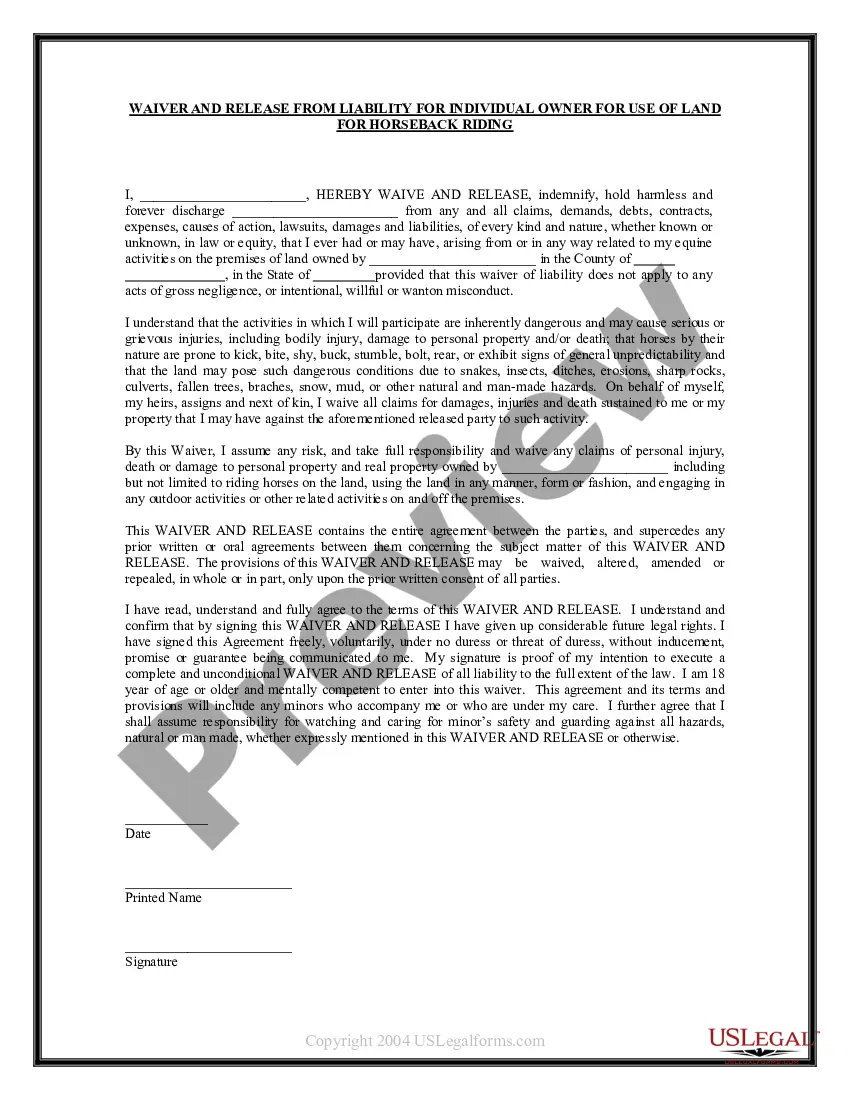
The Release of Liability Parent-Minor Horse Equine form is designed to protect equine professionals and facilities from legal claims arising from horse riding lessons or training involving a minor. This form captures an understanding of the inherent risks associated with equine activities and includes critical provisions like an indemnification clause. It differs from other liability waivers by specifically addressing the involvement of minors and their parents or guardians, ensuring consent and awareness of the potential dangers.
Main sections of this form
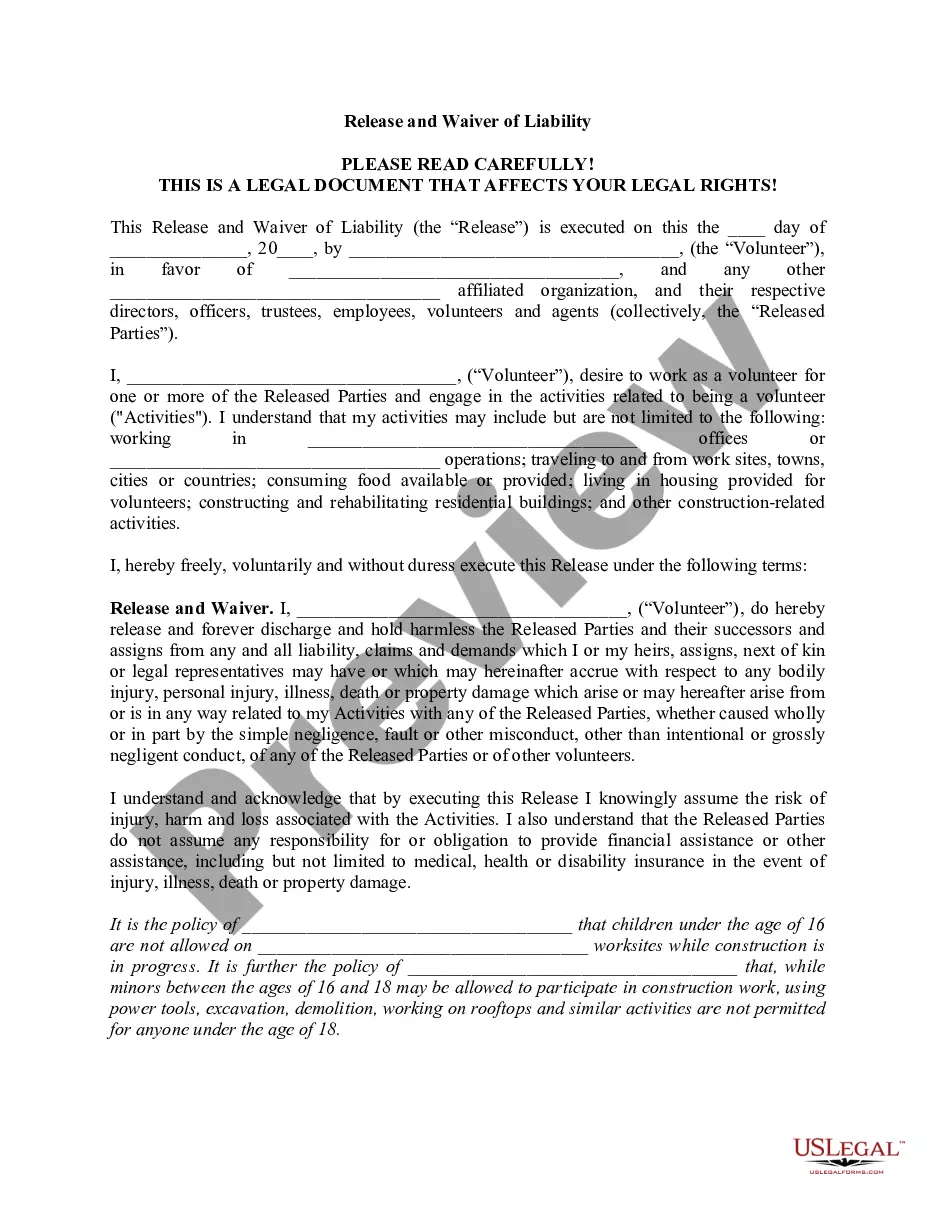
- Parties involved: Identifies the horse riding facility manager and the minor rider along with the parent or guardian.
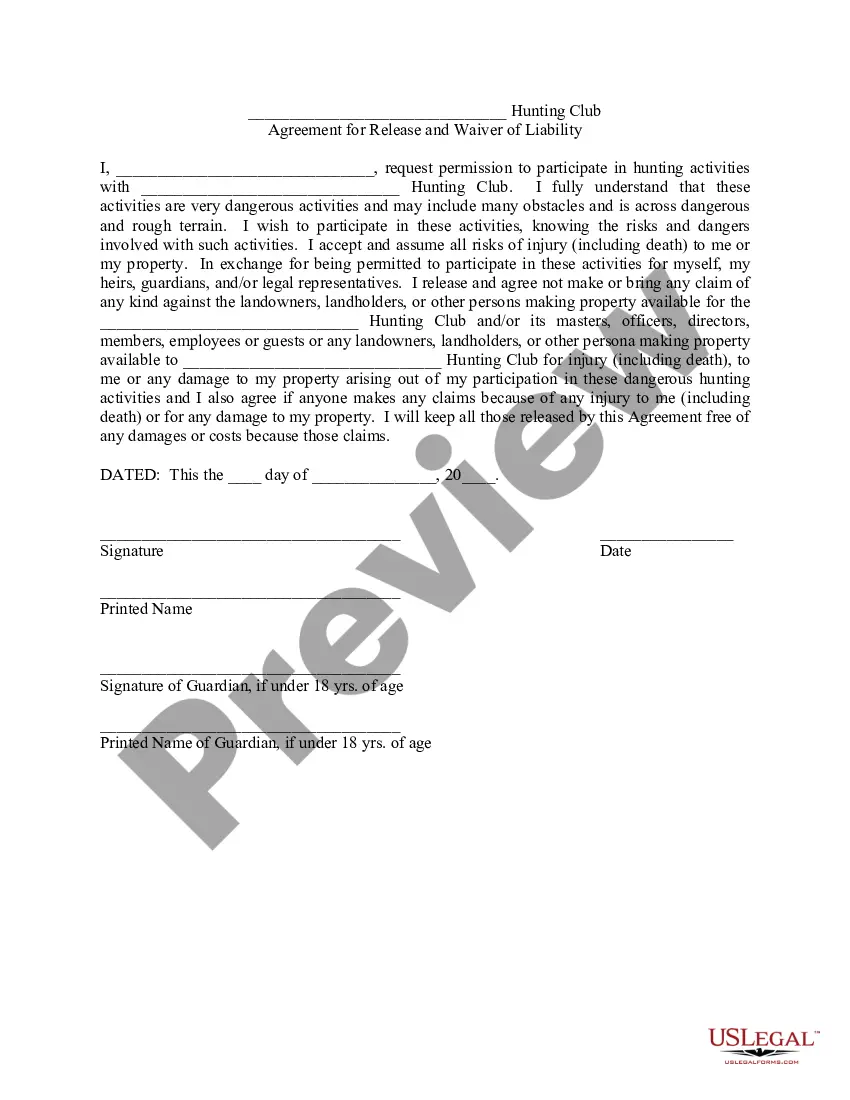
- Release of liability: Explicitly releases the manager from claims for personal injury or property damage, even in cases of negligence.
- Warning clause: States that under specific state laws, equine activity sponsors are not liable for certain injuries resulting from inherent risks.
- Health warranty: Requires that any horse used by the rider must be free of contagious diseases.
- Damage limitations: Specifies limits on damages that can be claimed and requires actions to be brought within one year of an incident.

When to use this document
This form should be used when a parent or guardian is enrolling a minor in horse riding lessons, training, or other equine activities. It is necessary to sign this document prior to participation to ensure that the risks are understood and legally acknowledged by both the parent/guardian and the minor rider. This form helps facilitate safe equestrian activities while protecting the facility from potential legal issues.
Who needs this form
- Parents or guardians of minor children who wish to engage in horse riding or equine-related activities.
- Equine facility managers and riding instructors looking to have a clear legal agreement in place before minors participate in their programs.
- Any organization or individual providing equine services that require acknowledgment of risks associated with horse riding.
How to complete this form
- Identify the parties: Fill in the names of the horse facility manager, minor rider, and the parent or guardian.
- Specify the date: Enter the date when the agreement is being executed.
- Acknowledge risks: Read through the release of liability and understand the risks associated with equine activities.
- Signatures: Ensure that the parent or guardian, as well as the minor (if appropriate), sign the form to validate it.
- Keep a copy: Retain a signed copy for both the facility's and the parent's files for future reference.
Notarization requirements for this form
This form does not typically require notarization unless specified by local law. However, it is advisable to check specific state regulations to ensure compliance and enforceability.
Get your form ready online
Our built-in tools help you complete, sign, share, and store your documents in one place.
Make edits, fill in missing information, and update formatting in US Legal Forms—just like you would in MS Word.
Download a copy, print it, send it by email, or mail it via USPS—whatever works best for your next step.
Sign and collect signatures with our SignNow integration. Send to multiple recipients, set reminders, and more. Go Premium to unlock E-Sign.
If this form requires notarization, complete it online through a secure video call—no need to meet a notary in person or wait for an appointment.
We protect your documents and personal data by following strict security and privacy standards.

Make edits, fill in missing information, and update formatting in US Legal Forms—just like you would in MS Word.

Download a copy, print it, send it by email, or mail it via USPS—whatever works best for your next step.

Sign and collect signatures with our SignNow integration. Send to multiple recipients, set reminders, and more. Go Premium to unlock E-Sign.

If this form requires notarization, complete it online through a secure video call—no need to meet a notary in person or wait for an appointment.

We protect your documents and personal data by following strict security and privacy standards.
Avoid these common issues
- Failing to have both the parent and minor sign the document, which may render it less effective.
- Not reviewing the form thoroughly, potentially leading to misunderstandings about the risks involved.
- Using the form without confirming its state-specific validity, particularly in jurisdictions with different equine laws.
Benefits of using this form online
- Convenience: Download and complete the form at your convenience without the need for in-person appointments.
- Editability: Easily fill in custom information and make necessary changes before finalizing.
- Legal reliability: Ensure compliance with relevant laws and regulations tailored for your state.
Legal use & context
- The form is enforceable as it clearly outlines the release of liability under South Carolina law.
- It protects equine professionals by limiting their liability for inherent risks associated with horse riding.
- Parties are encouraged to read all clauses carefully to fully understand their rights and responsibilities.
What to keep in mind
- This form is essential for minors participating in equine activities to protect both the rider and the facility.
- Ensuring all parties understand and sign the document is crucial for its legal validity.
- Each jurisdiction may have specific requirements, so always verify local laws if needed.
Looking for another form?

Form popularity
FAQ
Zebras are classified in the genus Equus (known as equines) along with horses and asses. These three groups are the only living members of the family Equidae.A 2013 phylogenetic study found that the plains zebra is more closely related to Grevy's zebras than mountain zebras.
Horses are ungulates mammals with hooves. They also have long tails, short hair, muscular torsos, long thick necks and elongated heads. Due to domestication, they are found all over the world. Horses have lived on Earth for more than 50 million years, according the American Museum of Natural History.
The deer (family Cervidae) comprises 43 species of hoofed ruminants in the order Artiodactyla.
Deer or true deer are hoofed ruminant mammals forming the family Cervidae. The two main groups of deer are the Cervinae, including the muntjac, the elk (wapiti), the red deer, the fallow deer, and the chital; and the Capreolinae, including the reindeer (caribou), the roe deer, the mule deer, and the moose.
Horses belong to a group of mammals with an odd number of toes. That rules out mammals with two toes, or "cloven hooves," like goats, pigs, cows, deer, and camels.They include rhinoceroses and tapirs, the horse's closest living relatives.
Vulgar. to have sexual intercourse.
Horses belong to a group of mammals with an odd number of toes. That rules out mammals with two toes, or "cloven hooves," like goats, pigs, cows, deer, and camels.They include rhinoceroses and tapirs, the horse's closest living relatives.
Equine, one of the mammal family of Equidae (order Perissodactyla) that includes the modern horses, zebras, and asses, as well as more than 60 species known only from fossils. North American wild horse (Equus caballus) standing in the sagebrush of the Granite Range, Washoe County, Nevada.