Pennsylvania Praecipe to Withdraw Divorce Complaint
What this document covers
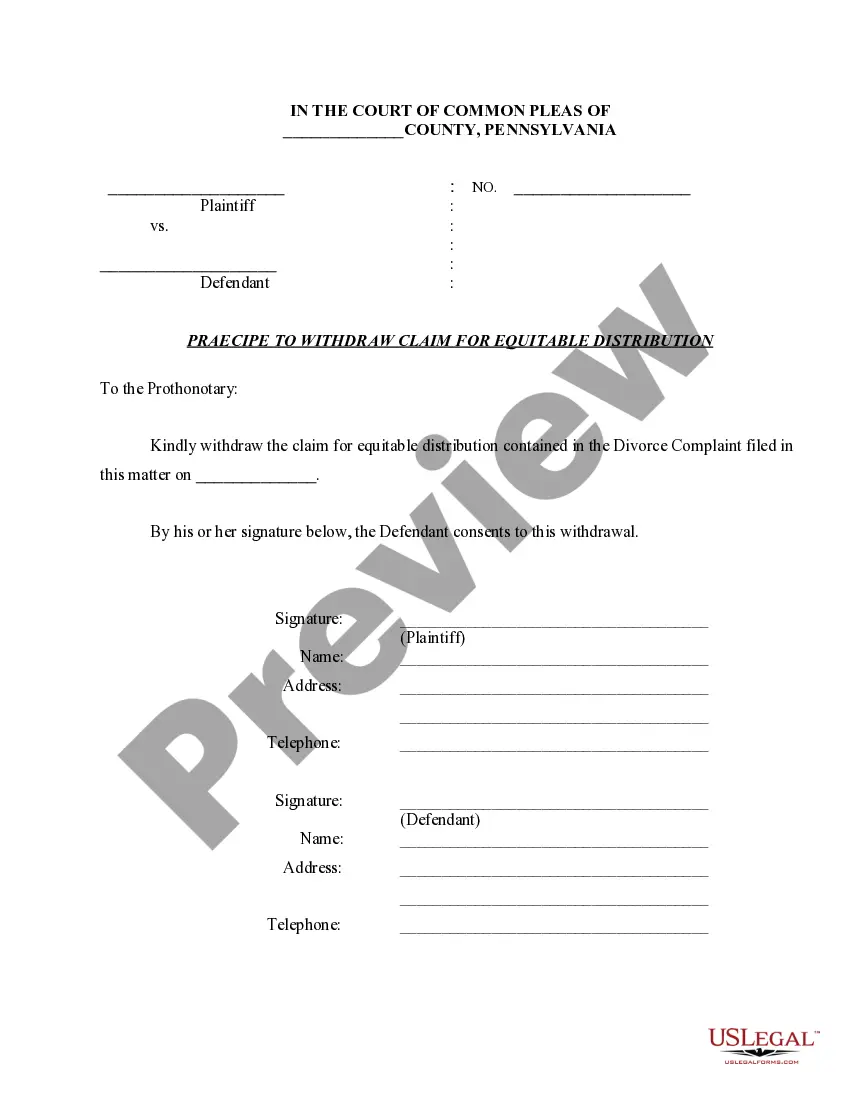
The Praecipe to Withdraw Divorce Complaint is a legal document used in Pennsylvania by a plaintiff to officially request the court to cancel their divorce complaint. This form is distinct because it ensures that no claims related to equitable division of property or custody are still pending, providing a clear closure to the initial divorce proceedings without further legal complications.
Key components of this form
- Identification of the court and the case number.
- Plaintiff's and defendant's names and addresses.
- Statement confirming that no pending claims related to marital property or custody exist.
- Certification of no counterclaims or separate petitions filed by the defendant.
- Signature and contact information of the plaintiff.
When to use this form
This form should be used when a plaintiff decides to withdraw their divorce complaint after it has been filed. This situation often arises if the parties reconcile, if there are unresolved matters that need further discussion, or if the parties agree that divorce is not the best option at this time.
Who can use this document
- Individuals who have initiated a divorce proceeding in Pennsylvania.
- Planned plaintiffs who no longer wish to pursue the divorce.
- Parties in a divorce case who have resolved their issues outside of court.
How to complete this form
- Identify the court by filling in the correct name and county.
- Enter the case number assigned to your divorce complaint.
- Fill in the names and contact information for both the plaintiff and defendant.
- Specify the date that the original complaint was filed.
- Sign the document to certify that all statements are accurate.
Does this form need to be notarized?
This form does not typically require notarization unless specified by local law. However, it is always advisable to check local requirements to ensure compliance.
Get your form ready online
Our built-in tools help you complete, sign, share, and store your documents in one place.
Make edits, fill in missing information, and update formatting in US Legal Forms—just like you would in MS Word.
Download a copy, print it, send it by email, or mail it via USPS—whatever works best for your next step.
Sign and collect signatures with our SignNow integration. Send to multiple recipients, set reminders, and more. Go Premium to unlock E-Sign.
If this form requires notarization, complete it online through a secure video call—no need to meet a notary in person or wait for an appointment.
We protect your documents and personal data by following strict security and privacy standards.

Make edits, fill in missing information, and update formatting in US Legal Forms—just like you would in MS Word.

Download a copy, print it, send it by email, or mail it via USPS—whatever works best for your next step.

Sign and collect signatures with our SignNow integration. Send to multiple recipients, set reminders, and more. Go Premium to unlock E-Sign.

If this form requires notarization, complete it online through a secure video call—no need to meet a notary in person or wait for an appointment.

We protect your documents and personal data by following strict security and privacy standards.
Avoid these common issues
- Failing to provide accurate case number information.
- Omitting required signatures or contact details.
- Not verifying that no other claims related to custody or property are pending.
Benefits of completing this form online
- Convenient access to legal documents anytime, anywhere.
- Editable templates that allow you to complete the form at your pace.
- Reliability and assurance that forms are up-to-date with current legal standards.
Looking for another form?
Form popularity
FAQ
Code § 1021.76a - Entry of default judgment. (a) The Board, on motion of the plaintiff, may enter default judgment against the defendant for failure to file within the required time an answer to a complaint that contains a notice to defend.
(1) A plaintiff may withdraw the complaint prior to the commencement of the hearing by filing a written notice of withdrawal with the magisterial district court.
Rule 1037. Judgment Upon Default or Admission. Assessment of Damages. (a) If an action is not commenced by a complaint, the prothonotary, upon praecipe praecipe of the defendant, shall enter a rule upon the plaintiff to file a complaint.
You Can Withdraw a Divorce Petition Soon after submitting your divorce papers to the local court, you should go to the county clerk and ask for the petition. If it hasn't yet been filed, you may be able to withdraw it.
Once the paperwork is filed, the divorce papers must be served to the other party. The other spouse, known as the defendant, then has 20 days from the date of receiving the divorce petition to respond.
Two Year Statute of Limitations As in most states, the statute of limitations in civil cases in Pennsylvania is two years. In most cases, this means that victims have two years from the date of their injury to file a civil lawsuit.
(3) In the case of an action for divorce under section 3301(d), an affidavit has been filed and no counter-affidavit has been filed or, if a counter-affidavit has been filed denying the affidavit's averments, the court determines that the marriage is irretrievably broken and the parties have lived separate and apart
In ance with Pennsylvania Rule of Civil Procedure 1361, a Plaintiff filing a complaint, or Defendant asserting a New Matter (affirmative defenses) or Counterclaim, must include a Notice to Plead, which provides the opposing party with notice that they have twenty days to file a written response to the given