Pennsylvania Guarantor - Consignor Notice Required by FTC on certain Transactions

State:
Multi-State
Control #:
US-GUARANTY
Format:
Word; 
Rich Text
Instant download

Description

The Rule applies to consumer credit contracts offered by finance companies, retailers (such as auto dealers and furniture and department stores), and credit unions for any personal purpose except to buy real estate.


When you agree to be a cosigner for someone else's debt, you are guaranteeing to pay if that person fails to pay the debt. The Rule requires that you be given a notice that explains the responsibility you are undertaking. Under the Rule, the cosigner notice must say:


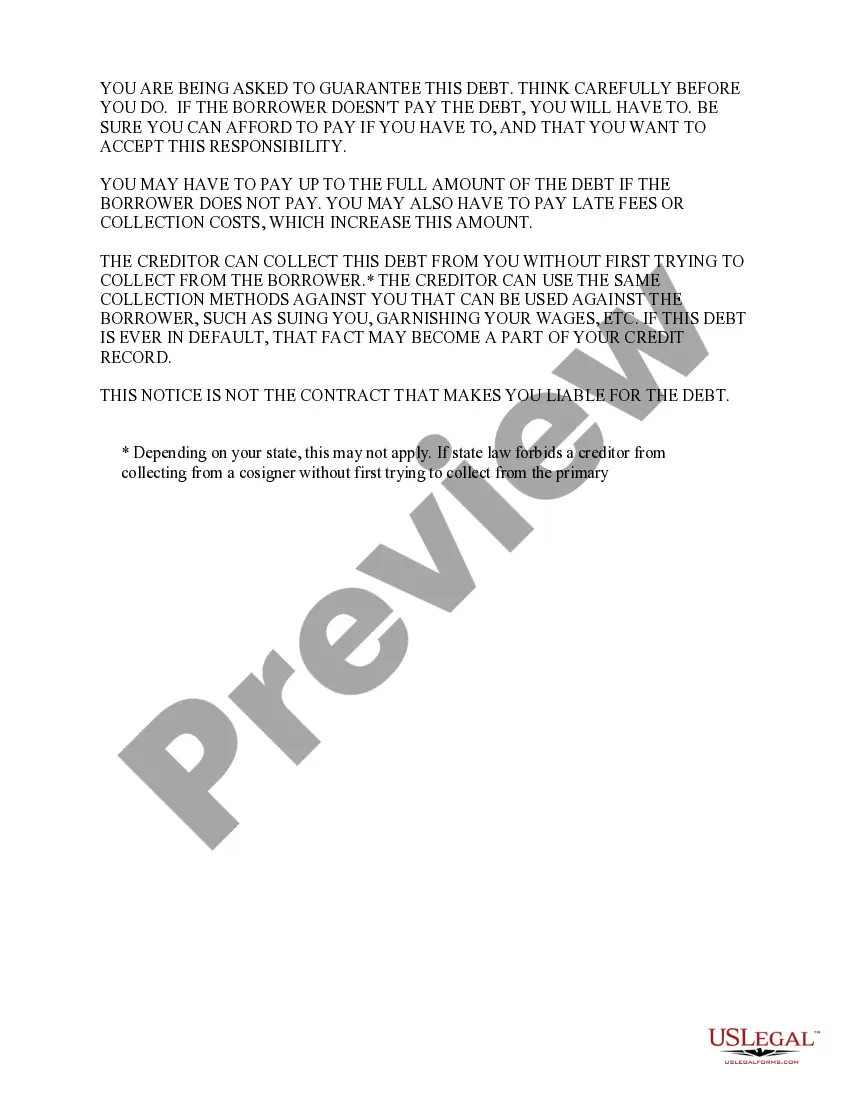
You are being asked to guarantee this debt. Think carefully before you do. If the borrower doesn't pay the debt, you will have to. Be sure you can afford to pay if you have to, and that you want to accept this responsibility.
You may have to pay up to the full amount of the debt if the borrower does not pay. You may also have to pay late fees or collection costs, which increase this amount.


The creditor can collect this debt from you without first trying to collect from the borrower.* The creditor can use the same collection methods against you that can be used against the borrower, such as suing you, garnishing your wages, etc. If this debt is ever in default, that fact may become a part of your credit record.


This notice is not the contract that makes you liable for the debt.


* Depending on your state, this may not apply. If state law forbids a creditor from collecting from a cosigner without first trying to collect from the primary debtor, this sentence may be crossed out or omitted on your cosigner notice.


This notice is not required when you receive benefits from the contract, such as when you buy goods, take out a loan, or open a joint credit-card account with another person. In these cases, you would be a co-buyer, co-borrower, or co-applicant (co-cardholder) rather than a cosigner. Therefore, the creditor would not be required to provide the notice.
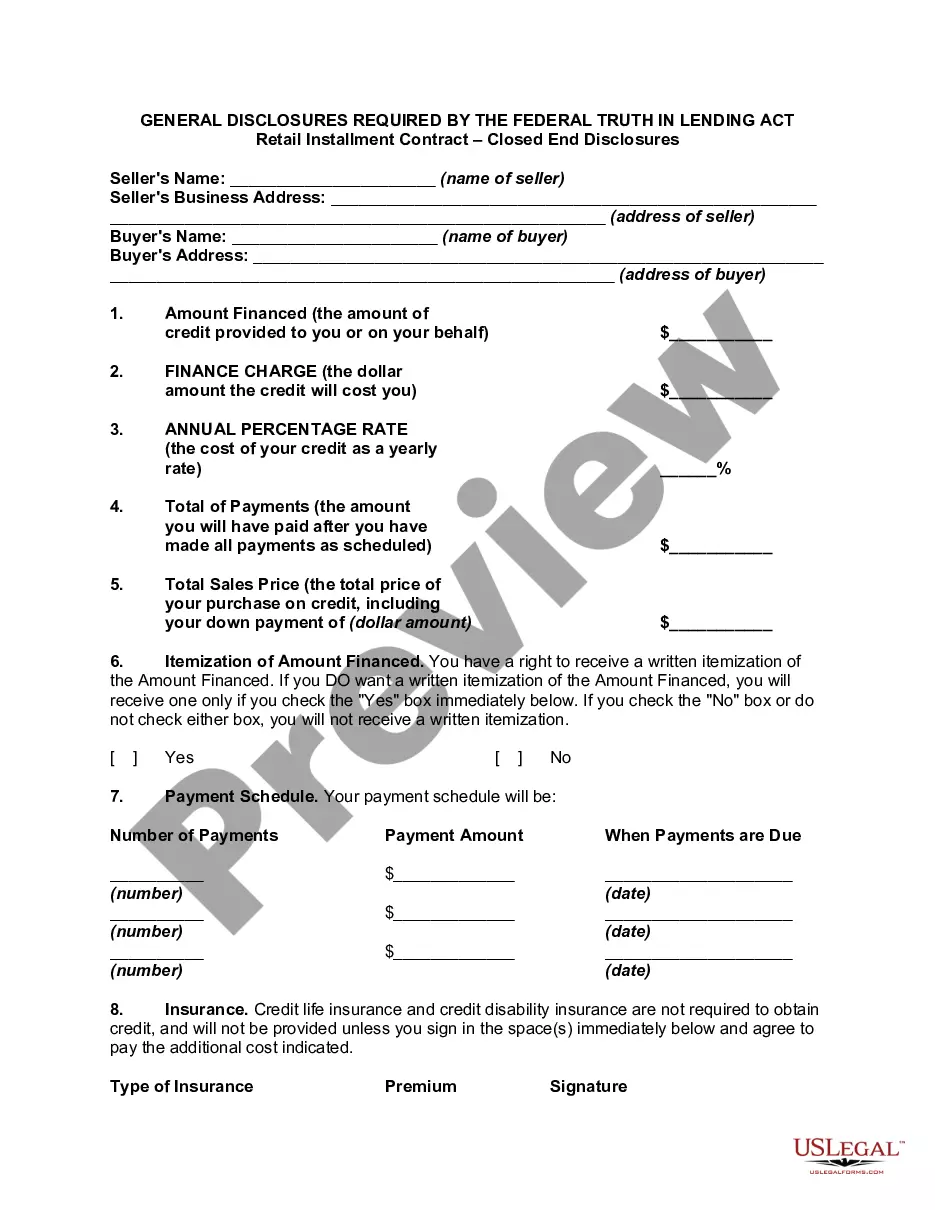
How to fill out Guarantor - Consignor Notice Required By FTC On Certain Transactions?

If you wish to obtain, gather, or print official document templates, utilize US Legal Forms, the premier assortment of legal forms that can be accessed online.

Take advantage of the site's straightforward and user-friendly search feature to find the documents you need. Various templates for business and personal purposes are organized by categories and titles, or keywords.

Use US Legal Forms to obtain the Pennsylvania Guarantor - Consignor Notice mandated by the FTC on specific Transactions in just a few clicks.

Every legal document template you acquire is yours permanently. You have access to every form you downloaded in your account. Select the My documents section and pick a form to print or download again.

Compete and obtain, and print the Pennsylvania Guarantor - Consignor Notice required by the FTC on specific Transactions with US Legal Forms. There are millions of professional and state-specific forms you can leverage for your business or personal needs.

  1. If you are already a US Legal Forms user, Log In to your account and click the Download button to locate the Pennsylvania Guarantor - Consignor Notice required by the FTC on certain Transactions.
  2. You can also access forms you previously downloaded from the My documents section of your account.
  3. If you are utilizing US Legal Forms for the first time, adhere to the instructions below.
  4. Step 1. Ensure that you have selected the form for the correct city/state.
  5. Step 2. Utilize the Preview function to review the form's content. Don't forget to read the description.
  6. Step 3. If you are unsatisfied with the form, use the Search area at the top of the screen to find alternative forms in the legal template format.
  7. Step 4. Once you have found the form you need, choose the Acquire now option. Select the pricing scheme you prefer and enter your details to create an account.
  8. Step 5. Complete the transaction. You may use your Visa or Mastercard or PayPal account to finalize the deal.
  9. Step 6. Choose the format of the legal form and download it to your device.
  10. Step 7. Complete, modify, and print or sign the Pennsylvania Guarantor - Consignor Notice required by the FTC on certain Transactions.

Form popularity

FAQ

To submit an HSR filing, you first need to gather all necessary documentation related to your transaction. Ensure that you comply with the Pennsylvania Guarantor - Consignor Notice Required by FTC on certain Transactions, which includes providing detailed information about the parties involved and the nature of the transaction. Next, complete the HSR forms accurately and submit them through the Federal Trade Commission's online submission system. For guidance throughout the process, consider using uslegalforms, which offers resources and templates that simplify the HSR filing.

The HSR filing is triggered when a transaction meets specific criteria defined by the FTC, particularly in relation to the acquisition of assets or ownership interests. When a Pennsylvania guarantor is involved, the Consignor Notice Required by FTC on certain Transactions becomes vital for compliance. If the transaction exceeds the applicable thresholds in terms of value, both parties must file a notification with the FTC and the Antitrust Division of the DOJ. To navigate these complex requirements effectively, consider utilizing the resources provided by US Legal Forms, which can help you understand and meet your obligations under the Pennsylvania guarantor regulations.

A premerger notification is a requirement under the Hart-Scott-Rodino Antitrust Improvements Act that mandates certain parties to inform the Federal Trade Commission (FTC) and the Department of Justice about potential mergers and acquisitions. This process allows regulatory bodies to review the transaction for possible anti-competitive effects before it occurs. Understanding this requirement is crucial, especially for anyone involved in transactions that involve a Pennsylvania guarantor or consignor notice required by the FTC on certain transactions. By using platforms like USLegalForms, you can ensure you comply with all legal obligations, making the entire process smoother.

The FTC's Credit Practices Rule protects consumers from abusive contract provisions that are designed to give the creditor an upper hand in collections and to evade legal protections for the debtor.

Here are four of them.Become a Subtenant or Roommate. If you're after an apartment, then you can try finding a situation where someone else already is fully obligated to pay the lease but is looking for help with the rent.Use a Co-Signer Service.Try a Peer-to-Peer Lender.Establish or Rebuild Your Credit History.

Pyramiding occurs when a credit union properly charges a late payment fee, the member makes a timely payment that does not include the amount of the late fee, resulting in the credit union assessing another late fee. Regulation Z also prohibits pyramiding late fees for mortgages and credit cards.

The information a co-signer must provide on the application includes: address, Social Security number, marital status, employment, income, expenses and assets. The co-signer must also answer "yes" or "no" to a list of questions regarding financial obligations, residency and real estate owned.

The prohibited contract provisions are confessions of judgment, waivers of exemption, wage assignments, and security interests in household goods. Second, the Rule requires creditors to advise consumers who cosign obligations about their potential liability if the other person fails to pay.

A cosigner guarantees the person for whom they are cosigning will repay the debt on-time and in-full. They are contractually obligated to repay the debt if the person they cosigned for fails to pay. As a cosigner, you are as responsible for the debt as the person for whom you cosigned.

Pursuant to this rulemaking authority, the FTC issued its Credit Practices Rule. The FTC's Credit Practices Rule is applicable to creditors that are within the FTC's jurisdiction; it is not applicable, for example, to banks, savings associations, and Federal credit unions.

Trusted and secure by over 3 million people of the world’s leading companies

Pennsylvania Guarantor - Consignor Notice Required by FTC on certain Transactions