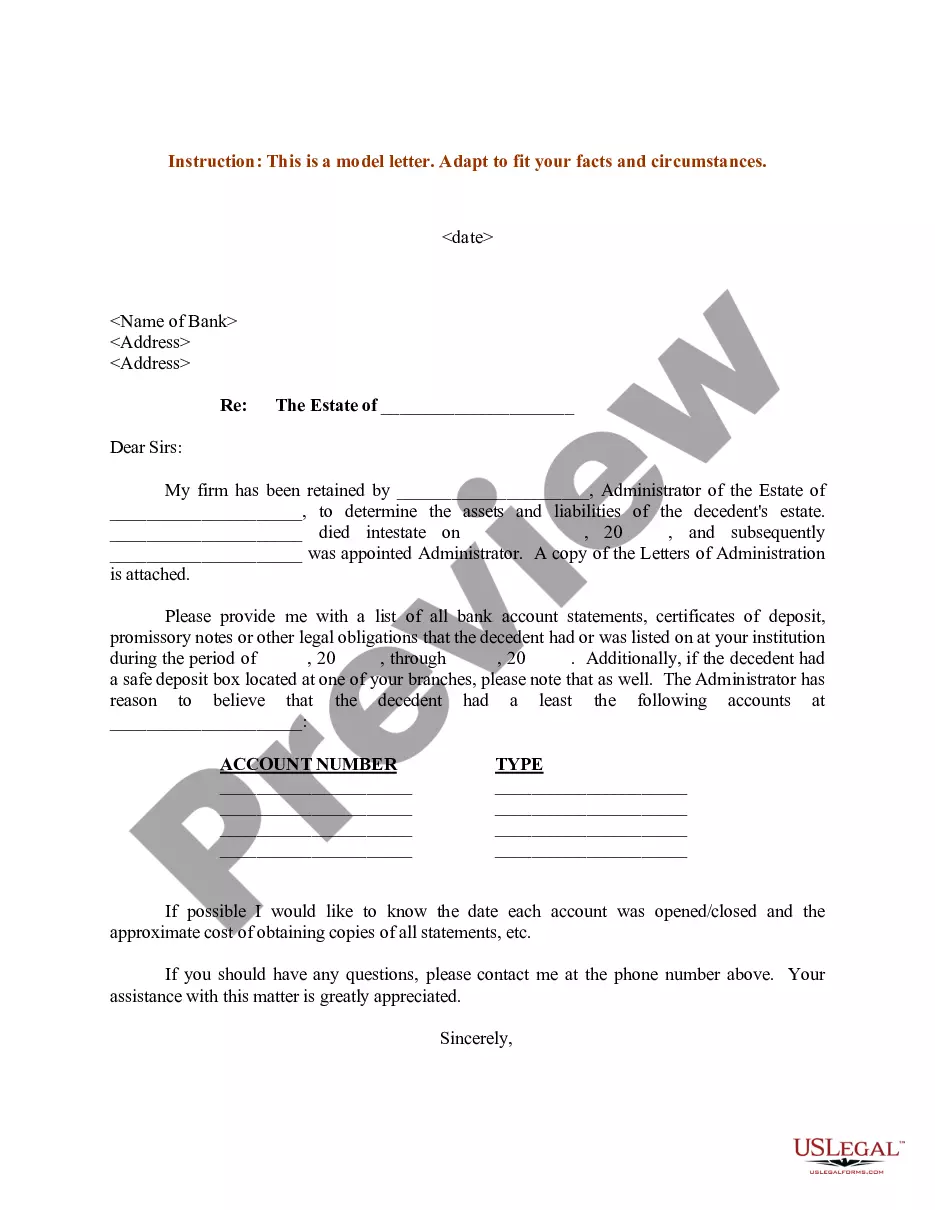
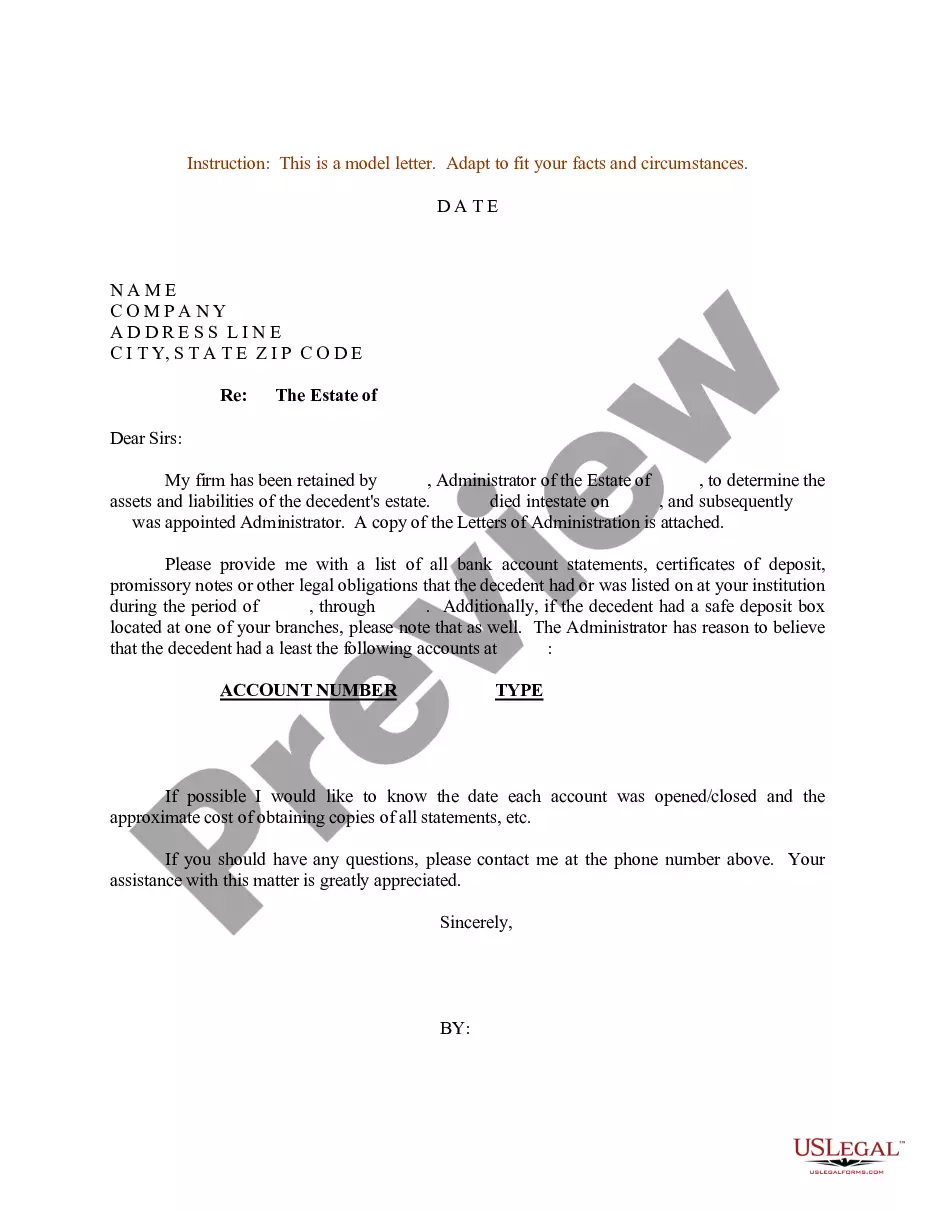
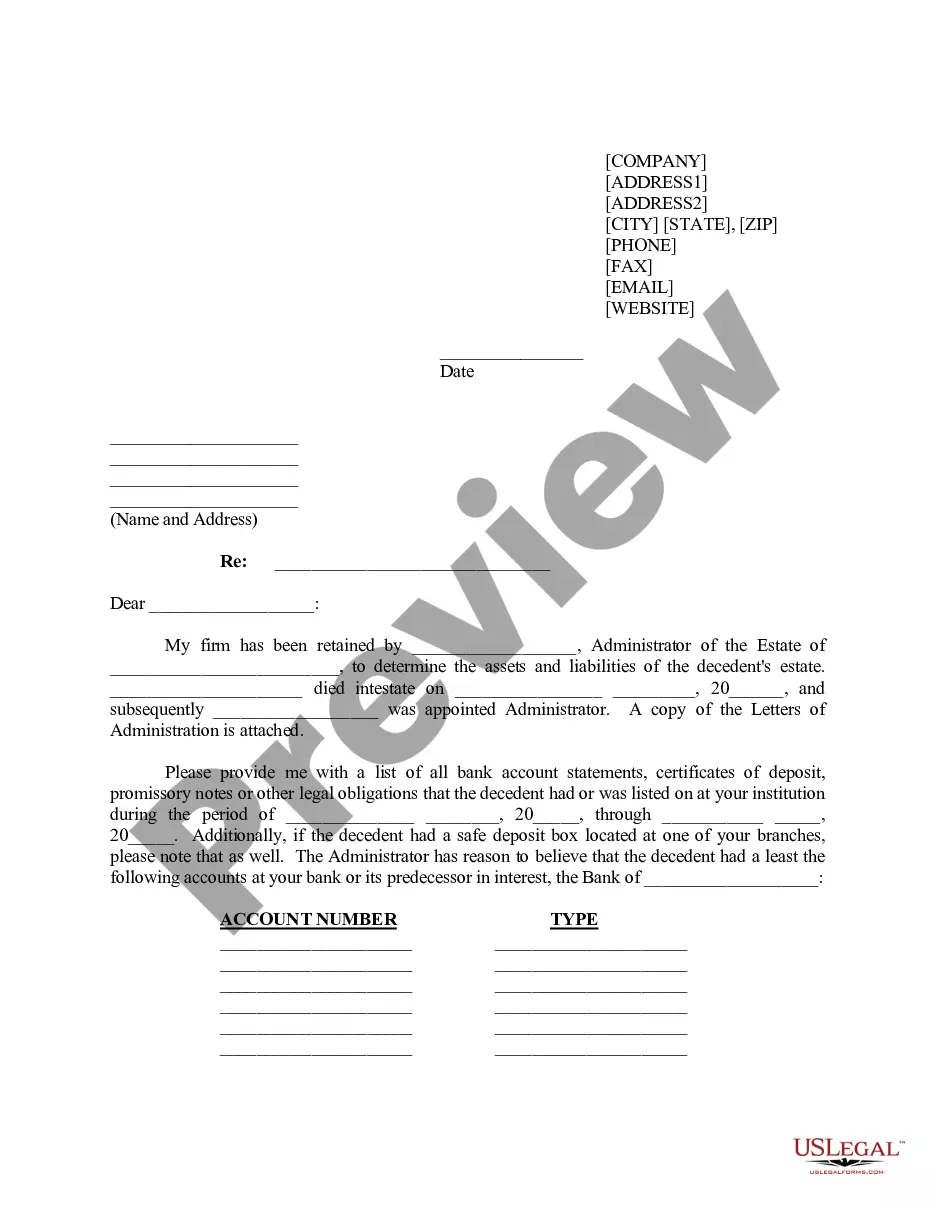
This form is a sample letter in Word format covering the subject matter of the title of the form.
Pennsylvania Sample Letter to Bank concerning Accounts of Decedent
State:
Multi-State
Category:
Control #:
US-0034LTR
Format:
Word;
Rich Text
48 downloads
Description
Free preview

Get your form ready online
Our built-in tools help you complete, sign, share, and store your documents in one place.
Built-in online Word editor
Make edits, fill in missing information, and update formatting in US Legal Forms—just like you would in MS Word.
Export easily
Download a copy, print it, send it by email, or mail it via USPS—whatever works best for your next step.
E-sign your document
Sign and collect signatures with our SignNow integration. Send to multiple recipients, set reminders, and more. Go Premium to unlock E-Sign.
Notarize online 24/7
If this form requires notarization, complete it online through a secure video call—no need to meet a notary in person or wait for an appointment.
Store your document securely
We protect your documents and personal data by following strict security and privacy standards.

Make edits, fill in missing information, and update formatting in US Legal Forms—just like you would in MS Word.

Download a copy, print it, send it by email, or mail it via USPS—whatever works best for your next step.

Sign and collect signatures with our SignNow integration. Send to multiple recipients, set reminders, and more. Go Premium to unlock E-Sign.

If this form requires notarization, complete it online through a secure video call—no need to meet a notary in person or wait for an appointment.

We protect your documents and personal data by following strict security and privacy standards.
Looking for another form?
How to fill out Sample Letter To Bank Concerning Accounts Of Decedent?
Are you currently in a scenario where you require documentation for either business or personal purposes almost every day? There are numerous legal document templates available online, but finding reliable versions can be challenging. US Legal Forms offers thousands of form templates, including the Pennsylvania Sample Letter to Bank regarding Accounts of Decedent, that are designed to comply with federal and state regulations.
If you are already acquainted with the US Legal Forms website and have an account, simply Log In. After that, you can download the Pennsylvania Sample Letter to Bank regarding Accounts of Decedent template.
If you do not have an account and wish to start using US Legal Forms, follow these steps: Obtain the form you need and ensure it is for the correct city/state. Use the Preview button to view the form. Check the summary to verify you have selected the correct form. If the form is not what you are looking for, use the Search field to find the form that meets your needs and requirements. Once you find the right form, click Purchase now. Select the payment method you prefer, fill in the necessary information to create your account, and complete the order using your PayPal or credit card. Choose a convenient file format and download your copy. Access all the document templates you have purchased in the My documents menu. You can download another version of the Pennsylvania Sample Letter to Bank regarding Accounts of Decedent at any time, if needed. Just select the required form to download or print the document template.
By using US Legal Forms, you can streamline the process of obtaining necessary legal documentation.
This platform is designed to simplify your life by providing reliable forms for all your documentation needs.
- Utilize US Legal Forms, the most extensive collection of legal forms, to save time and avoid errors.
- The service provides professionally crafted legal document templates that can be used for various purposes.
- Create an account on US Legal Forms and start making your life a bit easier.
- You can access thousands of legal forms tailored to meet your needs.
- Avoid the hassle of creating documents from scratch.
- Ensure compliance with legal requirements effortlessly.
- Experience convenience in handling daily documentation.
Form popularity
FAQ
Obtaining a letter of administration in Pennsylvania involves petitioning the probate court. This document gives you the legal authority to manage the deceased's estate and access their assets, including bank accounts. Uslegalforms offers resources to help you understand the process and provides templates, including a Pennsylvania Sample Letter to Bank concerning Accounts of Decedent, to assist you in your administrative tasks.
To gain access to bank accounts after someone has passed away, you need to follow a specific process. Begin by gathering necessary documents, such as the death certificate and any estate-related paperwork. You may also want to prepare a Pennsylvania Sample Letter to Bank concerning Accounts of Decedent, which clearly requests access to the deceased's accounts and outlines your role as the executor or beneficiary, streamlining your request.
Writing a letter to the bank after the account holder's death is straightforward. Start by stating the account holder's name, account number, and your relationship to them. Include a copy of the death certificate and mention that you are submitting a Pennsylvania Sample Letter to Bank concerning Accounts of Decedent to request access to the account. This clarity will help the bank process your request efficiently.
Accessing a deceased person's bank account typically requires proof of death and legal documentation. You may need to provide the bank with a death certificate and potentially a Pennsylvania Sample Letter to Bank concerning Accounts of Decedent. This letter should outline your relationship to the deceased and your request for access, ensuring a smoother process for obtaining the funds.
In Pennsylvania, bank accounts can be payable on death, allowing the account holder to designate a beneficiary. This means that upon the account holder's death, the funds in the account transfer directly to the beneficiary without going through probate. To facilitate this transfer, it's essential to provide a Pennsylvania Sample Letter to Bank concerning Accounts of Decedent, which notifies the bank of the account holder's passing and requests access for the beneficiary.
Bank account beneficiary rules usually allow payable-on-death beneficiaries to withdraw the entirety of a decedent's bank account immediately following their death, so long as they present the bank with the proper documentation to prove that the account holder has died and to confirm their own identity.
If there's a will without a named executor, the court will issue a Letter of Testamentary; if there's no will, the court will issue a Letter of Administration. Present either of these letters to the bank along with the death certificate to close the account.
A court must grant you the power to withdraw money from the account if you're neither a joint owner or an account beneficiary. For example, an executor must produce proof of executor status and a certified copy of the death certificate to collect funds and place them in an estate account.
If the account holder established someone as a beneficiary, the bank releases the funds to the named person once it learns of the account holder's death. After that, the financial institution typically closes the account. If the owner of the account didn't name a beneficiary, the process can be more complicated.
The deceased person is likely to have ongoing standing orders and direct debits, so it's best to notify these organisations of the death as soon as possible to avoid receiving letters demanding outstanding payments.