Pennsylvania Insulation Contractor Package
Overview of this form package
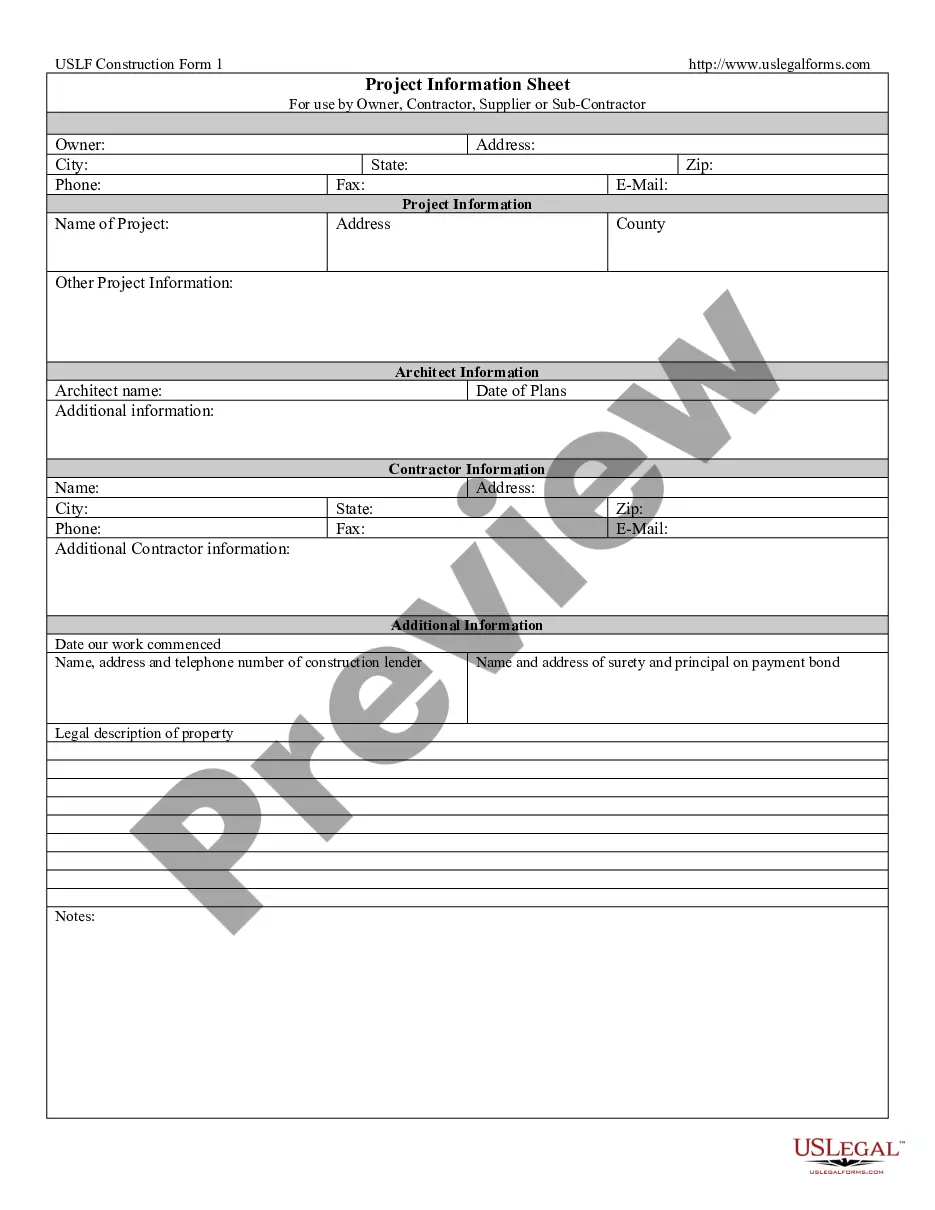
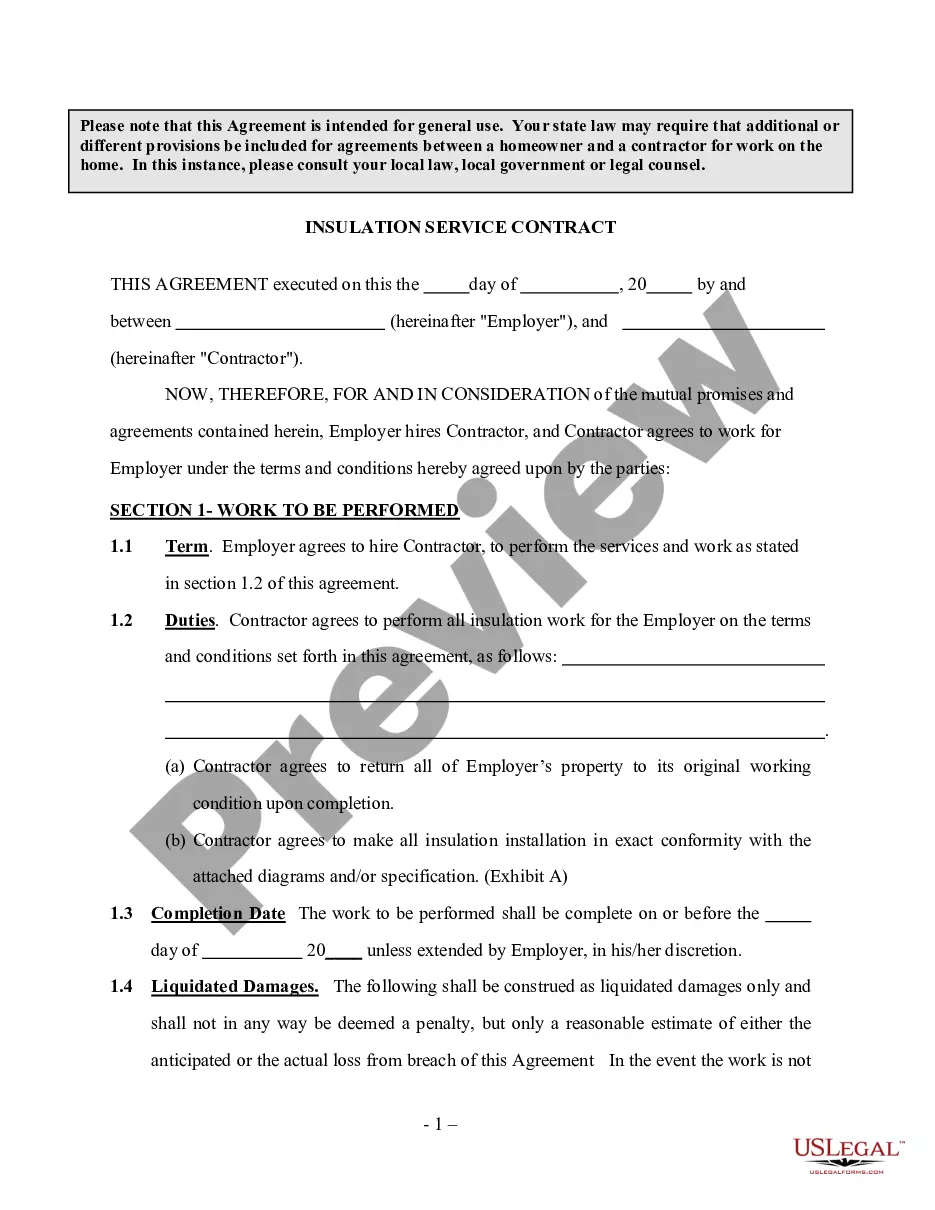
The Pennsylvania Insulation Contractor Package is a comprehensive collection of legal documents specifically designed for insulation contractors, owners, suppliers, and subcontractors. This package assists users in asserting their legal rights and managing crucial legal matters in residential insulation projects. Central to this package is the insulation contract, which is compliant with Pennsylvania state law, ensuring that you are fully equipped to handle your project's contractual obligations and rights effectively.
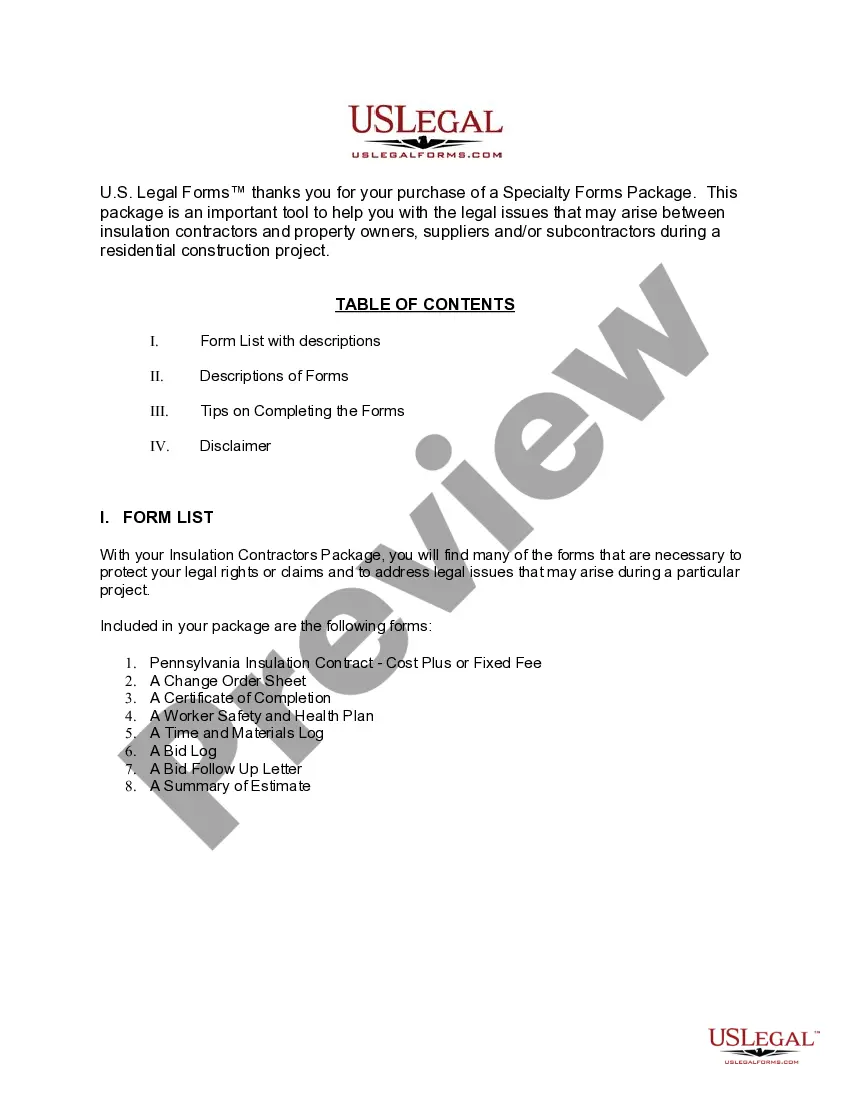
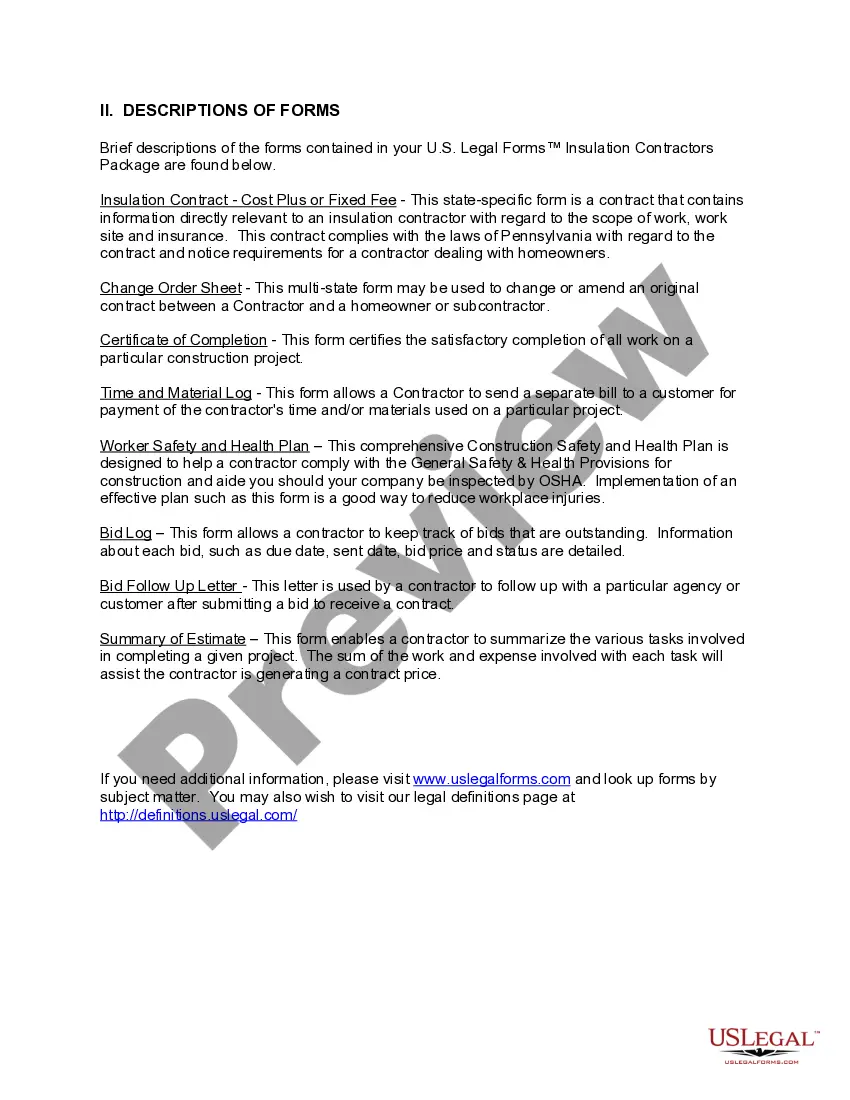
Forms you’ll find in this package
When to use this document
This package should be utilized in various scenarios, including:
- When entering into contracts for insulation installation services.
- When making changes to existing contracts through change orders.
- When documenting the completion of insulation work with a Certificate of Completion.
- When tracking bids and follow-ups for securing contracts on insulation projects.
- When ensuring compliance with safety regulations through a Worker Safety and Health Plan.
Who should use this form package
- Insulation contractors managing residential projects.
- Homeowners contracting insulation services.
- Suppliers providing materials for insulation projects.
- Subcontractors working alongside main contractors on insulation tasks.
- Any party needing to document terms and conditions of insulation work under Pennsylvania law.
How to complete these forms
- Review all included forms to familiarize yourself with the requirements.
- Identify the parties involved, including contractors and homeowners.
- Fill in relevant details such as dates, signatures, and specific project information.
- Ensure clarity in the terms outlined in the Insulation Contract.
- Document any changes or modifications using the Change Order Sheet as necessary.
- Maintain records using the Bid Log and Time and Material Log to track project progress and expenses.
Notarization details for included forms
Forms in this package usually don’t need notarization, but certain jurisdictions or signing circumstances may require it. US Legal Forms provides a secure online notarization option powered by Notarize, accessible 24/7 from anywhere.
Get your form ready online
Our built-in tools help you complete, sign, share, and store your documents in one place.
Make edits, fill in missing information, and update formatting in US Legal Forms—just like you would in MS Word.
Download a copy, print it, send it by email, or mail it via USPS—whatever works best for your next step.
Sign and collect signatures with our SignNow integration. Send to multiple recipients, set reminders, and more. Go Premium to unlock E-Sign.
If this form requires notarization, complete it online through a secure video call—no need to meet a notary in person or wait for an appointment.
We protect your documents and personal data by following strict security and privacy standards.

Make edits, fill in missing information, and update formatting in US Legal Forms—just like you would in MS Word.

Download a copy, print it, send it by email, or mail it via USPS—whatever works best for your next step.

Sign and collect signatures with our SignNow integration. Send to multiple recipients, set reminders, and more. Go Premium to unlock E-Sign.

If this form requires notarization, complete it online through a secure video call—no need to meet a notary in person or wait for an appointment.

We protect your documents and personal data by following strict security and privacy standards.
Common mistakes to avoid
- Failing to complete all required fields in the forms, which can void the contract.
- Neglecting to sign the Certificate of Completion before submitting it.
- Not keeping detailed records in the Bid Log, leading to discrepancies in bid management.
- Overlooking the need for additional documentation when making changes via the Change Order Sheet.
- Forgetting to update the Time and Material Log during the project.
Why complete this package online
- Convenient access to essential forms in a user-friendly digital format.
- Editable forms that allow customization to fit specific project needs.
- Reliable legal documents drafted by licensed attorneys to ensure compliance with state law.
- Cost-saving option as this package is more affordable than purchasing individual forms separately.
Looking for another form?
Form popularity
FAQ
R-30 Kraft-Faced 10.25 in. x 24 in. x 48 in. Batts (88 sq ft/bag) InsulationSaver.
A rough estimate for hiring someone to blow insulation into a flat roof, cathedral ceiling or wall cavities is $2-$3.50 a square foot, or $1,000-$3,500 for filling 1,000 square feet of empty wall or roof space.
Generally, insulators charge about $50 to $80 per hour. To help you calculate the cost of insulation, consider the size of the installation, the shape of the ceiling and additional services incurred. For accurate pricing, have a professional insulation installer take measurements and provide cost estimates.
The average cost to install loose-fill (blown-in) insulation or batt insulation in a 1,200 sq. ft. attic ranges from $1,700-$2,000.
On average, most homeowners spend between $813 and $1492 or $1.50 to $3.00 per square foot to install attic insulation. Pricing depends on the size of your attic, the type of insulation material used, and labor rates. For example, blown-in insulation for an attic in a 1,200 square foot home costs about $1,850.
Cellulose blow-in insulation is constructed out of recycled paper. To determine how much cellulose insulation you need, take the square footage of the space and divide it by either the depth or the desired R-value.
Are you a licensed installer? Can I speak with your references? What warranty or guarantee do you provide for your insulation? What personal protective equipment do you require for your workers? Do you carry liability insurance and workers comp insurance? What type of insulation products do you offer?
The cost to insulate an attic with blown-in insulation runs from $600 to $1,200, assuming it is 1,000 square feet in size. If you choose to hire a professional, expect to pay from $40 to $70 an hour for labor in addition to the cost of materials.
Typical recommendations for exterior walls are R-13 to R-23, while R-30, R-38 and R-49 are common for ceilings and attic spaces. See the Department of Energy's (DOE) ranges for recommended levels of insulation below.