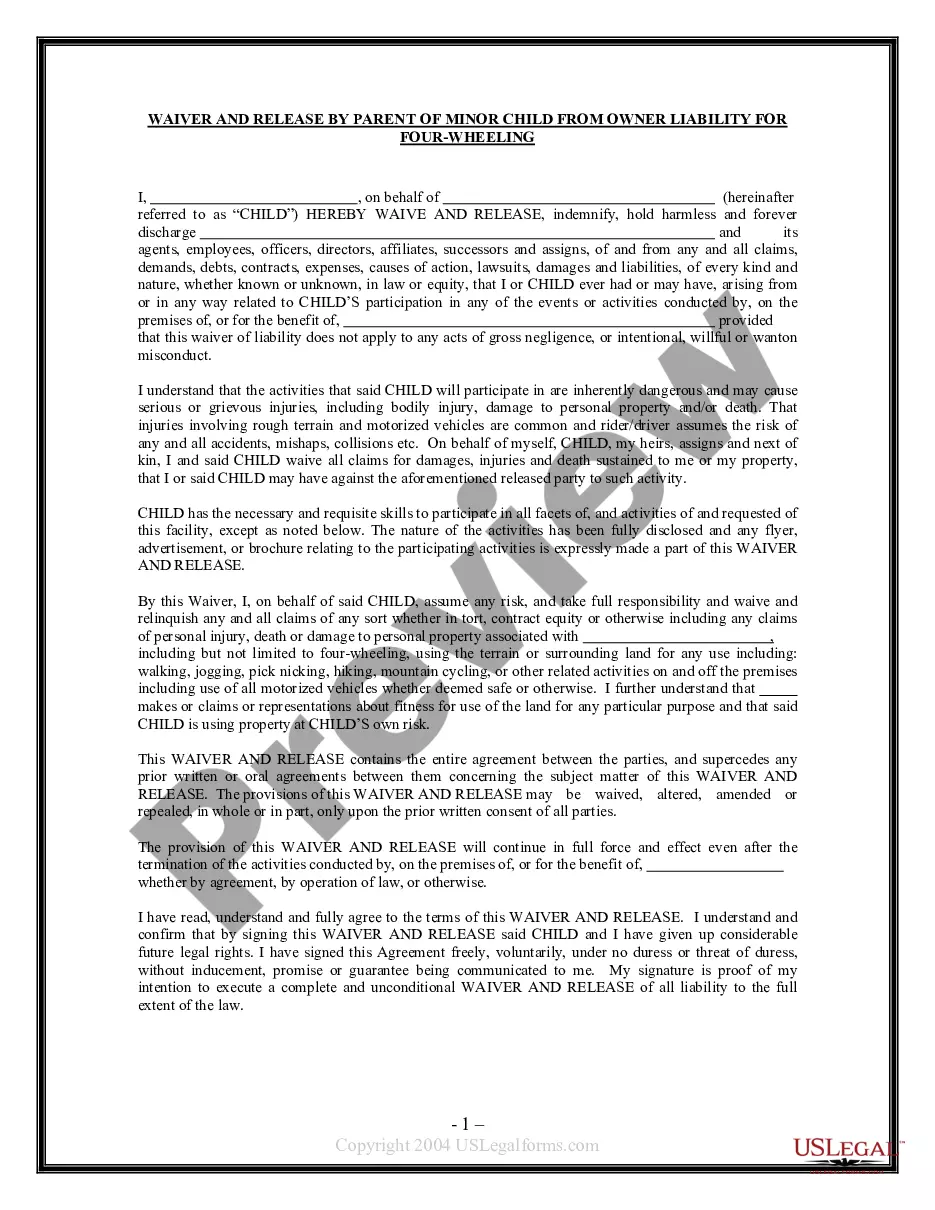
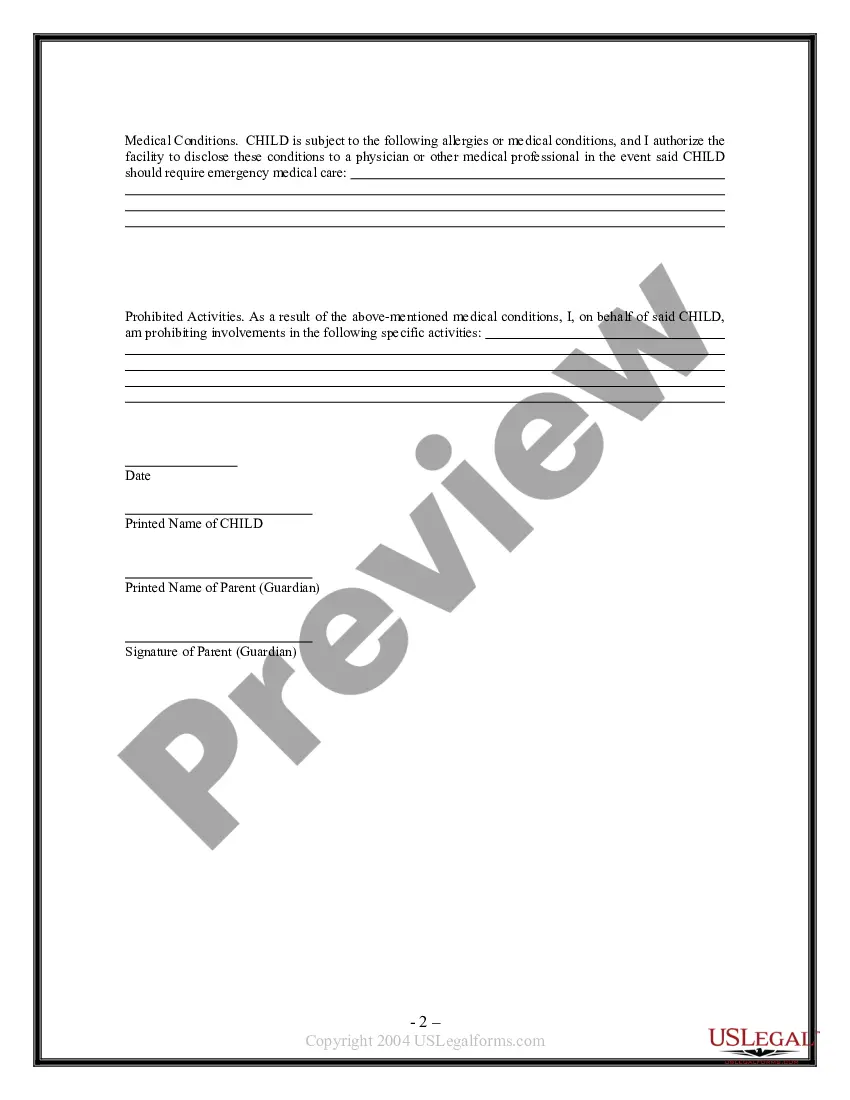
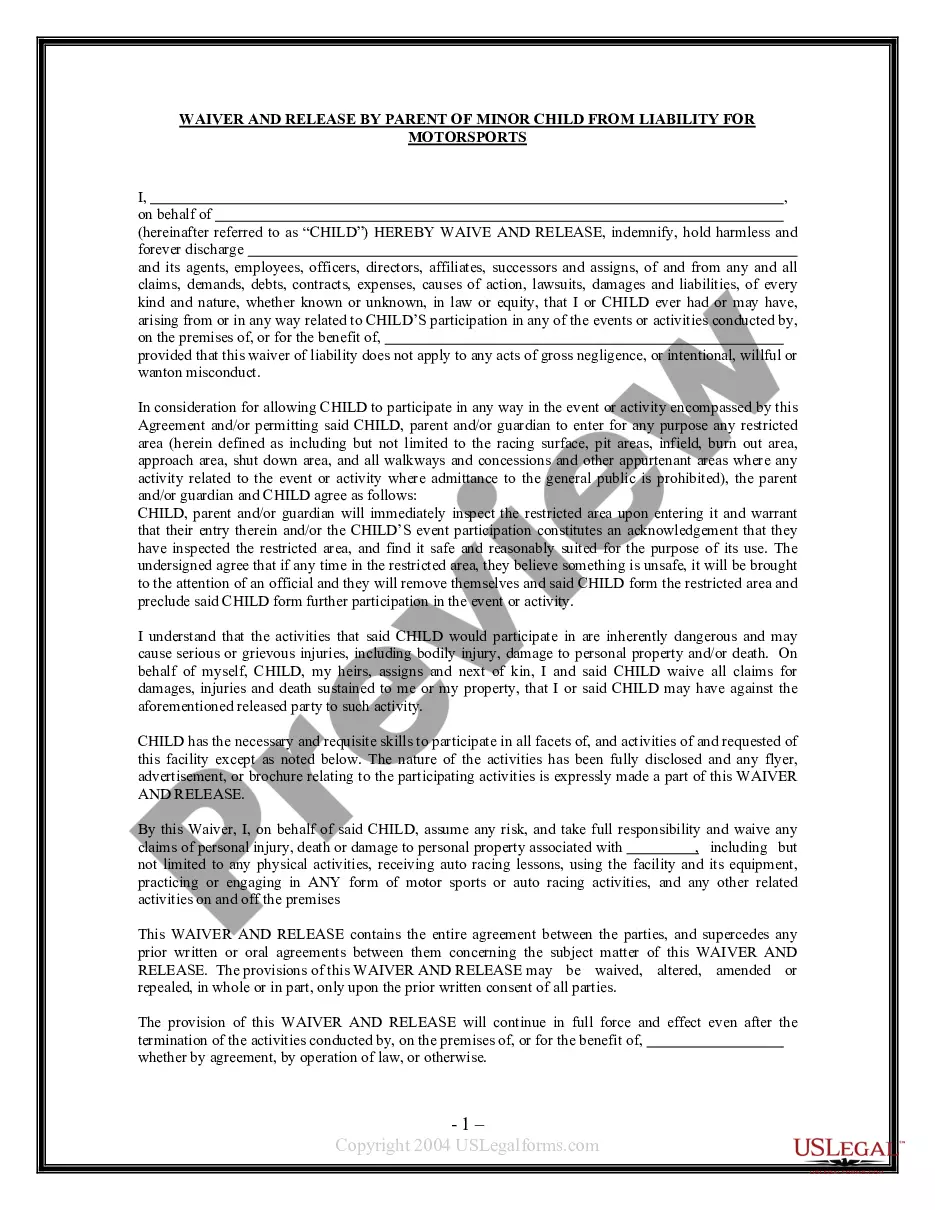
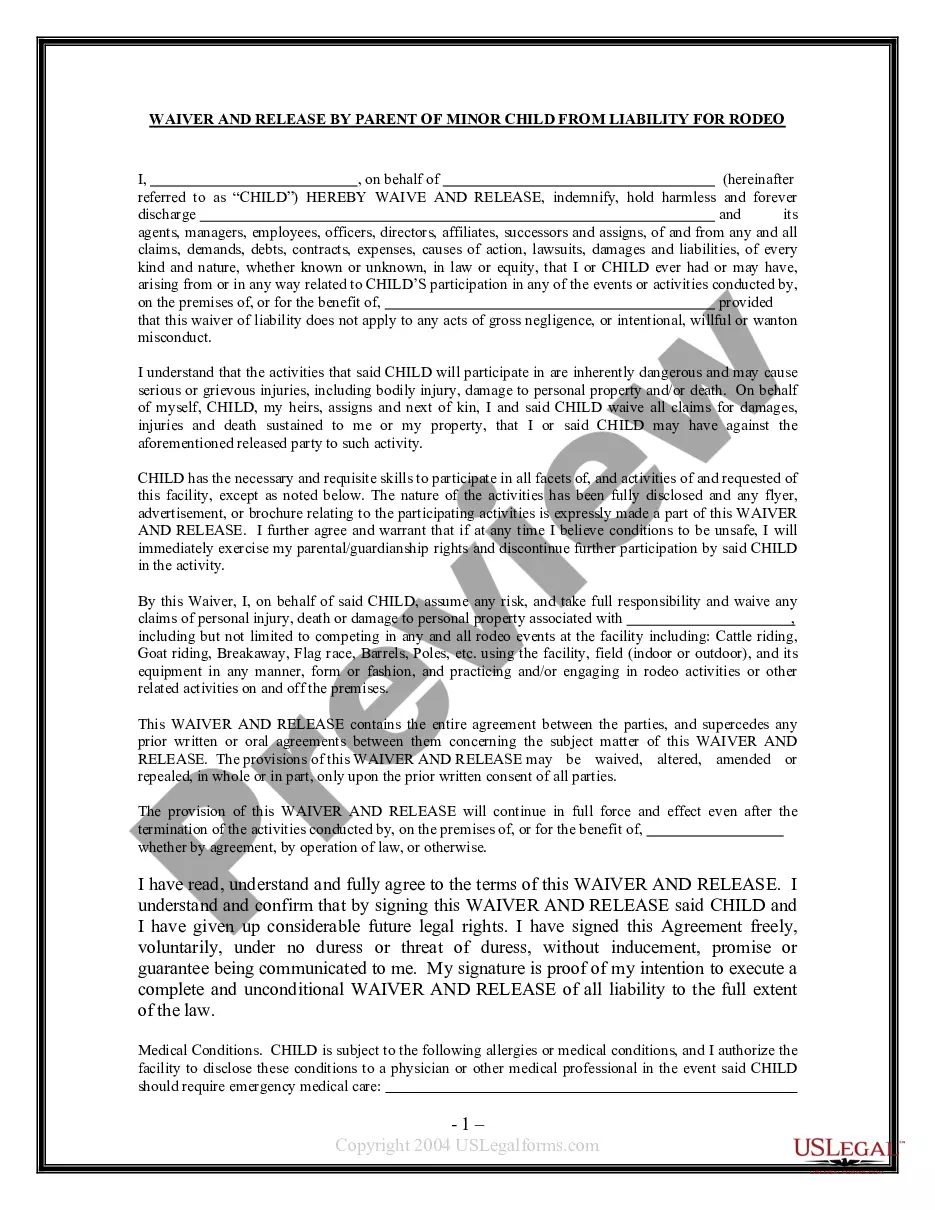
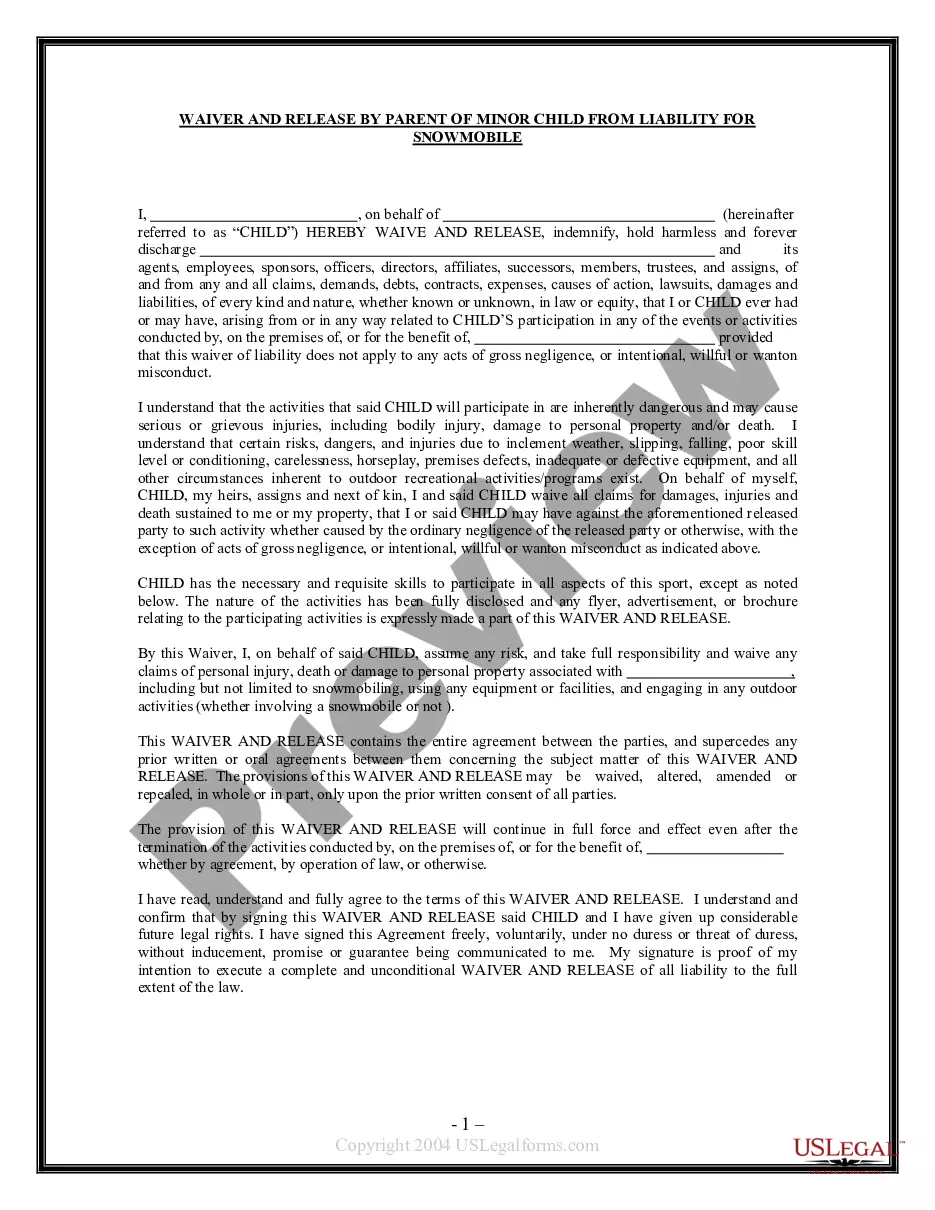
This form allows a parent or guardian to release a four-wheeling facility from liability for injuries which may be incurred by a minor child while on the premises, taking part in activities, etc.
Oregon Waiver and Release From Liability For Minor Child for Four-Wheeling
Category:
State:
Multi-State
Control #:
US-WAV-34M
Format:
Word;
Rich Text
Instant download
Description
Free preview
How to fill out Waiver And Release From Liability For Minor Child For Four-Wheeling?
Are you presently in a circumstance where you require documentation for either organizational or personal reasons almost all the time.
There are numerous valid document templates available online, but finding ones you can rely on is not easy.
US Legal Forms provides a vast array of form templates, such as the Oregon Waiver and Release From Liability For Minor Child for Four-Wheeling, which can be prepared to comply with federal and state regulations.
- If you are already acquainted with the US Legal Forms website and possess an account, simply Log In.
- After that, you can download the Oregon Waiver and Release From Liability For Minor Child for Four-Wheeling template.
- If you do not have an account and wish to start using US Legal Forms, follow these steps.
- Obtain the form you need and ensure it is for the correct city/county.
- Utilize the Review option to examine the form.
- Check the description to ensure you have selected the correct form.
- If the form is not what you are looking for, use the Search field to find the form that meets your needs and specifications.
- Once you find the appropriate form, click Purchase now.
- Select the pricing plan you want, fill in the required details to create your account, and pay for the order using your PayPal or Visa or Mastercard.
- Choose a convenient file format and download your copy.
- Access all the document templates you have purchased in the My documents list. You can obtain an additional copy of the Oregon Waiver and Release From Liability For Minor Child for Four-Wheeling anytime, if necessary. Just click on the desired form to download or print the document template.
- Utilize US Legal Forms, the most extensive collection of legal forms, to save time and avoid errors. The service offers professionally created legal document templates that you can use for a variety of purposes. Create an account on US Legal Forms and start simplifying your life.
Form popularity
FAQ
In Oregon, the law requires that children must be at least 16 years old to ride an ATV by themselves. However, younger children can operate an ATV if they are supervised by an adult and have completed an approved safety training course. It’s important to use the Oregon Waiver and Release From Liability For Minor Child for Four-Wheeling to protect against potential liabilities when minors are involved in such activities.
A parental release of liability form is a document that allows parents or guardians to waive their right to hold an organization or individual liable for injuries that may occur during activities involving minors. This form is crucial for activities like four-wheeling, as it emphasizes the inherent risks. The Oregon Waiver and Release From Liability For Minor Child for Four-Wheeling serves as a protective measure for both the child and the activity provider.
Yes, you can create your own liability waiver; however, it’s essential to ensure it complies with state laws. Using a professionally drafted Oregon Waiver and Release From Liability For Minor Child for Four-Wheeling can provide better protection. By utilizing templates available on platforms like US Legal Forms, you can customize the waiver to fit your needs while ensuring it meets legal standards.
Here is all that pertains writing an effective liability waiver:Get help. Writing a waiver should not be complicated.Use the correct structure.Proper formatting.Include a subject line.Include a caution!Talk about the activity risks.Do not forget an assumption of risk.Hold harmless.More items...?
Liability waivers are enforceable in California solely to the extent they shift to the customer the risk of ordinary negligence. Under California law, a liability waiver cannot excuse an injury caused by a defendant's gross negligence, recklessness or intentionally wrongful act.
Components of a waiverGet help. Writing a waiver should not be complicated.Use the correct structure. Waivers should be written in a certain structure.Proper formatting.Include a subject line.Include a caution!Talk about the activity risks.Do not forget an assumption of risk.Hold harmless.More items...?
As tempting as it may be, you should never write your own liability waiver. Unless you're a fully qualified lawyer with experience in this area, it's likely that you'll omit critical language that puts your business at risk for lawsuits.
Generally, a liability waiver document is a legally binding agreement that relinquishes the right of one party to pursue legal remedy for injuries accrued on the property, regardless of fault involved.
Ambiguous language or missing information can invalidate a waiver. The waiver contains errors that make it invalid. The language of the waiver must obey relevant state laws. An improperly worded or drafted waiver, as well as one that violates the law or public policy, may not hold up in court.
A liability waiver is a legal document that a person who participates in an activity may sign to acknowledge the risks involved in their participation. By doing so, the company attempts to remove legal liability from the business or person responsible for the activity.