Oregon Mining Claim Affidavit
Overview of this form
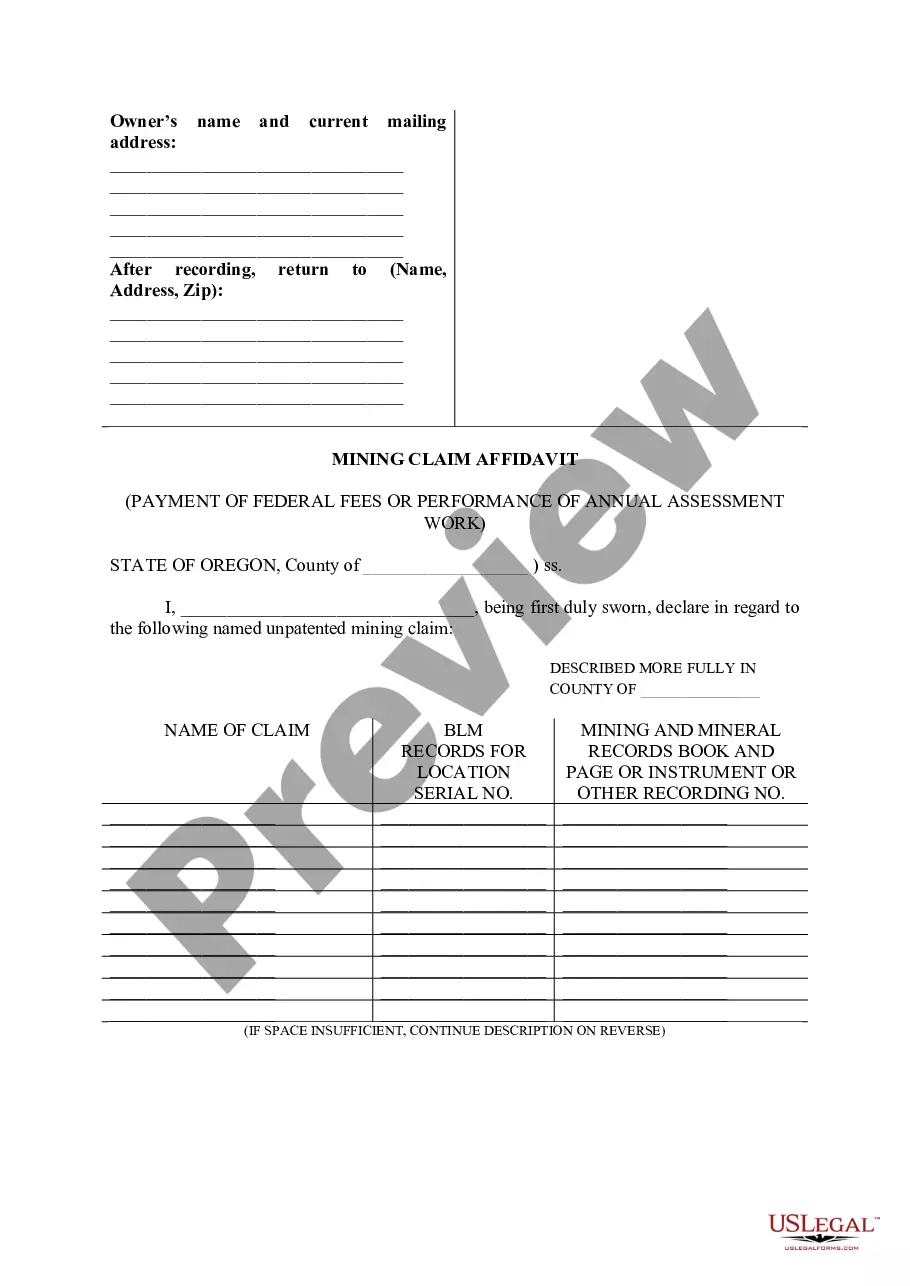
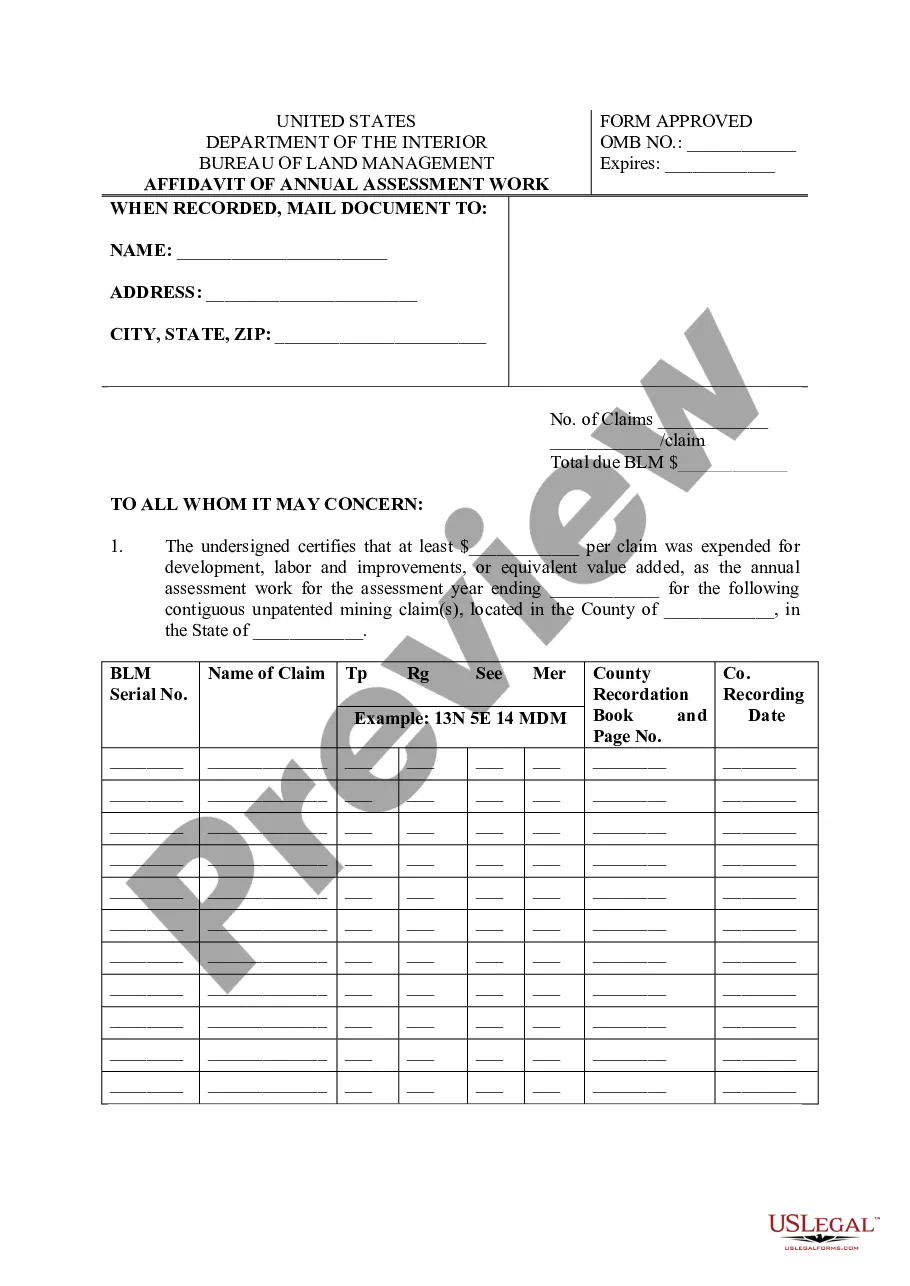
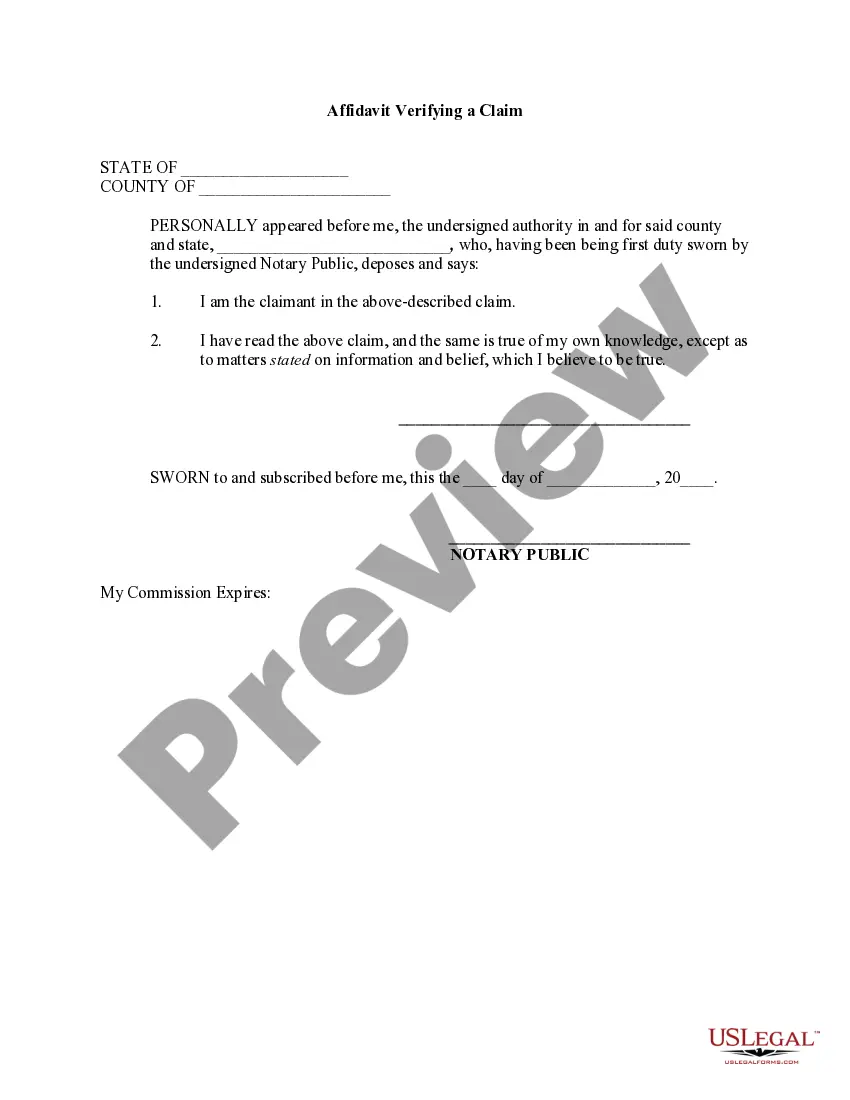
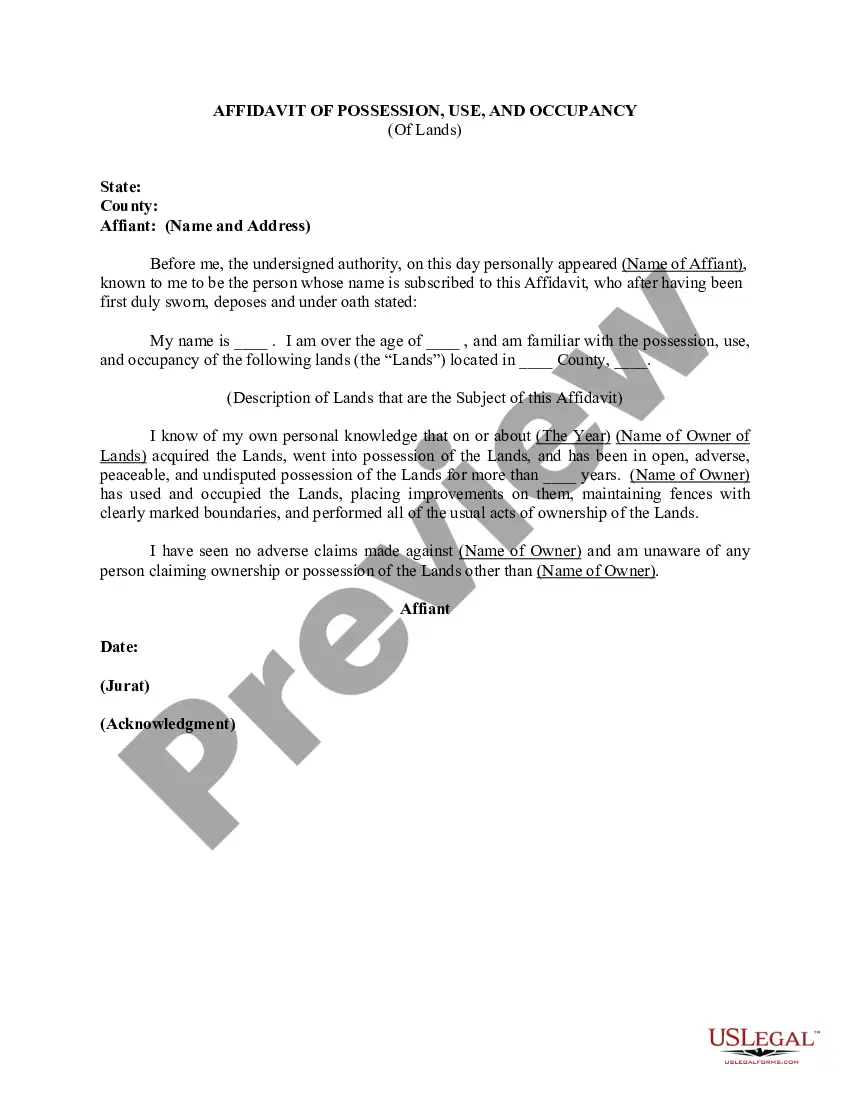
The Mining Claim Affidavit is a legal document used by a claim owner to verify their mining claim and state their compliance with federal fee requirements or annual assessment work obligations. This form is essential for those wishing to maintain their unpatented mining claim in good standing, providing a clear statement of claims, work performed, and improvements made.
Key components of this form
- Owner's name and current mailing address.
- Information about the mining claim, including its name and serial number.
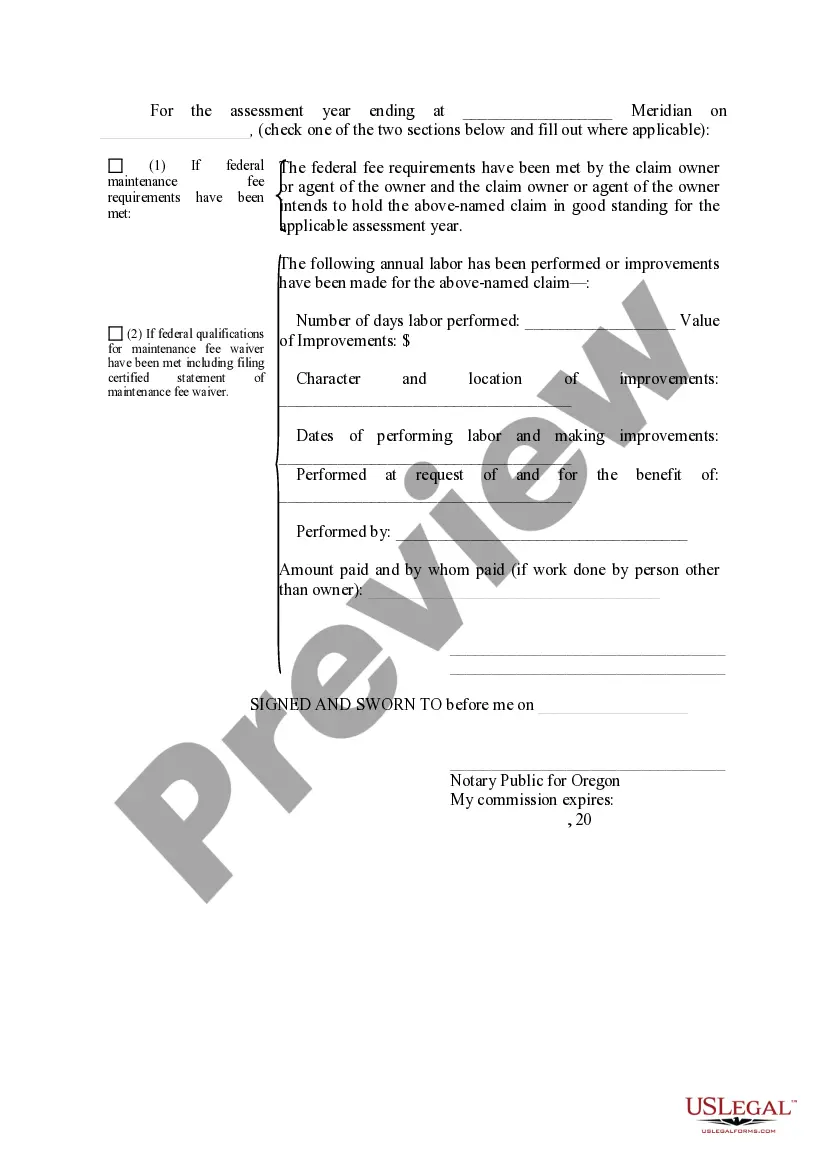
- Details on whether federal maintenance fees have been paid or if an annual assessment work waiver applies.
- Record of labor performed or improvements made to the mining claim.
- Notary section for legal verification of the affidavit.
When this form is needed
This form should be used when the owner of a mining claim in Oregon needs to prove compliance with federal maintenance fee requirements or document annual work completed on the claim. It is typically required to maintain the claim's good standing, ensuring that ownership rights are preserved and protecting against potential loss of the claim.
Who can use this document
The following individuals should consider using the Mining Claim Affidavit:
- Mining claim owners who wish to verify claim details and compliance.
- Individuals or entities conducting mining operations that require documentation of annual assessment work.
- Agents acting on behalf of claim owners to file necessary affidavits.
How to prepare this document
- Enter the owner's name and current mailing address at the top of the form.
- Provide information about the mining claim, including its name, county, and serial number.
- Indicate whether federal fee requirements have been met or if a waiver applies.
- Document any labor performed or improvements made, including dates and descriptions.
- Sign the affidavit in the presence of a notary public to validate the document.
Notarization requirements for this form
Yes, this form must be notarized to be legally valid. Once you complete the affidavit, you will need to sign it in the presence of a notary public to ensure it meets the legal requirements for filing.
Get your form ready online
Our built-in tools help you complete, sign, share, and store your documents in one place.
Make edits, fill in missing information, and update formatting in US Legal Forms—just like you would in MS Word.
Download a copy, print it, send it by email, or mail it via USPS—whatever works best for your next step.
Sign and collect signatures with our SignNow integration. Send to multiple recipients, set reminders, and more. Go Premium to unlock E-Sign.
If this form requires notarization, complete it online through a secure video call—no need to meet a notary in person or wait for an appointment.
We protect your documents and personal data by following strict security and privacy standards.

Make edits, fill in missing information, and update formatting in US Legal Forms—just like you would in MS Word.

Download a copy, print it, send it by email, or mail it via USPS—whatever works best for your next step.

Sign and collect signatures with our SignNow integration. Send to multiple recipients, set reminders, and more. Go Premium to unlock E-Sign.

If this form requires notarization, complete it online through a secure video call—no need to meet a notary in person or wait for an appointment.

We protect your documents and personal data by following strict security and privacy standards.
Mistakes to watch out for
- Failing to provide complete and accurate information about the mining claim.
- Omitting the required notarization, which can invalidate the affidavit.
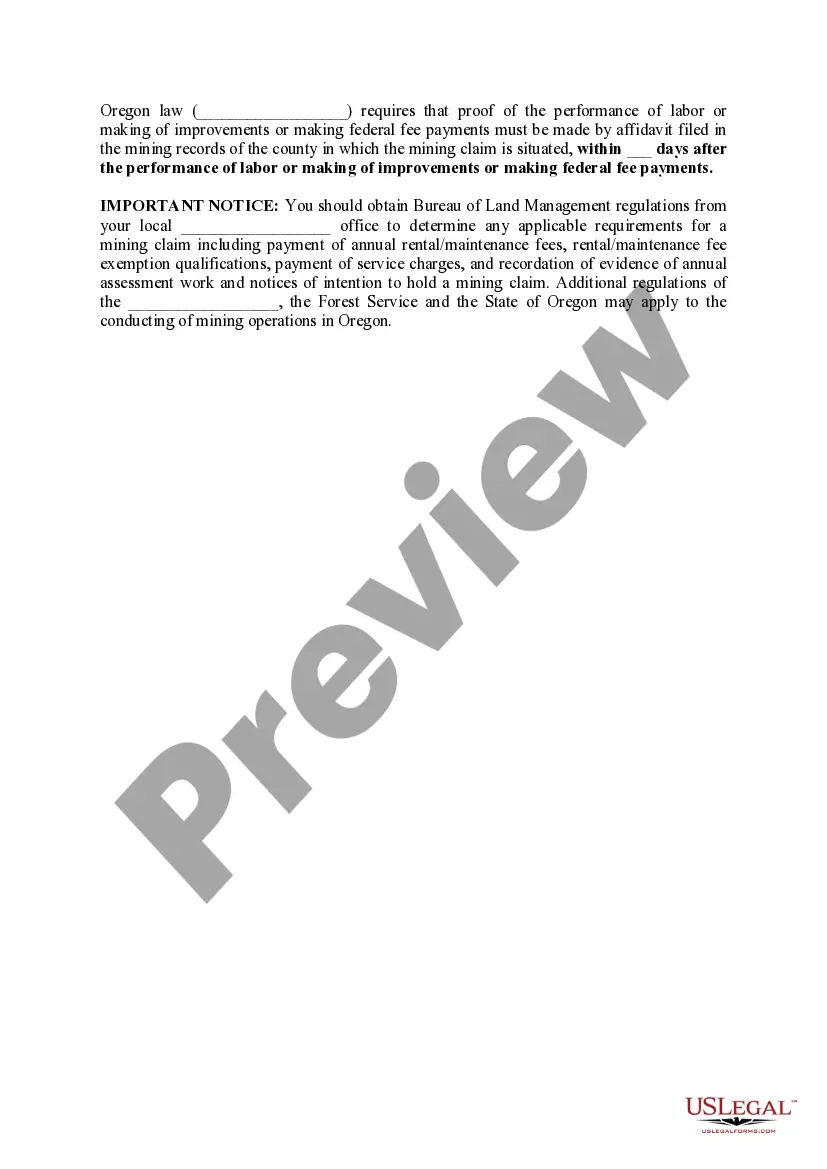
- Missing the filing deadline for submitting the affidavit to the county mining records.
Advantages of online completion
- Convenient access to complete and download the form from any location.
- Editability allows for easy incorporation of specific claim details.
- Reliable templates drafted by licensed attorneys ensure compliance with legal standards.
Legal use & context
- Affidavits like this one provide proof of compliance with federal mining regulations.
- Filing the affidavit in a timely manner is crucial to maintain ownership rights over the mining claim.
Quick recap
- The Mining Claim Affidavit serves to verify claim details and compliance with fees or labor requirements.
- Proper completion and notarization are essential for legal validity.
- Understanding state-specific filing requirements helps ensure the affidavit is submitted correctly.
Looking for another form?




Form popularity
FAQ
A miner has the right only to the minerals; he may not live on the land without permission. If a cabin is located on a new claim, it belongs to the BLM and may not be used by the miner. A mining claim may also be staked on certain Forest Service (USFS) land, with much of the same requirements.
Locate it: Find an area of public land that is not currently claimed. Prospect it: Visit the area of land, dig up some material, pan it and find at least one piece of gold. Stake it: Place a monument in each corner of the claim, labeling the name of the claim.
Mining claims both patented or unpatented are interests in real property. A patented mining claim is one for which the federal government has passed its title to the claimant, giving the claimant exclusive title to the surface of the claim area and its locatable minerals.
Federal lands where you can stake a claim are located in 19 states. These states are Alaska, Montana, Utah, Arizona, Arkansas, Nebraska, South Dakota, California, Nevada, Oregon, Colorado, New Mexico, Florida, Idaho, North Dakota, Louisiana, Wyoming, Mississippi, and Washington.
For placer mining claims only, the fees are $165 for every 20 acres or portion thereof. Claimants who filed a Small Miner's Waiver last year in 2019 for the 2020 assessment year will be required to file an Affidavit of Annual Assessment Work form, including the required $15 processing fee per claim on or before Dec.
Locate it: Find an area of public land that is not currently claimed. Prospect it: Visit the area of land, dig up some material, pan it and find at least one piece of gold. Stake it: Place a monument in each corner of the claim, labeling the name of the claim.
You must provide BLM with a mining plan. After it is reviewed, it will be approved or more information will be required.A miner has the right only to the minerals; he may not live on the land without permission. If a cabin is located on a new claim, it belongs to the BLM and may not be used by the miner.
1. You are NOT buying Land. When you own a mining claim, you have purchased the exclusive rights to mine the minerals on that land, but you are not purchasing real estate. The land itself is not yours.