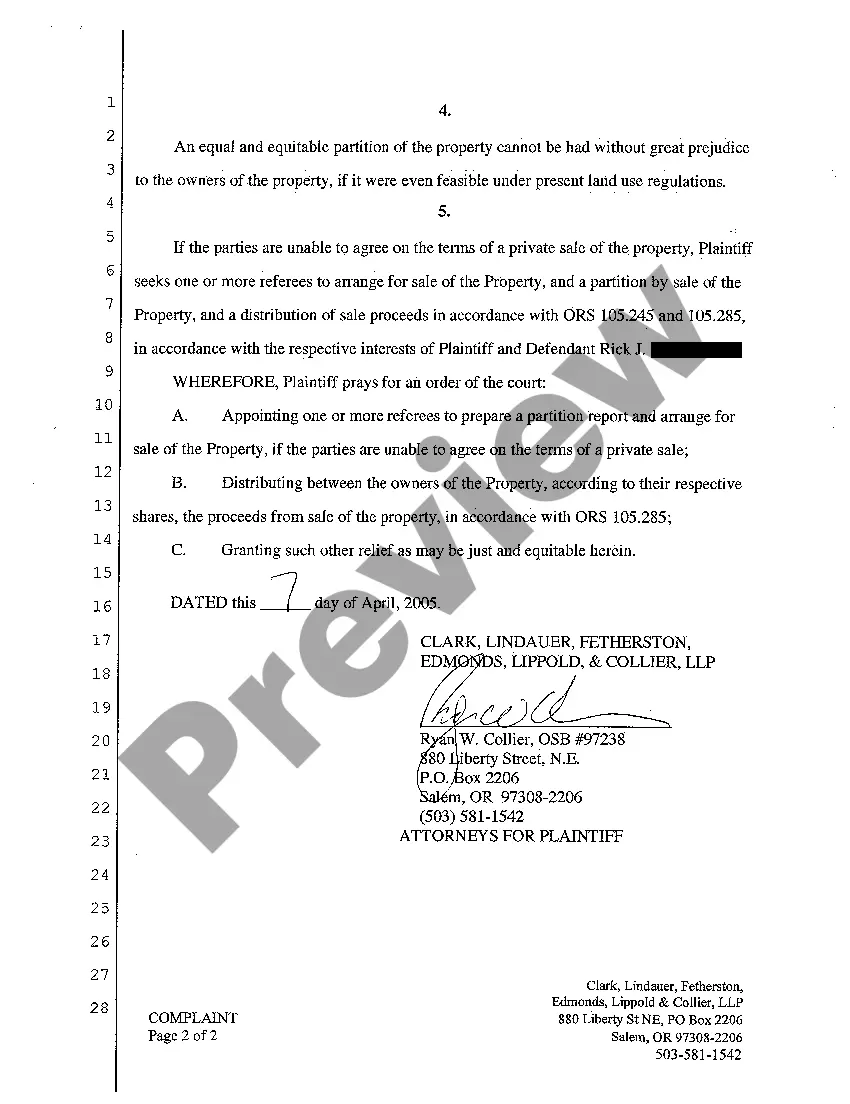
Oregon Complaint - Suit for Partition and Sale
Does this document require notarization?
This form does not typically require notarization to be legally valid. However, some jurisdictions or document types may still require it. US Legal Forms provides secure online notarization powered by Notarize, available 24/7 for added convenience.


Form popularity
FAQ
Filing a petition to partition Typically, a "lis pendens," or default notice, is also filed at the same time as the petition. This document simply notifies everyone who has been named in the partition action that the lawsuit is being filed.
A suit for partition is filed in a Civil Court having jurisdiction over the area where the property is located. If there are several properties, the lawsuit can be filed in any one of the courts. The partition suit results in a decree which ends the joint nature of the property.
How much does a partition action cost? In California, the cost of partition action and attorneys fees can vary greatly, depending on the complexity of the property and issues involved and the resistance of your opposing party. Attorney's fees can range from $20,000 to $100,000+ per party.
Can A Partition Be Stopped? Typically, a partition action cannot be stopped once a lawsuit is filed because anyone who wants to dissolve ownership that is jointly owned with another person has a legal right to sell his/her interest if desired.
You can hire a trust litigation attorney to litigate a partition action. Your attorney may fight to increase the value of your share of the property if, for example, you paid for maintenance, repairs, improvements, property taxes, mortgage payments, etc.
When owners of jointly owned property can't agree on the sale of the entire property, a partition lawsuit to force its sale may be filed. In a partition lawsuit, the court can order the sale of the entire property and divide proceeds among its owners.
It generally takes about a year and half to two years to get to trial on a partition action.