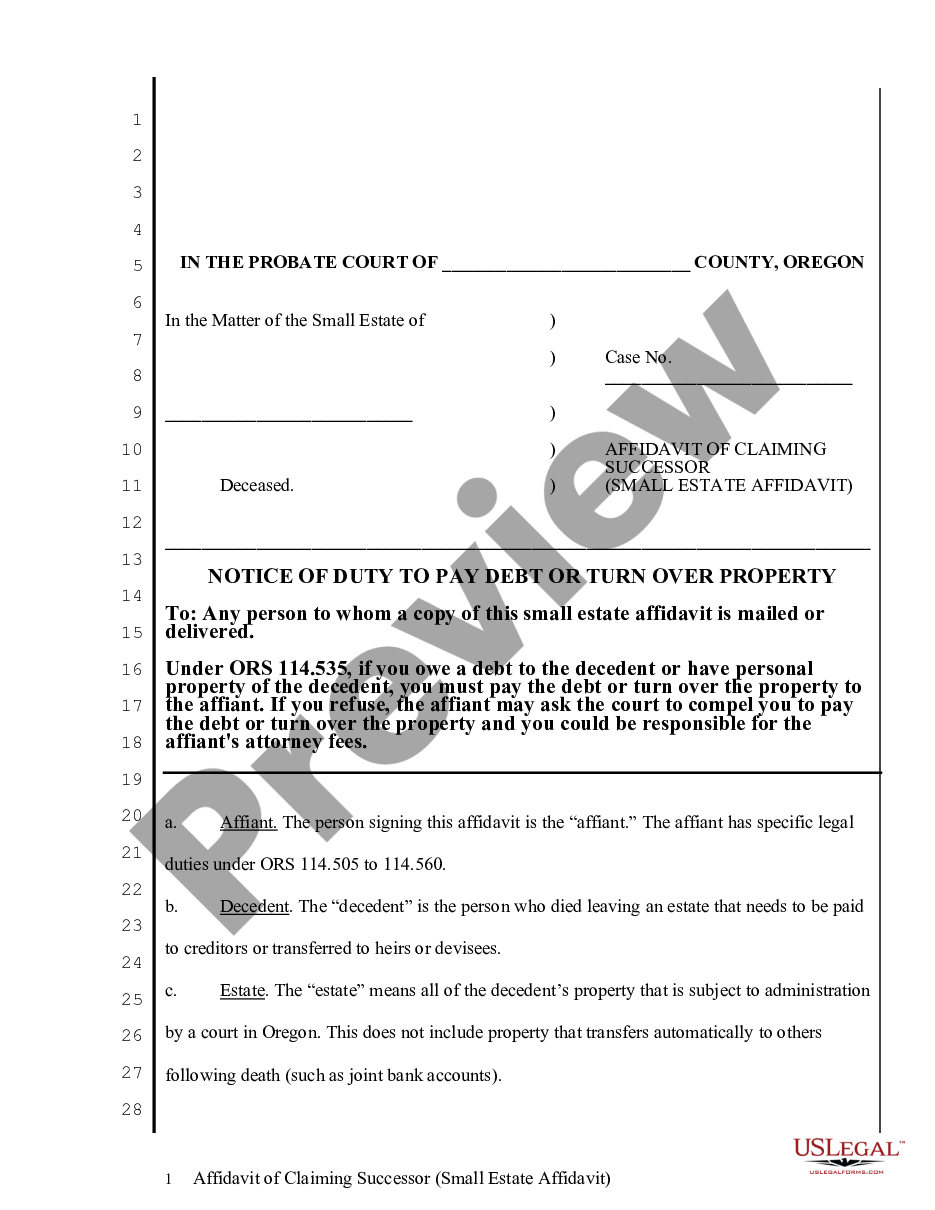
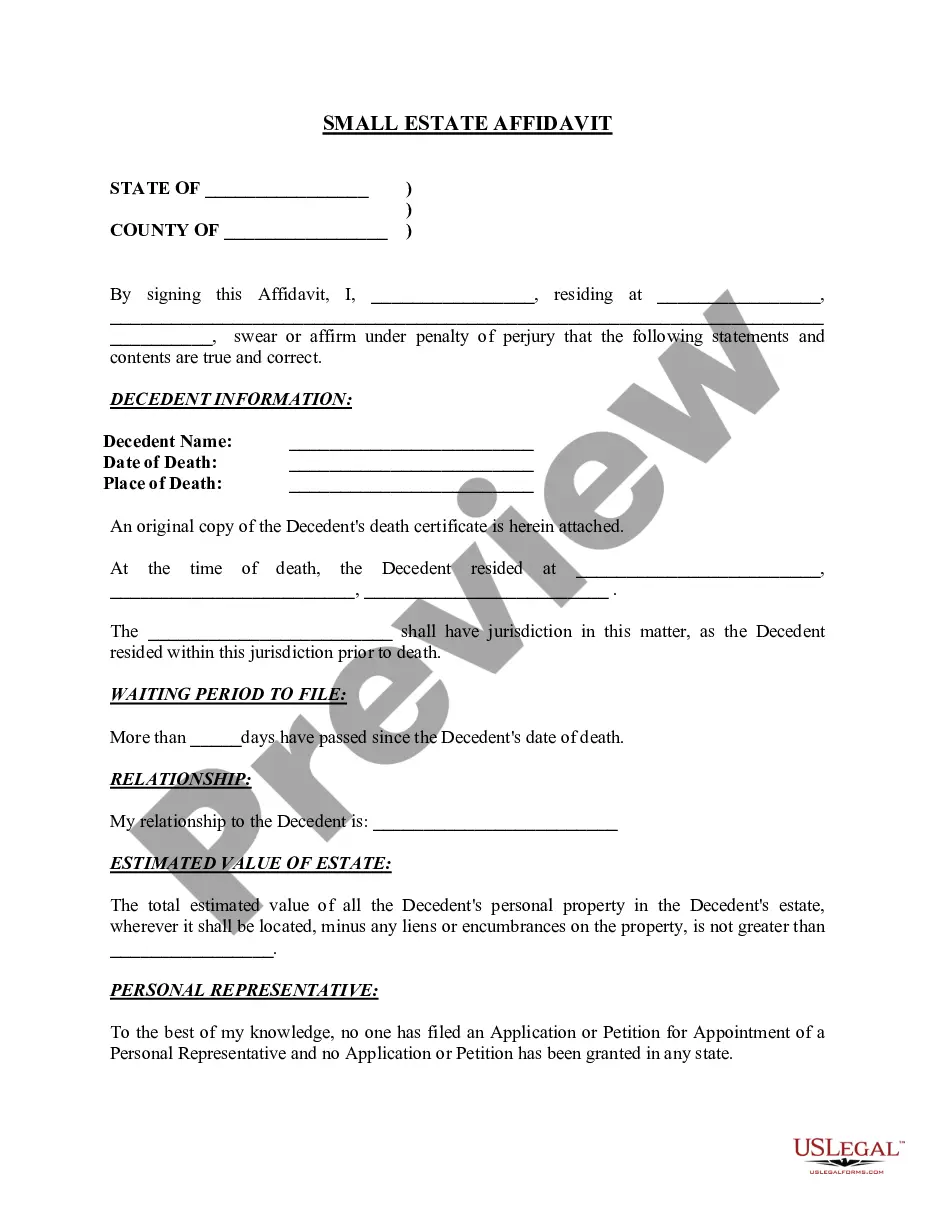
Small Estate Affidavit for Estates under 75,000 Personal - 200,000 Real Property
Small Estates General Summary:
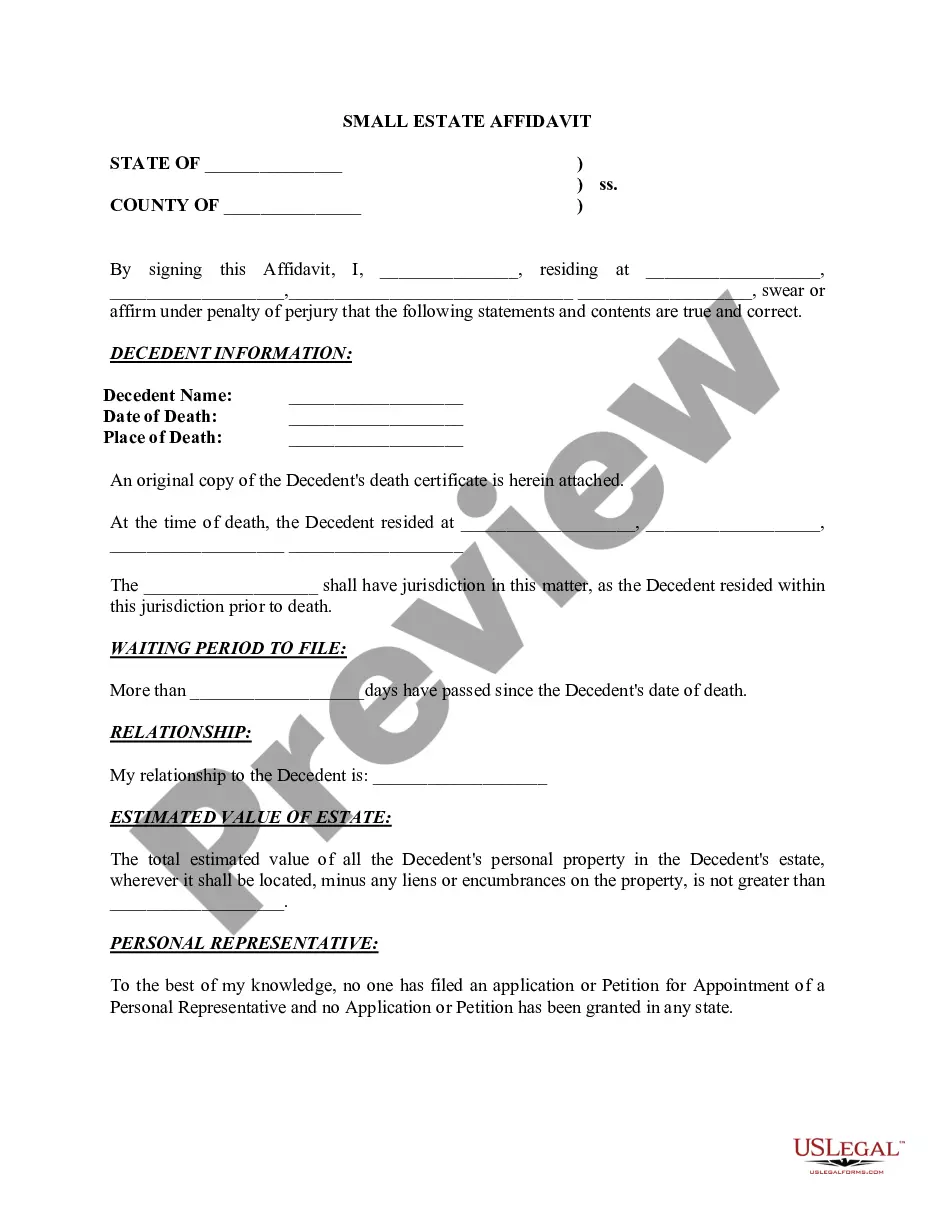
Small Estate laws were enacted in order to enable heirs to obtain property of the deceased
without probate, or with shortened probate proceedings, provided certain
conditions are met. Small estates can be administered with less time and
cost. If the deceased had conveyed most property to a trust but there
remains some property, small estate laws may also be available. Small
Estate procedures may generally be used regardless of whether there was
a Will. In general, two forms of small estate procedures are
recognized:
1.
Small Estate Affidavit -Some States allow an affidavit
to be executed by the spouse and/or heirs of the deceased and present the
affidavit to the holder of property such as a bank to obtain property of
the deceased. Other states require that the affidavit be filed with the
Court. The main requirement before you may use an affidavit is that
the value of the personal and/or real property of the estate not exceed
a certain value.
2.
Summary Administration -Some states allow a Summary
administration. Some States recognize both the Small Estate affidavit and
Summary Administration, basing the requirement of which one to use on the
value of the estate. Example: If the estate value is 10,000 or less an
affidavit is allowed but if the value is between 10,000 to 20,000 a summary
administration is allowed.
Oregon Summary:
Under Oregon statutes, if the estate of
the decedent is sufficiently small as defined by §114.515,
an interested party may petition the court to be named as the
personal representative of the deceased. Oregon law imposes several
responsibilities upon the personal representative before the assets of
the estate may be distributed. Please see below for details.
Oregon Requirements:
Oregon requirements are set forth in the statutes below.
114.515.
(1) If the estate of a decedent meets the requirements of subsection (2) of this section, any of the following persons may file an affidavit with the clerk of the probate court in any county where there is venue for a proceeding seeking the appointment of a personal representative for the estate:
(a) One or more of the claiming successors of the decedent.
(b) If the decedent died testate, any person named as personal representative in the decedent's will.
(2) An affidavit under this section may be filed only if:
(a) The fair market value of the estate is $275,000 or less;
(b) Not more than $75,000 of the fair market value of the estate is attributable to personal property; and
(c) Not more than $200,000 of the fair market value of the estate is attributable to real property.
(3) An affidavit under this section may not be filed until 30 days after the death of the decedent.
(4) An affidavit filed under the provisions of this section must contain the information required in ORS 114.525 and shall be made a part of the probate records.
(5) In determining fair market value under this section, the fair market value of the entire interest in the property included in the estate shall be used without reduction for liens or other debts.
(6) The clerk of the probate court shall charge and collect a fee of $23 for the filing of any affidavit under this section.
(7) Any error or omission in an affidavit filed under this section may be corrected by filing an amended affidavit within four months after the filing of the affidavit.
(8) One or more supplemental affidavits may be filed at any time after the filing of an affidavit under this section for the purpose of including property not described in the original affidavit. Copies of all previously filed affidavits must be attached to the supplemental affidavit and all information required in ORS 114.525 must be reflected in the supplemental affidavit. A supplemental affidavit may not be filed if by reason of the additional property described in the supplemental affidavit any limitation imposed by subsection (2) of this section is exceeded.
SECTION 2. The amendments to ORS 114.515 by section 1 of this 2009 Act apply only to decedents who die on or after the effective date of this 2009 Act. 114.520 Authorization from Department of State Lands required for filing of affidavit by creditor if decedent dies intestate and without heirs; rules.
(1) If a decedent dies intestate and without heirs, a creditor of an estate who is a claiming successor may not file an affidavit under ORS 114.515 unless the creditor has received written authorization from an estate administrator of the Department of State Lands appointed under ORS 113.235. Except as provided by rule adopted by the Director of the Department of State Lands, an estate administrator shall consent to the filing of an affidavit under ORS 114.515 by a creditor only if it appears after investigation that the estate is insolvent.
(2) A creditor of an estate who is subject to subsection (1) of this section may give written notice to an estate administrator of the Department of State Lands informing the estate administrator that the creditor intends to file an affidavit under ORS 114.515. Upon receiving the notice permitted by this subsection, the estate administrator shall investigate the assets and liabilities of the estate. Within 30 days after receiving the notice required by this subsection, the estate administrator shall either:
(a) Give written authorization to the creditor for the filing of an affidavit by the creditor under ORS 114.515; or
(b) Inform the creditor that the Department of State Lands will file an affidavit as claiming successor under ORS 114.515.
(3) If a decedent dies intestate and without heirs, a creditor of an estate who is a claiming successor and who files an affidavit under ORS 114.515 must notate at the top of the affidavit that the affidavit is being filed by a creditor of the estate. If the affidavit contains the notation required by this subsection, the clerk of the probate court may not accept the affidavit for filing unless there is attached to the affidavit written authorization for the filing of the affidavit by the creditor from an estate administrator of the Department of State Lands. The written authorization may be a copy of a memorandum of an interagency agreement between the Department of State Lands and another state agency.
114.525 Content of affidavit.
An affidavit filed under ORS 114.515 shall:
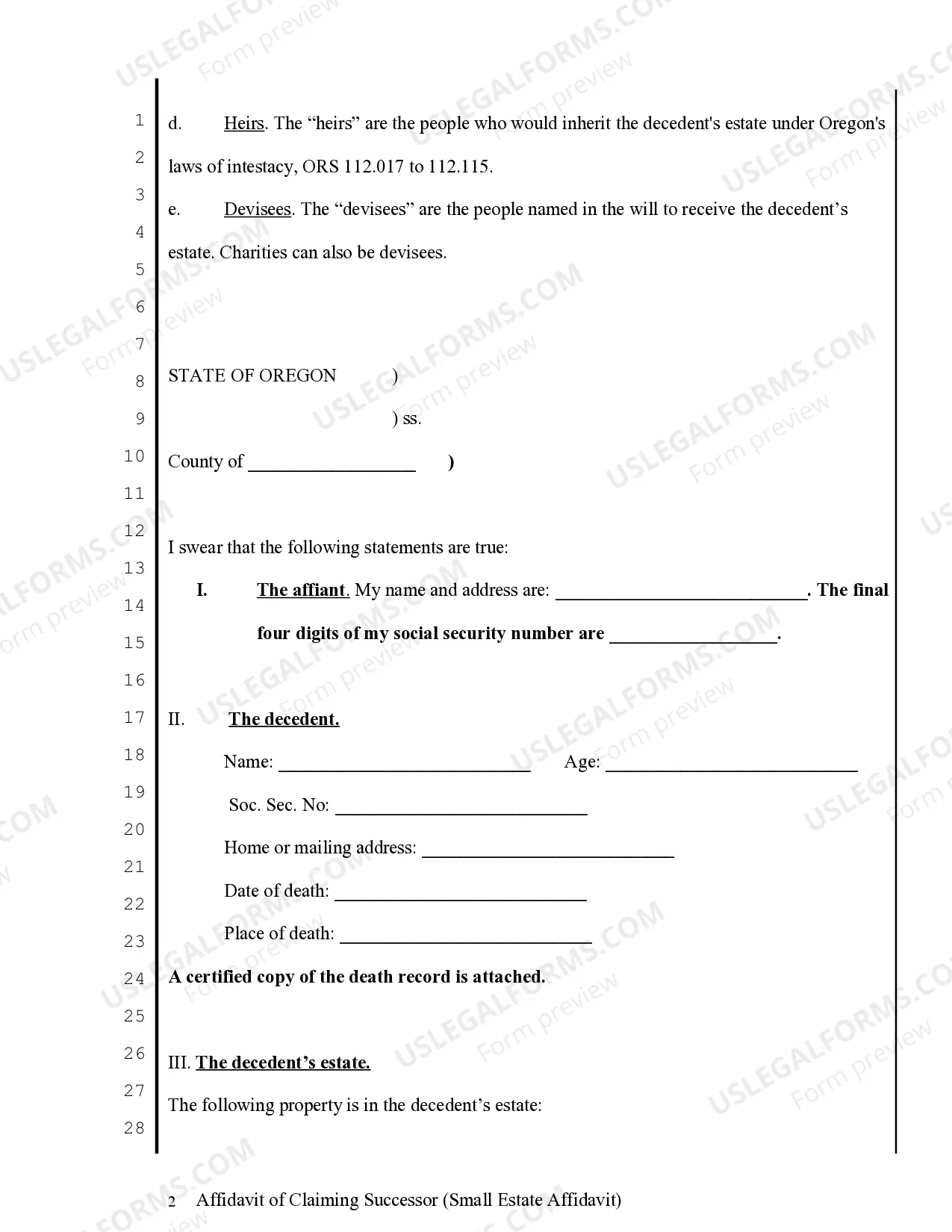
(1) State the name, age, domicile, post-office address and Social Security number of the decedent;
(2) State the date and place of the decedent's death. A certified copy of the death certificate shall be attached to the affidavit;
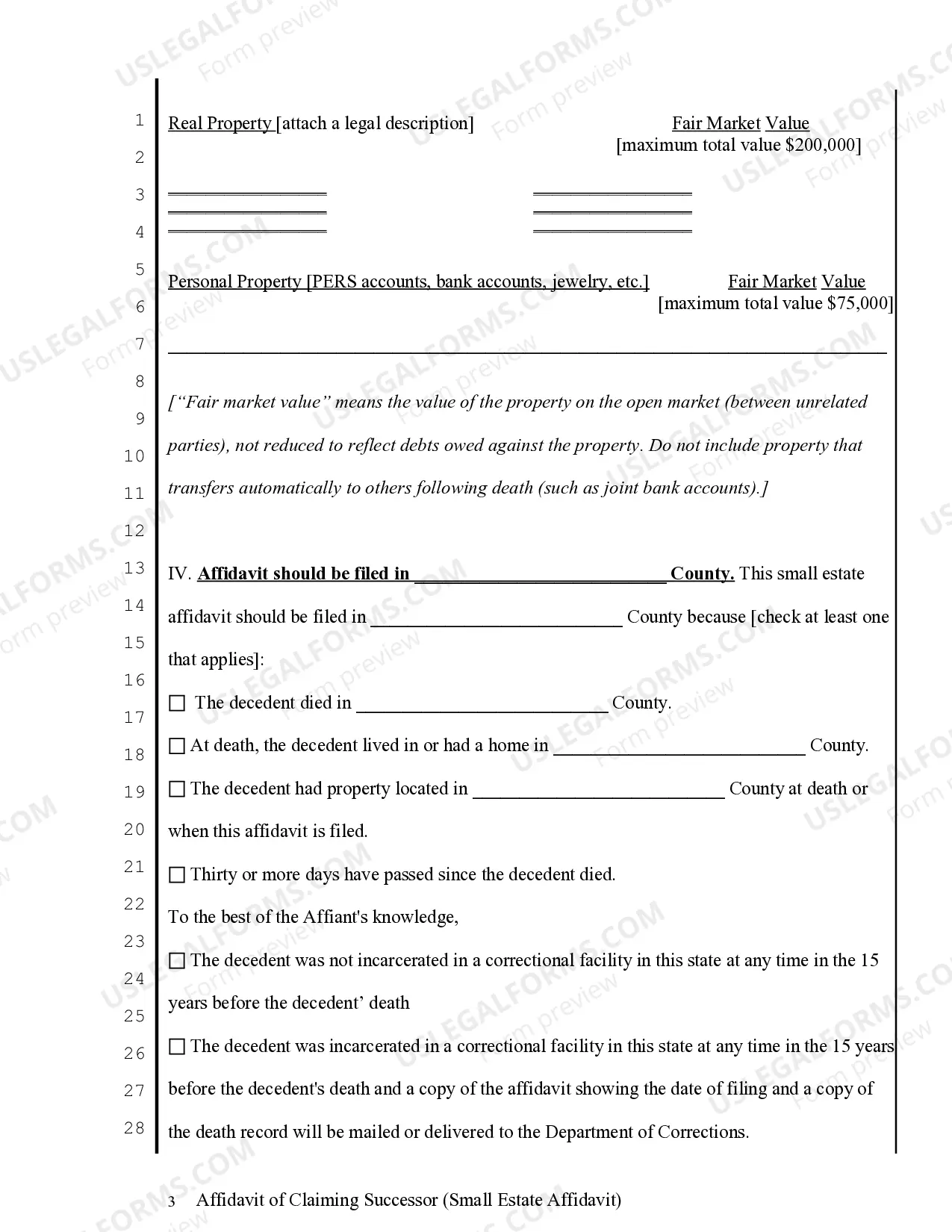
(3) Describe and state the fair market value of all property in the estate, including a legal description of any real property;
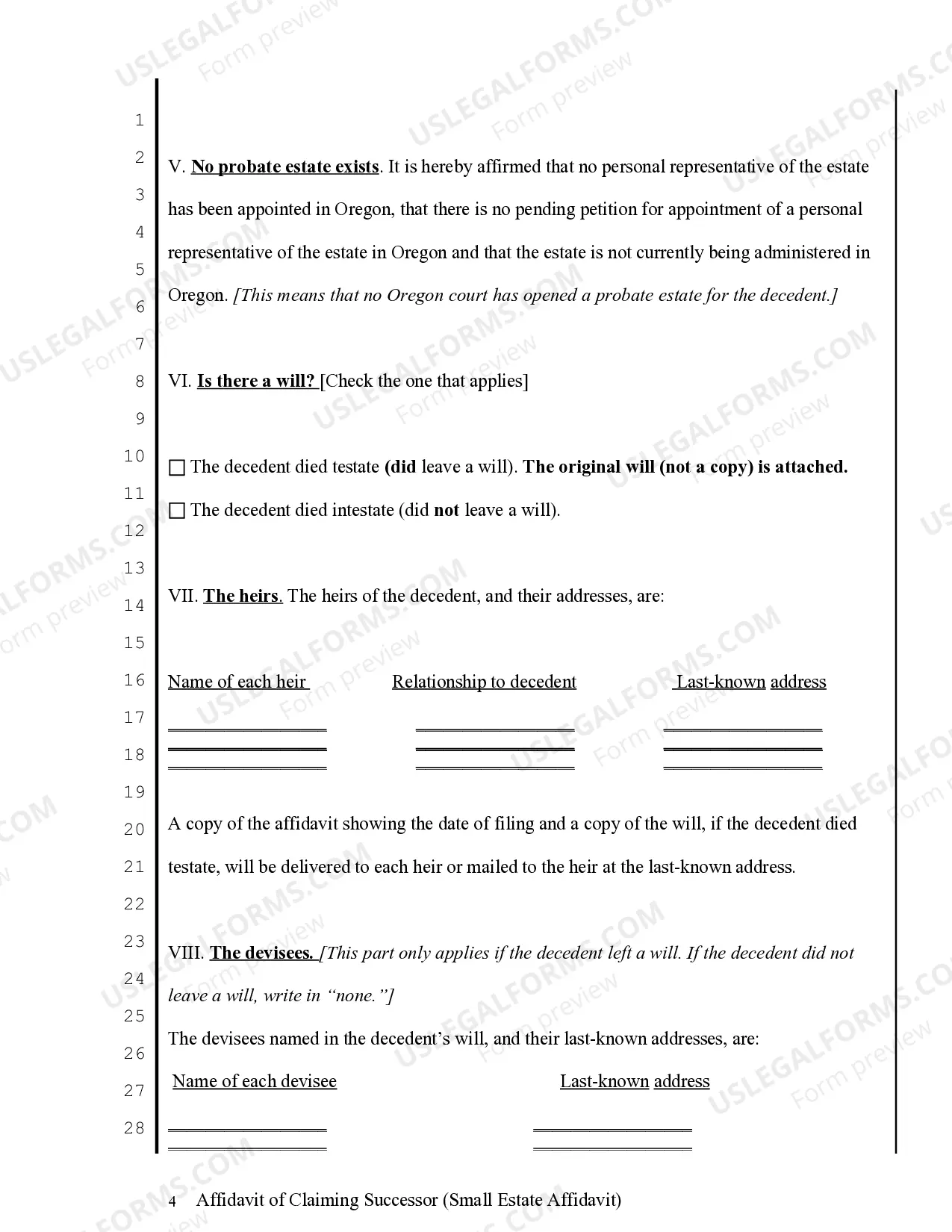
(4) State that no application or petition for the appointment of a personal representative has been granted in Oregon;
(5) State whether the decedent died testate or intestate, and if the decedent died testate, the will shall be attached to the affidavit;
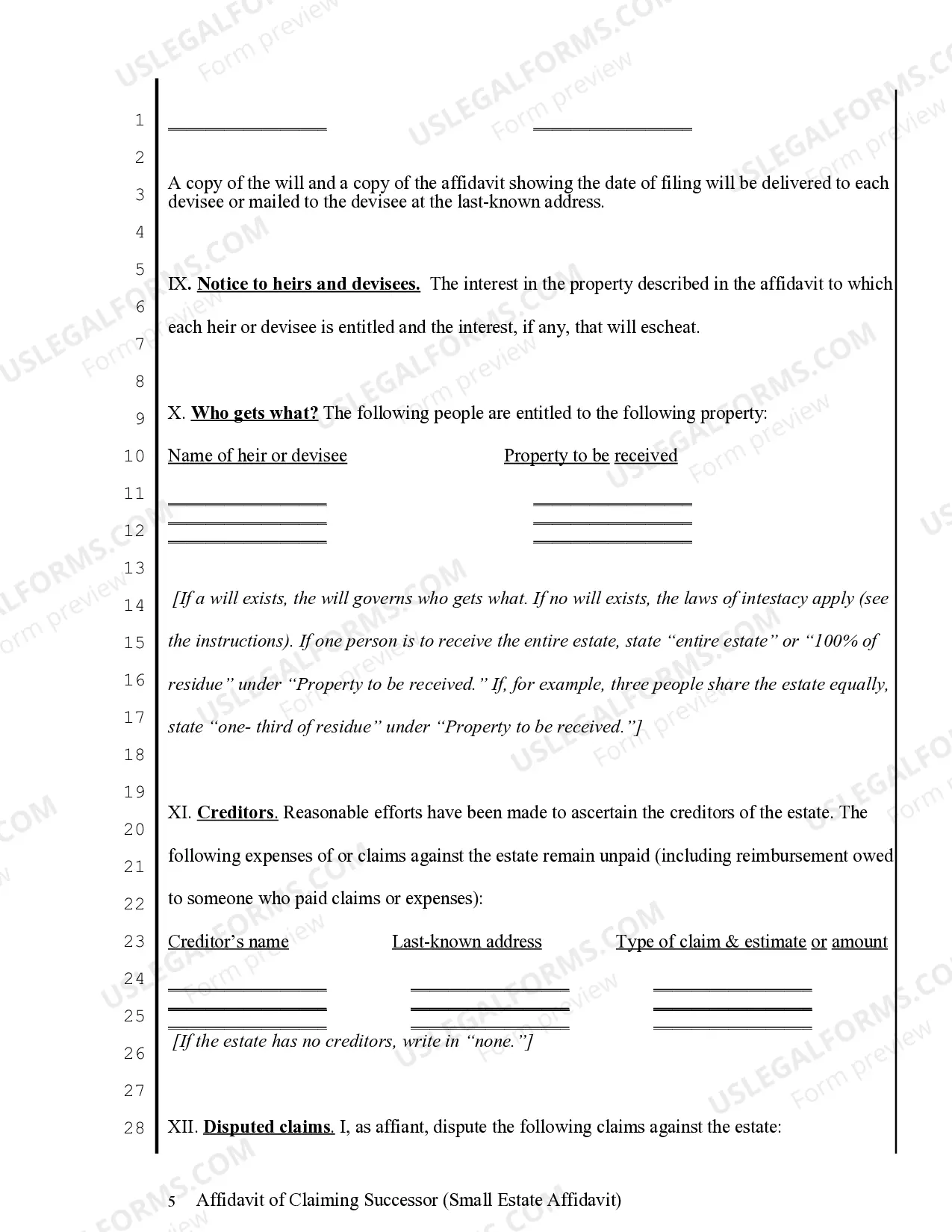
(6) List the heirs of the decedent and the last address of each heir as known to the affiant, and state that a copy of the affidavit showing the date of filing and a copy of the will, if the decedent died testate, will be delivered to each heir or mailed to the heir at the last-known address;
(7) If the decedent died testate, list the devisees of the decedent and the last address of each devisee as known to the affiant and state that a copy of the will and a copy of the affidavit showing the date of filing will be delivered to each devisee or mailed to the devisee at the last-known address;
(8) State the interest in the property described in the affidavit to which each heir or devisee is entitled and the interest, if any, that will escheat;
(9) State that reasonable efforts have been made to ascertain creditors of the estate. List the expenses of and claims against the estate remaining unpaid or on account of which the affiant or any other person is entitled to reimbursement from the estate, including the known or estimated amounts thereof and the names and addresses of the creditors as known to the affiant, and state that a copy of the affidavit showing the date of filing will be delivered to each creditor who has not been paid in full or mailed to the creditor at the last-known address;
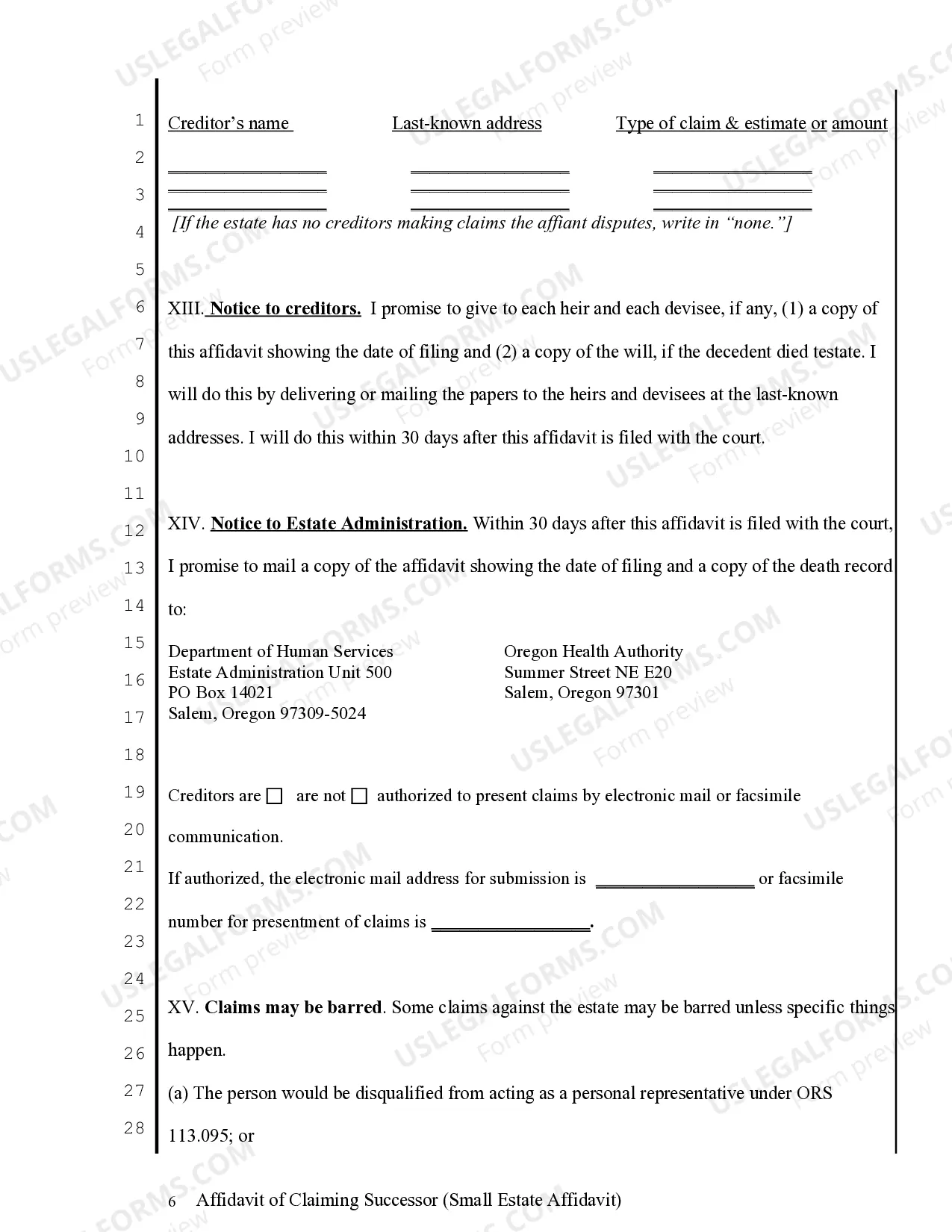
(10) Separately list the name and address of each person known to the affiant to assert a claim against the estate that the affiant disputes and the known or estimated amount thereof and state that a copy of the affidavit showing the date of filing will be delivered to each such person or mailed to the person at the last-known address;
(11) State that a copy of the affidavit showing the date of filing will be mailed or delivered to the Department of Human Services;
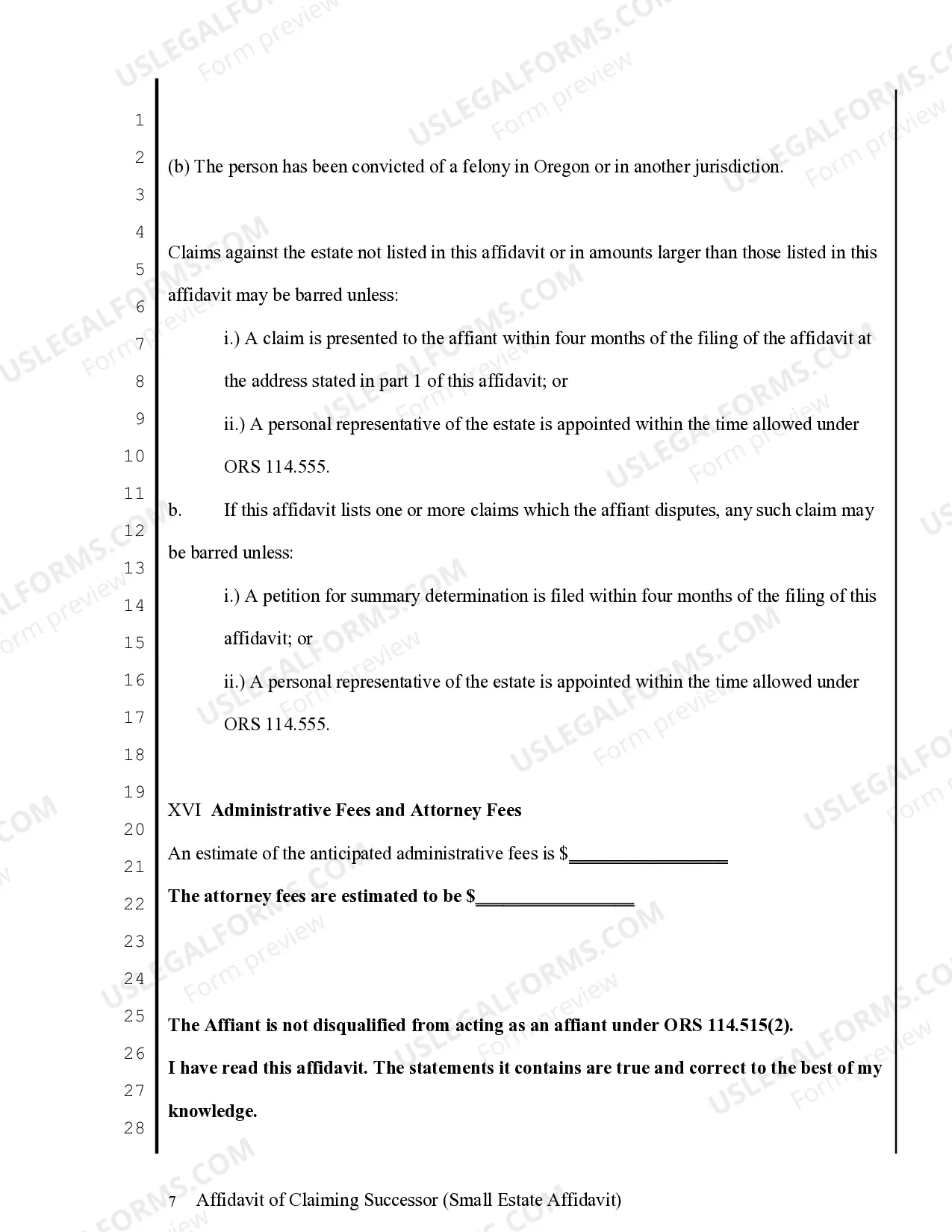
(12) State that claims against the estate not listed in the affidavit or in amounts larger than those listed in the affidavit may be barred unless:
(a) A claim is presented to the affiant within four months of the filing of the affidavit at the address stated in the affidavit for presentment of claims; or
(b) A personal representative of the estate is appointed within the time allowed under ORS 114.555; and
(13) If the affidavit lists one or more claims that the affiant disputes, state that any such claim may be barred unless:
(a) A petition for summary determination is filed within four months of the filing of the affidavit; or
(b) A personal representative of the estate is appointed within the time allowed under ORS 114.555.
114.535.
(1) Any person indebted to the decedent or having possession of personal property belonging to the estate, to whom a certified copy of the affidavit filed under ORS 114.515 is delivered by the affiant on or after the 10th day following the filing of the affidavit, shall pay, transfer or deliver the personal property to the affiant. Any person who has received property of the decedent under ORS 446.616, 722.262 or 803.094, or any similar statute providing for the transfer of property of an estate which is not being probated shall pay, transfer or deliver the property to the affiant if the person would be required to pay, transfer or deliver the property to a personal representative of the estate. The transferor is discharged and released from any liability or responsibility for the transfer in the same manner and with the same effect as if the property had been transferred, delivered or paid to a personal representative of the estate of the decedent.
(2) A transfer agent of any corporate security registered in the name of the decedent shall change the registered ownership on the books of the corporation to the person entitled thereto on presentation of a certified copy of the affidavit filed under ORS 114.515.
(3) If a person to whom an affidavit is delivered refuses to pay, deliver or transfer any personal property to the affiant or the person entitled to the property as disclosed in the affidavit filed under ORS 114.515, the property may be recovered or its payment, delivery or transfer compelled upon proof of the transferee's entitlement in a proceeding brought for the purpose by or on behalf of the transferee.
(4) If the affidavit was signed by the Director of Human Services or an attorney approved by the director under section 6 of this 2009 Act, the director or the designee attorney may certify a copy of the affidavit for the purposes described in subsection or (2) of this section.
114.540 Procedure for claims; disallowance; summary determination.
(1) A claim against an estate with respect to which an affidavit is filed under ORS 114.515 may be presented to the affiant within four months after the affidavit was filed. If an amended affidavit is filed under ORS 114.515(7), claims against the estate must be filed within four months after the filing of the amended affidavit. If a supplemental affidavit is filed under ORS 114.515(8), claims against the estate must be filed within four months after the filing of the supplemental affidavit. Each claim presented to the affiant must include the information required by ORS 115.025.
(2) A claim presented to the affiant shall be considered allowed as presented unless within 60 days after the date of presentment of the claim the affiant mails or delivers a notice of disallowance of the claim in whole or in part to the claimant and any attorney for the claimant. A notice of disallowance of a claim shall inform the claimant that the claim has been disallowed in whole or in part and, to the extent disallowed, will be barred unless:
(a) The claimant proceeds as provided in subsection (3) of this section; or
(b) A personal representative is appointed within the time allowed under ORS 114.555.
(3) A creditor of the estate whose claim has been presented within the time permitted by subsection (1) of this section and disallowed by the affiant may within 30 days after the date of mailing or delivery of the notice of disallowance file with the probate court a petition for summary determination of the claim by the court. A creditor of the decedent whose claim is listed in the affidavit as disputed may within four months after the filing of the affidavit file with the probate court a petition for summary determination of the creditor's claim by the court. The court shall hear the matter without a jury, after notice to the creditor and affiant, and any interested person may be heard in the proceeding. The claim may be proved as provided in ORS 115.195(2). Upon the hearing the court shall determine the claim in a summary manner and shall make an order allowing or disallowing the claim in whole or in part. If the court allows the claim in whole or in part, the order shall direct the affiant, to the extent of property of the estate allocable to the payment of the claim pursuant to ORS 115.125, or any claiming successor to whom payment, delivery or transfer has been made under ORS 114.505 to 114.560 as a person entitled thereto as disclosed in the affidavit, to the extent of the value of the property received, to pay to the creditor the amount so allowed. No appeal may be taken from the order of the court made upon the summary determination.
114.545 Duties of person filing affidavit; payment of claims; conveyance of real property; liability of person to whom property transferred or payment made.
(1) The affiant:
(a) Shall take control of the property of the estate coming into the possession of the affiant.
(b) Within 30 days after filing the affidavit shall mail, deliver or cause to be recorded each instrument which the affidavit states will be mailed, delivered or recorded.
(c) From and to the extent of the property of the estate, shall pay or reimburse any person who has paid:
(A) Expenses described in ORS 115.125(l)(b) and (c) and listed in the affidavit;
(B) Claims listed in the affidavit as undisputed;
(C) Allowed claims presented to the affiant within the time permitted by ORS 114.540; and
(D) Claims which the probate court directs the affiant to pay.
(d) Shall pay claims and expenses under paragraph (c) of this subsection in the order of priority prescribed by ORS 115.125.
(e) May transfer or sell any vehicle that is part of the estate before the completion of the period established under ORS 114.555 if the affiant complies with the requirements established by the Department of Transportation for such purposes under ORS 803.094.
(f) May convey any real or personal property that is part of the estate before the completion of the period established under ORS 114.555, provided that each heir or devisee succeeding to the interest conveyed joins in the conveyance and that any proceeds of sale, net of the reasonable expenses of sale and any debt secured as of the date of the decedent's death by a duly perfected lien on the property, shall become a part of the estate subject to ORS 114.505 to 114.560. If the property is a manufactured structure as defined in ORS 446.561, the affiant must assign interest in the structure as provided in ORS 446.616. Any conveyance to a purchaser in good faith and for a valuable consideration made by the affiant and the heir or devisee succeeding to the interest conveyed, or made by the heir or devisee succeeding to the interest conveyed after completion of the period established under ORS 114.555, conveys the interest stated in the conveyance free of any interest of the claiming successors, and the purchaser has no duty with respect to application of the consideration paid for the conveyance.
(2) Any claiming successor to whom payment, delivery or transfer is made under ORS 114.505 to 114.560 as a person entitled thereto as disclosed in the affidavit is personally answerable and accountable:
(a) To the extent of the value of the property received, to creditors of the estate to the extent such creditors are entitled to payment under subsection (1) of this section; and
(b) To any personal representative of the estate of the decedent thereafter appointed.
(3) The affiant shall cause to be recorded in the deed records of any county in which real property belonging to the decedent is situated an affiant or claiming successor's deed executed in the manner required by ORS chapter 93.
(4) For a manufactured structure as defined in ORS 446.561 belonging to a decedent and assessed as personal property, the affiant shall file with the Department of Consumer and Business Services the necessary information for recording the successor's interest in the manufactured structure on an ownership document.
114.550 Summary review of administration of estate; hearing.
The affiant or any claiming successor of the estate who has not been paid the full amount owed such claiming successor may, within two years after the filing of an affidavit under ORS 114.515, file with the probate court a petition for summary review of administration of the estate. A creditor may not file a petition under this section if the creditor received a copy of an affidavit filed under ORS 114.515 delivered or mailed to such creditor within 30 days after the date the affidavit was filed, the creditor was shown as a disputed creditor in the affidavit, and the creditor has not filed a petition for summary determination under ORS 114.540. The court shall hear the matter without a jury, after notice to the claiming successor and the affiant, and any interested person may be heard in the proceeding. Upon the hearing the court shall review administration of the estate in a summary manner and may order the affiant to sell property of the estate and pay creditors, to pay creditors of the estate from property of the estate or of the affiant, or to distribute property of the estate to the claiming successors, or may order any person who has received property of the estate to pay amounts owed to claiming successors of the estate in whole or in part.
114.555 Effect of failure to appoint personal representative.
If a personal representative is not appointed within four months after the filing of the affidavit authorized by ORS 114.515, the interest of the decedent in all of the property described in the affidavit is transferred to the person or persons shown by the affidavit to be entitled thereto, and any other claims against the property are barred except as provided in ORS 114.540, 114.545 and 114.550. 114.560 Exclusive remedy.
The exclusive remedy of a person injured by the failure of the affiant or any claiming successor to comply with the requirements of ORS 114.505 to 114.560 shall be a summary determination under ORS 114.540, a summary review of administration under ORS 114.550, or appointment of a personal representative for the estate within the time allowed by ORS 114.555.