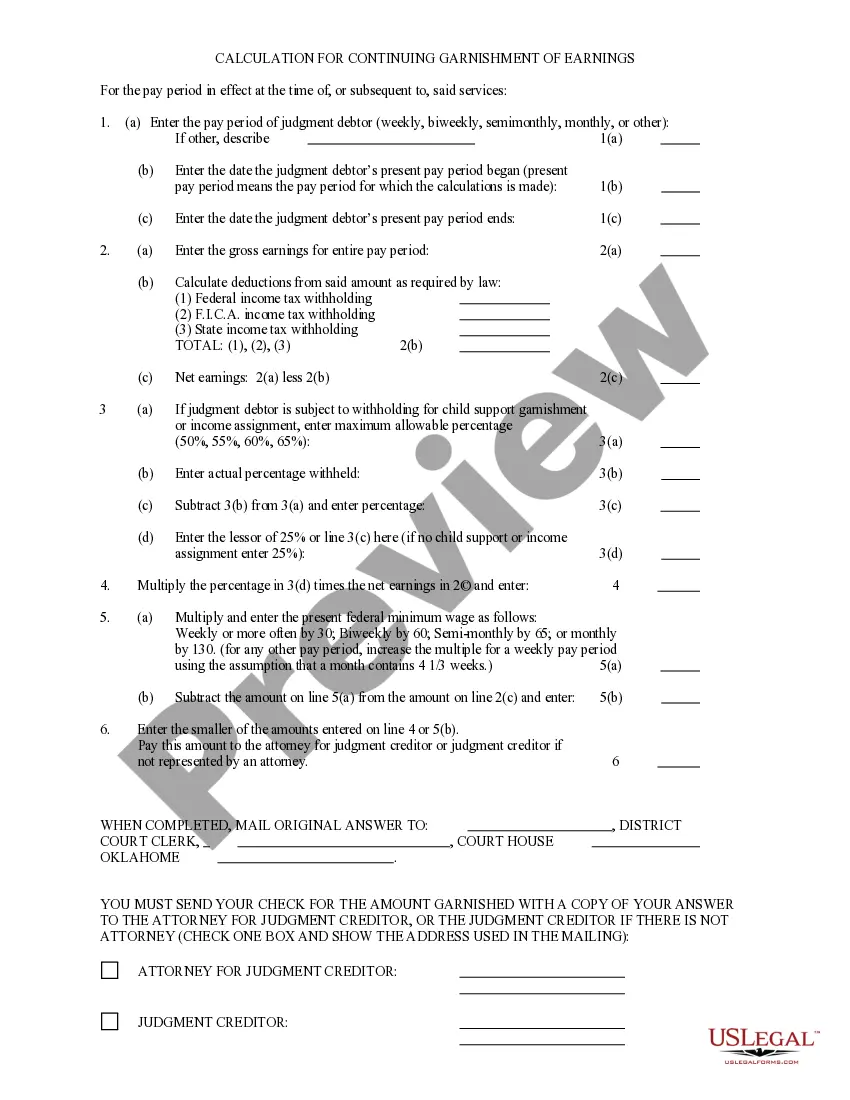
Oklahoma Calculation for Continuing Garnishment of Earnings
What this document covers
The Calculation for Continuing Garnishment of Earnings is a legal document used to determine the amount of a debtor's earnings that can be garnished by a creditor. This form is essential for ensuring that garnishments comply with legal limits and is distinct from other garnishment forms that may not account for the pay period specifics of the debtor's employment.
Form components explained
- Pay period of the judgment debtor (weekly, biweekly, semimonthly, monthly, or other)
- Calculation fields for determining the allowable garnishment amount
- Signature section for the involved parties
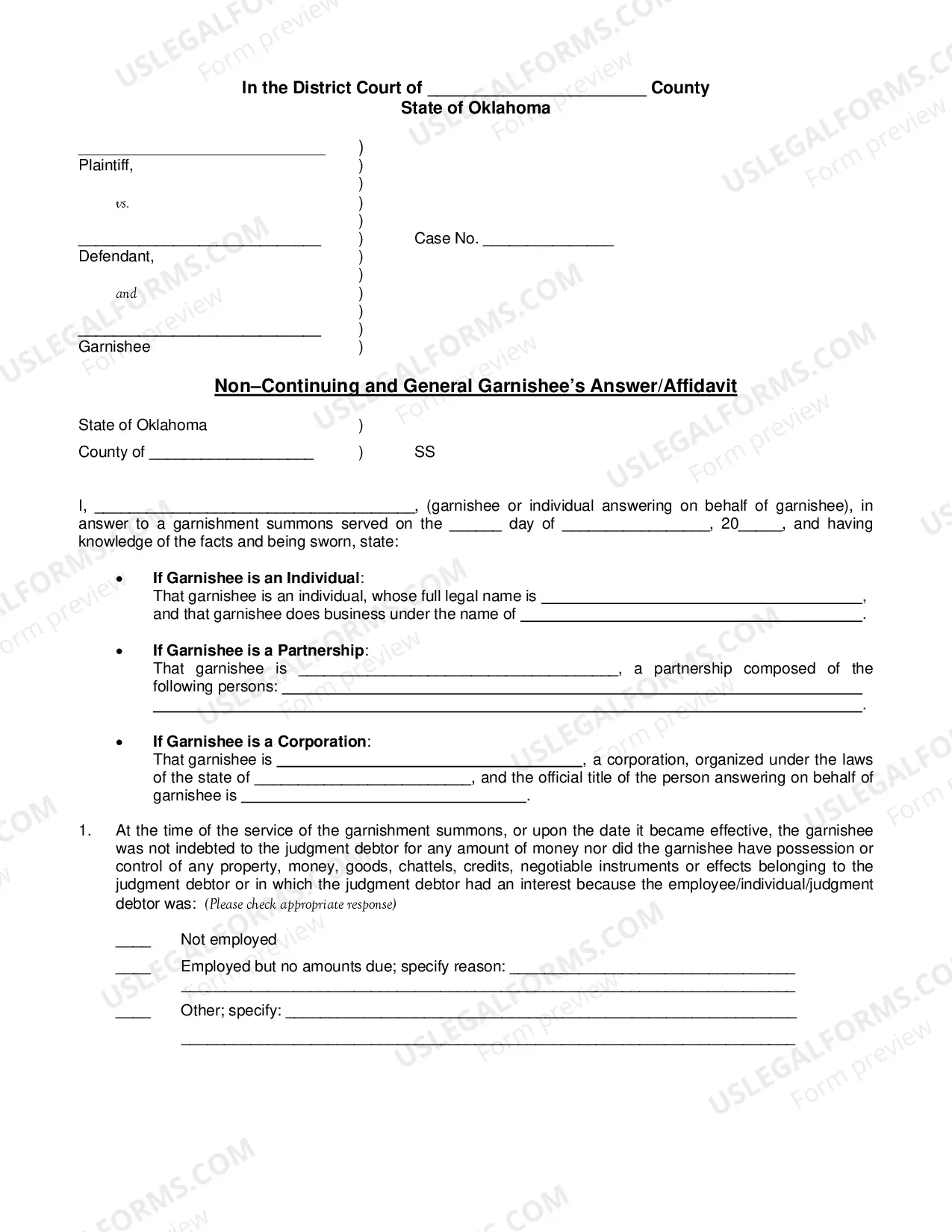
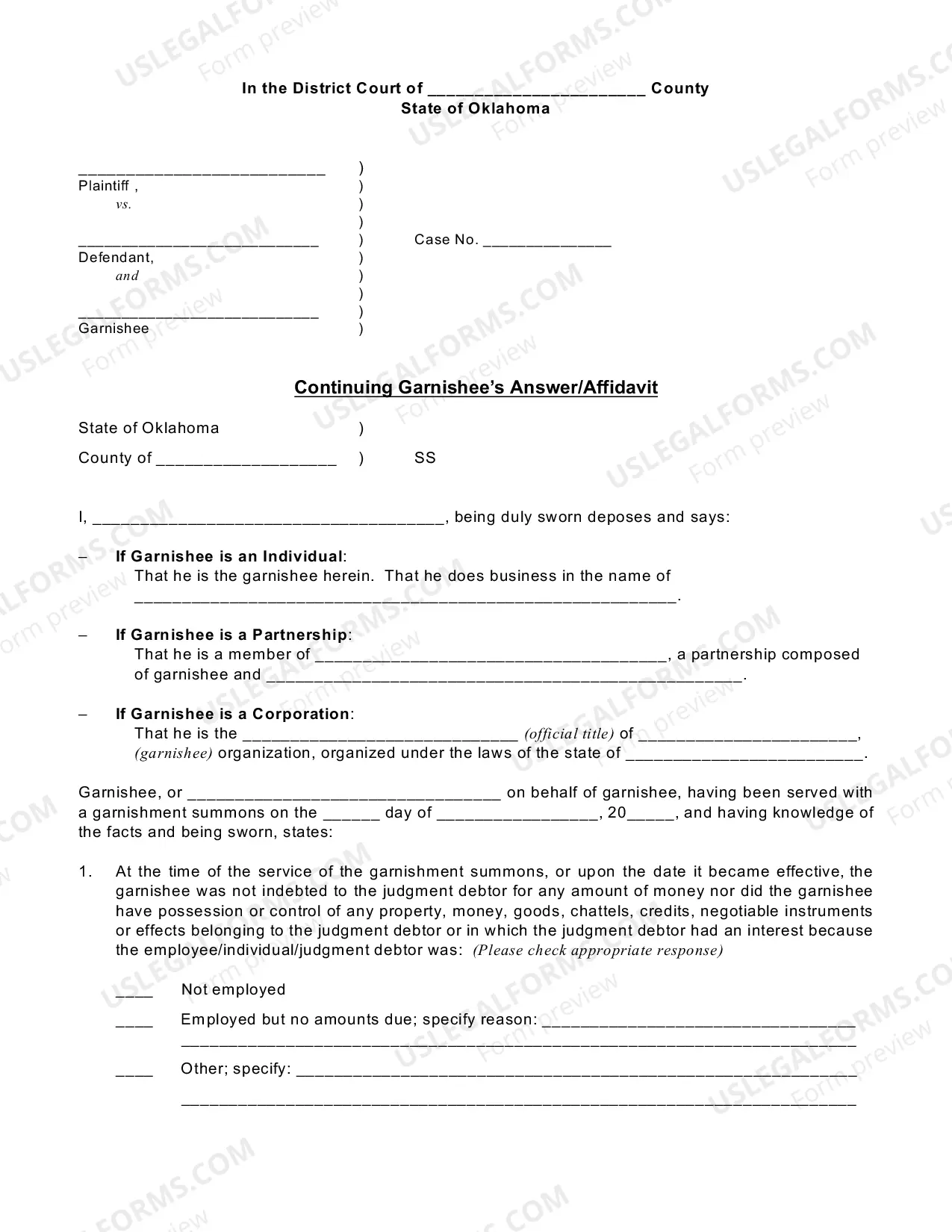
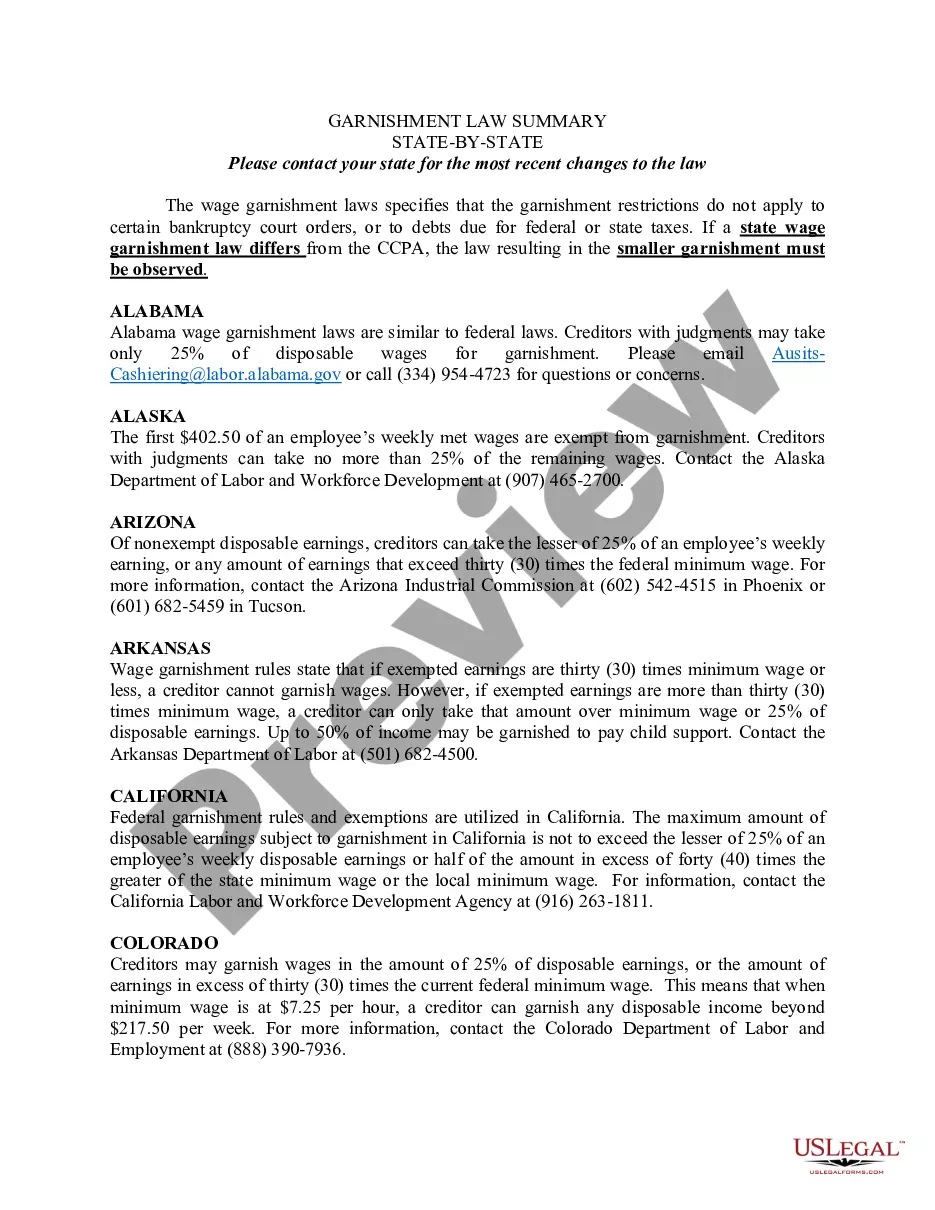
When this form is needed
This form should be used when a creditor has obtained a judgment against a debtor and needs to legally garnish wages. It allows for the ongoing calculation of the garnishment based on the debtor's current earnings, ensuring compliance with relevant laws.
Who this form is for
- CREDITORS seeking to enforce a judgment
- EMPLOYERS responsible for withholding the garnished earnings
- DEBTORS who want to understand potential deductions from their wages
Steps to complete this form
- Identify the pay period for the judgment debtor.
- Fill in the corresponding fields for the amount to be garnished based on the pay period.
- Calculate the garnishment amount according to legal guidelines.
- Ensure all necessary signatures are provided.
- Review the completed form for accuracy before submission.
Does this document require notarization?
This form does not typically require notarization to be legally valid. However, some jurisdictions or document types may still require it. US Legal Forms provides secure online notarization powered by Notarize, available 24/7 for added convenience.
Get your form ready online
Our built-in tools help you complete, sign, share, and store your documents in one place.
Make edits, fill in missing information, and update formatting in US Legal Forms—just like you would in MS Word.
Download a copy, print it, send it by email, or mail it via USPS—whatever works best for your next step.
Sign and collect signatures with our SignNow integration. Send to multiple recipients, set reminders, and more. Go Premium to unlock E-Sign.
If this form requires notarization, complete it online through a secure video call—no need to meet a notary in person or wait for an appointment.
We protect your documents and personal data by following strict security and privacy standards.

Make edits, fill in missing information, and update formatting in US Legal Forms—just like you would in MS Word.

Download a copy, print it, send it by email, or mail it via USPS—whatever works best for your next step.

Sign and collect signatures with our SignNow integration. Send to multiple recipients, set reminders, and more. Go Premium to unlock E-Sign.

If this form requires notarization, complete it online through a secure video call—no need to meet a notary in person or wait for an appointment.

We protect your documents and personal data by following strict security and privacy standards.
Common mistakes
- Not correctly identifying the debtor's pay period.
- Failing to calculate the garnishment amount according to the laws.
- Omitting required signatures or dates.
Why complete this form online
- Convenience of downloading and completing the form at your own pace.
- Editability allows for easy corrections and accurate information entry.
- Reliable templates drafted by licensed attorneys increase legal compliance.
Looking for another form?

Form popularity
FAQ
Determine disposable earnings by subtracting legally required deductions from the employee's gross wages. Legally required deductions are those that the government requires, such as federal income tax, Social Security tax and Medicare tax. The result is the disposable earnings, which are subject to wage garnishment.
Calculates the garnishment order with the highest priority. Calculates what percentage of the employee's available wages was withheld for the first order by taking the amount withheld, divided by the available wages.
A writ of continuing garnishment serves as a lien and continuing levy against the nonexempt earnings of the judgment debtor, until such time earnings are no longer due; the underlying judgment is vacated, modified or satisfied in full; or the writ is dismissed.
Continuous writ of garnishment could refer to a garnishment order granting a third party to attach money or property of a defendant on a continuing basis for so long as the court may decide or until otherwise ordered by the court having competent jurisdiction.
If it's already started, you can try to challenge the judgment or negotiate with the creditor. But, they're in the driver's seat, and if they don't allow you to stop a garnishment by agreeing to make voluntary payments, you can't really force them to. You can, however, stop the garnishment by filing a bankruptcy case.
Notwithstanding any other provision of this chapter, if salary or wages are to be garnished to satisfy a judgment, the court shall issue a continuing writ of garnishment to the judgment debtor's employer which provides for the periodic payment of a portion of the salary or wages of the judgment debtor as the salary or
The Maximum Amount that Can Be Garnished Employment income above these amounts can be garnisheed in its entirety.In Alberta, for instance, you keep the first $800 of your monthly net income, then creditors can garnish 50% of your monthly net income between $800 and $2400, and 100% of any net income above $2400.
For ordinary garnishments (i.e., those not for support, bankruptcy, or any state or federal tax), the weekly amount may not exceed the lesser of two figures: 25% of the employee's disposable earnings, or the amount by which an employee's disposable earnings are greater than 30 times the federal minimum wage (currently
(When it comes to wage garnishment, disposable income means anything left after the necessary deductions such as taxes and Social Security.) Either 25% or the amount by which your weekly income exceeds 30 times the federal minimum wage (currently $7.25 an hour), whichever is less.