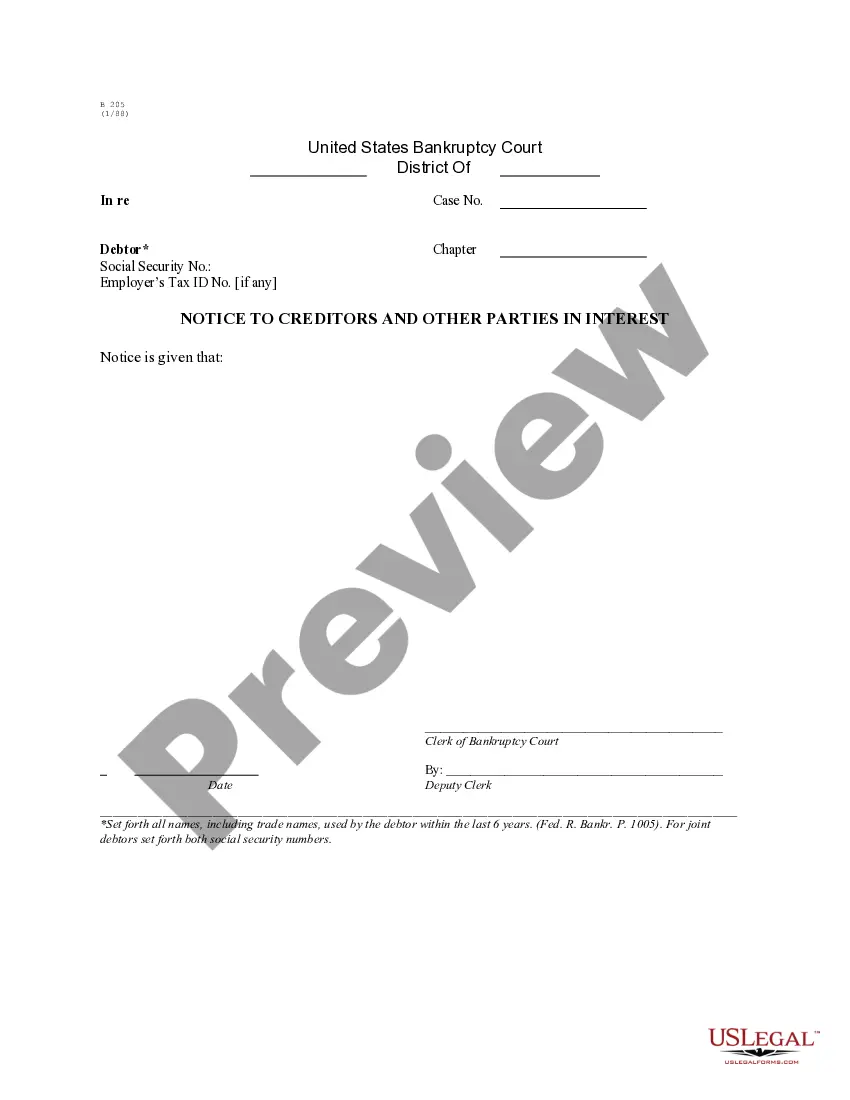
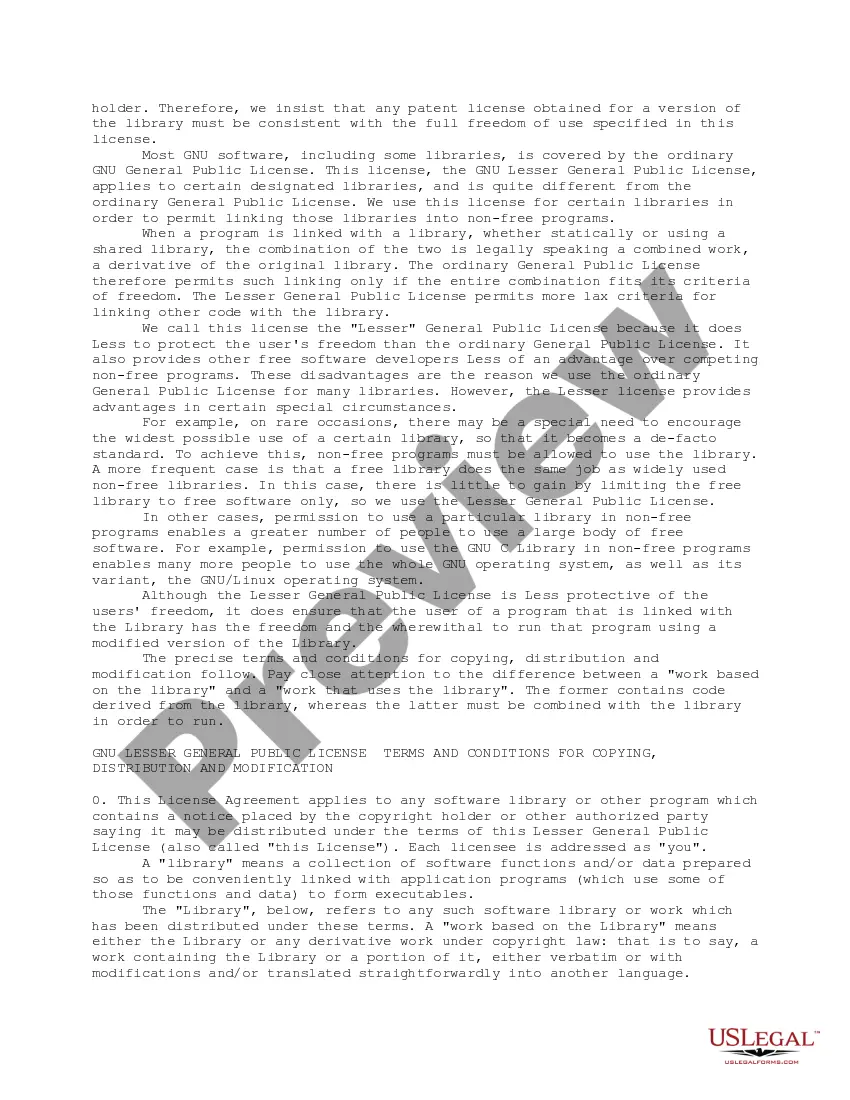
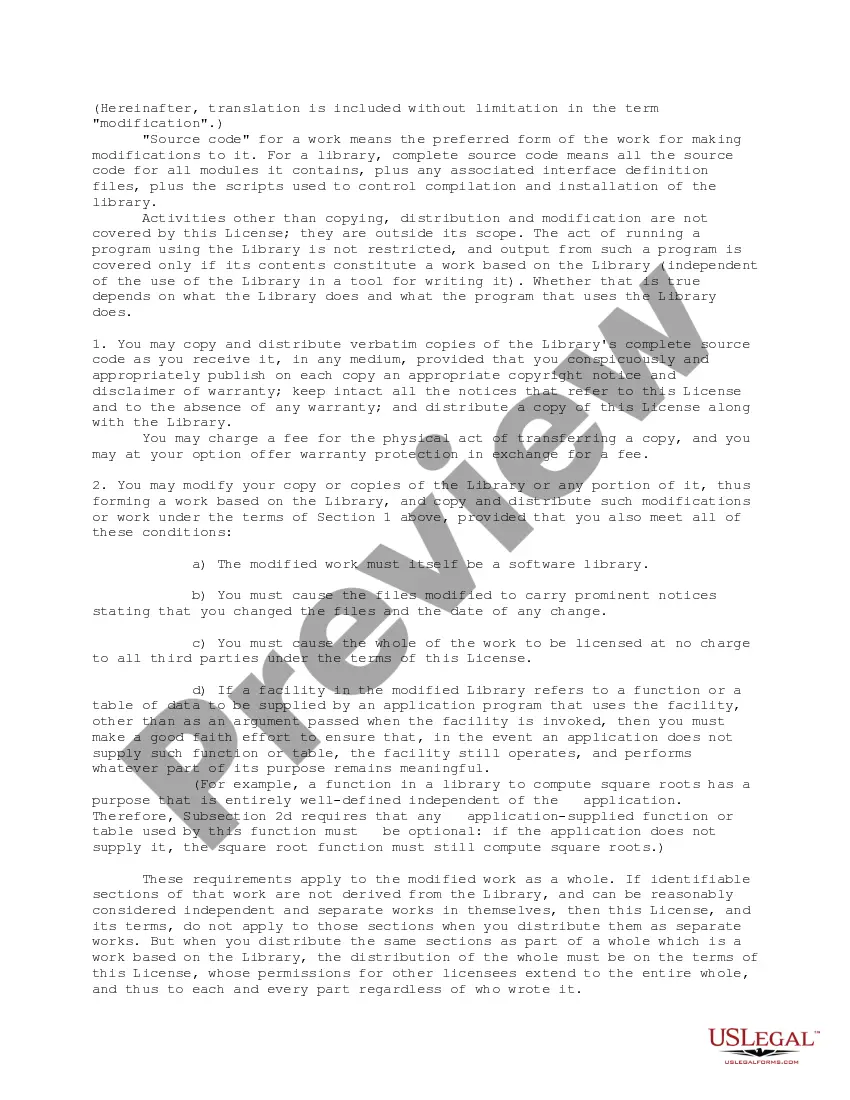
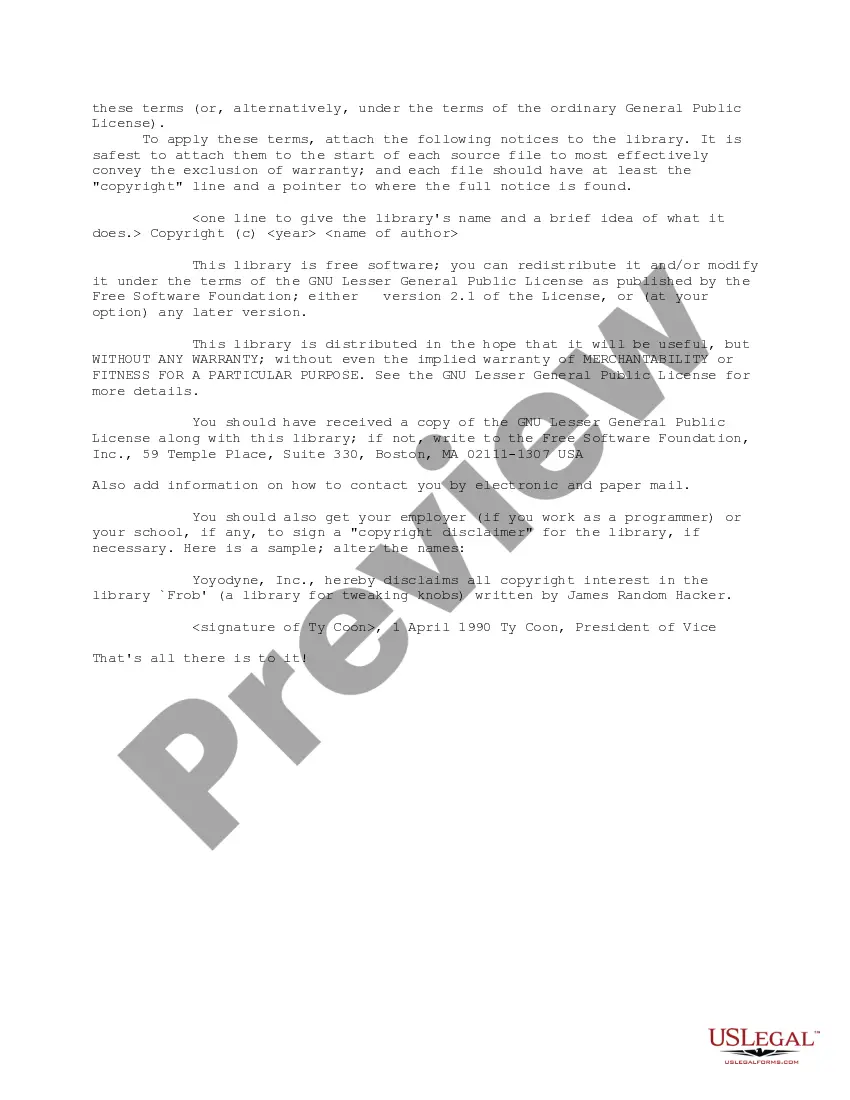
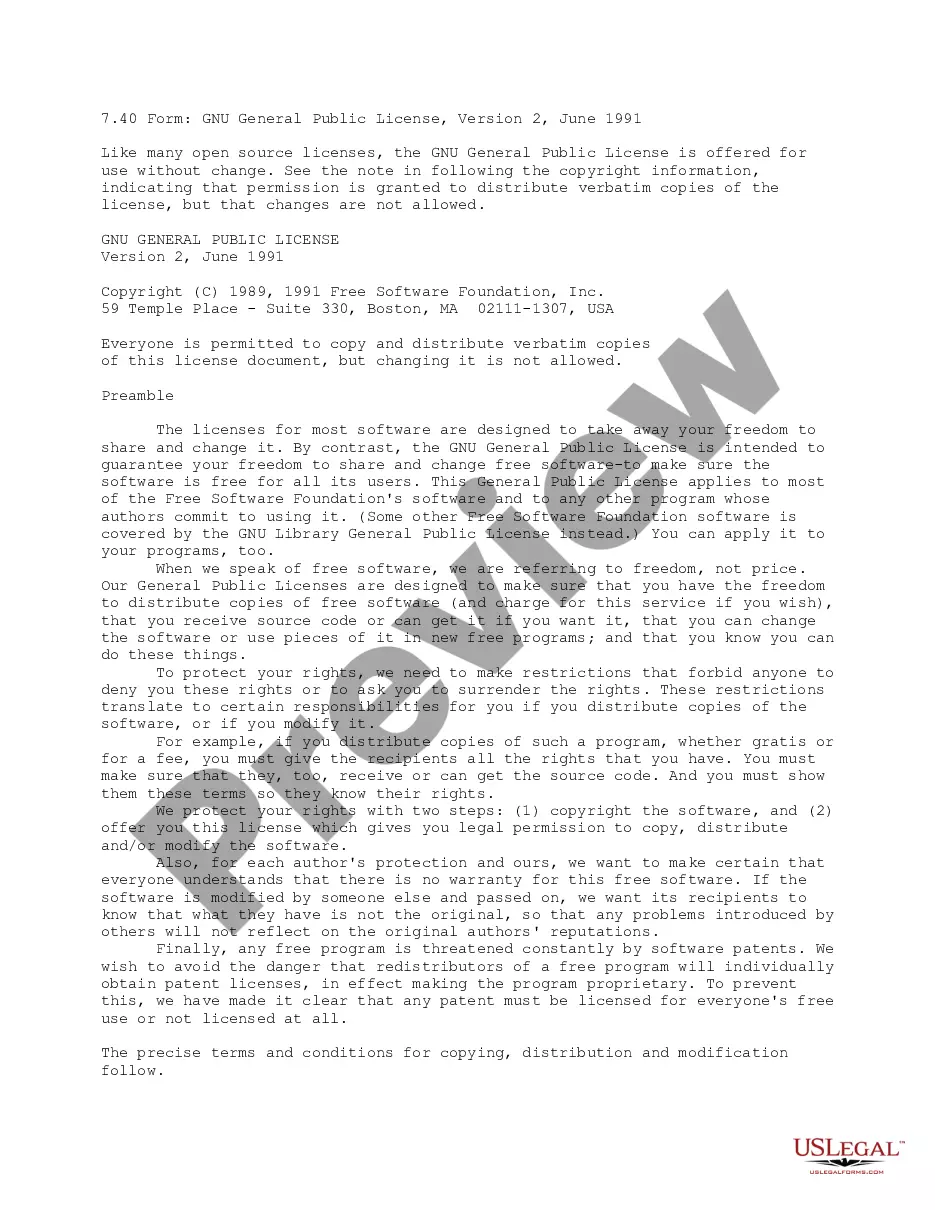
This license contains the terms and conditions needed to make free software libraries
available to the public. With this license, the software can be changed under certain
conditions and redistributed.
Ohio GNU Lesser General Public License
Instant download
Description
Free preview
Get your form ready online
Our built-in tools help you complete, sign, share, and store your documents in one place.
Built-in online Word editor
Make edits, fill in missing information, and update formatting in US Legal Forms—just like you would in MS Word.
Export easily
Download a copy, print it, send it by email, or mail it via USPS—whatever works best for your next step.
E-sign your document
Sign and collect signatures with our SignNow integration. Send to multiple recipients, set reminders, and more. Go Premium to unlock E-Sign.
Notarize online 24/7
If this form requires notarization, complete it online through a secure video call—no need to meet a notary in person or wait for an appointment.
Store your document securely
We protect your documents and personal data by following strict security and privacy standards.

Make edits, fill in missing information, and update formatting in US Legal Forms—just like you would in MS Word.

Download a copy, print it, send it by email, or mail it via USPS—whatever works best for your next step.

Sign and collect signatures with our SignNow integration. Send to multiple recipients, set reminders, and more. Go Premium to unlock E-Sign.

If this form requires notarization, complete it online through a secure video call—no need to meet a notary in person or wait for an appointment.

We protect your documents and personal data by following strict security and privacy standards.
Looking for another form?



How to fill out GNU Lesser General Public License?
Selecting the appropriate valid document template may prove to be a challenge.
Of course, there is a multitude of templates available online, but how can you find the valid format you need.
Utilize the US Legal Forms website. The service provides thousands of templates, including the Ohio GNU Lesser General Public License, which can serve business and personal needs.
You can browse the form using the Review button and read the form details to confirm it is suitable for you.
- All the forms are reviewed by experts and comply with state and federal regulations.
- If you are already registered, Log In to your account and click on the Obtain button to access the Ohio GNU Lesser General Public License.
- Use your account to search through the legal forms you have previously acquired.
- Visit the My documents section of your account to obtain another copy of the document you require.
- If you are a new user of US Legal Forms, here are straightforward instructions to follow.
- First, ensure you have selected the correct document for your city/county.
Form popularity
FAQ
In brief: GPL is mostly for programs while LGPL is limited to software libraries. Whenever changes are made under GPL license, source codes are required and changes must also be licensed under GPL, while LGPL may allow non-GPL programs to link to libraries but must still provide source codes.
The GNU Lesser General Public License (LGPL) is a member of the GNU family of open source licenses, along with the GNU GPL v2, the GNU GPL v3, and the GNU AGPL License.
Among today's more popular OSS licenses is the GNU (of the GNU Project) General Public License Version 2.0, commonly referred to as simply GPL v2. Initially released in 1991, the GPL 2 is a copyleft license, meaning users must abide by some strict rules and requirements.
Applying LGPL to a library ensures that the library itself and any modified versions of it will remain open source. But it can be used by closed source software.
Short answer is yes, you can sell your application under any license you like.
Now you may think you already do this, but looking at the licenses, I see little to no difference between GPL and LGPL unless I really study it (or already know the difference)LGPL is not viral like GPL.
Software under the GPL may be run for all purposes, including commercial purposes and even as a tool for creating proprietary software, such as when using GPL-licensed compilers. Users or companies who distribute GPL-licensed works (e.g. software), may charge a fee for copies or give them free of charge.
You can use and distribute LGPL libraries on your website and use them in combination with commercial code. The only big restriction is that you must keep the library open source, including any modifications you make to it, and allow your users to obtain the source, licence and copyright information for the library.
1 (LGPL v2. 1 for short) is a variation of the regular GNU General Public License (GPL). Originally known as the GNU Library General Public License, it was drafted by the Free Software Foundation (FSF) to provide a weaker (or Lesser) form of copyleft for use in certain specific circumstances.
The GNU General Public License, often shortened to GNU GPL (or simply GPL), lists terms and conditions for the copying, modification and redistribution of open source software. The GPL was created by Richard Stallman in order to protect GNU software from being made proprietary.