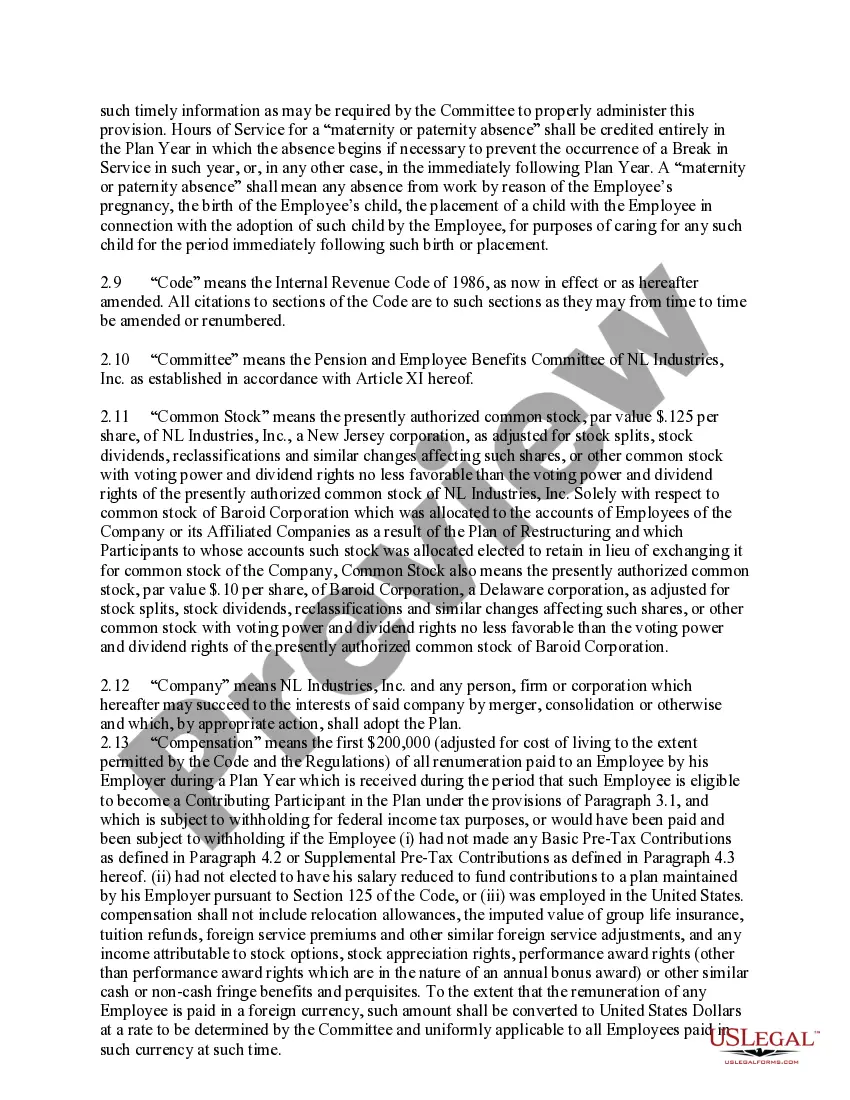
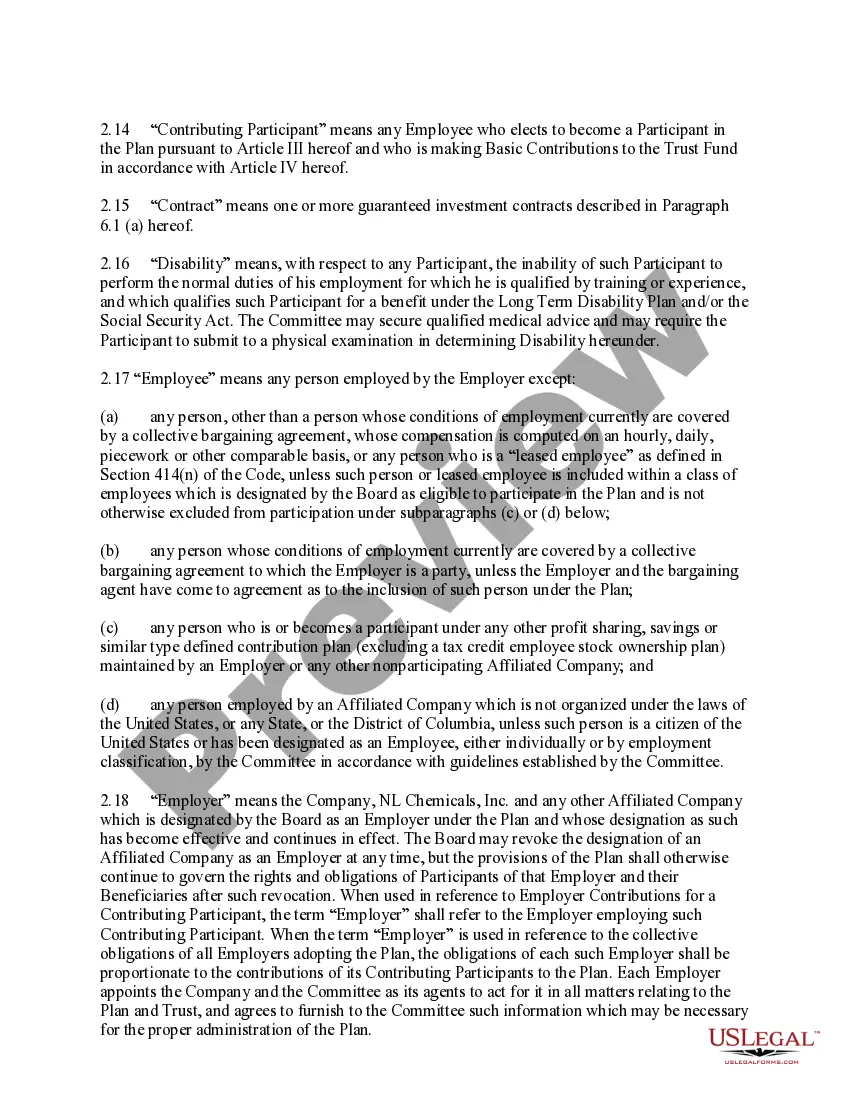
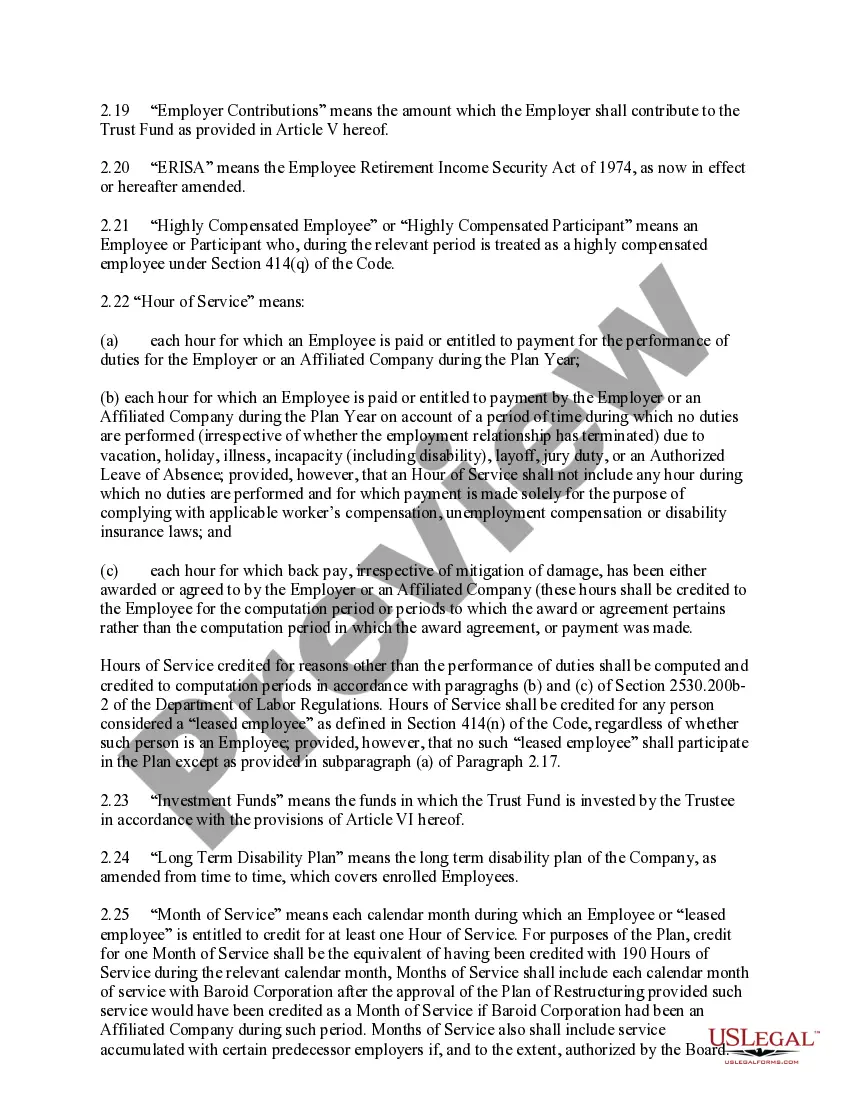
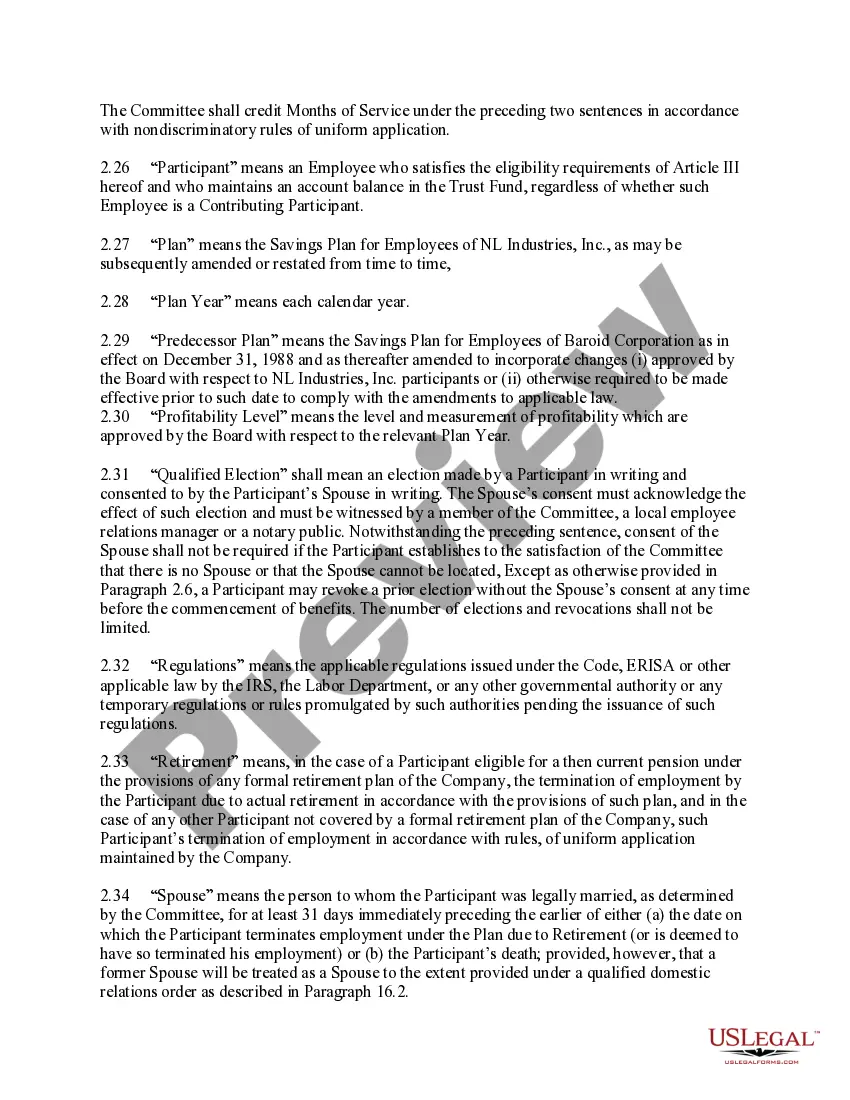
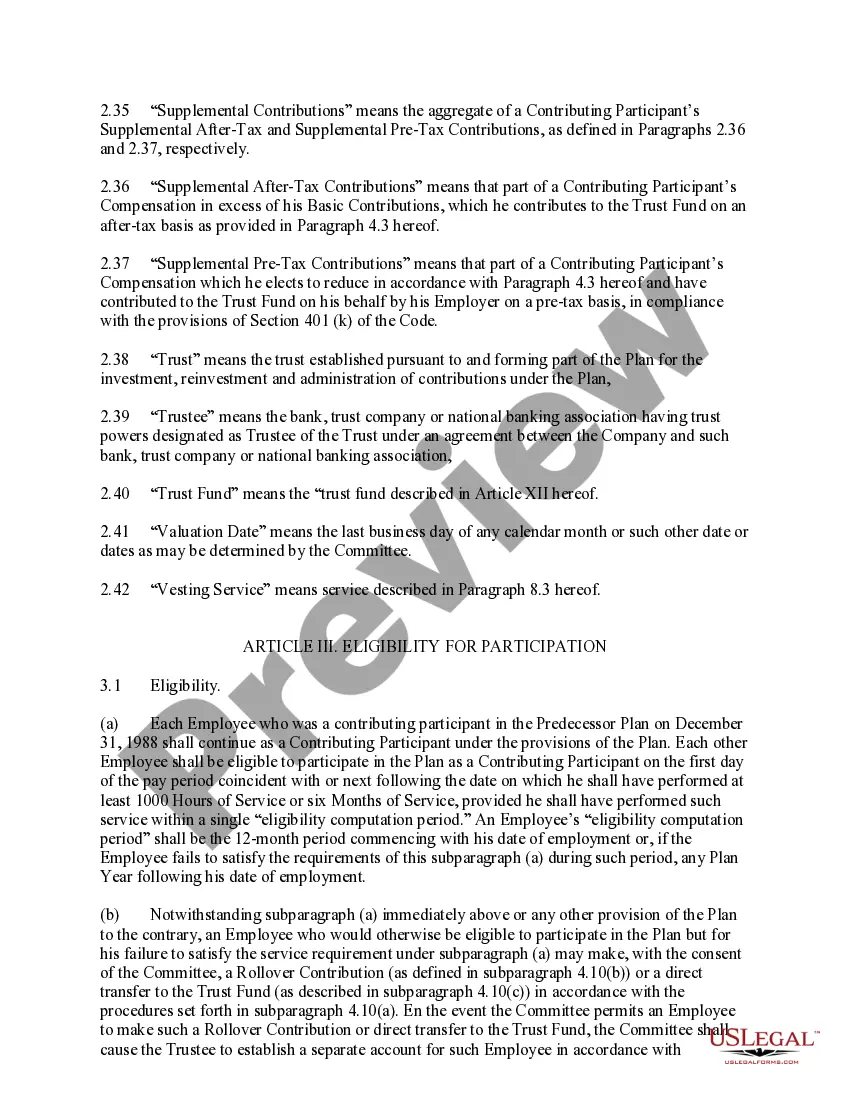
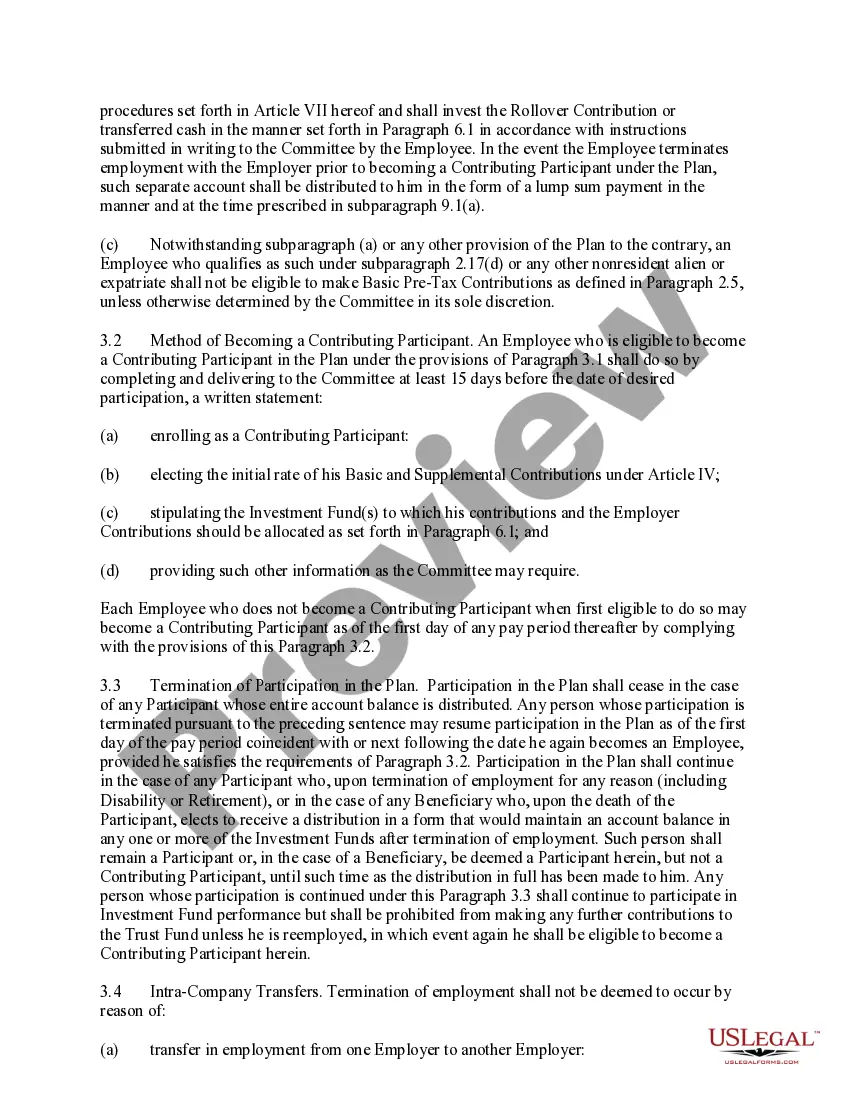
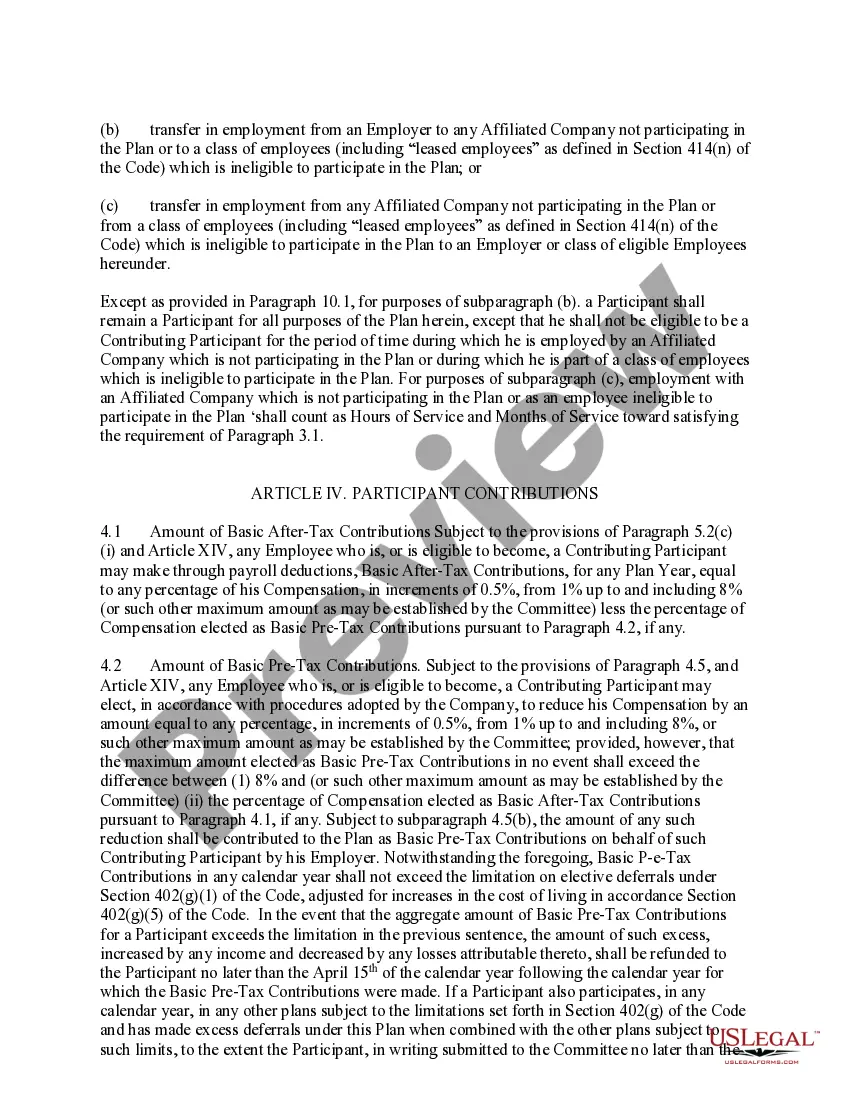
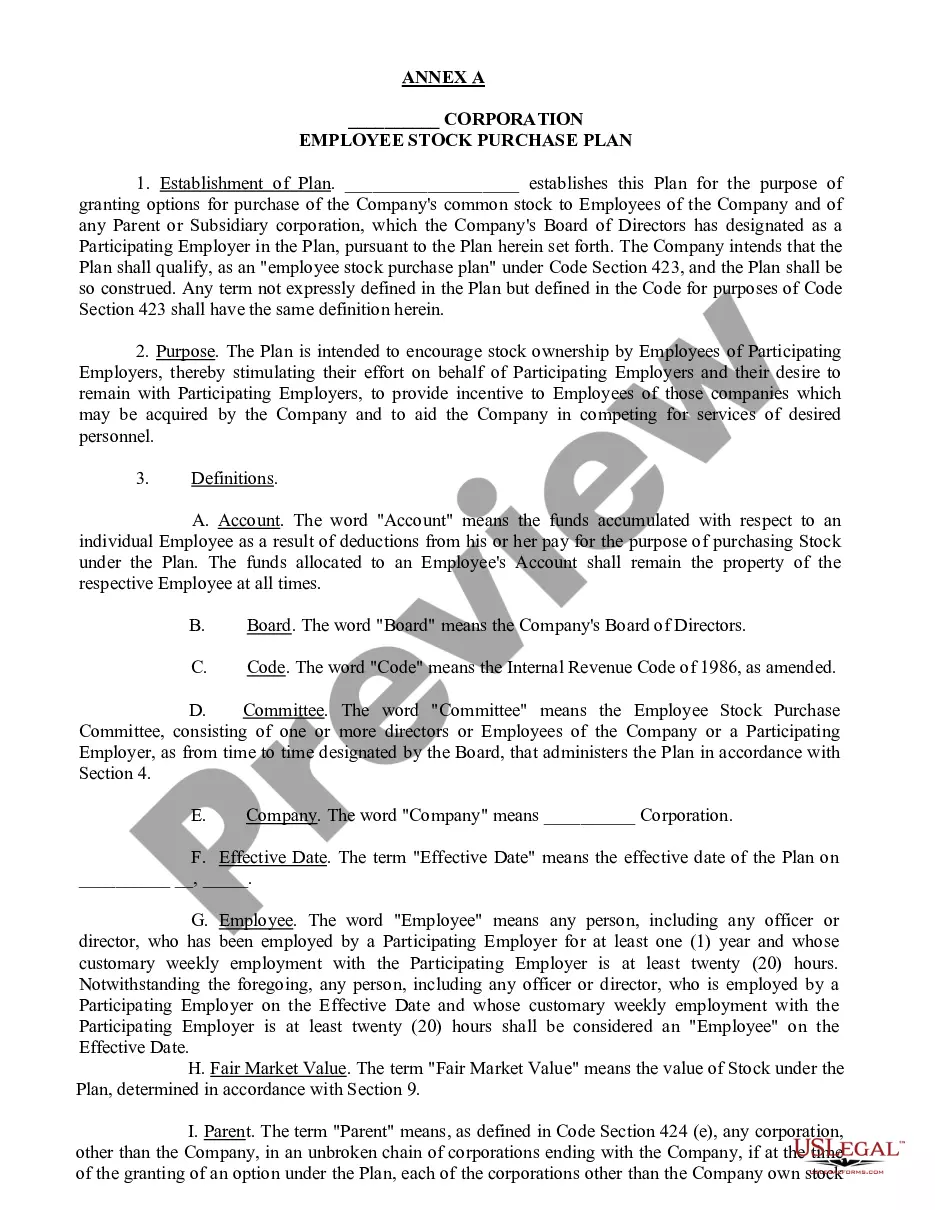
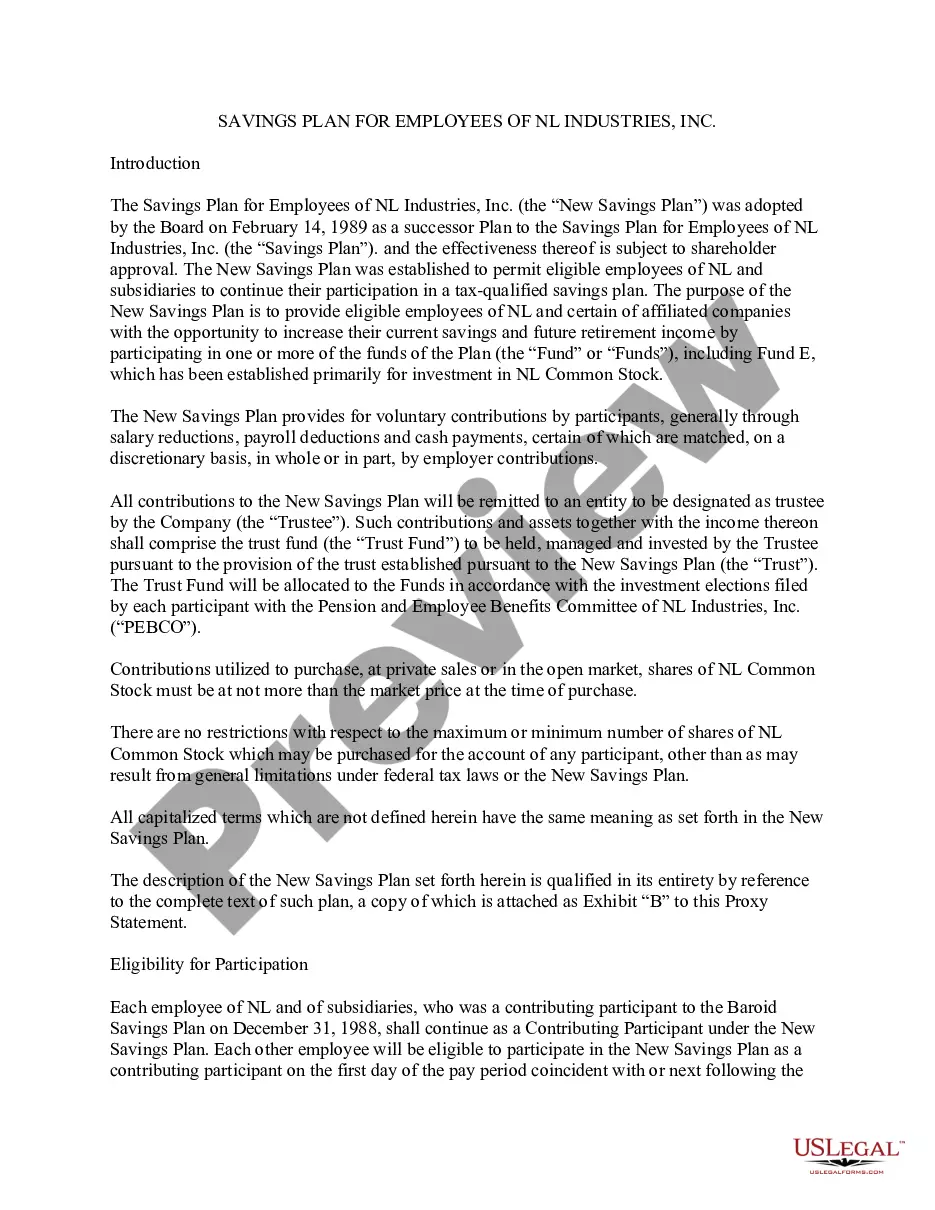
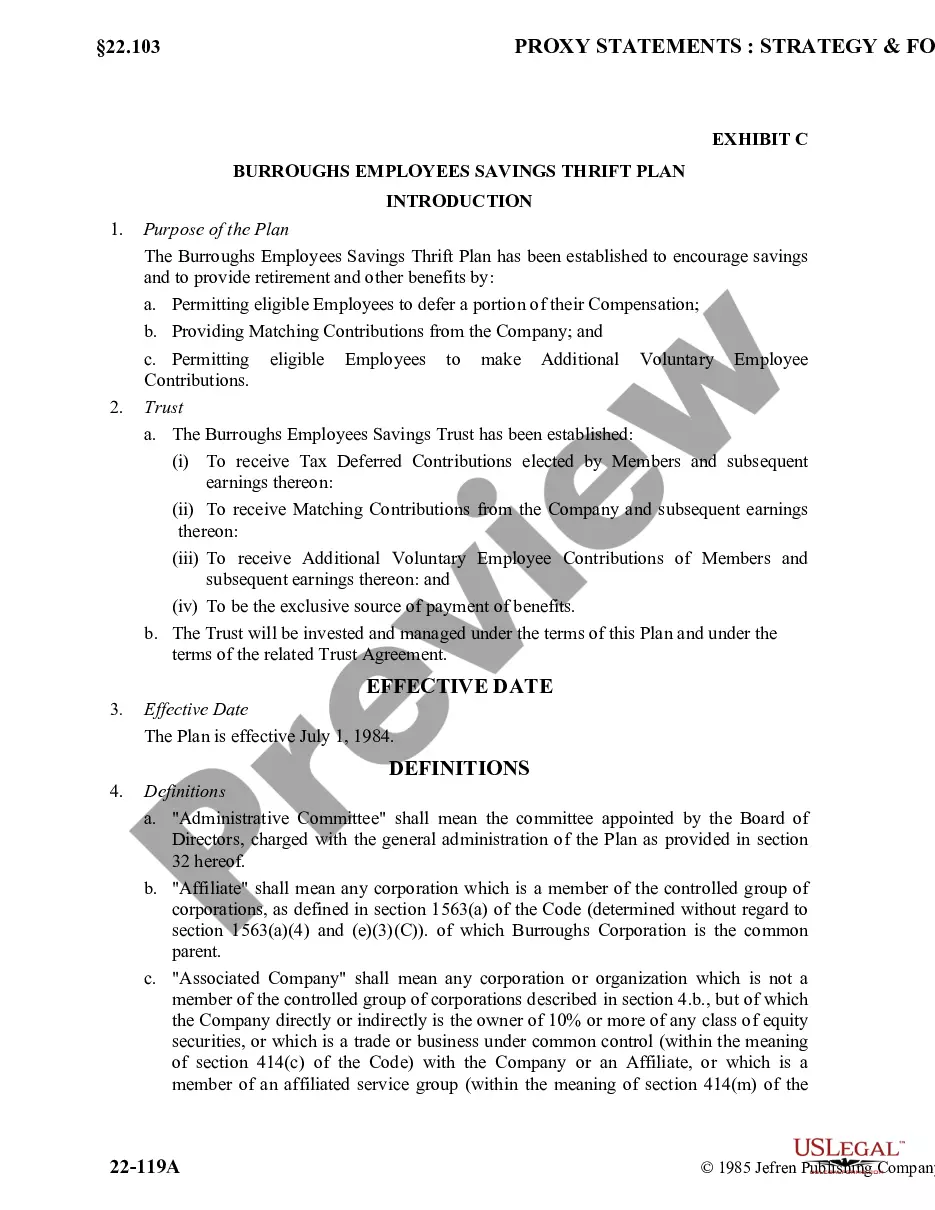
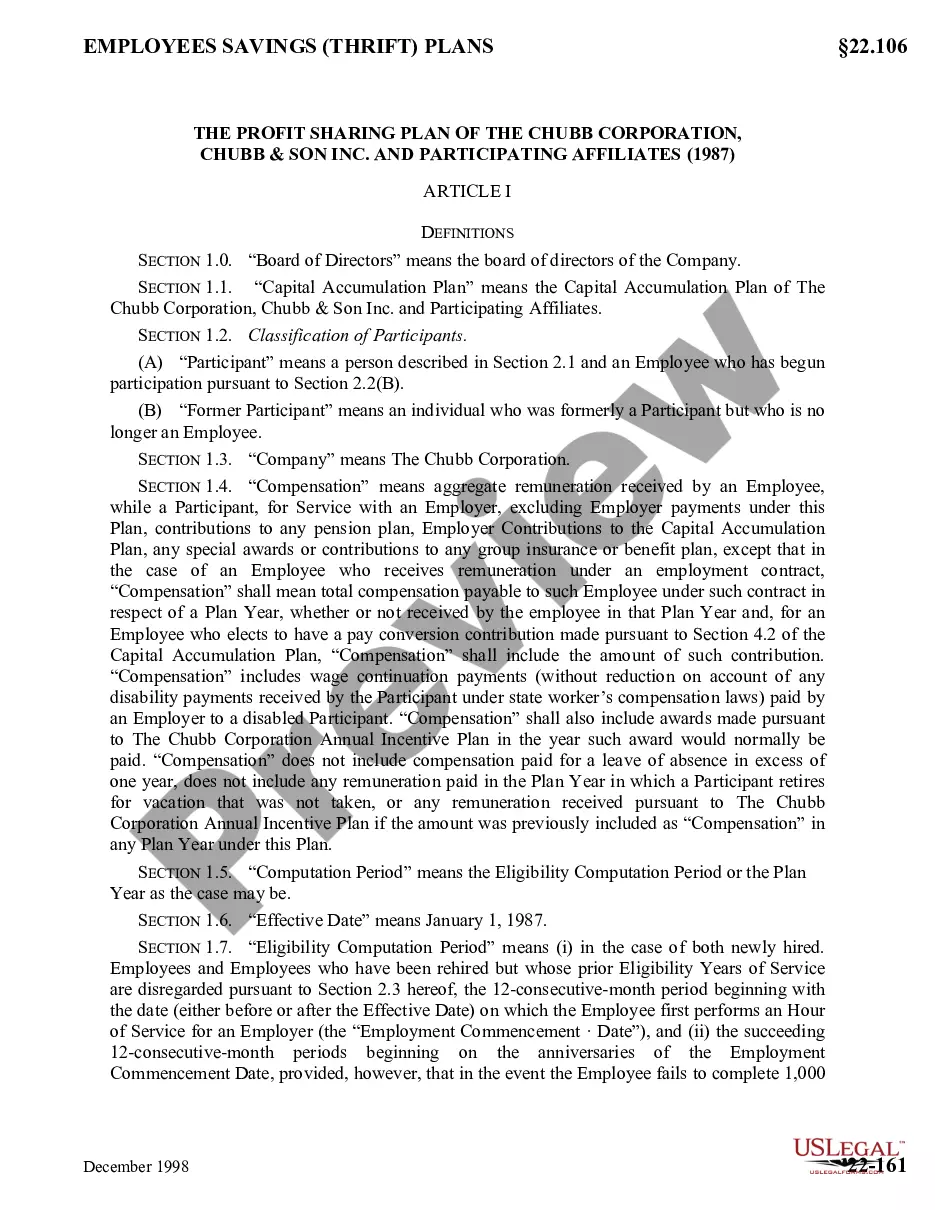
22-109E 22-109E . . . Employee Savings Plan (401(k) Plan) under which (a) participants make voluntary contributions through salary reductions, payroll deductions and/or cash payments, certain of which are matched in whole or in part by employer contributions and (b) such contributions are allocated to one or more investment funds in accordance with investment elections of each participant
Ohio Savings Plan for Employees
Category:
State:
Multi-State
Control #:
US-CC-22-109E
Format:
Word;
Rich Text
Instant download
Description
Free preview

Get your form ready online
Our built-in tools help you complete, sign, share, and store your documents in one place.
Built-in online Word editor
Make edits, fill in missing information, and update formatting in US Legal Forms—just like you would in MS Word.
Export easily
Download a copy, print it, send it by email, or mail it via USPS—whatever works best for your next step.
E-sign your document
Sign and collect signatures with our SignNow integration. Send to multiple recipients, set reminders, and more. Go Premium to unlock E-Sign.
Notarize online 24/7
If this form requires notarization, complete it online through a secure video call—no need to meet a notary in person or wait for an appointment.
Store your document securely
We protect your documents and personal data by following strict security and privacy standards.

Make edits, fill in missing information, and update formatting in US Legal Forms—just like you would in MS Word.

Download a copy, print it, send it by email, or mail it via USPS—whatever works best for your next step.

Sign and collect signatures with our SignNow integration. Send to multiple recipients, set reminders, and more. Go Premium to unlock E-Sign.

If this form requires notarization, complete it online through a secure video call—no need to meet a notary in person or wait for an appointment.

We protect your documents and personal data by following strict security and privacy standards.
Looking for another form?
How to fill out Savings Plan For Employees?
Finding the right legal record web template can be a have difficulties. Obviously, there are a lot of themes available online, but how would you find the legal develop you require? Utilize the US Legal Forms web site. The assistance delivers a huge number of themes, like the Ohio Savings Plan for Employees, that can be used for organization and private requires. All of the kinds are examined by professionals and satisfy federal and state requirements.
In case you are already registered, log in for your account and click the Obtain option to have the Ohio Savings Plan for Employees. Make use of your account to look from the legal kinds you have ordered previously. Visit the My Forms tab of your account and have one more duplicate of the record you require.
In case you are a whole new user of US Legal Forms, listed here are basic guidelines that you should stick to:
- Initial, make sure you have selected the right develop for your personal town/area. You may look through the shape making use of the Preview option and read the shape description to make certain it will be the right one for you.
- When the develop is not going to satisfy your requirements, use the Seach field to get the proper develop.
- Once you are certain the shape would work, click the Buy now option to have the develop.
- Select the prices plan you want and type in the required info. Make your account and pay for an order making use of your PayPal account or bank card.
- Select the file formatting and download the legal record web template for your product.
- Complete, change and print out and signal the acquired Ohio Savings Plan for Employees.
US Legal Forms is the largest collection of legal kinds that you can see numerous record themes. Utilize the company to download appropriately-made documents that stick to state requirements.
Form popularity
FAQ
Ohio Deferred Compensation is a supplemental 457(b) retirement plan for all Ohio public employees. It provides participants with educational tools, a diverse set of investment options, flexible savings and withdrawal options, as well as portability when changing jobs within the public sector.
Discounts are offered to state employees for many different attractions and events.
The two plans are also different in that 401(k) plans do not offer a three-year Pre-Retirement Catch-Up; and 457(b) plans do. Another difference is that a 401(k) distribution prior to age 59½ may be subject to a 10% early withdrawal penalty and 457(b) plans generally do not have the same early withdrawal penalty.
A 401(k) is intended for long-term retirement savings that grow through investments in the financial markets. But 401(k) plans come with restrictions on when funds can be accessed. Savings accounts are lower risk and don't have as many limitations, but can't be invested like a 401(k).
The Employee Savings Plan, or ESP, is a savings plan offered by employers that allows employees to save over many years via paycheck deductions for a variety of goals, such as retirement.
If you invest in a 457(b) plan, you'll have access to certain advantages like tax-deferred growth and the opportunity to choose how to invest funds. There are also potential disadvantages to keep in mind, including fees that may be higher than other types of investments and no employer match.
457(b) plans are generally available for state and local government employees, as well as certain tax-exempt nonprofits. These plans are very similar to other types of employer-offered retirement accounts. Employees can make contributions up to the annual limit, invest these funds, and grow their retirement nest egg.
To enroll in the 457(b) deferred compensation plan, you must be an eligible faculty or administrative staff employee with eligible earnings of more than $257,000 in 2023 for 2024 participation. Employees hired in 2024 must be hired with a scheduled annual compensation over $257,000 for 2024 participation.