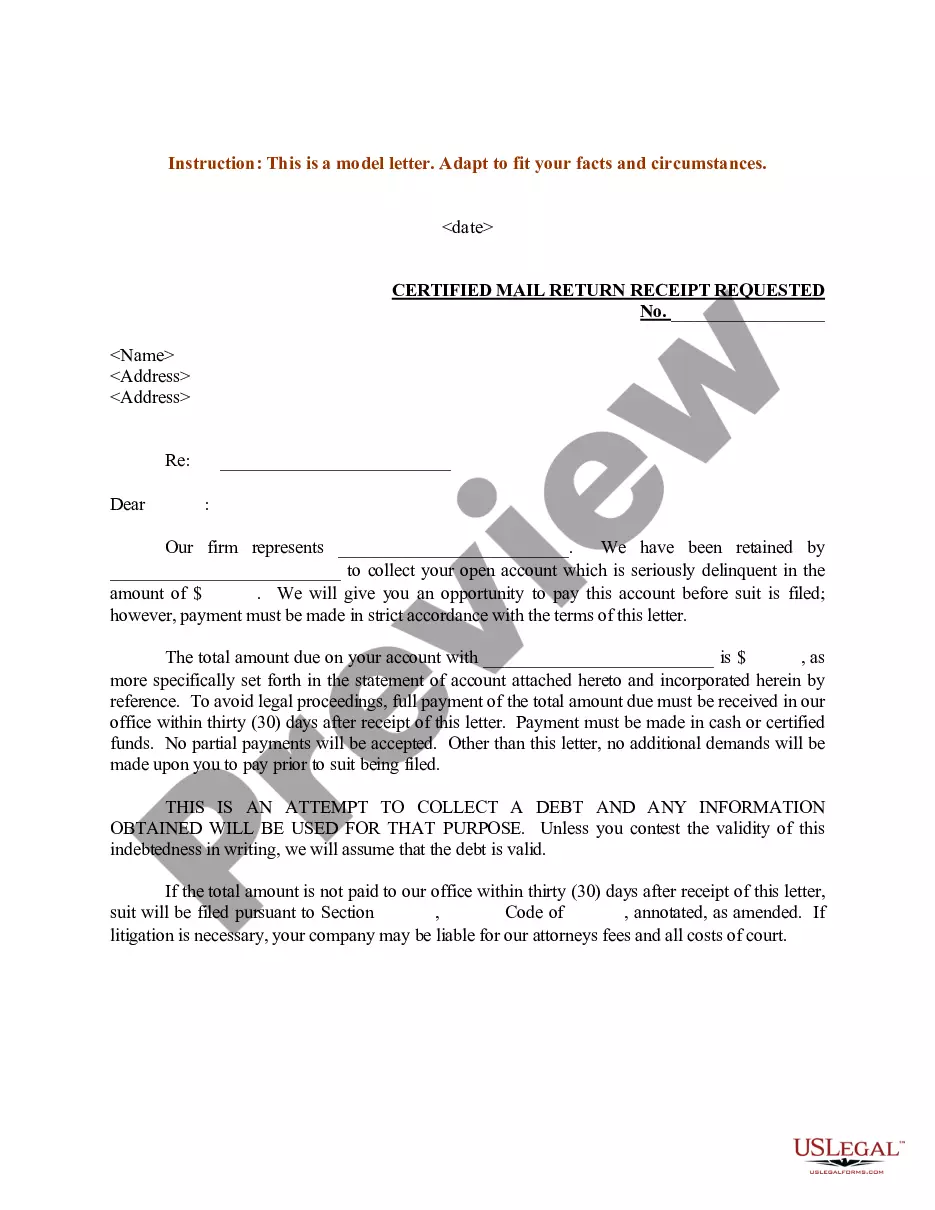
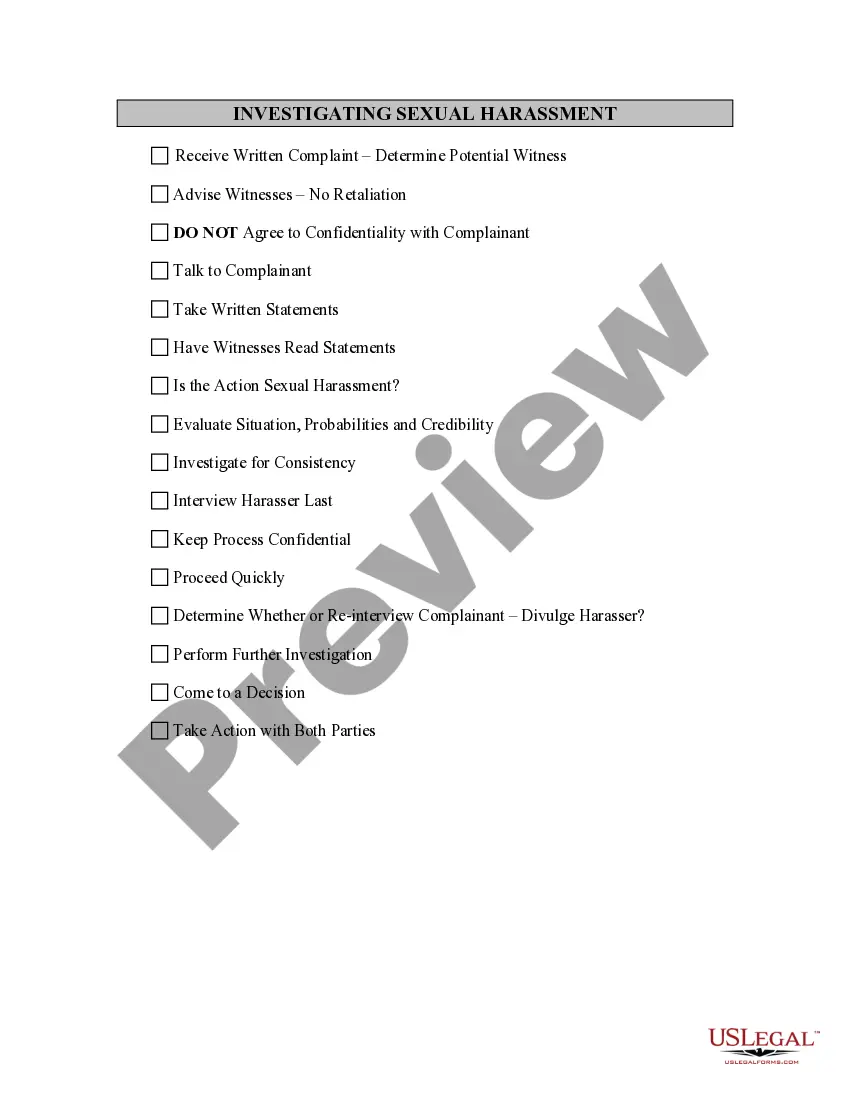
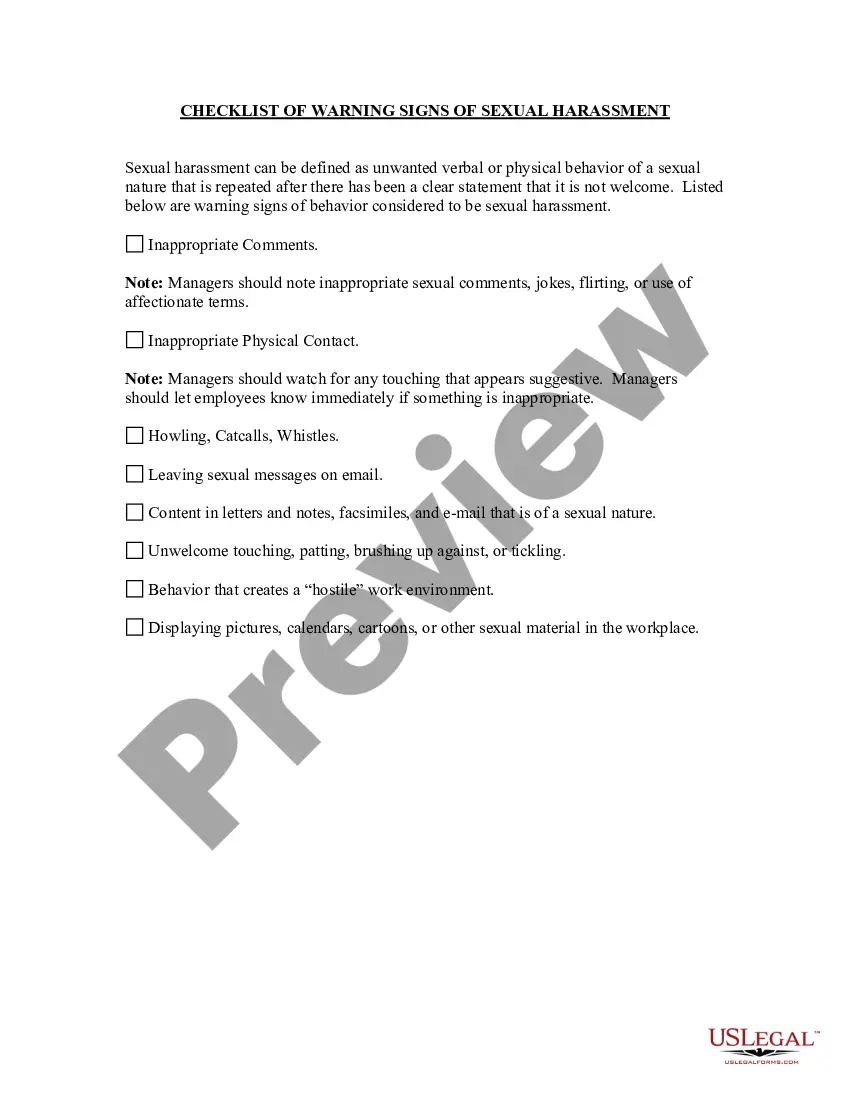
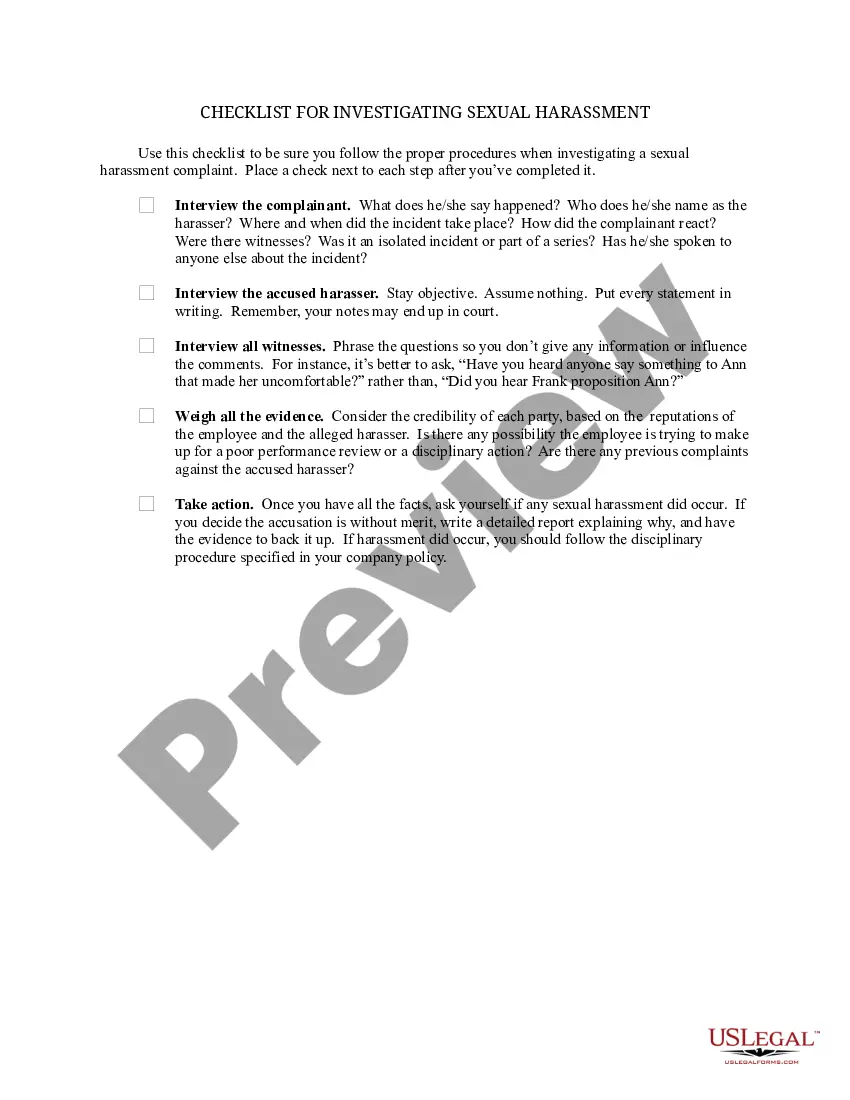
Ohio Investigating Sexual Harassment Checklist - Workplace
Description
Get your form ready online
Our built-in tools help you complete, sign, share, and store your documents in one place.
Make edits, fill in missing information, and update formatting in US Legal Forms—just like you would in MS Word.
Download a copy, print it, send it by email, or mail it via USPS—whatever works best for your next step.
Sign and collect signatures with our SignNow integration. Send to multiple recipients, set reminders, and more. Go Premium to unlock E-Sign.
If this form requires notarization, complete it online through a secure video call—no need to meet a notary in person or wait for an appointment.
We protect your documents and personal data by following strict security and privacy standards.

Make edits, fill in missing information, and update formatting in US Legal Forms—just like you would in MS Word.

Download a copy, print it, send it by email, or mail it via USPS—whatever works best for your next step.

Sign and collect signatures with our SignNow integration. Send to multiple recipients, set reminders, and more. Go Premium to unlock E-Sign.

If this form requires notarization, complete it online through a secure video call—no need to meet a notary in person or wait for an appointment.

We protect your documents and personal data by following strict security and privacy standards.
Looking for another form?




How to fill out Investigating Sexual Harassment Checklist - Workplace?
Selecting the most suitable official document format can be challenging.
Certainly, there are numerous templates available online, but how can you find the official form you need? Use the US Legal Forms website.
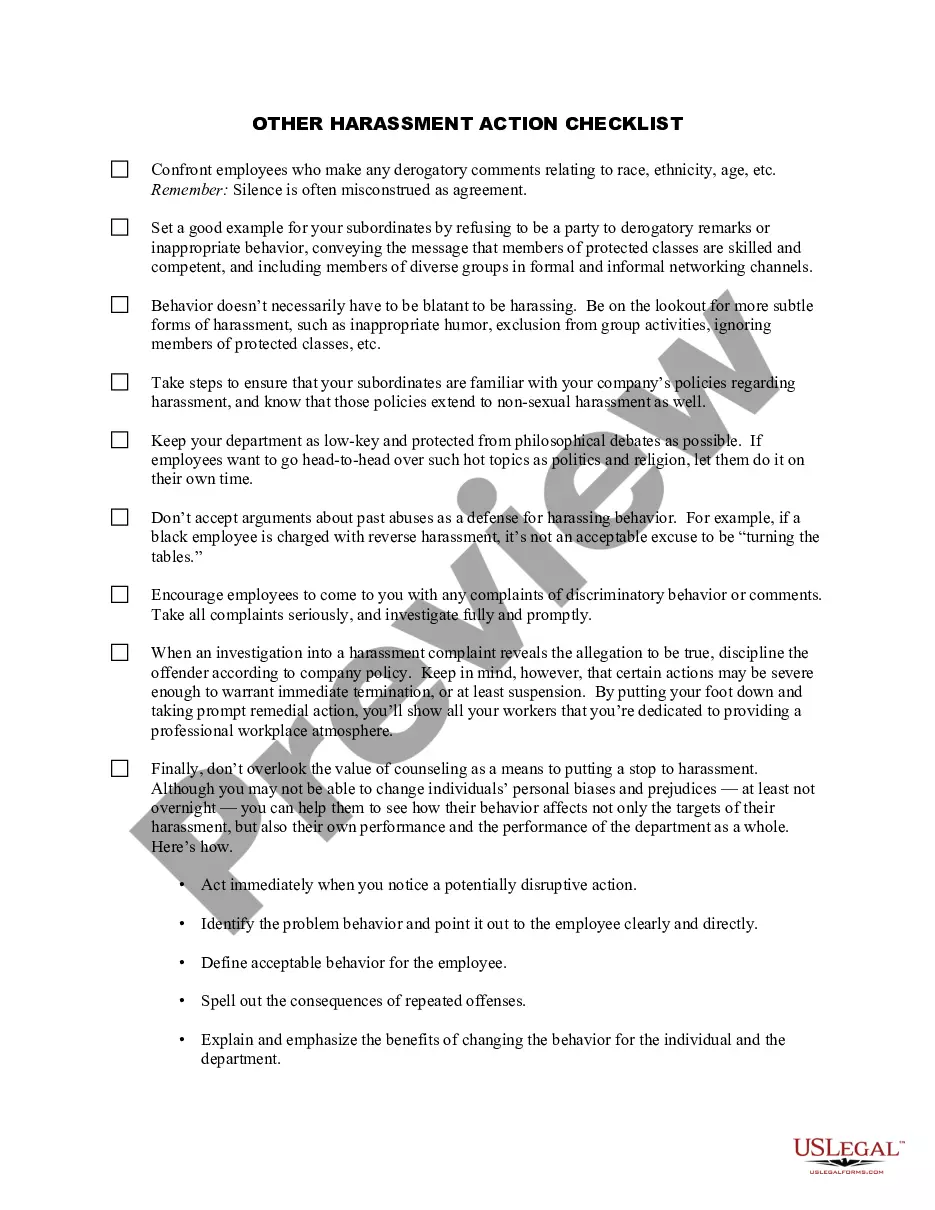
The platform offers a vast array of templates, including the Ohio Investigating Sexual Harassment Checklist - Workplace, which can be utilized for both business and personal purposes.
First, ensure you have selected the correct form for your specific city/region. You can view the form with the Preview option and read the form description to confirm it is suitable for you.
- All of the forms are reviewed by experts and comply with state and federal regulations.
- If you are already registered, Log In to your account and click the Obtain button to download the Ohio Investigating Sexual Harassment Checklist - Workplace.
- Use your account to access the legal forms you have previously purchased.
- Navigate to the My documents section of your account to retrieve an additional copy of the document you require.
- If you are a new user of US Legal Forms, here are simple instructions for you to follow.
Form popularity
FAQ
Harassment is unwelcome conduct that is based on race, color, religion, sex (including sexual orientation, gender identity, or pregnancy), national origin, older age (beginning at age 40), disability, or genetic information (including family medical history).
There are five major types of workplace harassments, they are:Verbal harassment.Psychological harassment.Cyberbullying.Sexual harassment.Physical harassment.
Following its December 2019 decision holding that confidentiality mandates during the course of workplace investigations are presumptively lawful, the National Labor Relations Board (NLRB) recently held that employers can instruct employees to keep an open internal investigation confidential.
Harassment is unwelcome conduct that is directed at a member of a protected class that is specified by law (race, color, religion, sex, pregnancy, national origin, age 40 or older or disability). This conduct is against the law when it is a condition of continued employment or creates a hostile work environment.
To successfully establish a hostile work environment claim in Ohio, you will need to prove each of the following five elements: (1) you are a member of a protected class; (2) you were subjected to unwelcome harassment; (3) the harassment was based on your membership in a protected class; (4) the harassment was
Prohibiting employee discussions of an ongoing investigation is allowed only if the employer can show that it has a legitimate business justification outweighing the employees' rights.
The commission than states, Harassment becomes unlawful where 1) enduring the offensive conduct becomes a condition of continued employment, or 2) the conduct is severe or pervasive enough to create a work environment that a reasonable person would consider intimidating, hostile, or abusive.
Employers also may require witnesses (and even the complainant) to cooperate in their investigations. For example, in TRW, Inc. v. Superior Court, the California Court of Appeal held that an employer may discharge an employee who refuses to answer questions during the course of a security investigation.
You can take action by filing a complaint with the California Department of Fair Employment and Housing, or DFEH. You can also file a complaint with the Equal Employment Opportunity Commission, or EEOC.
An employer is required to conduct an investigation into incidents and complaints of workplace harassment that is appropriate in the circumstances. In other words, a formal complaint is not required to trigger an investigation.