Ohio Affidavit for Mechanic's Lien
What is this form?
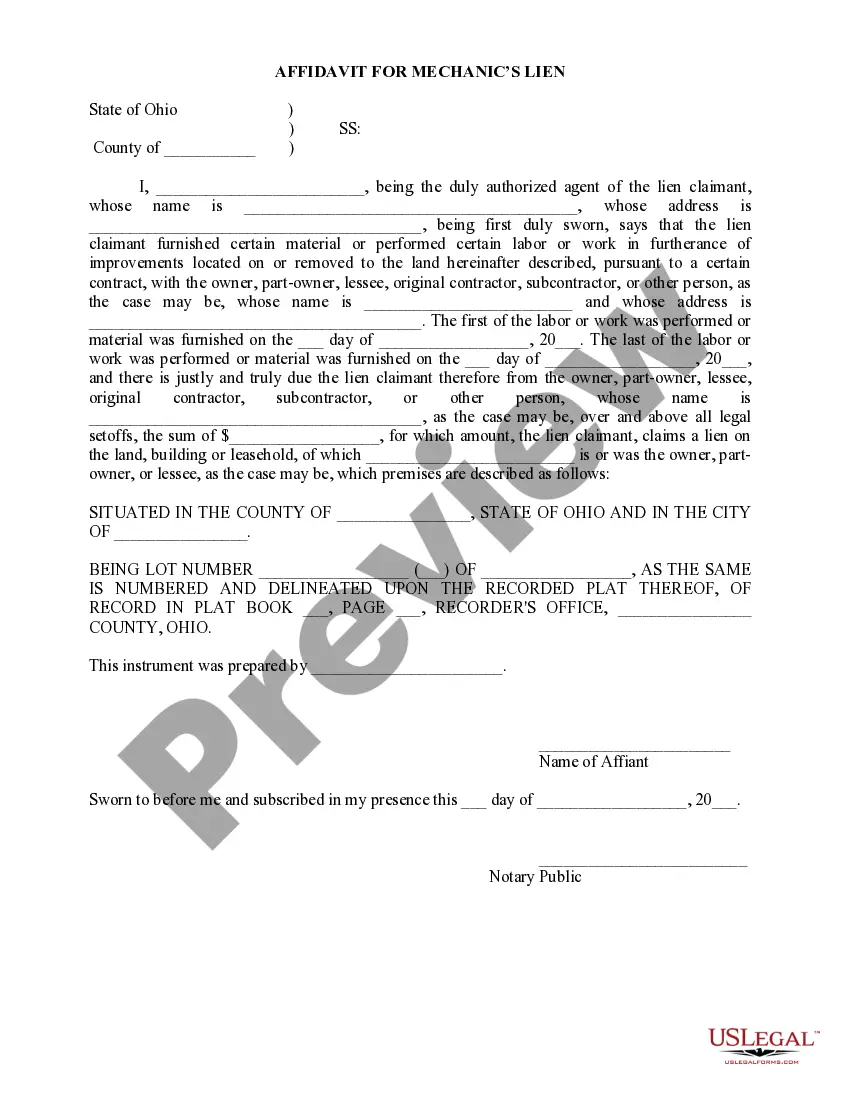
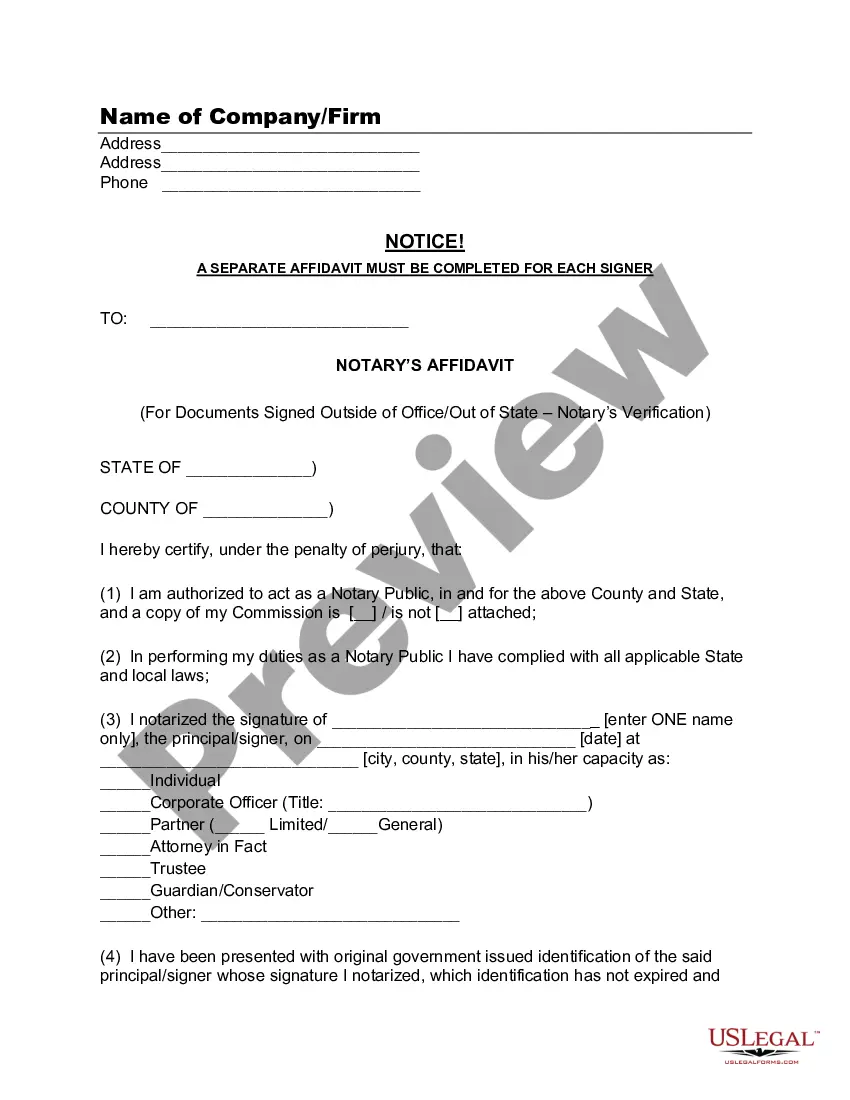
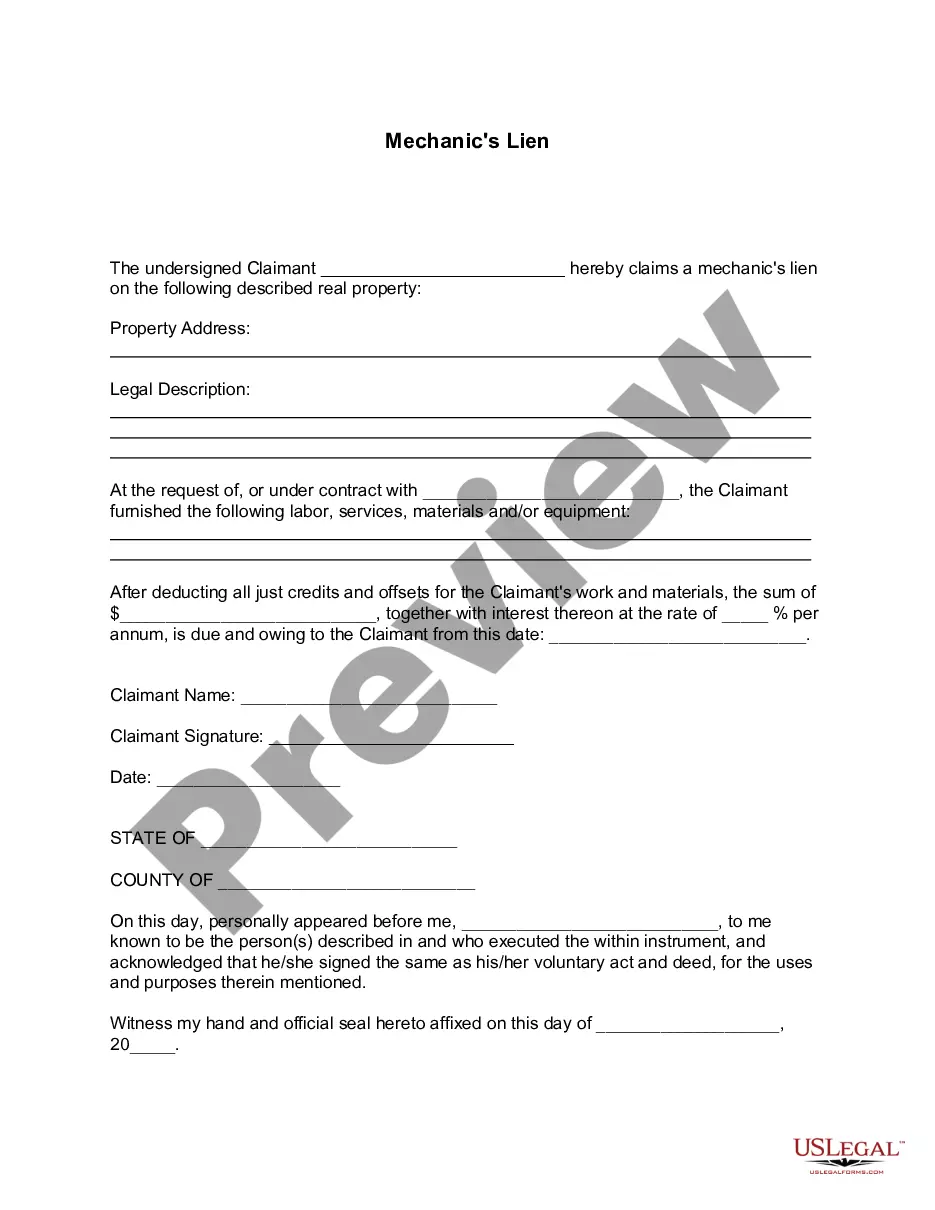
The Affidavit for Mechanic's Lien is a legal document that allows individuals or businesses to claim a lien against a property for unpaid labor or materials provided in relation to property improvements. Unlike other forms of lien documentation, this specific affidavit is necessary for asserting rights over a property in cases where payment has not been received for construction or renovation work. Filing this form with the county recorder enables lien claimants to ensure that their claims for payment are formally recognized under Ohio law.
Form components explained
- Identifying details of the lien claimant and the property owner.
- Description of the labor or materials provided and the contract terms.
- Specific dates when the work started and was completed.
- Amount due to the lien claimant for services rendered.
- Legal description of the property subject to the lien.
- Notary signature section to validate the document.
Situations where this form applies
This form should be used when a contractor, subcontractor, or supplier has not received payment for labor or materials provided to improve real property. If you have completed work or supplied goods and the property owner or contractor has failed to make payment, filing this affidavit is a critical step for securing your financial interests in the property.
Who can use this document
- Contractors who completed work on a property.
- Suppliers of construction materials who have not been paid.
- Subcontractors providing services under a larger contract.
- Any party involved in property improvement seeking to secure payment.
Instructions for completing this form
- Identify the lien claimant by providing their name and address.
- State the name and address of the property owner or contractor.
- Detail the labor or materials provided and the respective dates.
- Input the total amount owed for the work completed.
- Include a legal description of the property as specified in local records.
- Sign the affidavit in the presence of a notary public for validation.
Is notarization required?
Yes, this form must be notarized to be legally valid. Notarization helps authenticate the identity of the signer and the integrity of the document. US Legal Forms offers integrated online notarization, allowing you to confirm your affidavit through secure video calls anytime, enhancing convenience while ensuring legal equivalence.
Get your form ready online
Our built-in tools help you complete, sign, share, and store your documents in one place.
Make edits, fill in missing information, and update formatting in US Legal Forms—just like you would in MS Word.
Download a copy, print it, send it by email, or mail it via USPS—whatever works best for your next step.
Sign and collect signatures with our SignNow integration. Send to multiple recipients, set reminders, and more. Go Premium to unlock E-Sign.
If this form requires notarization, complete it online through a secure video call—no need to meet a notary in person or wait for an appointment.
We protect your documents and personal data by following strict security and privacy standards.

Make edits, fill in missing information, and update formatting in US Legal Forms—just like you would in MS Word.

Download a copy, print it, send it by email, or mail it via USPS—whatever works best for your next step.

Sign and collect signatures with our SignNow integration. Send to multiple recipients, set reminders, and more. Go Premium to unlock E-Sign.

If this form requires notarization, complete it online through a secure video call—no need to meet a notary in person or wait for an appointment.

We protect your documents and personal data by following strict security and privacy standards.
Common mistakes
- Failing to include required details about the labor or materials provided.
- Not specifying the correct dates of service.
- Leaving out the property owner's information or legal description.
- Not having the affidavit notarized before filing.
Why complete this form online
- Convenient access to legally drafted templates at any time.
- Ability to edit and customize the form to meet specific needs.
- Reliable documents created by licensed attorneys, ensuring legal compliance.
Looking for another form?

Form popularity
FAQ
While they don't require lien filings to be notarized, they do require a lien filer to jump through various other hoops that, if not done properly, might cause your filing to be rejected or invalidated: Delaware.
When a contractor files a mechanics' (construction) lien on your home, the lien makes your home into what's called security for an outstanding debt, which the contractor claims is due and unpaid for services or materials.
To enforce the lien, the contractor must file a lawsuit within 90 days from the date of recording the lien. If this deadline is passed, the contractor may not be able to enforce the lien and may be required to remove the lien.
LIen waivers are not required to be notarized. The primary times that a document needs to be notarized is if it is going to be filed with the county recorder or it is an affidavit. There are some other documents that often use notarization, but lien waivers don't fall into any of those that "need to be notarized."
If contractors and suppliers don't get paid on a construction project in Ohio, they can file a mechanics lien to secure payment. A mechanics lien is a legal tool that provides the unpaid party with a security interest in the property.
Mechanic's liens are valid for 6 years, unless a Notice to Commence Suite is served on the lien claimant. 15 A Notice to Commence Suit can be issued by the Owner or by the General Contractor, on behalf of the Owner.
The process of bonding off a mechanics lien starts after a claimant has filed a mechanics lien. After the claim is made, a general contractor or a property owner can contact a surety bond company to purchase a surety bond that replaces the value of the lien that was filed against the property.
The process of bonding off a mechanics lien starts after a claimant has filed a mechanics lien. After the claim is made, a general contractor or a property owner can contact a surety bond company to purchase a surety bond that replaces the value of the lien that was filed against the property.