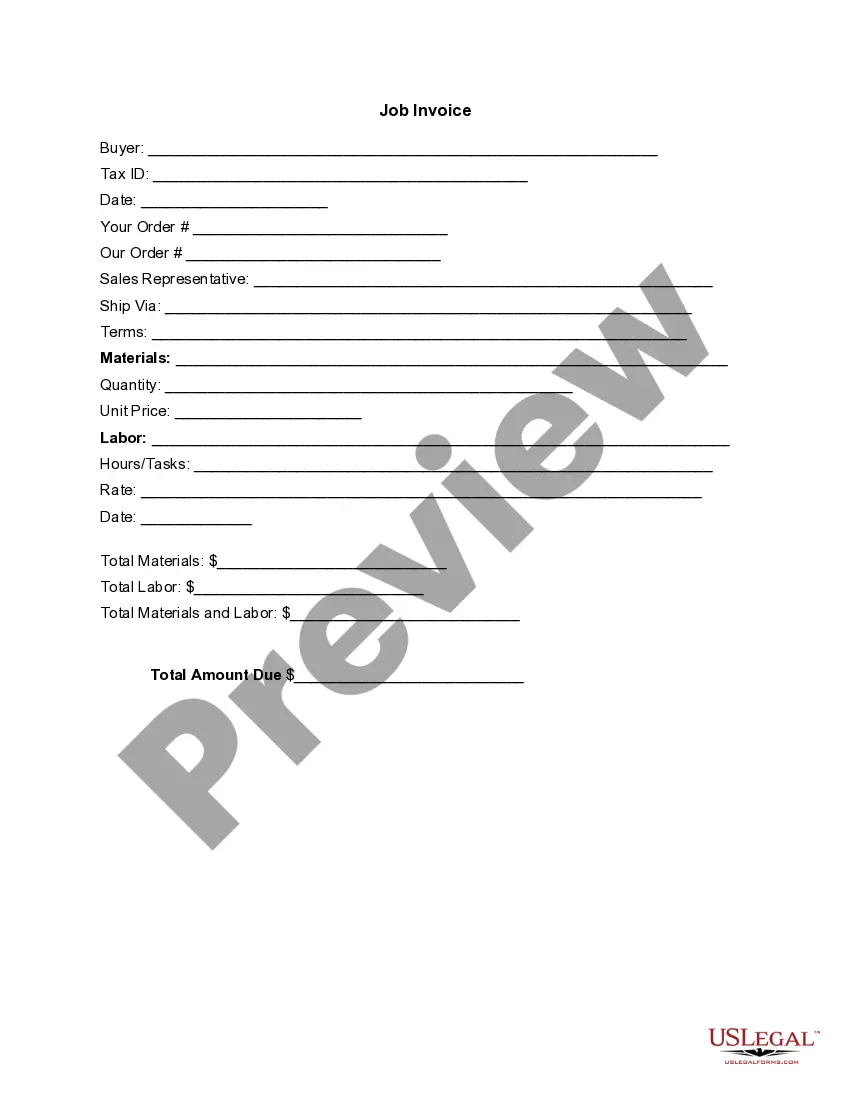
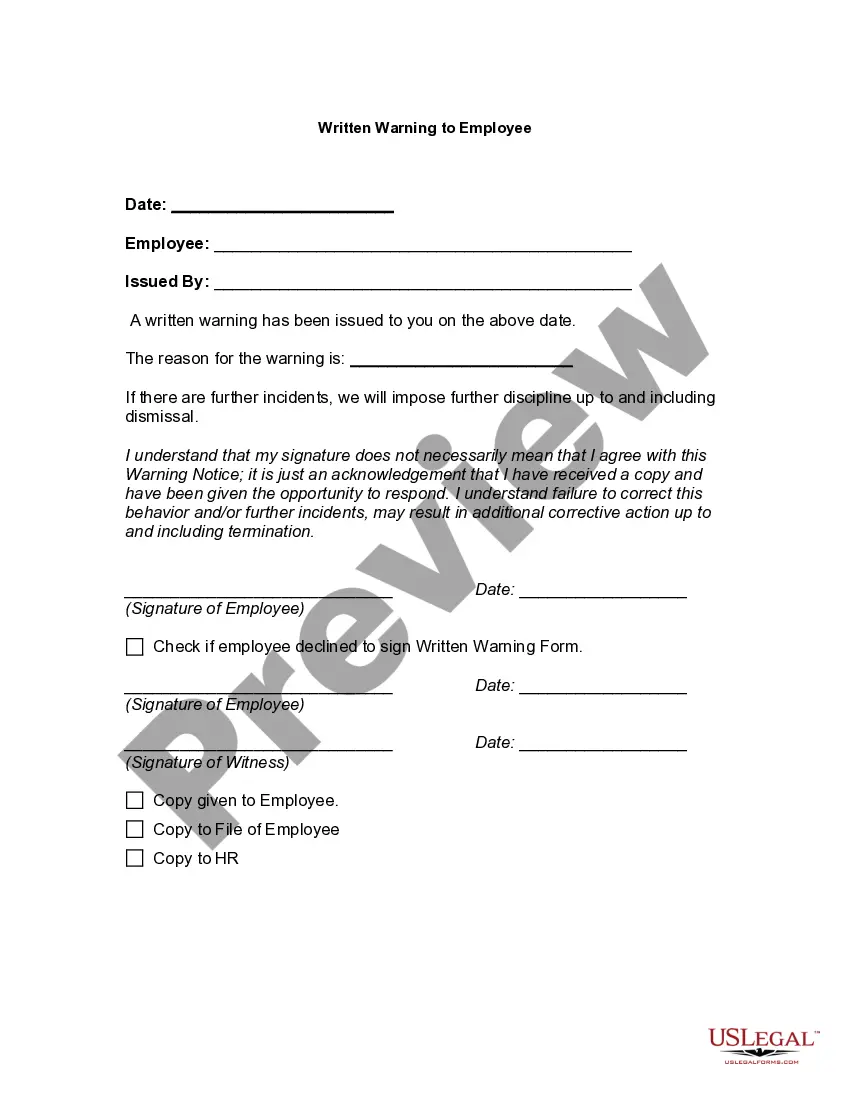
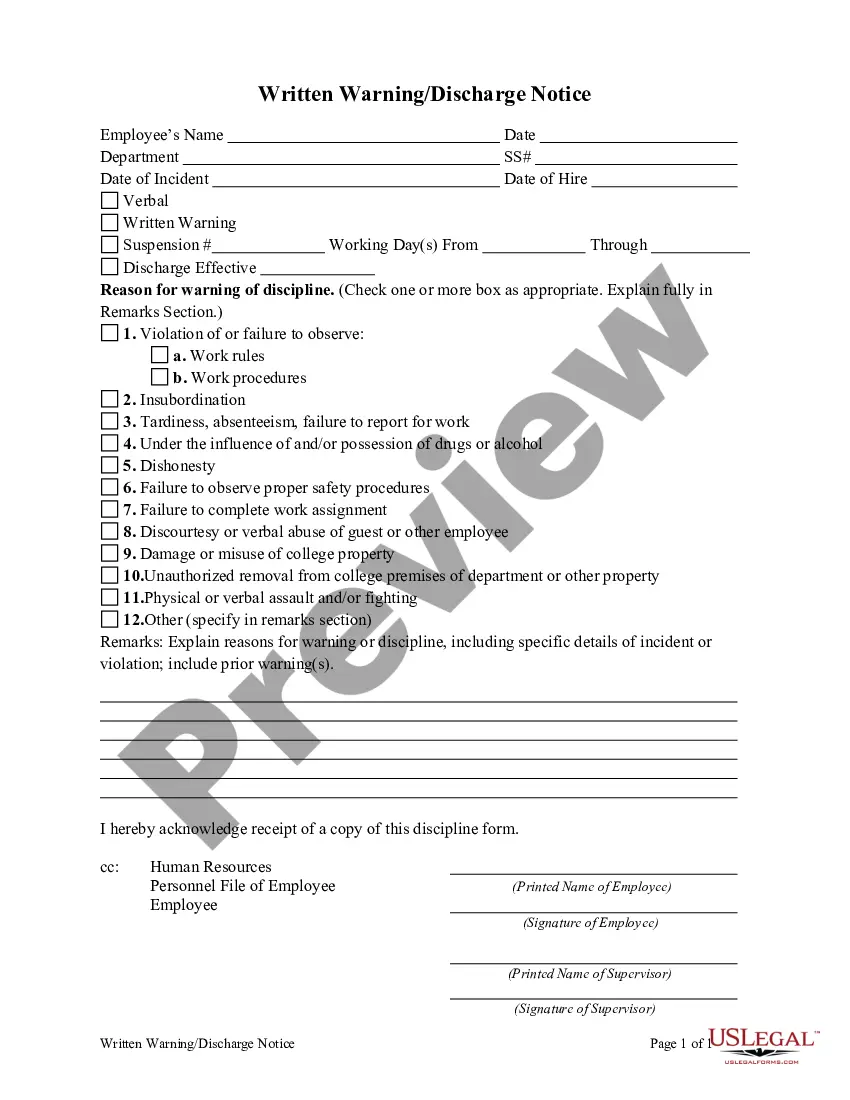
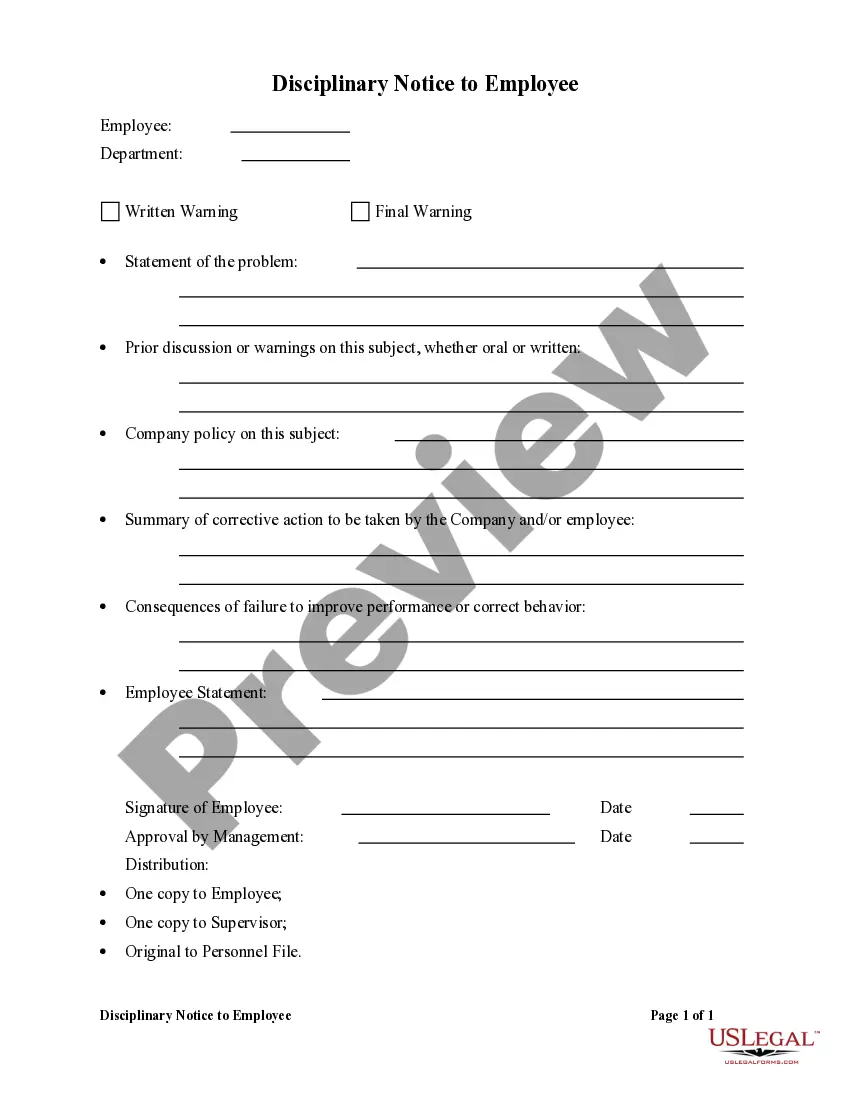
New York Written Warning to Employee
Description
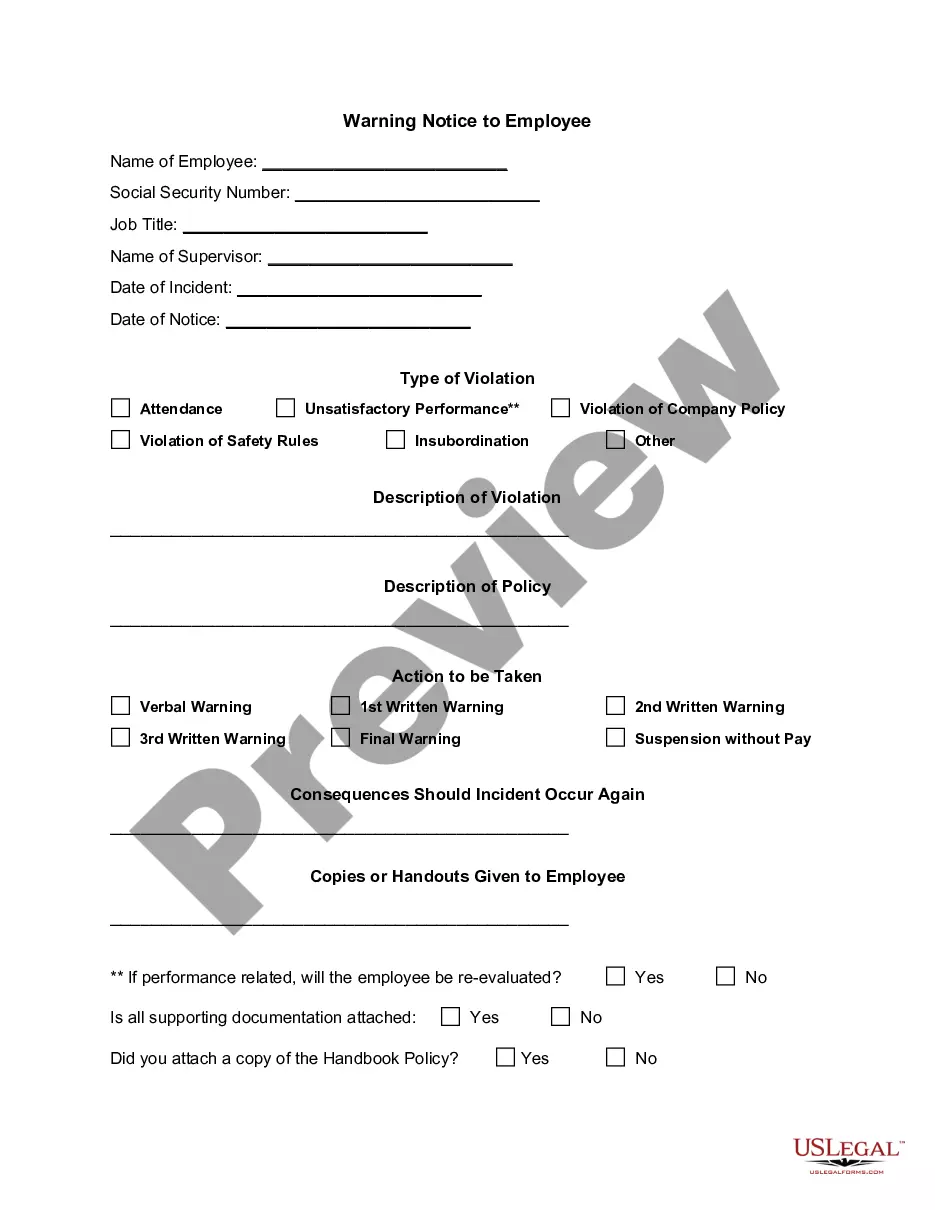
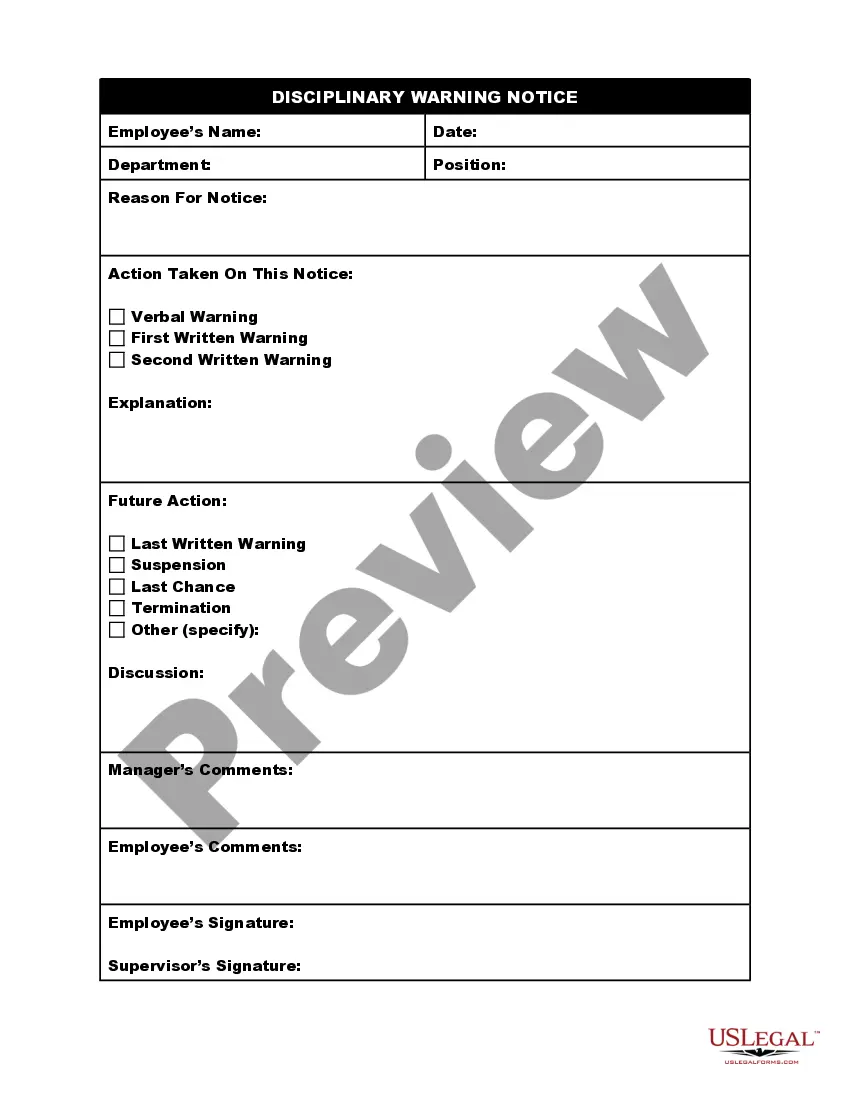
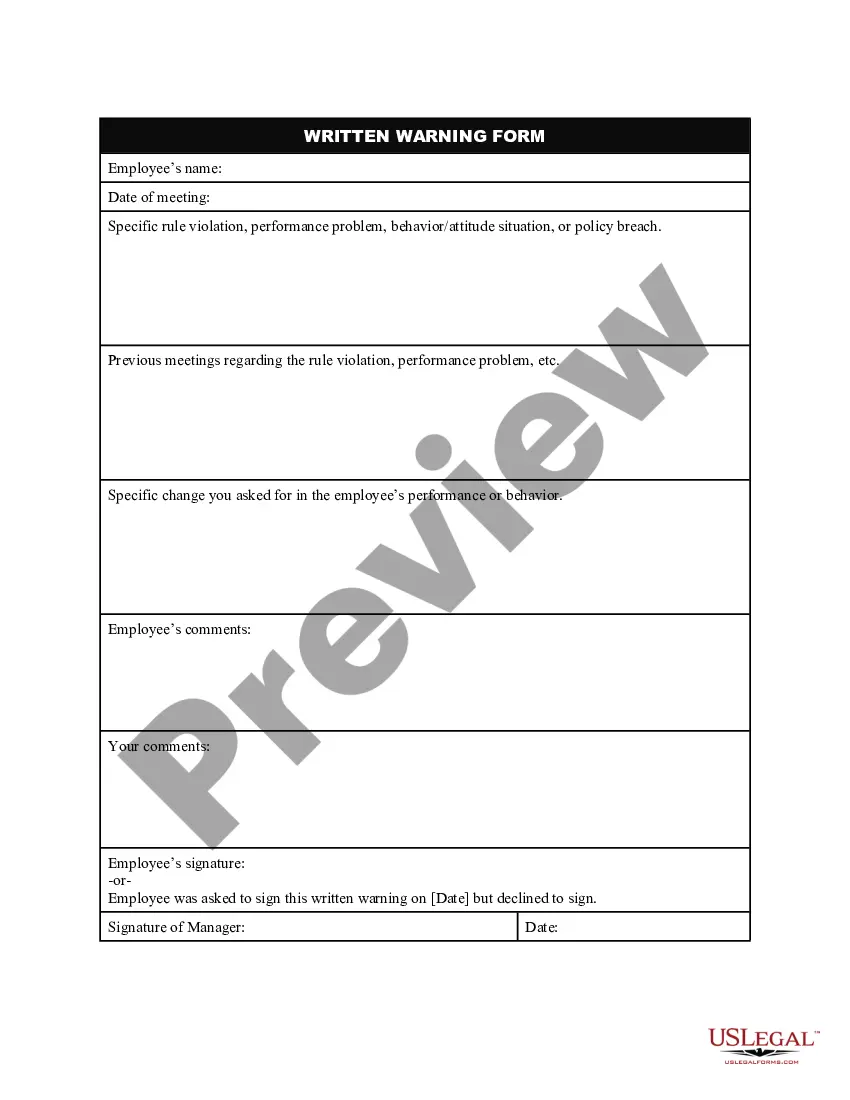
Get your form ready online
Our built-in tools help you complete, sign, share, and store your documents in one place.
Make edits, fill in missing information, and update formatting in US Legal Forms—just like you would in MS Word.
Download a copy, print it, send it by email, or mail it via USPS—whatever works best for your next step.
Sign and collect signatures with our SignNow integration. Send to multiple recipients, set reminders, and more. Go Premium to unlock E-Sign.
If this form requires notarization, complete it online through a secure video call—no need to meet a notary in person or wait for an appointment.
We protect your documents and personal data by following strict security and privacy standards.

Make edits, fill in missing information, and update formatting in US Legal Forms—just like you would in MS Word.

Download a copy, print it, send it by email, or mail it via USPS—whatever works best for your next step.

Sign and collect signatures with our SignNow integration. Send to multiple recipients, set reminders, and more. Go Premium to unlock E-Sign.

If this form requires notarization, complete it online through a secure video call—no need to meet a notary in person or wait for an appointment.

We protect your documents and personal data by following strict security and privacy standards.
Looking for another form?

How to fill out Written Warning To Employee?
Are you currently in a circumstance where you frequently require documents for either business or personal purposes.
There are numerous legal document templates available online, but finding reliable ones can be challenging.
US Legal Forms offers a vast selection of document templates, including the New York Written Warning to Employee, designed to meet federal and state regulations.
Once you find the right template, click Purchase now.
Choose the pricing plan you prefer, fill in the required information to create your account, and complete your order using PayPal or a credit card.
- If you are already acquainted with the US Legal Forms website and have an account, simply sign in.
- Then, you can download the New York Written Warning to Employee template.
- If you do not have an account and wish to start using US Legal Forms, follow these steps.
- Select the form you need and ensure it is for the correct area/region.
- Use the Preview option to examine the form.
- Review the description to ensure that you have selected the correct document.
- If the form is not what you are looking for, use the Search field to find the template that meets your needs.
Form popularity
FAQ
Here are the 10 guidelines for drafting a written warning.Document verbal warnings first. Track all verbal warnings and disciplinary measures in writing at the time they are given.Determine tone.Consult with manager.Formalities.State company policy.Describe what happened.State expectations.Outline consequences.More items...
The WARN Act is triggered by: Plant closings. The shutdown of a single employment site, facility or operating unit, that results in a loss of at least 50 full-time employees, during a 30 day period or. Mass layoffs.
As set out above, even though a warning can be issued verbally, any disciplinary action to be taken against an employee must be confirmed in writing and retained as part of their disciplinary record on their employment file.
The following states or territories have their own versions of the WARN Act that expand on the protections of the federal law, by covering small layoffs or by having fewer exceptions: California, Hawaii, Illinois, Iowa, Maine, New Hampshire, New Jersey, New York, Tennessee, Wisconsin and the Virgin Islands.
Can you go straight to a final written warning? An employer may be justified in going straight to a final written warning, without a verbal or first written warning, if the matter complained of is sufficiently serious. This could be, for example, a serious misconduct or performance issue.
An employer may be justified in going straight to a final written warning, without a verbal or first written warning, if the matter complained of is sufficiently serious. This could be, for example, a serious misconduct or performance issue.
The New York State Worker Adjustment and Retraining Notification (WARN) Act requires covered businesses to provide early warnings of closures and layoffs to all affected employees, employee representatives, the Department of Labor, and Local Workforce Development Boards.
In cases of serious misconduct or poor performance, the employer does not have to give a first written warning and can instead go straight to a final written warning. For example, where the employee's actions have, or could, cause serious harm to the business.
In order to issue any type of warning, you need to invite the person to a formal meeting, usually badged as a disciplinary hearing. Although there is no legal notification of specific timescales, it is good practice to offer at least a couple of days notice so that the person can prepare their side of the story.
Worker Adjustment and Retraining Notification Act (WARN) (29 USC 2100 et. seq.) - Protects workers, their families and communities by requiring most employers with 100 or more employees to provide notification 60 calendar days in advance of plant closings and mass layoffs.