New York Affirmation of Due Diligence
Understanding this form
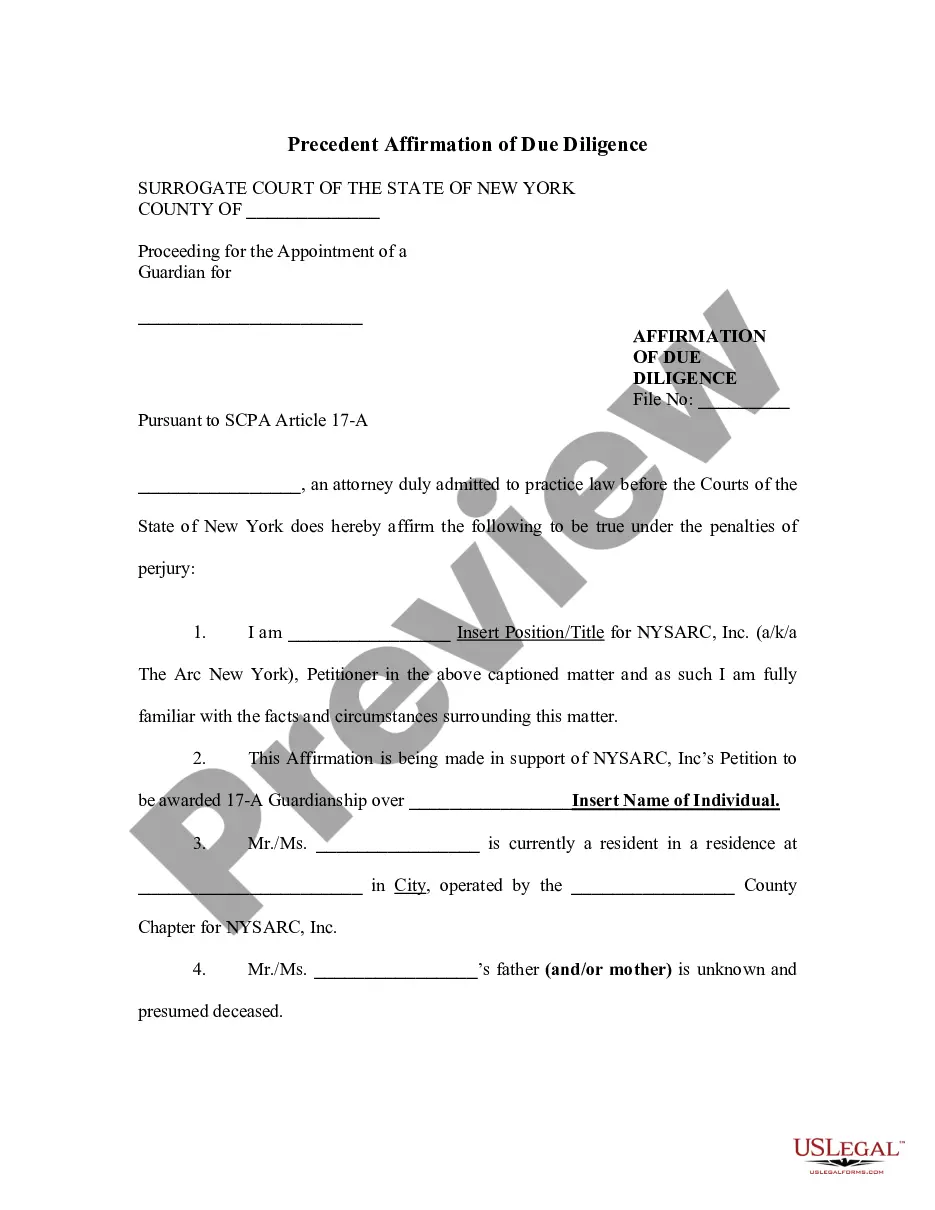
The Affirmation of Due Diligence is a legal document used to prove that a party has made every reasonable effort to notify others involved in legal proceedings. This form is particularly important in guardianship cases, such as those governed by New York's Surrogate Court. It differs from other affidavits by focusing specifically on the efforts to inform relevant parties about pending legal actions and is essential for those seeking guardianship when obtaining certain documents is challenging.
What’s included in this form
- Introduction of the affirming attorney and their qualifications
- Details about the petitioning entity and the individual for whom guardianship is sought
- Information on the proposed individual's current living situation
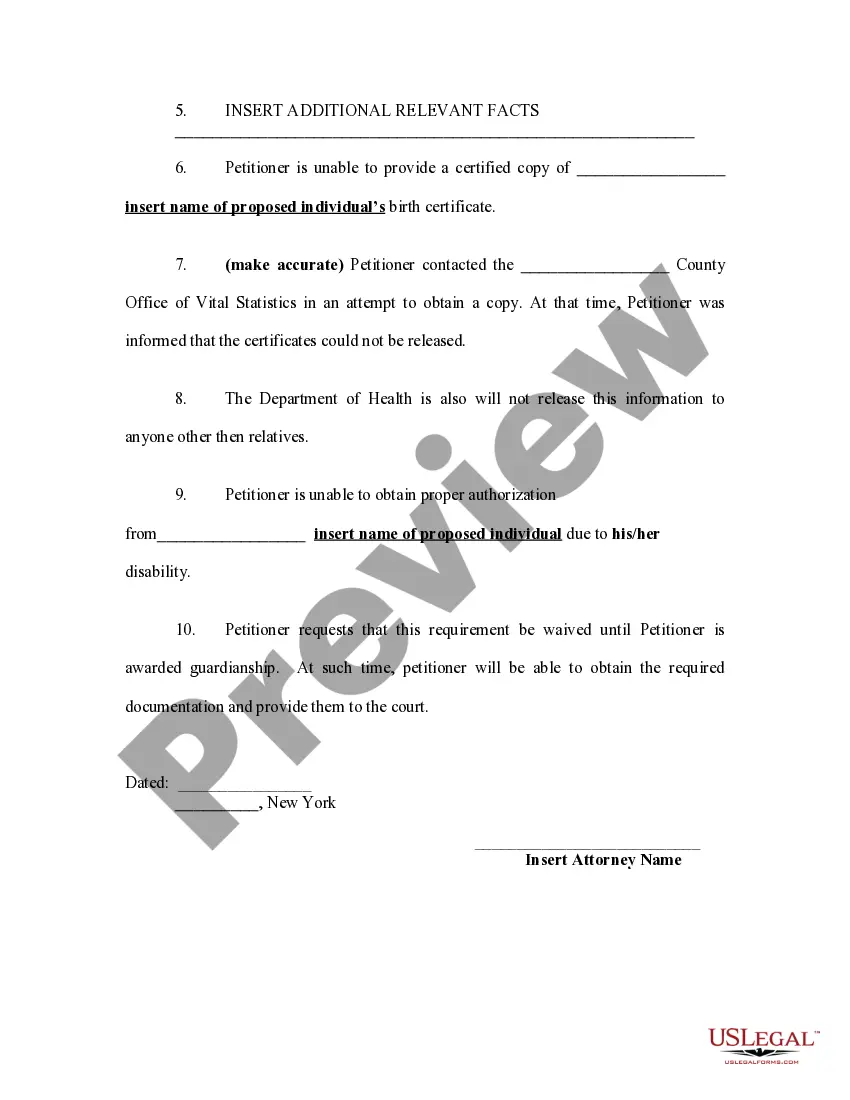
- Statements regarding the inability to obtain necessary documents, like a birth certificate
- Request for waiving documentation requirements pending guardianship approval
When to use this form
This form is used in situations where an individual or organization is applying for guardianship under New York law but faces difficulties in notifying the parents or obtaining necessary documentation about the individual needing guardianship. It is especially relevant when the parentage is unclear or when required documents are unavailable due to the individualâs circumstances.
Intended users of this form
- Attorneys representing entities or individuals applying for guardianship
- Organizations, such as non-profits, seeking legal guardianship for vulnerable individuals
- Individuals facing difficulties in notifying parents or obtaining birth certificates due to special circumstances
How to complete this form
- Identify the affirming attorney's name and position.
- Fill out the relevant details about the individual applying for guardianship.
- Provide information regarding the individual's current residence and circumstances.
- Document the efforts made to obtain identifying documents and the reasons for any failure.
- Sign and date the affirmation, ensuring compliance with legal standards for submission.
Does this document require notarization?
This form does not typically require notarization unless specified by local law. However, having it notarized can add an extra level of authenticity to your affirmation.
Get your form ready online
Our built-in tools help you complete, sign, share, and store your documents in one place.
Make edits, fill in missing information, and update formatting in US Legal Forms—just like you would in MS Word.
Download a copy, print it, send it by email, or mail it via USPS—whatever works best for your next step.
Sign and collect signatures with our SignNow integration. Send to multiple recipients, set reminders, and more. Go Premium to unlock E-Sign.
If this form requires notarization, complete it online through a secure video call—no need to meet a notary in person or wait for an appointment.
We protect your documents and personal data by following strict security and privacy standards.

Make edits, fill in missing information, and update formatting in US Legal Forms—just like you would in MS Word.

Download a copy, print it, send it by email, or mail it via USPS—whatever works best for your next step.

Sign and collect signatures with our SignNow integration. Send to multiple recipients, set reminders, and more. Go Premium to unlock E-Sign.

If this form requires notarization, complete it online through a secure video call—no need to meet a notary in person or wait for an appointment.

We protect your documents and personal data by following strict security and privacy standards.
Typical mistakes to avoid
- Leaving critical fields blank, such as the name of the proposed individual.
- Failing to accurately describe the efforts made to obtain necessary documents.
- Not having the affirmation signed by the appropriate party.
Benefits of using this form online
- Convenience of downloading the form instantly.
- Editable format allowing customization for specific needs.
- Access to professionally drafted templates ensuring legal compliance.
Looking for another form?
Form popularity
FAQ
If Decedent owned real property jointly with another person and had less than $50,000 of personal property, then IT IS a small estate. If there's real property and a Will, then a probate proceeding should be filed. If there's no Will and real property then an administration proceeding should be filed.
A will is invalid if it is not properly witnessed or signed. Most commonly, two witnesses must sign the will in the testator's presence after watching the testator sign the will. The witnesses typically need to be a certain age, and should generally not stand to inherit anything from the will.
The one big exception to these basic rules is that in about half the states, a will that was not witnessed, but was entirely handwritten and signed by the will-maker, is valid. It must be clear that the document was intended to be a will. The legal term for this kind of document is a holographic will.
In the state of New York, a will should be notarized in order to be considered legally binding. This means that if you are writing or updating your will. You must take it to a notary public and have them witness it in order for it to be valid.
Ancillary letters of administration In situations where the decedent passes away in another state but leaves behind a property in the New York, the administrator requires ancillary letters to deal with the property of the decedent.
To be valid at all times, a Will must be in writing, dated and signed by the maker of the Will with two witnesses signing and adding their addresses under their signature. Just writing out your wishes without the witness formality is not suggested.
For a challenge to a Will to succeed, the person who goes to court must prove that there was undue influence that forced the Will to be written the way it was. Or, that the signature was forged, or the signer was incompetent at the time of signing.
(Proof of Service) (NY) This affirmation of service of interlocutory documents (NY) is a standard template that attorneys can use to prove service of an interlocutory document (other than the initial summons and complaint) in a civil action in New York Supreme Court.