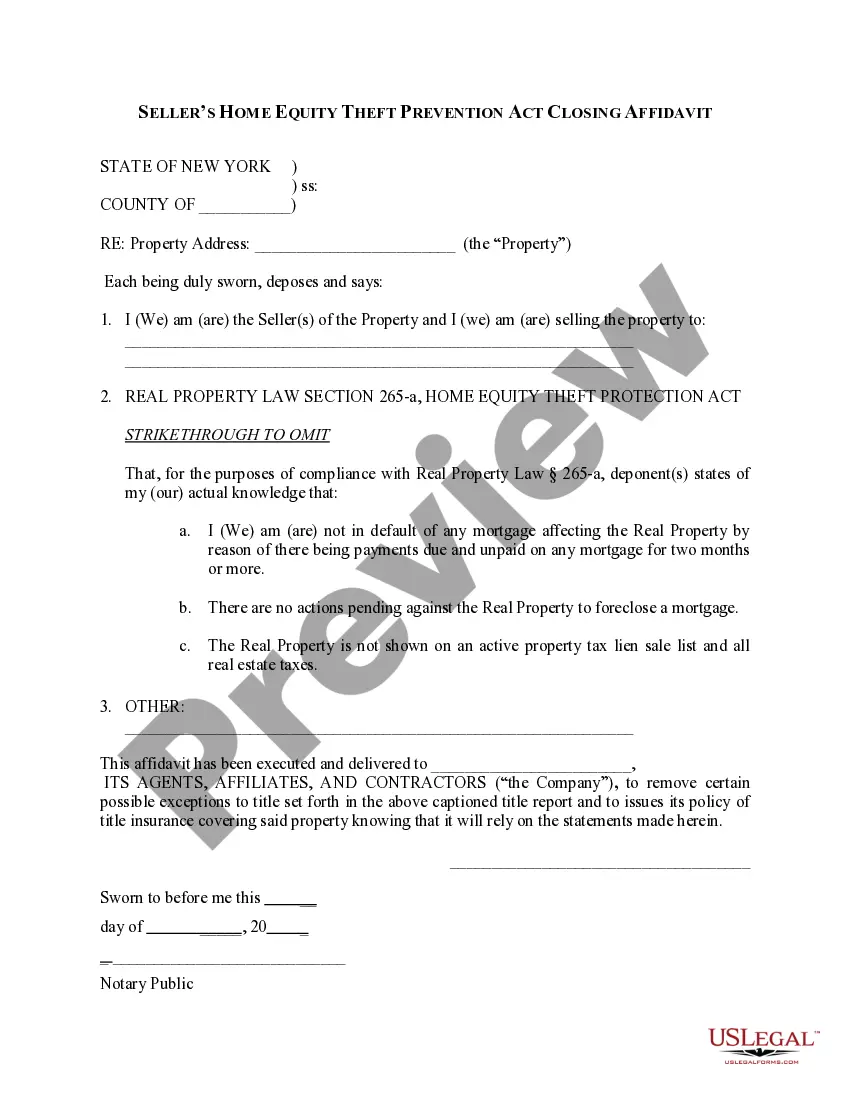
New York Seller's Home Equity Theft Prevention Act Closing Affidavit
Overview of this form
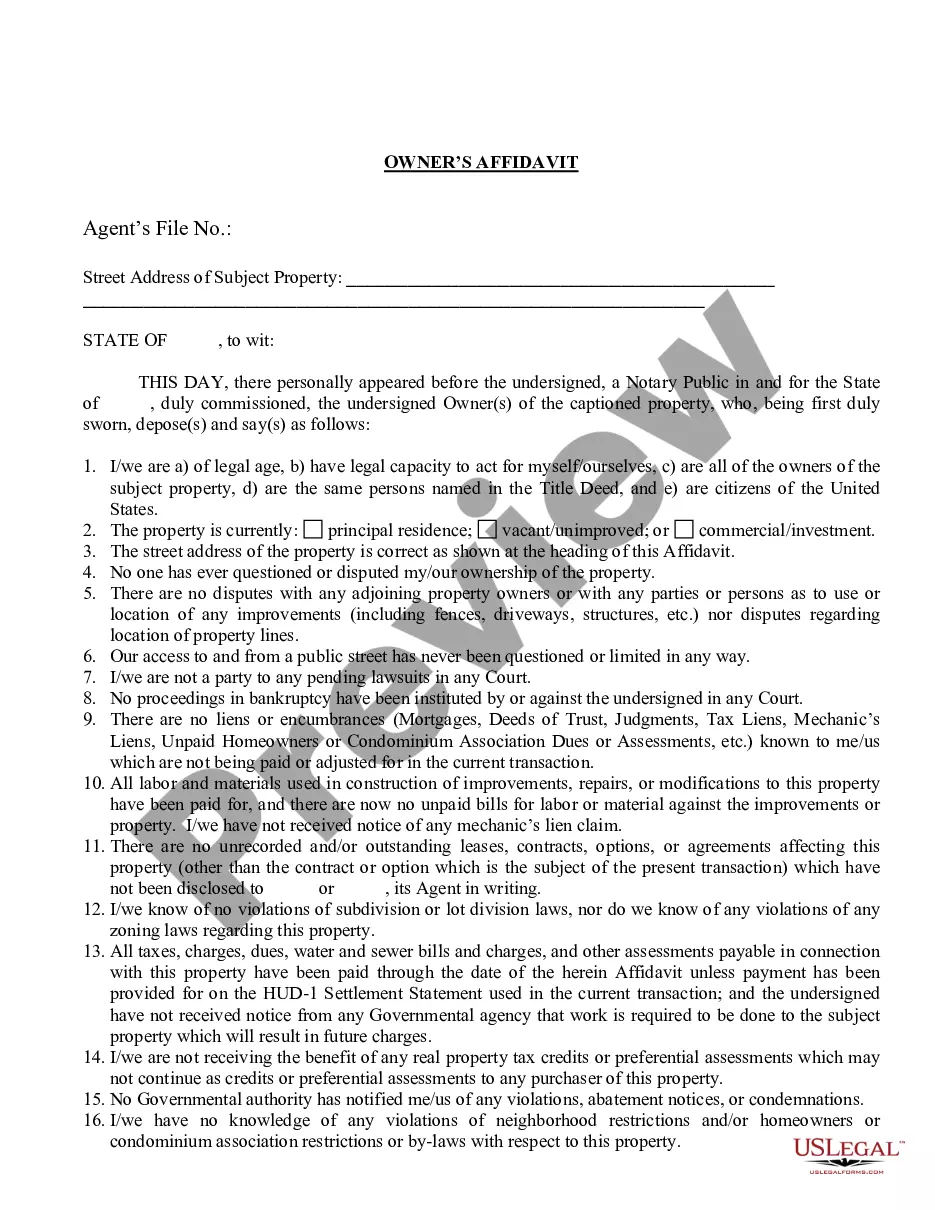
The Seller's Home Equity Theft Prevention Act Closing Affidavit is a legal document designed to protect homeowners in New York who are selling their property during default or foreclosure proceedings. This affidavit helps sellers confirm that they are not in default, ensuring transparency in the sale process and protecting against fraudulent schemes that may target distressed homeowners.
What’s included in this form
- Identification of the seller and the buyer.
- Verification of mortgage status, confirming no defaults or overdue payments.
- Statement regarding pending legal actions, ensuring no foreclosure is active.
- Assurance that the property is not on a tax lien sale list.
- Declaration for title insurance reliance on the statements made in the affidavit.

Common use cases
This affidavit should be used by homeowners selling their property in New York, specifically when they are experiencing financial difficulties such as being in default or facing foreclosure. It serves to protect sellers from potential scams and fraudulent activities during the property sale process.
Who can use this document
- Homeowners in New York who are selling their primary residence.
- Individuals facing foreclosure or default on their mortgage payments.
- Sellers who want to protect themselves from home equity theft scams.
- Real estate agents assisting distressed homeowners in property transactions.
Completing this form step by step
- Identify the parties involved, including the seller(s) and the buyer(s).
- Specify the address of the property being sold.
- Confirm the status of any mortgages and ensure no defaults exist.
- Indicate whether there are any pending foreclosure actions or tax liens on the property.
- Sign the affidavit in the presence of a notary public.
Does this document require notarization?
Yes, this form must be notarized to be legally valid. The affidavit requires the seller(s) to sign in the presence of a notary public, ensuring the authenticity of the statements made. US Legal Forms offers integrated online notarization through secure video calls, allowing you to complete this step conveniently without travel.
Get your form ready online
Our built-in tools help you complete, sign, share, and store your documents in one place.
Make edits, fill in missing information, and update formatting in US Legal Forms—just like you would in MS Word.
Download a copy, print it, send it by email, or mail it via USPS—whatever works best for your next step.
Sign and collect signatures with our SignNow integration. Send to multiple recipients, set reminders, and more. Go Premium to unlock E-Sign.
If this form requires notarization, complete it online through a secure video call—no need to meet a notary in person or wait for an appointment.
We protect your documents and personal data by following strict security and privacy standards.

Make edits, fill in missing information, and update formatting in US Legal Forms—just like you would in MS Word.

Download a copy, print it, send it by email, or mail it via USPS—whatever works best for your next step.

Sign and collect signatures with our SignNow integration. Send to multiple recipients, set reminders, and more. Go Premium to unlock E-Sign.

If this form requires notarization, complete it online through a secure video call—no need to meet a notary in person or wait for an appointment.

We protect your documents and personal data by following strict security and privacy standards.
Common mistakes to avoid
- Failing to accurately state the mortgage status, leading to potential legal issues.
- Not including all required signatures, which can invalidate the affidavit.
- Omitting property details or misrepresenting the property address.
- Neglecting to check for pending legal actions against the property.
Key takeaways
- The Seller's Home Equity Theft Prevention Act Closing Affidavit safeguards homeowners in New York from fraudulent transactions.
- Accurate completion is crucial for protection against legal repercussions.
- The affidavit must be notarized to ensure its validity in property sales.
- Understanding the form's components helps sellers navigate the sale process effectively.
Looking for another form?
Form popularity
FAQ
Twelve states currently allow home equity theft: Alabama, Arizona, Colorado, Illinois, Maine, Massachusetts, Minnesota, Nebraska, New Jersey, New York, Oregon, South Dakota, and the District of Columbia.
Section 265-a of the Real Property Law is intended to address instances of ?home equity theft? that occur when homeowners of residential property (defined as a 1?4 family owner/occupied residence) are in default on their mortgage payments or the property is in foreclosure, including the preservation of the equity in
Established by the Truth in Lending Act (TILA) under U.S. federal law, the right of rescission allows a borrower to cancel a home equity loan, home equity line of credit (HELOC), or refinance with a new lender, other than with the current mortgagee, within three days of closing.
The Home Equity Theft Prevention Act (HETPA, NY RPL §265-a) is a New York State law passed on July 26, 2006, to provide homeowners of residential property with information and disclosures in order to make informed decisions when approached by persons seeking a sale or transfer of the homeowner's property, particularly
Section 265-a of the Real Property Law is intended to address instances of ?home equity theft? that occur when homeowners of residential property (defined as a 1?4 family owner/occupied residence) are in default on their mortgage payments or the property is in foreclosure, including the preservation of the equity in
In Alabama, Colorado, Maine, Massachusetts, Michigan, Minnesota, New York, North Dakota, Oregon, and Wisconsin, governments not only keep the value of unpaid property taxes and interest from the sale of a seized home?they also keep the surplus value rather than returning it to the property owner.
A recent study from Pacific Legal Foundation dug into the numbers of this issue of ?home equity theft.? The report found that between 2014 and 2021, 7,900 homes were taken as payment on property tax debts.