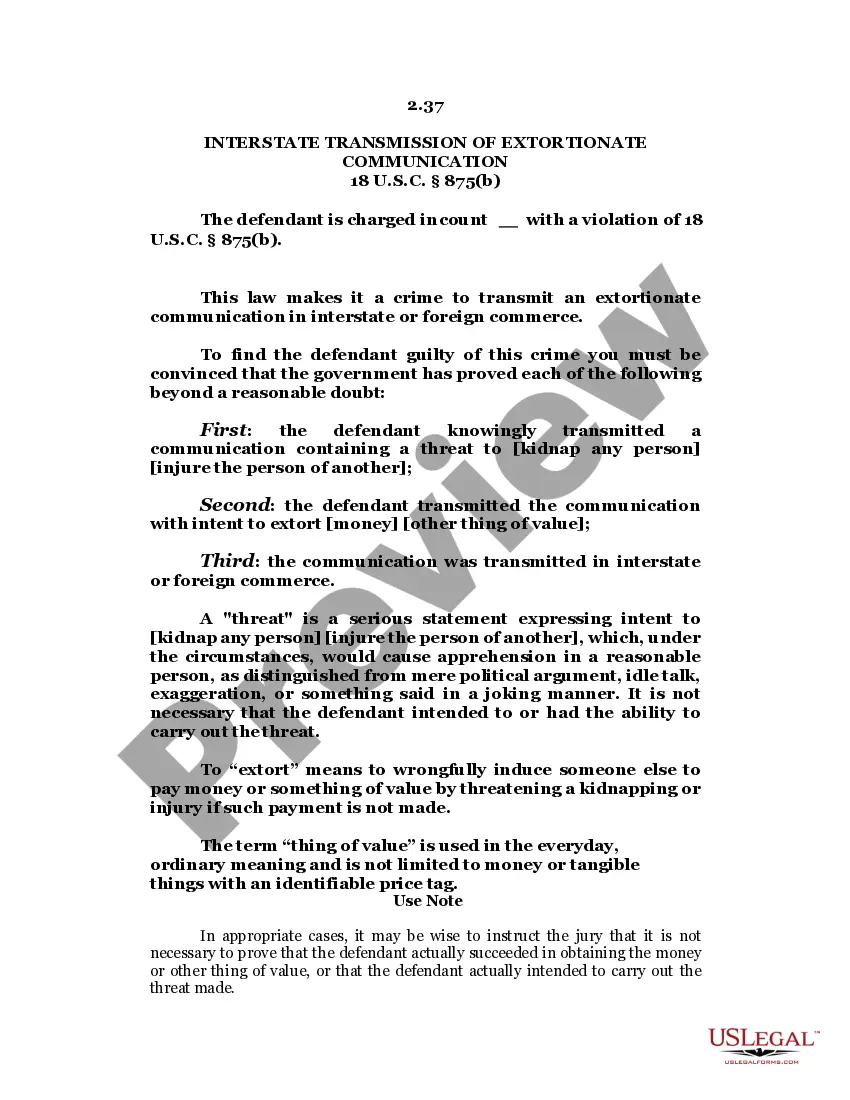
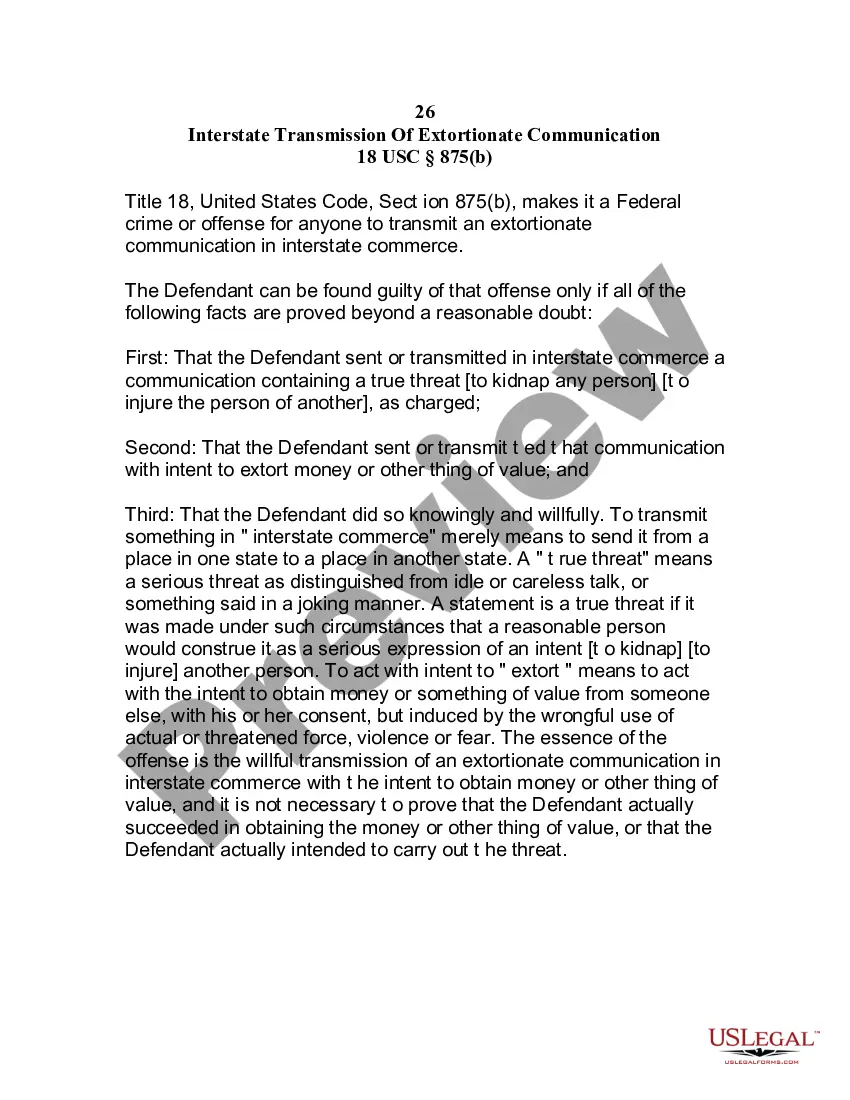
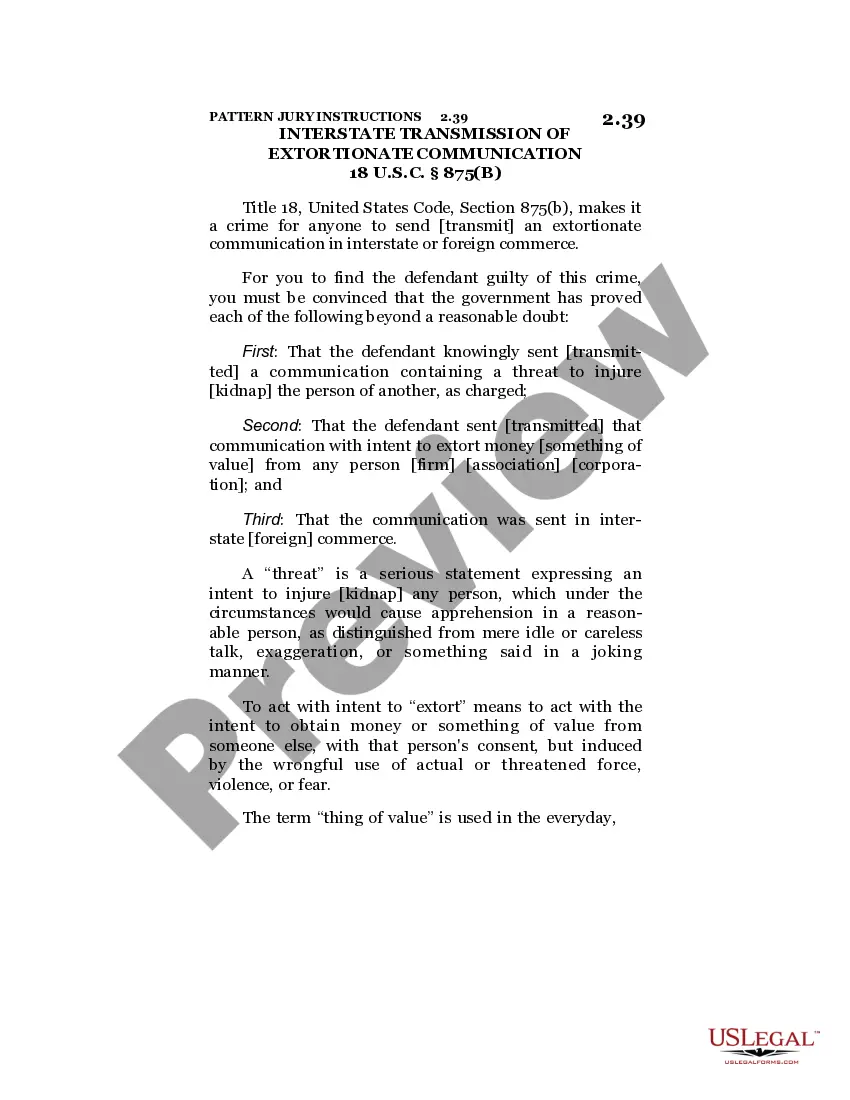
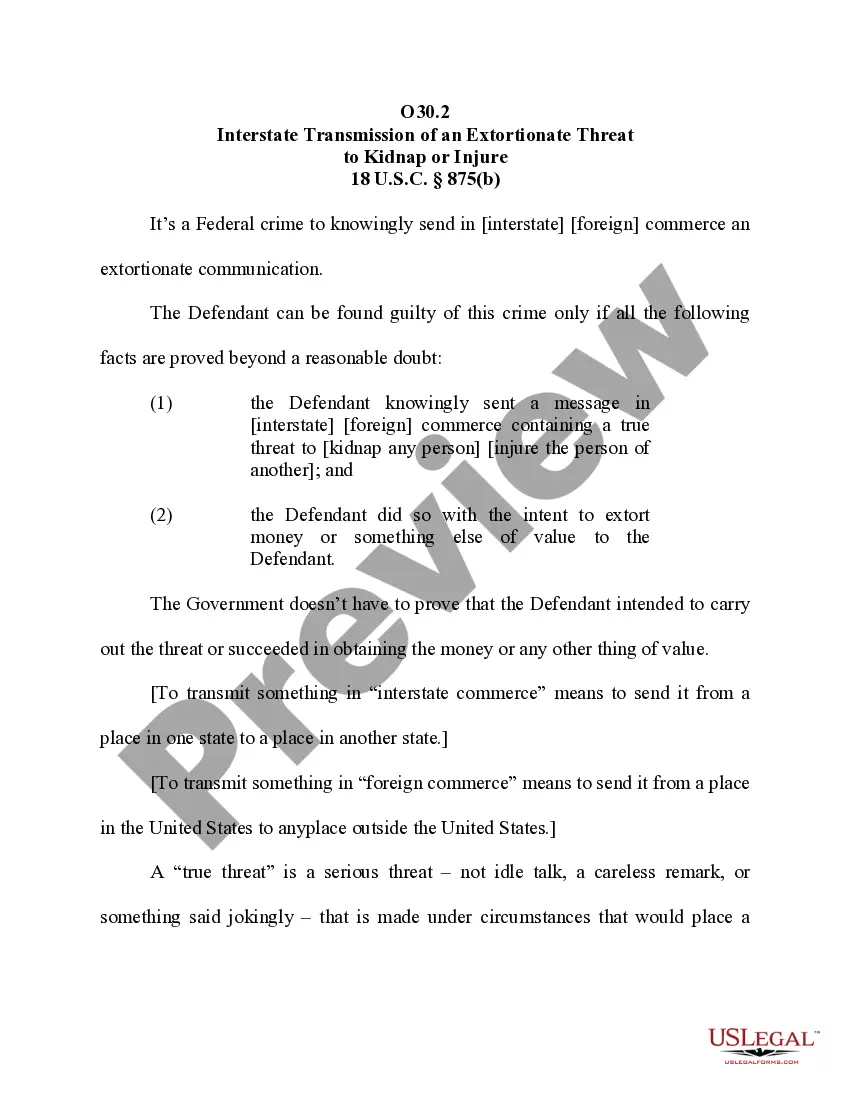
2.37 INTERSTATE TRANSMISSION OF EXTORTIONATE COMMUNICATION / 18 U.S.C. Sec. 875(b)
What is this form?
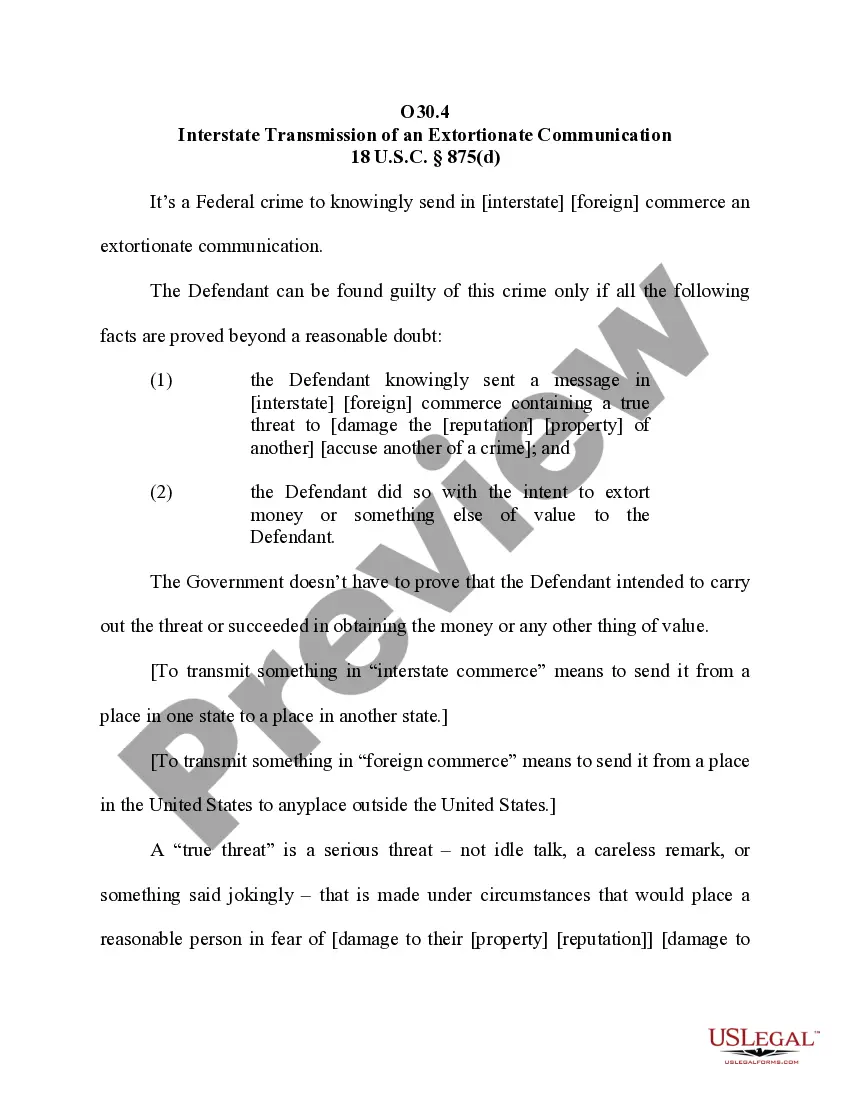
The Interstate Transmission of Extortionate Communication form, also referred to as the extortion communication form, is a legal document used to address violations of 18 U.S.C. § 875(b). This law makes it illegal to transmit threats of harm or kidnapping across state lines or in foreign commerce with the intent to extort money or something of value. This form differs from other legal documents by specifically targeting serious threats communicated in a criminal context, emphasizing the intent to extort rather than mere communication of threats.
Main sections of this form
- The defendant's specific charges under 18 U.S.C. § 875(b).
- Elements that constitute a violation, such as the nature of the communication and intent to extort.
- Definition of a "threat" and the standards for determining its seriousness.
- Clarification on what constitutes "extortion" and "things of value."
- Legal definitions relevant to the case, including "interstate or foreign commerce."

When this form is needed
This form is essential when there is a legal charge or investigation involving the transmission of threats aimed at extorting money or other valuables. It is particularly useful in cases where threats are made across state lines or internationally and where there may be federal jurisdiction.
Who this form is for
- Individuals facing charges of extortion related to interstate communications.
- Defense attorneys representing clients in such cases.
- Legal professionals or advocates involved in criminal justice.
- Victims of extortion who may need to understand the legal concepts involved.
Steps to complete this form
- Identify the specific charges being brought under 18 U.S.C. § 875(b).
- Clearly articulate the nature of the communication that constitutes the threat.
- Document the intent to extort as evidenced in the communication.
- Provide evidence of the communication being transmitted in interstate or foreign commerce.
- Ensure that all definitions and legal standards explained in the form are accurately reflected in any summations.
Notarization requirements for this form
This form does not typically require notarization unless specified by local law. It is advisable to confirm local regulations to ensure compliance.
Get your form ready online
Our built-in tools help you complete, sign, share, and store your documents in one place.
Make edits, fill in missing information, and update formatting in US Legal Forms—just like you would in MS Word.
Download a copy, print it, send it by email, or mail it via USPS—whatever works best for your next step.
Sign and collect signatures with our SignNow integration. Send to multiple recipients, set reminders, and more. Go Premium to unlock E-Sign.
If this form requires notarization, complete it online through a secure video call—no need to meet a notary in person or wait for an appointment.
We protect your documents and personal data by following strict security and privacy standards.

Make edits, fill in missing information, and update formatting in US Legal Forms—just like you would in MS Word.

Download a copy, print it, send it by email, or mail it via USPS—whatever works best for your next step.

Sign and collect signatures with our SignNow integration. Send to multiple recipients, set reminders, and more. Go Premium to unlock E-Sign.

If this form requires notarization, complete it online through a secure video call—no need to meet a notary in person or wait for an appointment.

We protect your documents and personal data by following strict security and privacy standards.
Avoid these common issues
- Failing to demonstrate the required intent to extort.
- Using vague language that does not clearly define the threat communicated.
- Neglecting to provide evidence that the communication crossed state lines or was sent internationally.
- Misunderstanding the definitions of âthreatâ and âextortion,â leading to incorrect applications of the law.
Advantages of online completion
- Convenient access to necessary legal documents without needing to visit a physical office.
- Editable templates allow users to customize forms according to their specific situations.
- Reliability in knowing the forms are drafted and vetted by licensed attorneys.
Legal use & context
- This form embodies federal law and is enforceable across all states.
- The legal context involves serious criminal implications for those found guilty.
- Understanding the nuances of extortion and threats is critical for legal representation.
Summary of main points
- The form pertains to legal violations involving extortionate communications across state lines.
- Clear articulation of threats and intent is necessary for legal effectiveness.
- Understanding the implications of federal law in cases of extortion is crucial.
Looking for another form?

Form popularity
FAQ
Federal Extortion Case Example He sends an e-mail to the boss demanding $1,000,000 in exchange for his silence about the boss' own criminal activity. The defendant employee has violated 18 U.S.C. § 873 by attempting to extort $1,000,000 from the victim, even though he never actually received the payment.
Threatening the president of the United States is a federal felony under United States Code Title 18, Section 871. It consists of knowingly and willfully mailing or otherwise making "any threat to take the life of, to kidnap, or to inflict great bodily harm upon the president of the United States".
The section provides for a penalty for simple assault of a fine, imprisonment for up to one year, or both, and a penalty in all other cases of a fine, imprisonment for up to eight years, or both.
Whoever, under a threat of informing, or as a consideration for not informing, against any violation of any law of the United States, demands or receives any money or other valuable thing, shall be fined under this title or imprisoned not more than one year, or both. (June 25, 1948, ch. 645, 62 Stat.
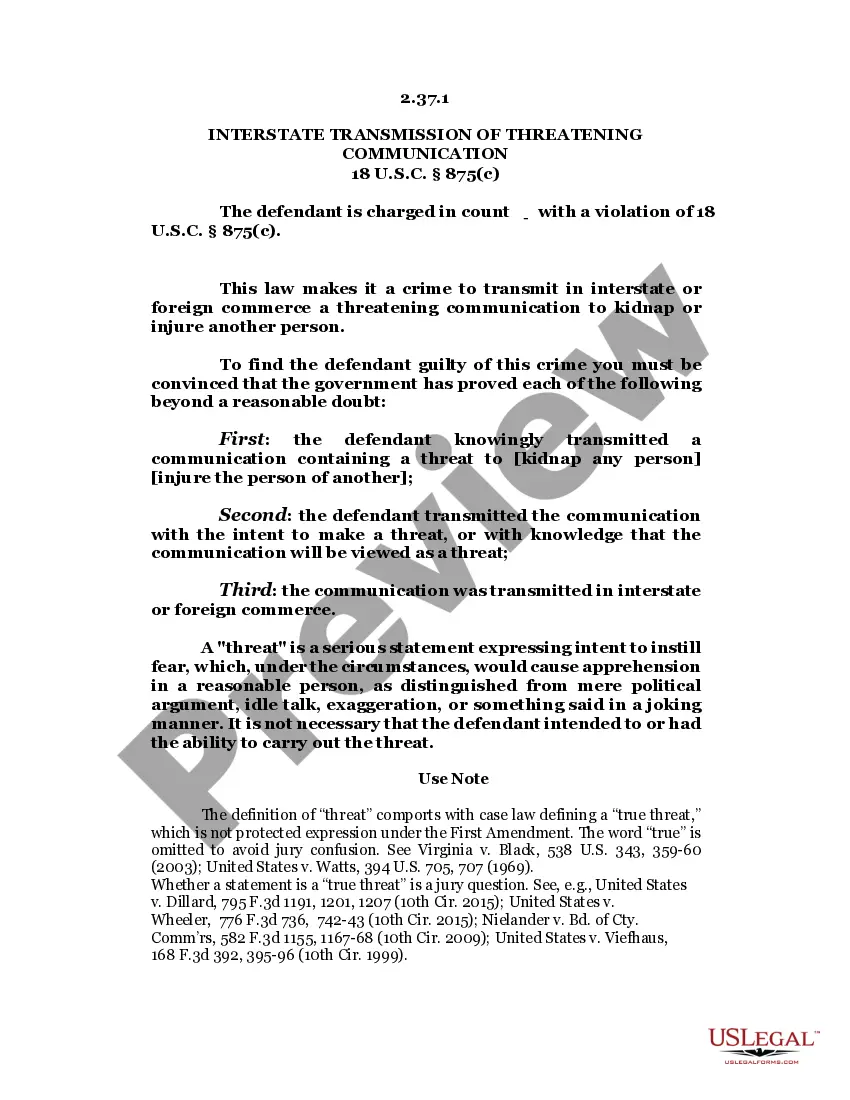
875(c), which provides that any individual who "transmits in interstate or foreign commerce any communication containing any threat to ? injure the person of another" is guilty of a felony and faces up to five years in prison.
Whoever transmits in interstate or foreign commerce any communication containing any demand or request for a ransom or reward for the release of any kidnapped person, shall be fined under this title or imprisoned not more than twenty years, or both.
§ 873 Blackmail or Extortion Penalties. Blackmail or extortion under Title 18 of the United States Code, Section 873 is a federal crime punishable by: up to one year in federal prison, a fine, or both imprisonment and a fine.