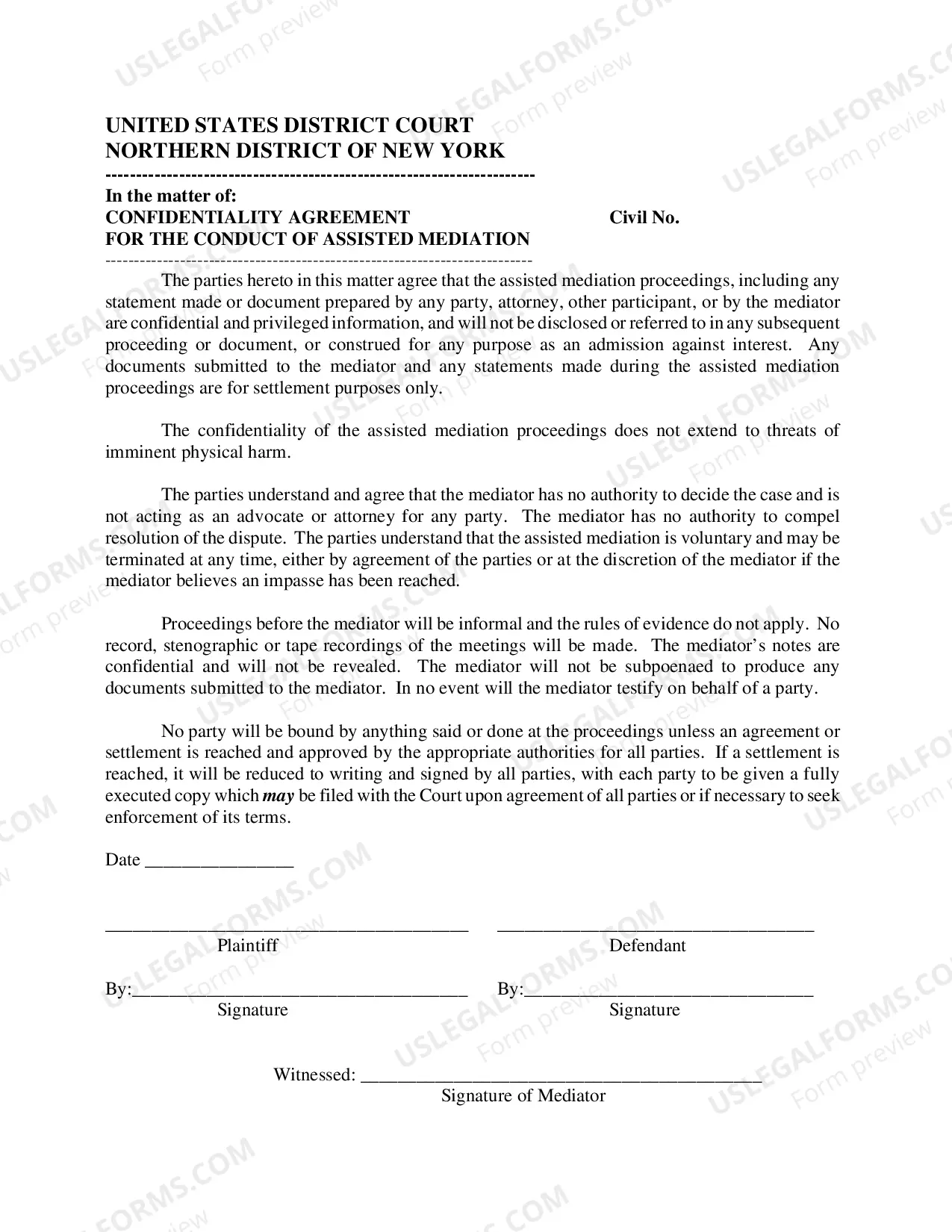
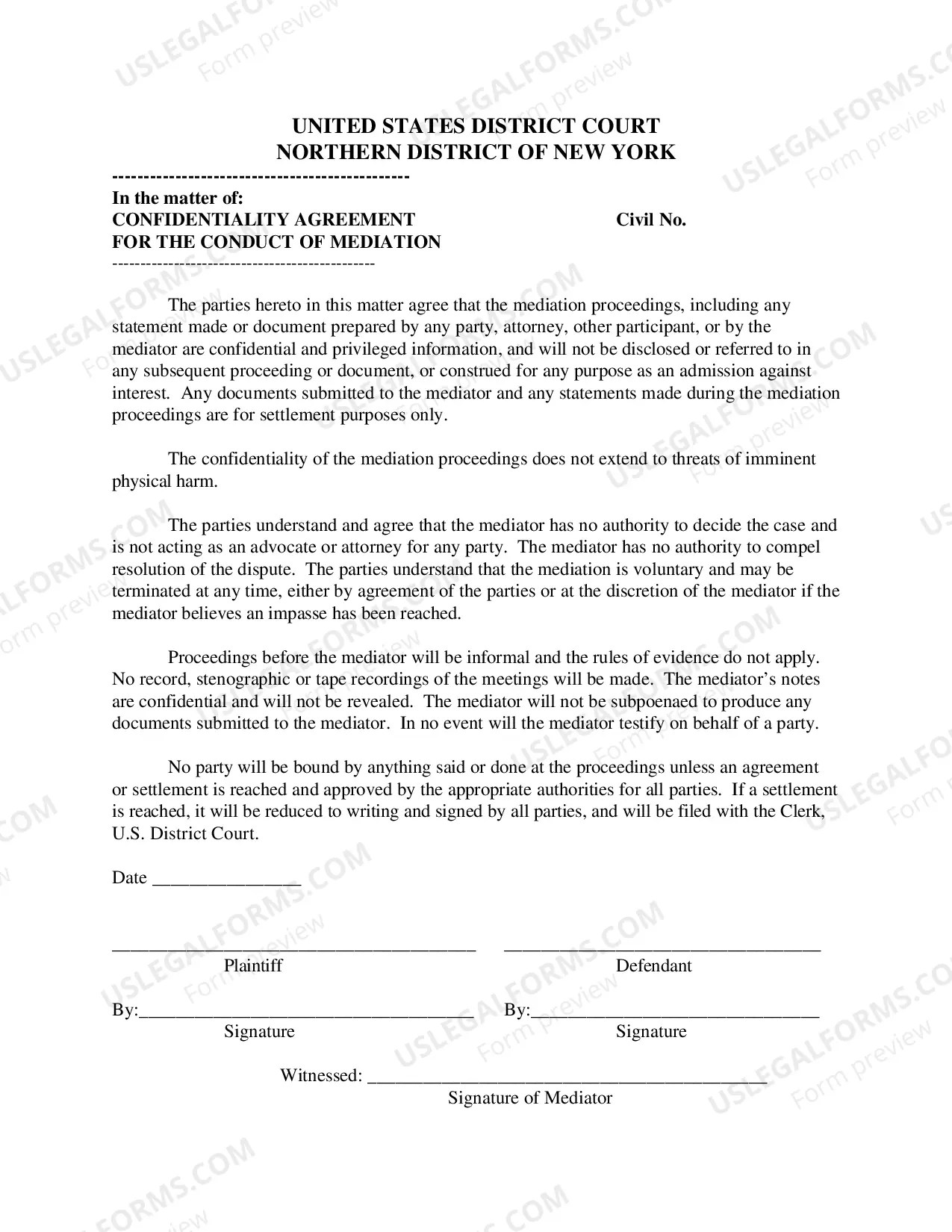
New York Confidentiality Assisted Mediation (NY CAM) is a dispute resolution process that helps parties in conflict resolve their issues in a private, confidential, and respectful manner. NY CAM is a form of alternative dispute resolution (ADR), which is an effective means of resolving disputes outside the traditional court system. NY CAM is tailored to the needs of the parties and can include any combination of the following processes: facilitative mediation, evaluative mediation, mediation-arbitration, and private judging. Each process involves a trained and experienced mediator who helps the parties reach a mutually acceptable agreement. The mediator facilitates communication between the parties and helps them identify underlying interests and needs. The mediator also works with the parties to develop a settlement agreement that is agreeable to both sides. The mediator ensures that all parties are treated fairly throughout the process and that the negotiated agreement is legally binding. NY CAM offers a quick, cost-effective, and confidential way to resolve disputes without the need for a lengthy and expensive court battle. It is a useful tool for parties who want to maintain privacy and control of the process and outcome.
New York Confidentiality Assisted Mediation
Description
Get your form ready online
Our built-in tools help you complete, sign, share, and store your documents in one place.
Make edits, fill in missing information, and update formatting in US Legal Forms—just like you would in MS Word.
Download a copy, print it, send it by email, or mail it via USPS—whatever works best for your next step.
Sign and collect signatures with our SignNow integration. Send to multiple recipients, set reminders, and more. Go Premium to unlock E-Sign.
If this form requires notarization, complete it online through a secure video call—no need to meet a notary in person or wait for an appointment.
We protect your documents and personal data by following strict security and privacy standards.

Make edits, fill in missing information, and update formatting in US Legal Forms—just like you would in MS Word.

Download a copy, print it, send it by email, or mail it via USPS—whatever works best for your next step.

Sign and collect signatures with our SignNow integration. Send to multiple recipients, set reminders, and more. Go Premium to unlock E-Sign.

If this form requires notarization, complete it online through a secure video call—no need to meet a notary in person or wait for an appointment.

We protect your documents and personal data by following strict security and privacy standards.
Looking for another form?

How to fill out New York Confidentiality Assisted Mediation?
If you’re looking for a way to properly prepare the New York Confidentiality Assisted Mediation without hiring a legal professional, then you’re just in the right spot. US Legal Forms has proven itself as the most extensive and reliable library of official templates for every private and business scenario. Every piece of documentation you find on our online service is drafted in accordance with nationwide and state laws, so you can be certain that your documents are in order.
Follow these simple guidelines on how to obtain the ready-to-use New York Confidentiality Assisted Mediation:
- Make sure the document you see on the page meets your legal situation and state laws by examining its text description or looking through the Preview mode.
- Type in the document name in the Search tab on the top of the page and select your state from the dropdown to find another template if there are any inconsistencies.
- Repeat with the content check and click Buy now when you are confident with the paperwork compliance with all the requirements.
- Log in to your account and click Download. Sign up for the service and choose the subscription plan if you still don’t have one.
- Use your credit card or the PayPal option to purchase your US Legal Forms subscription. The document will be available to download right after.
- Decide in what format you want to get your New York Confidentiality Assisted Mediation and download it by clicking the appropriate button.
- Import your template to an online editor to fill out and sign it quickly or print it out to prepare your paper copy manually.
Another wonderful thing about US Legal Forms is that you never lose the paperwork you purchased - you can pick any of your downloaded blanks in the My Forms tab of your profile whenever you need it.
Form popularity
FAQ
Confidentiality is at the heart of a mediation session and is critical to a successful resolution. The parties must be assured that they can share sensitive information at the session, where it is necessary to see that their true needs and interests may be met, without fear of subsequent disclosure to their detriment.
A confidential mediation statement, on the other hand, provides an opportunity to clearly assert your client's strengths and the other side's weaknesses without having to pull your punches, enabling you to telegraph to the mediator the arguments about which you are most confident.
There is no New York or federal statute that creates a mediation privilege or guarantees confidentiality with the sole exception of McKinney's Judiciary law § 849-b, which prohibits disclosure of a mediator's writings and files, but only applies to community dispute resolution centres, not courts.
Typically, anything that gets said at mediation will be considered confidential. This is particularly important when it comes to monetary negotiations. However, in addition to the numbers exchanged, and statements made at mediation, any documents submitted, or evidence relied upon, will also be confidential.
The parties may not disclose discussions or other communications with the mediator unless all parties agree, because it is required by law, or because otherwise confidential communications are relevant to a complaint against a mediator or the Mediation Program arising out of the mediation.
Some of the statutory exceptions include (1) when disclosure is necessary for criminal prosecution; (2) when necessary to prove coercion or fraud that led to the mediated settlement; (3) in order to establish the existence or terms of a settlement agreement; and (4) when necessary to impose sanctions or to discipline
¶ (c) All communications, negotiations, or settlement discussions by and between participants in the course of a mediation or a mediation consultation shall remain confidential.? A party cannot, however, utilize mediation to protect from discovery otherwise discoverable evidence.