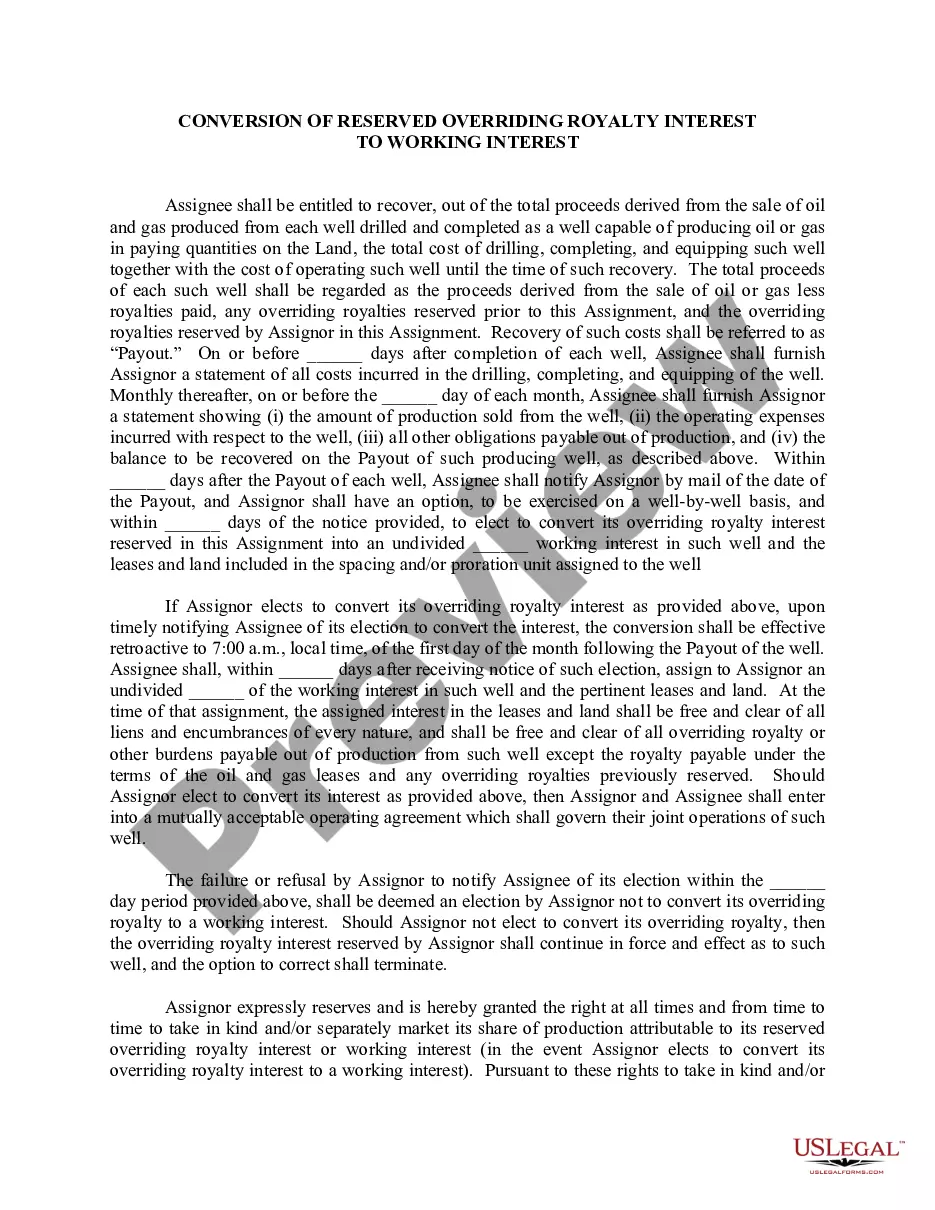
New York Judgment of Default
About this form
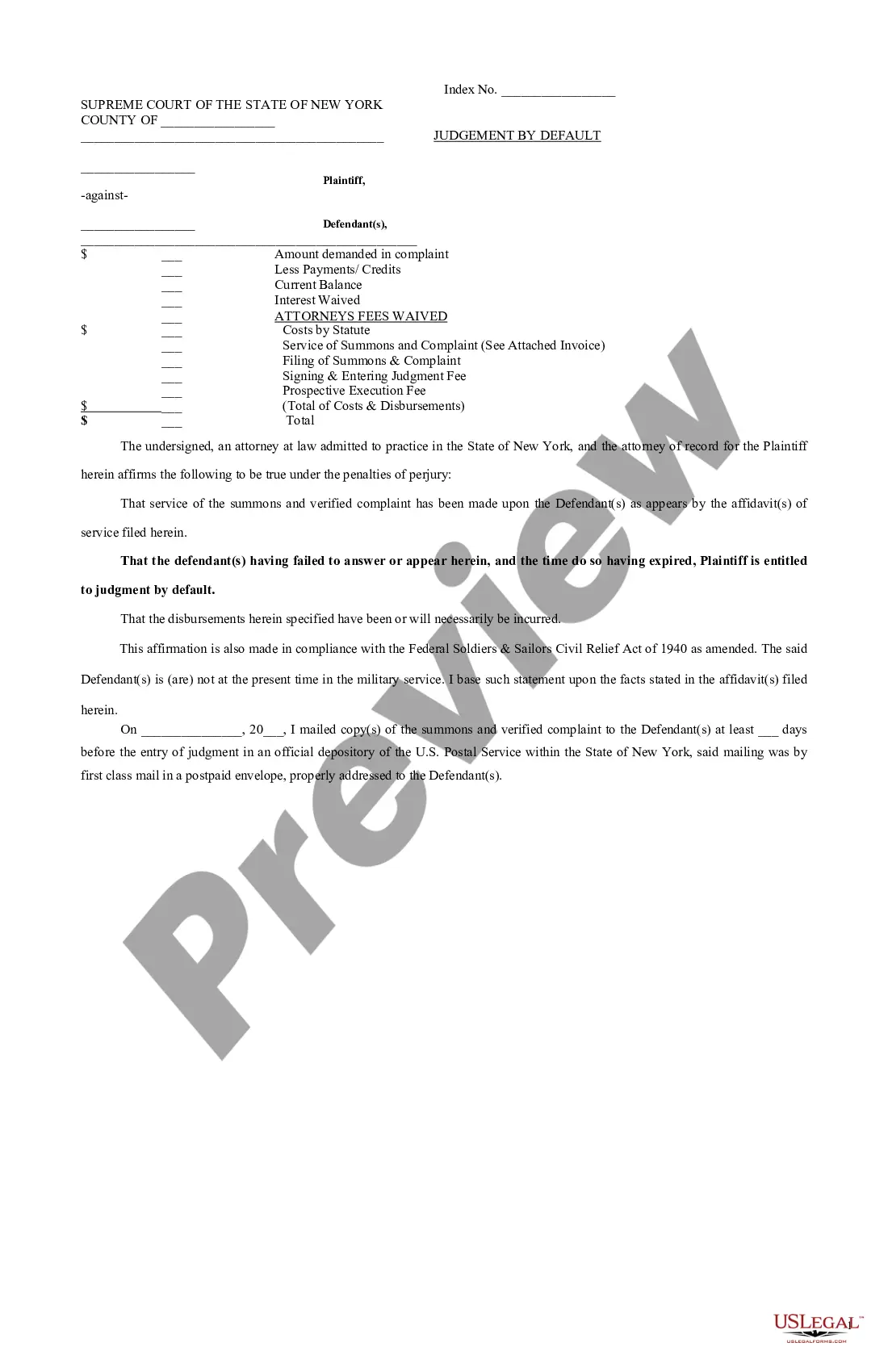
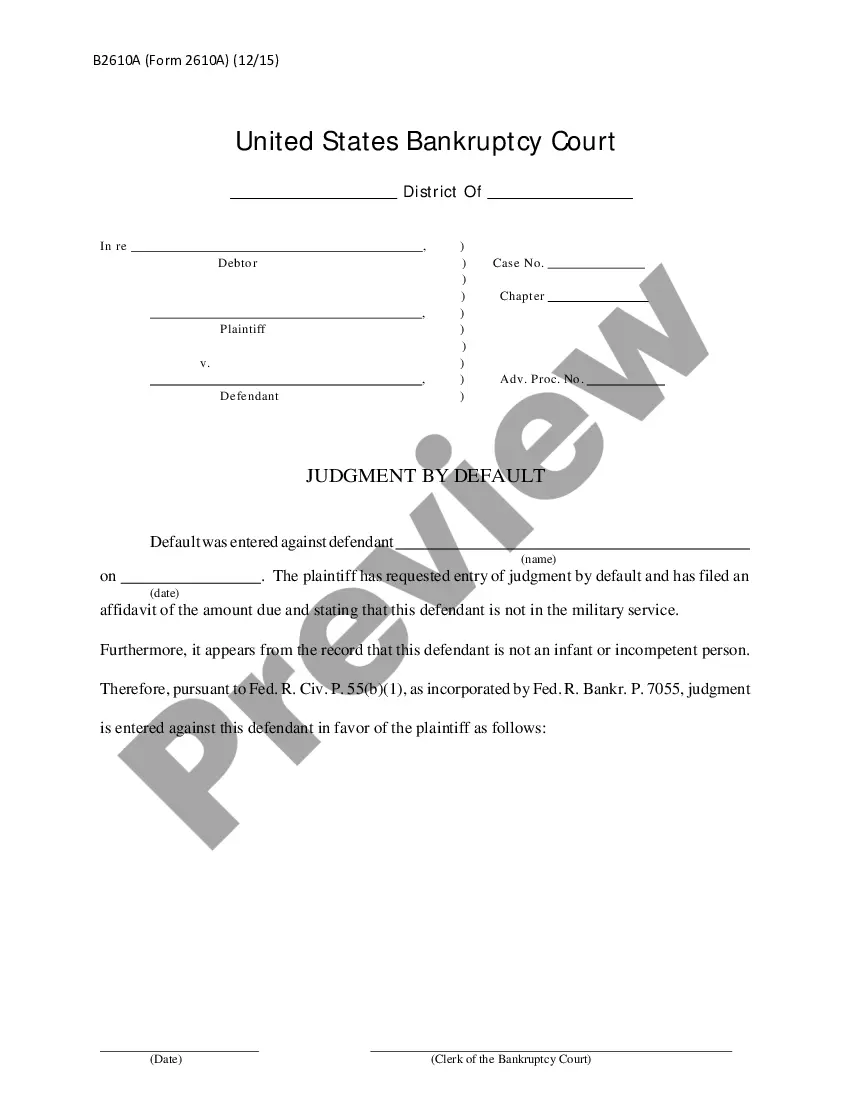
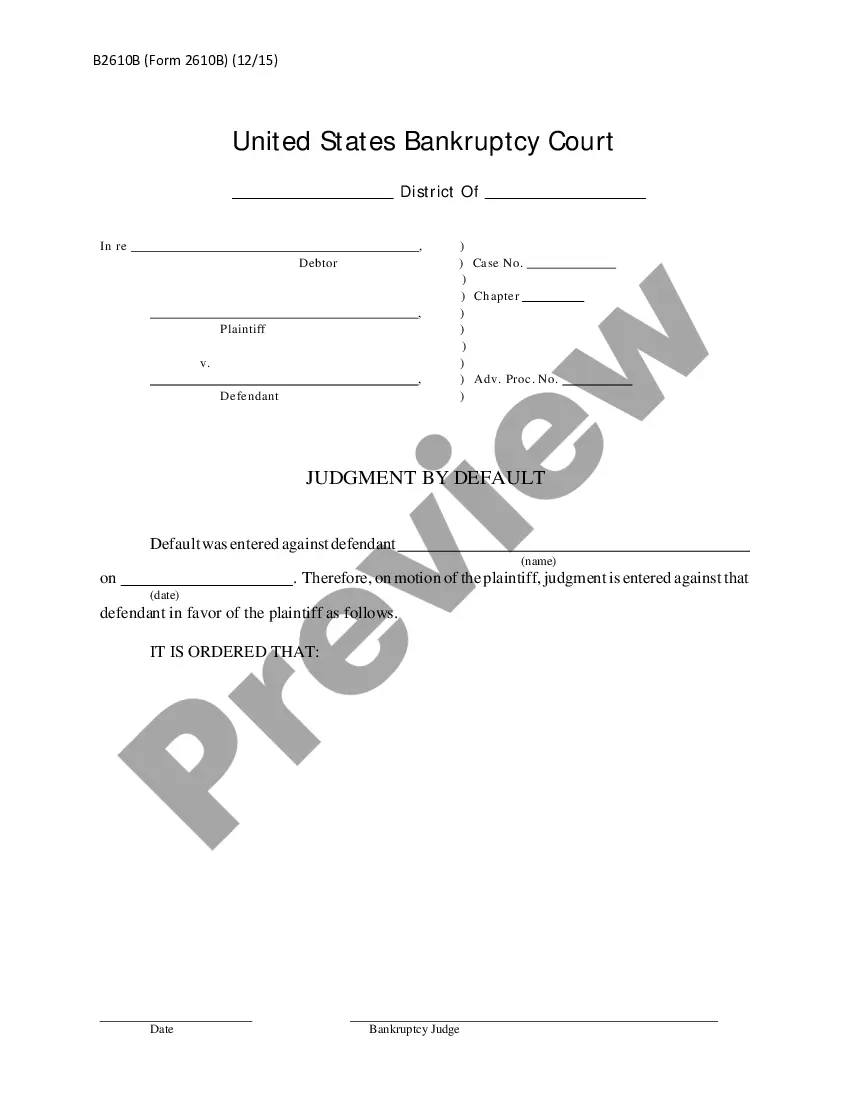
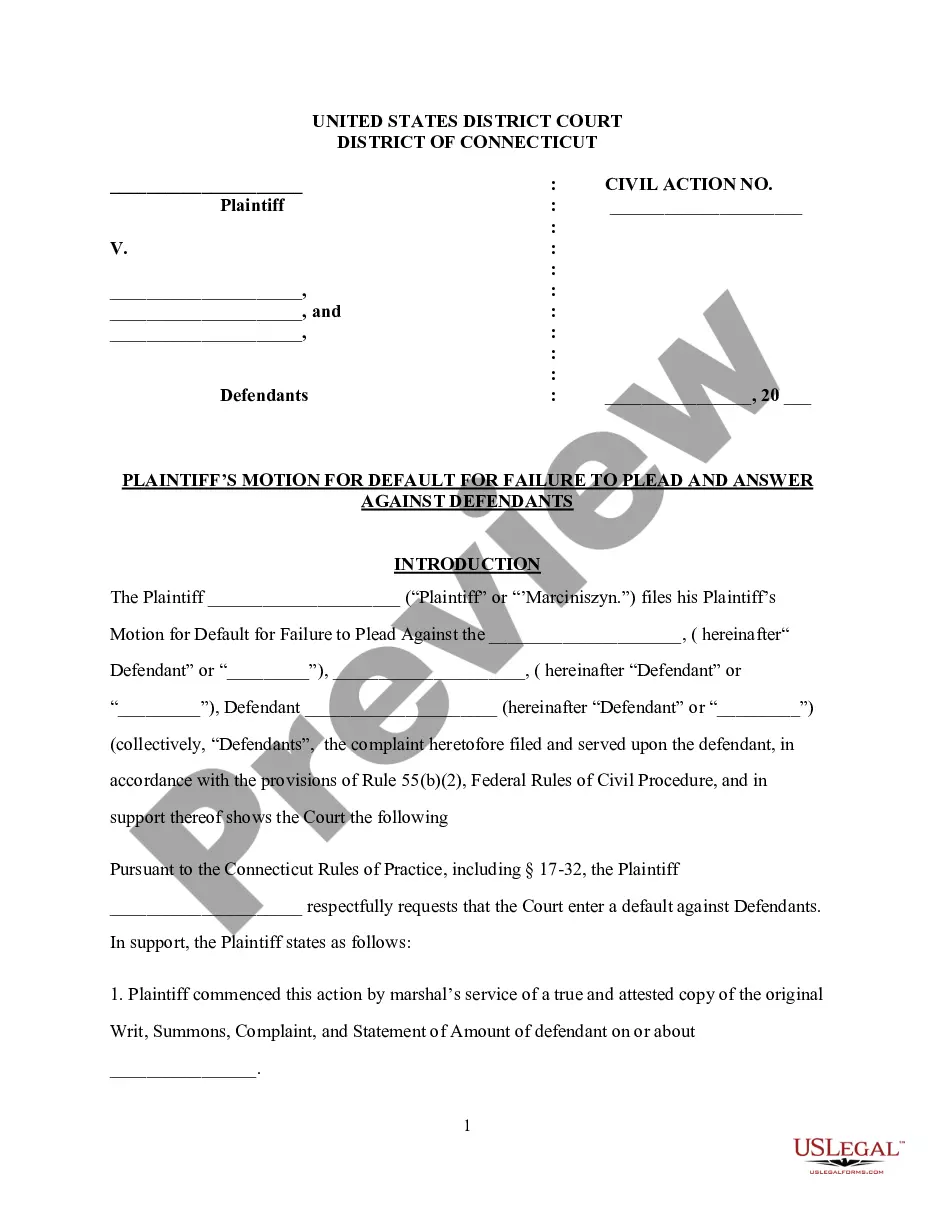
The Judgment of Default is a legal document filed in court when a defendant fails to respond to a summons and verified complaint. This form is specifically used to obtain a default judgment, meaning the plaintiff requests the court to rule in their favor due to the other party's inaction. Unlike contested judgments, default judgments arise without any disputes or hearings, streamlining the recovery process for plaintiffs.
Key parts of this document
- Index number: Unique identifier for the court case.
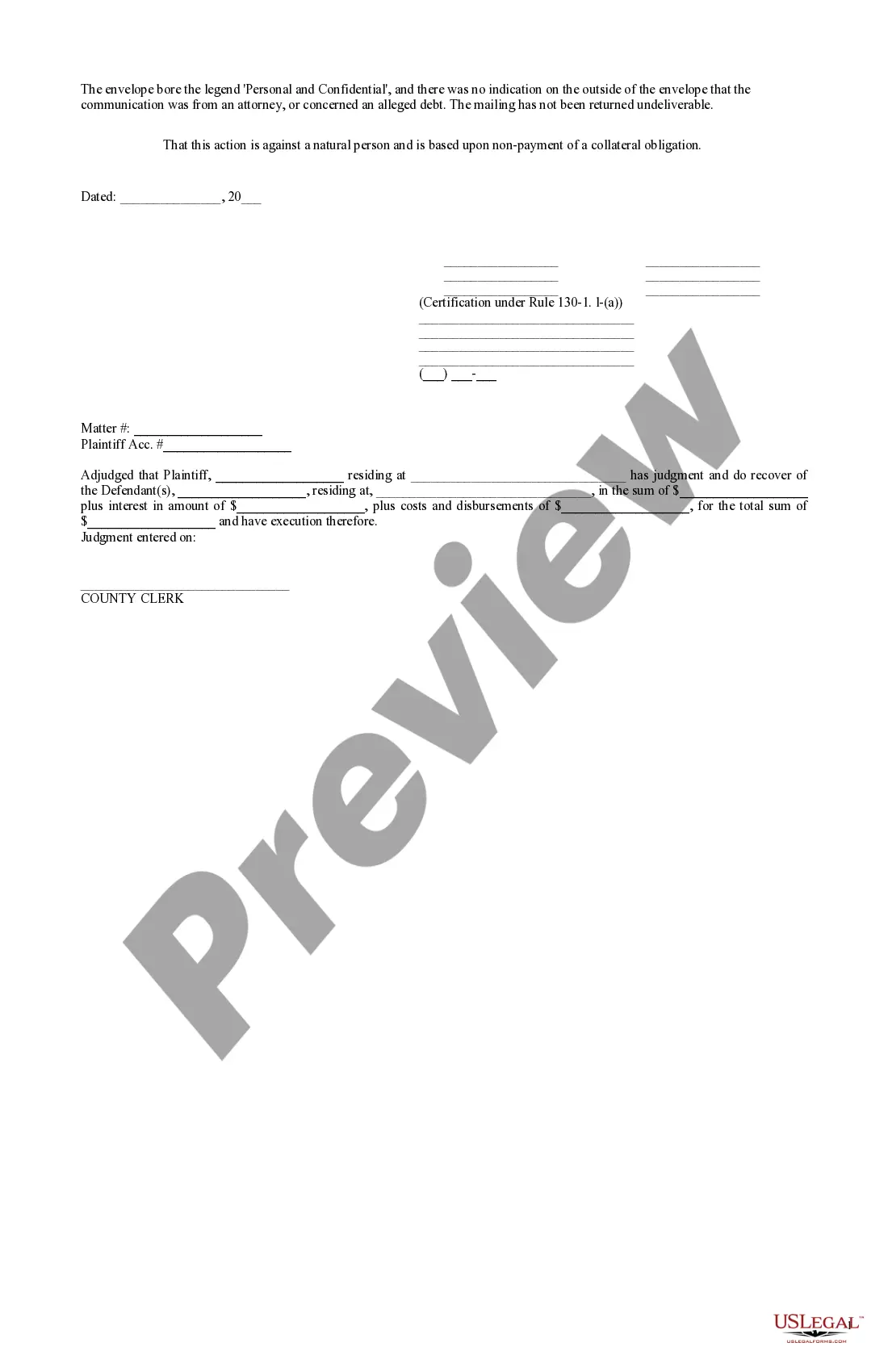
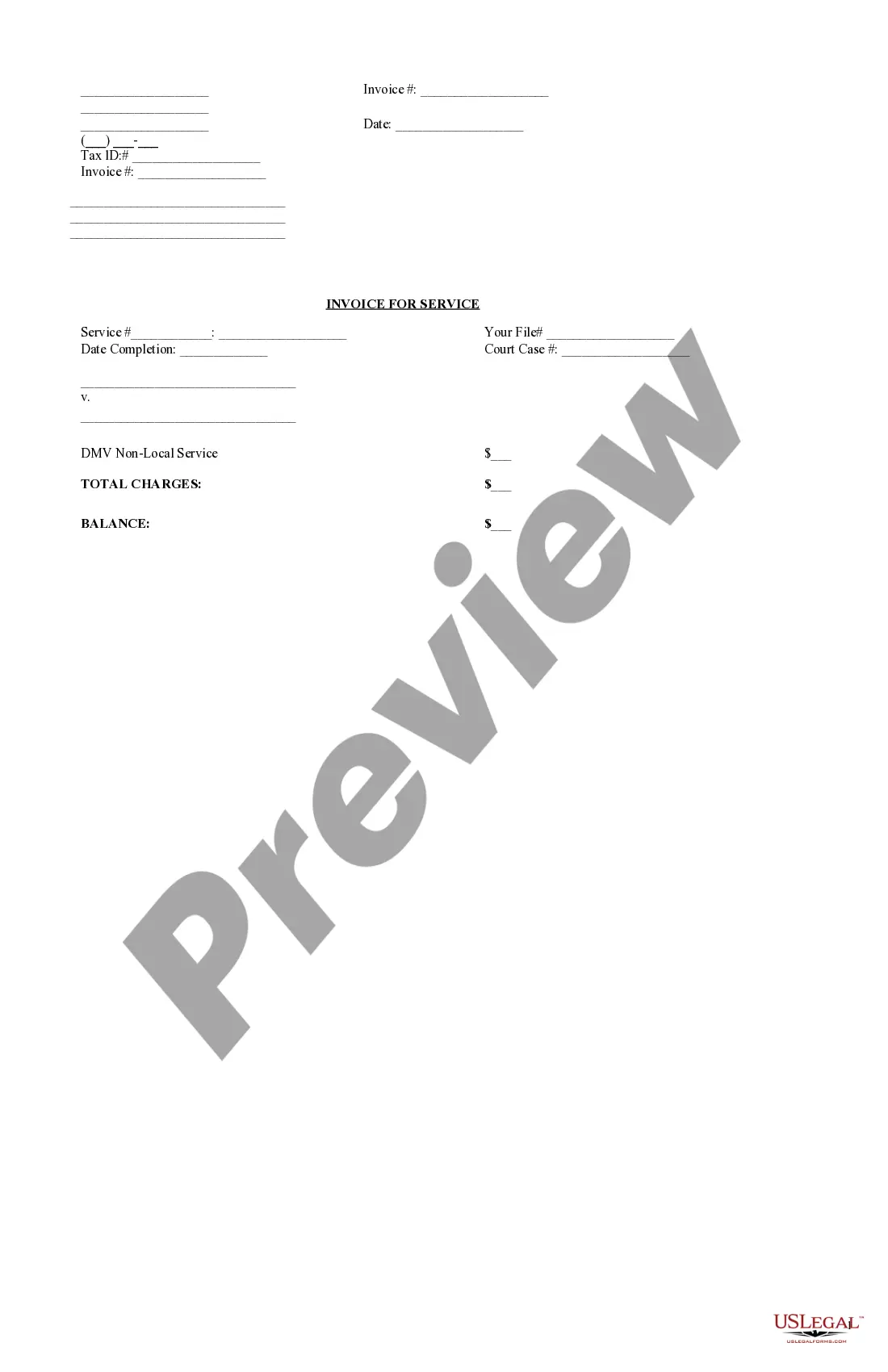
- Judgment details: Amount demanded, payments, current balance, and calculation of total costs.
- Affirmation by the plaintiff's attorney: Verification of service and entitlement to judgment.
- Certification: Details regarding compliance and confirmation that the defendant is not in military service.
- Entry date: When the judgment is officially recorded.
Situations where this form applies
This form should be used when the defendant has failed to respond to a legal complaint or summons within the required time frame. Typical situations include collections for unpaid debts or breach of contract where the defendant has not engaged in the legal process. By filing this form, plaintiff can secure a ruling without needing to present evidence in a contested court hearing.
Who should use this form
- Individuals or businesses seeking to recover a debt.
- Legal professionals representing plaintiffs in civil cases.
- Anyone filing a lawsuit that leads to a defendant's non-response.
Completing this form step by step
- Fill in the index number and court information at the top of the document.
- Specify the amount demanded, any payments or credits, and the total amount owed.
- Include the attorney's affirmation confirming service of the summons and complaint.
- Document the mailing details, including the dates and manner of service to the defendant.
- Sign and date the form as required, and ensure all required fields are completed.
Is notarization required?
This form does not typically require notarization unless specified by local law. It is advisable to check state-specific regulations to confirm any requirements regarding notarization.
Get your form ready online
Our built-in tools help you complete, sign, share, and store your documents in one place.
Make edits, fill in missing information, and update formatting in US Legal Forms—just like you would in MS Word.
Download a copy, print it, send it by email, or mail it via USPS—whatever works best for your next step.
Sign and collect signatures with our SignNow integration. Send to multiple recipients, set reminders, and more. Go Premium to unlock E-Sign.
If this form requires notarization, complete it online through a secure video call—no need to meet a notary in person or wait for an appointment.
We protect your documents and personal data by following strict security and privacy standards.

Make edits, fill in missing information, and update formatting in US Legal Forms—just like you would in MS Word.

Download a copy, print it, send it by email, or mail it via USPS—whatever works best for your next step.

Sign and collect signatures with our SignNow integration. Send to multiple recipients, set reminders, and more. Go Premium to unlock E-Sign.

If this form requires notarization, complete it online through a secure video call—no need to meet a notary in person or wait for an appointment.

We protect your documents and personal data by following strict security and privacy standards.
Mistakes to watch out for
- Failing to include the index number, which is essential for case identification.
- Not verifying whether the defendant is in military service, which can impact the ability to obtain a default judgment.
- Skipping the affirmation by the attorney, which is critical for legal validation of the judgment.
- Not correctly specifying the amount sought, resulting in confusion or legal challenges.
Benefits of completing this form online
- Convenient access to templates that can be downloaded immediately.
- Ability to edit the form to fit specific case requirements before printing.
- Drafted by licensed attorneys, ensuring compliance with legal standards.
- Time-saving process compared to traditional legal service methods.
Main things to remember
- The Judgment of Default is used when a defendant fails to respond.
- This form streamlines the process for obtaining a judgment in favor of the plaintiff.
- Accurate completion and submission are crucial for legal validity.
- Always verify any state-specific requirements or additional documents needed when filing.
Looking for another form?
Form popularity
FAQ
A judgment is good for 20 years, but if the plaintiff wants to enforce the judgment against land it is only good for 10 years unless the plaintiff renews it for another 10 years.
A default judgment means that the court has decided that you owe money. This a result of the person suing you in small claims court and you failed to appear at the hearing.
A money judgment obtained in NY is enforceable for a period of 20 years from the greater of (1) the judgment entry date, or (2) the date of any post judgment payments.
In order to vacate, set aside, or remove a default judgment in New York, you must make a motion to the court in which the judgment was entered. The motion will contain a specific request for the court to vacate the judgment and return monies taken to satisfy the judgment.
The statute of limitations in New York is six years for any type of debt. The six-year time period is counted from when a debt repayment became due or when the debtor made the most recent payment, whichever is more recent.
New York State judgments are valid for 20 years. A judgment can act as a lien on real property for ten years which may be extended for an additional term if you to take affirmative action.
California allows the judgment to last ten years and it can be renewed for an additional ten years if the creditor files the required forms in a timely fashion. Failure to renew the judgment prior to the ten-year time limit voids the judgment forever.
New York State judgments are valid for 20 years. A judgment can act as a lien on real property for ten years which may be extended for an additional term if you to take affirmative action.
The action for renewal judgment may be commenced by filing a summons and complaint or a summons, a motion for summary judgment in lieu of a complaint and an affidavit by a person with personal knowledge of the facts by offering evidentiary proof that he/she is the original judgment creditor, or the judgment creditor's