New York Quitclaim Deed - Individual to Individual with a Retained Life Estate
Understanding this form
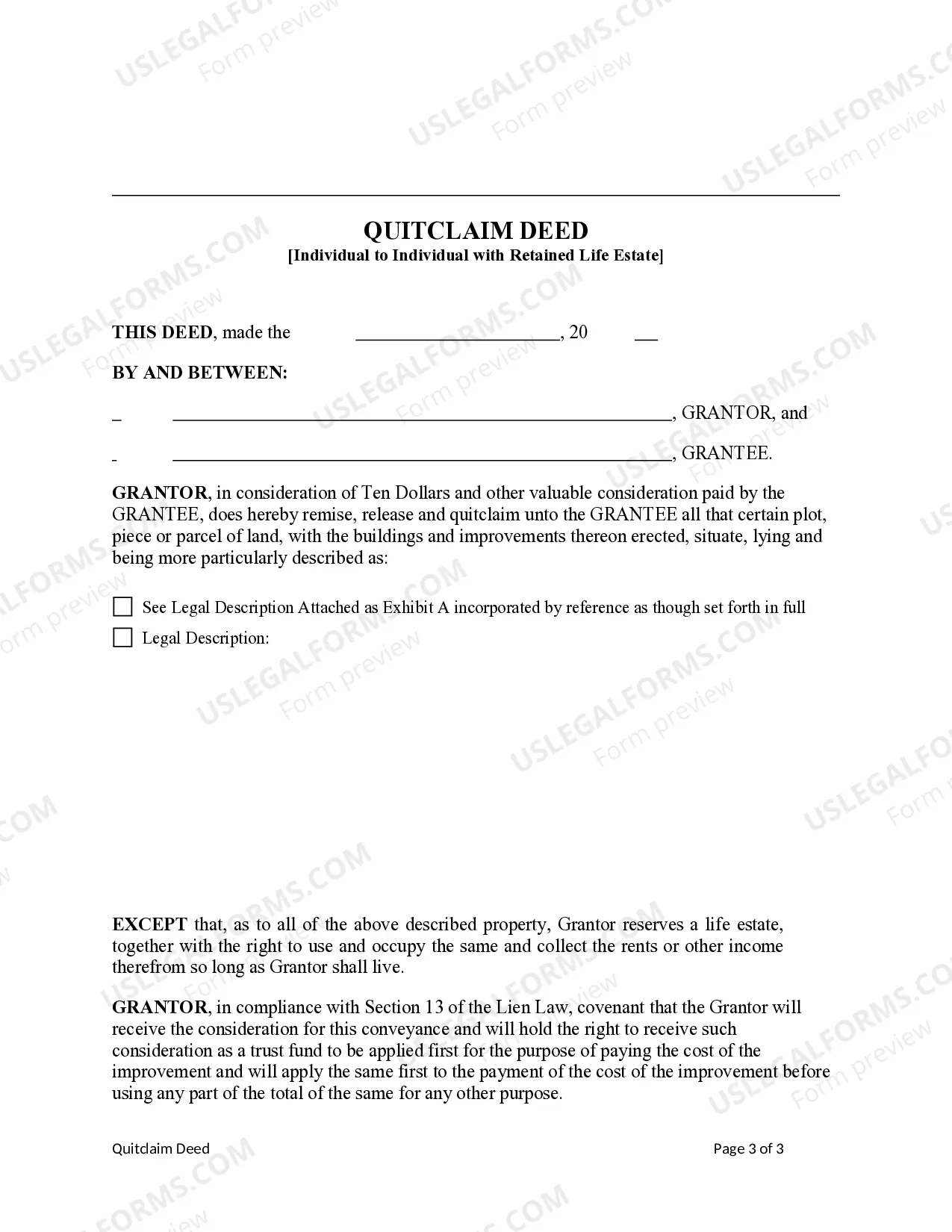
The Quitclaim Deed - Individual to Individual with a Retained Life Estate is a legal document that allows one individual (the Grantor) to transfer ownership of a property to another individual (the Grantee), while retaining the right to use the property for the rest of their life. This form is commonly used when the Grantor wishes to pass property to a family member or friend while maintaining a life interest in the property. Unlike a warranty deed, a quitclaim deed does not guarantee that the Grantor holds valid title or the right to convey the property.
Form components explained
- Identification of parties: Clearly defines the Grantor and Grantee.
- Property description: Provides a detailed description of the property being transferred.
- Life estate clause: Specifies that the Grantor retains a life estate in the property.
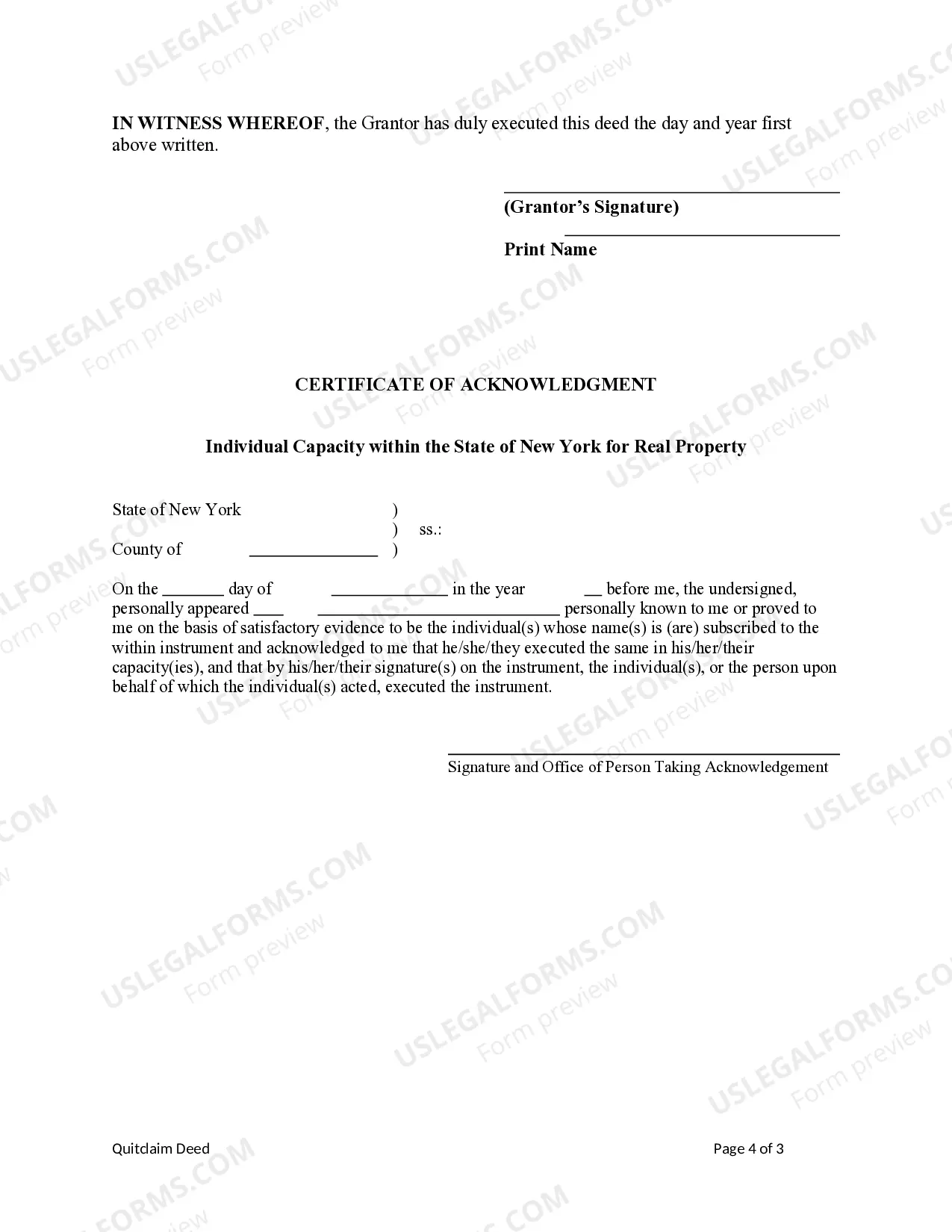
- Signatures: Requires the signature of the Grantor and a witness or notary as applicable.
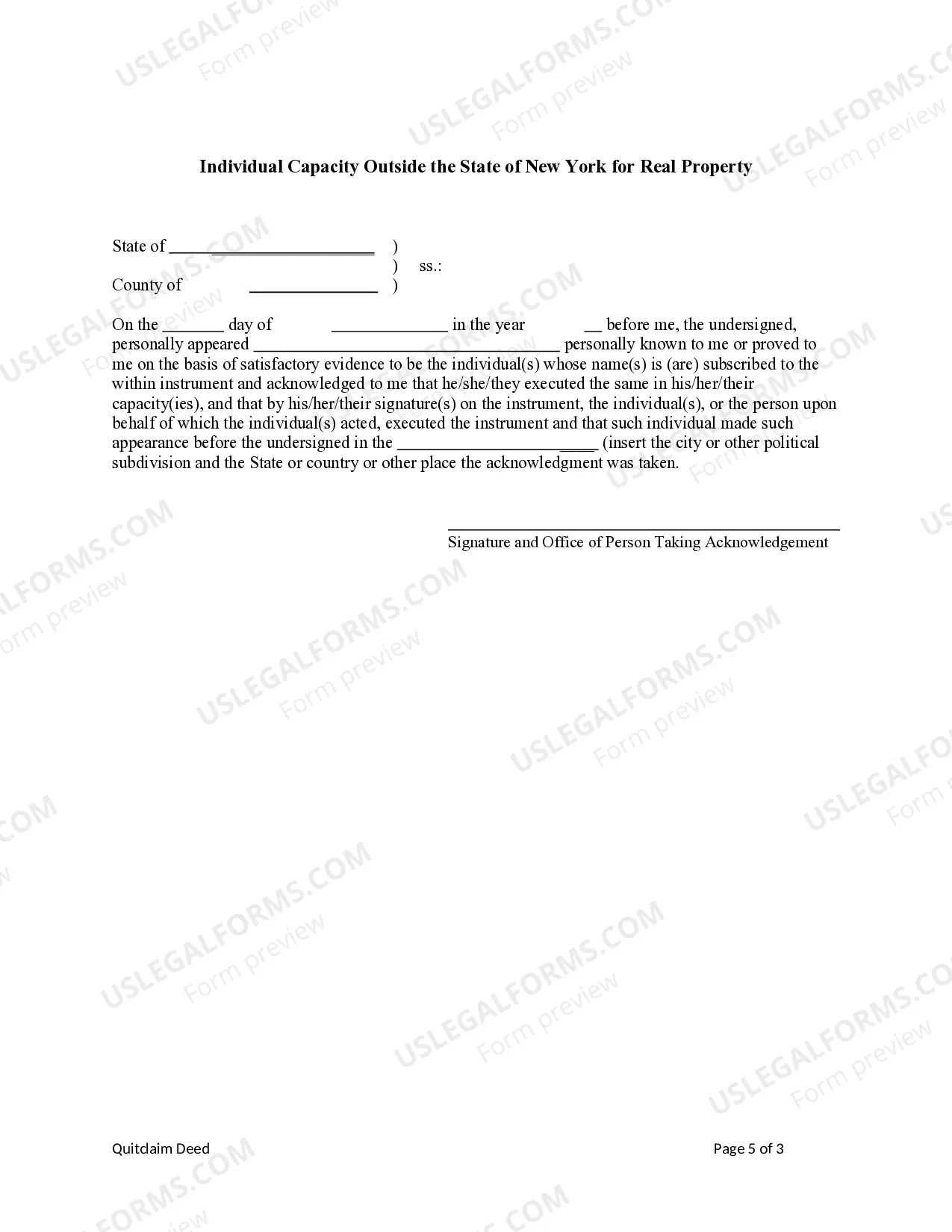
- Legal acknowledgment: Includes a section for the acknowledgment needed for legal validity.




Situations where this form applies
This form is typically used in situations where an individual wants to transfer property ownership to another person while retaining the right to live in or use the property for the rest of their life. Examples include transferring family land to children while continuing to reside on the property or facilitating a friendly transfer of property ownership among friends. It is particularly useful in estate planning scenarios.
Who should use this form
- Individuals looking to transfer real property to another person.
- Property owners who wish to retain a life estate after the transfer.
- Families planning their estate and property transitions.
- Anyone needing a straightforward property transfer without the need for warranty claims.
Steps to complete this form
- Identify the Grantor and Grantee: Enter the full names of the individuals involved in the transfer.
- Specify the property: Clearly describe the property being conveyed, including address and legal description.
- Include life estate details: Add a clause that explicitly states the Grantor retains a life estate in the property.
- Obtain necessary signatures: Have the Grantor sign the deed in the presence of a witness or notary.
- File the deed: Ensure the completed deed is filed with the appropriate local government office to finalize the transfer.
Notarization guidance
To make this form legally binding, it must be notarized. Our online notarization service, powered by Notarize, lets you verify and sign documents remotely through an encrypted video session.
Get your form ready online
Our built-in tools help you complete, sign, share, and store your documents in one place.
Make edits, fill in missing information, and update formatting in US Legal Forms—just like you would in MS Word.
Download a copy, print it, send it by email, or mail it via USPS—whatever works best for your next step.
Sign and collect signatures with our SignNow integration. Send to multiple recipients, set reminders, and more. Go Premium to unlock E-Sign.
If this form requires notarization, complete it online through a secure video call—no need to meet a notary in person or wait for an appointment.
We protect your documents and personal data by following strict security and privacy standards.

Make edits, fill in missing information, and update formatting in US Legal Forms—just like you would in MS Word.

Download a copy, print it, send it by email, or mail it via USPS—whatever works best for your next step.

Sign and collect signatures with our SignNow integration. Send to multiple recipients, set reminders, and more. Go Premium to unlock E-Sign.

If this form requires notarization, complete it online through a secure video call—no need to meet a notary in person or wait for an appointment.

We protect your documents and personal data by following strict security and privacy standards.
Avoid these common issues
- Failing to accurately describe the property can lead to disputes.
- Not retaining a life estate clause if the Grantor intends to stay on the property.
- Neglecting to sign the deed in front of the required witnesses or notary.
- Forgetting to file the deed with the local office for it to be legally effective.
Why complete this form online
- Convenience of completing the form at your own pace from any device.
- Editability allows for easy corrections and updates before finalizing.
- Access to templates drafted by legal professionals ensures reliability and compliance.
Summary of main points
- The Quitclaim Deed allows property transfer while retaining a life estate.
- It is crucial to properly describe the property being conveyed.
- Obtaining proper notarization is essential for the document's validity.
- This form is particularly useful for estate planning and family property transfers.
Looking for another form?
Form popularity
FAQ
If the quitclaim deed requires the signature of all co-owners, the deed is invalid unless all co-owners have signed it and the deed is then delivered to the grantee.If one individual owns real estate and desires to add a co-owner such as a spouse, a quitclaim deed might be used.
1 attorney answer Your mother's dementia does not, as a matter of law, make her incapable of executing a quitclaim deed. However, if your Power of Attorney was duly recorded and is a General Power of Attorney, you are the person who is the attorney in fact for...
In general, a person with dementia can sign a power of attorney designation if they have the capacity to understand what the document is, what it does, and what they are approving. Most seniors living with early stage dementia are able to make this designation.
A certain level of capacity is necessary in order to sign legal documents. Someone who is in the end stages of Alzheimer's disease probably does not have the requisite capacity to sign legal documents. However, a person with a diagnosis of dementia may very well be able to sign legal documents.
Fill in the deed form. Print it out. Have the grantor(s) sign and get the signature(s) notarized. Complete a transfer tax form, Form TP-584. Complete and print out Form RP-5217 (or, if you are in New York City, Form RP-5217NYC).
Fill out the quit claim deed form, which can be obtained online, or write your own using the form as a guide. The person giving up the interest in the property is the grantor, and the person receiving the interest is the grantee.
Legal Documents These documents can authorize another person to make health care and financial decisions, including plans for long-term care. As much as possible, the person with Alzheimer's should participate in legal planning, as long as they are mentally able to sign official documents.
Yes, you can use a Quitclaim Deed to transfer a gift of property to someone. You must still include consideration when filing your Quitclaim Deed with the County Recorder's Office to show that title has been transferred, so you would use $10.00 as the consideration for the property.
But you might be wondering if an owner can transfer a deed to another person without a real estate lawyer. The answer is yes. Parties to a transaction are always free to prepare their own deeds.A quitclaim deed, for example, is far simpler than a warranty deed.