New York Quitclaim Deed - One Individual to Three Individuals
Understanding this form
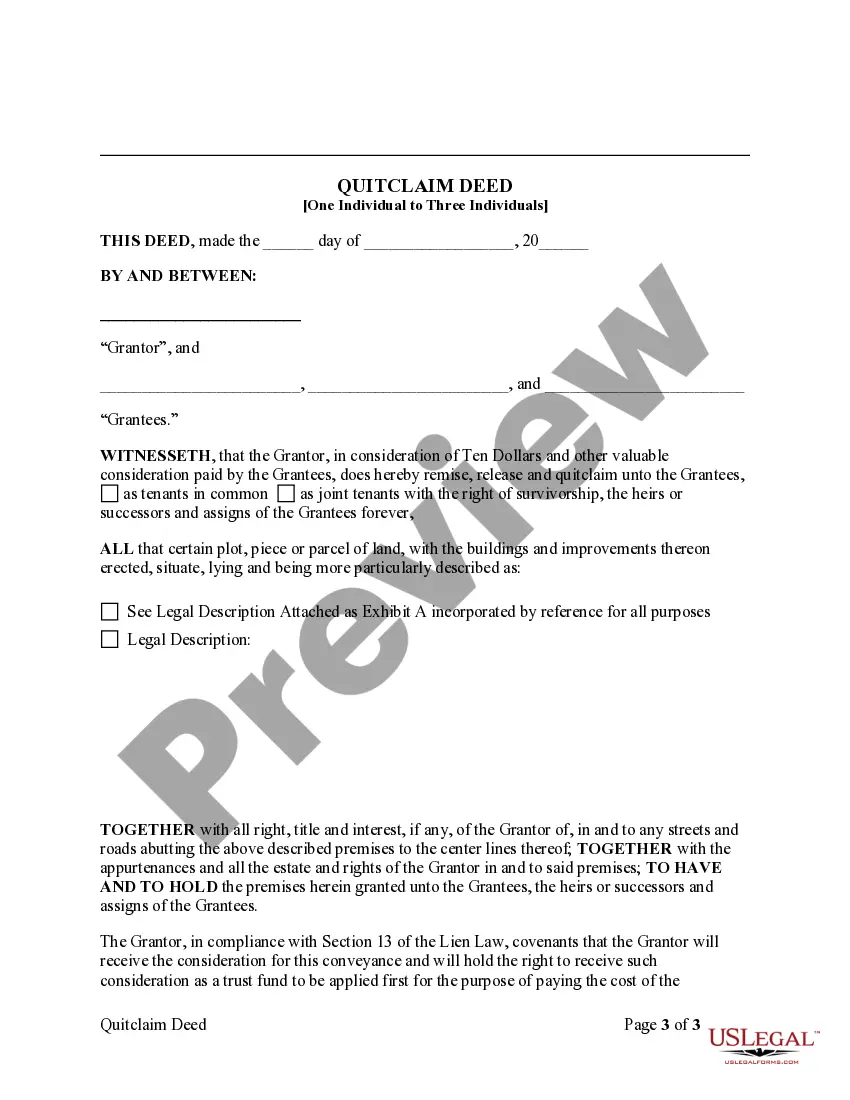
This Quitclaim Deed form allows one individual (the grantor) to transfer ownership of real estate to three individuals (the grantees). Unlike other types of deeds, a quitclaim deed does not guarantee that the grantor has clear title to the property, making it a simpler and quicker way to convey property rights. This specific form is particularly tailored for situations where property ownership is being shared among multiple individuals.
Main sections of this form
- Identification of the grantor and the three grantees.
- Property description detailing the land being transferred.
- Consideration amount, typically stated as Ten Dollars.
- Specification of the type of tenancy (tenants in common or joint tenants with the right of survivorship).
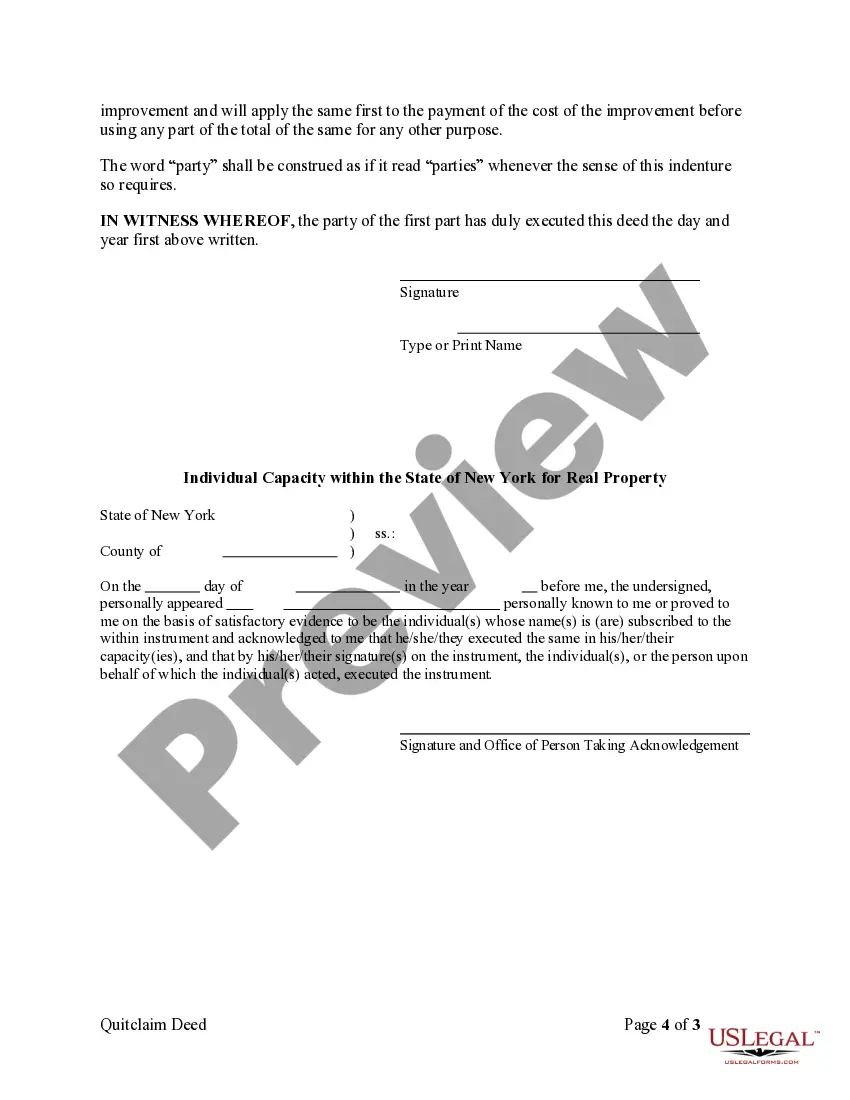
- Signature lines for the grantor and acknowledgment section for notarization.





When this form is needed
This form is useful when an individual wishes to transfer property ownership to three other individuals without a lengthy legal process. It's commonly used in family transactions, among co-investors, or in circumstances where the grantor wishes to simplify the transfer of property rights. Real estate transactions that don't require full warranties of title are ideal scenarios for the use of a quitclaim deed.
Who this form is for
Consider this form if:
- You are an individual looking to transfer property ownership to three other individuals.
- You want a straightforward, quick method for property transfer without warranties.
- You are involved in a family or partnership arrangement regarding real estate ownership.
How to complete this form
- Identify the grantor and the three grantees by entering their names.
- Specify the property being conveyed in detail, including any legal description if necessary.
- Enter the date of the deed.
- Include the consideration amount.
- Sign the deed where indicated, and ensure it is acknowledged if required.
Does this document require notarization?
This form does not typically require notarization unless specified by local law. However, it is recommended to have the deed notarized to ensure its validity and proper acknowledgment, which can help avoid disputes in the future.
Get your form ready online
Our built-in tools help you complete, sign, share, and store your documents in one place.
Make edits, fill in missing information, and update formatting in US Legal Forms—just like you would in MS Word.
Download a copy, print it, send it by email, or mail it via USPS—whatever works best for your next step.
Sign and collect signatures with our SignNow integration. Send to multiple recipients, set reminders, and more. Go Premium to unlock E-Sign.
If this form requires notarization, complete it online through a secure video call—no need to meet a notary in person or wait for an appointment.
We protect your documents and personal data by following strict security and privacy standards.

Make edits, fill in missing information, and update formatting in US Legal Forms—just like you would in MS Word.

Download a copy, print it, send it by email, or mail it via USPS—whatever works best for your next step.

Sign and collect signatures with our SignNow integration. Send to multiple recipients, set reminders, and more. Go Premium to unlock E-Sign.

If this form requires notarization, complete it online through a secure video call—no need to meet a notary in person or wait for an appointment.

We protect your documents and personal data by following strict security and privacy standards.
Common mistakes to avoid
- Failing to accurately describe the property being transferred.
- Not including the required signatures and notarization, if applicable.
- Leaving out the consideration amount.
Advantages of online completion
- Convenience of completing the form from home without the need to visit a lawyer.
- Editability allows you to correct errors before finalizing the document.
- Access to templates created by licensed attorneys ensures reliability and compliance with legal standards.
Looking for another form?

Form popularity
FAQ
Six people can be on title. It can cause a lot of problems when it comes time to sell though. If even one of the six won't sign, you have a problem. They can sign at different times and from different locations depending on the closing attorney or escrow company.
Fill in the deed form. Print it out. Have the grantor(s) sign and get the signature(s) notarized. Complete a transfer tax form, Form TP-584. Complete and print out Form RP-5217 (or, if you are in New York City, Form RP-5217NYC).
Fill in the deed form. Print it out. Have the grantor(s) sign and get the signature(s) notarized. Complete a transfer tax form, Form TP-584. Complete and print out Form RP-5217 (or, if you are in New York City, Form RP-5217NYC).
But you might be wondering if an owner can transfer a deed to another person without a real estate lawyer. The answer is yes. Parties to a transaction are always free to prepare their own deeds.A quitclaim deed, for example, is far simpler than a warranty deed.
You would simply prepare a deed to you and your fiance. You would then have to prepare and execute the other necessary forms take them to the clerks office and file them. I suggest that you consult with a local attorney. They can do this at a modest cost.
Fees to File a Quitclaim Deed in New York As of 2018, the basic fee for filing a quitclaim deed of residential or farm property is $125, while the fee for all other property is $250. These fees are for the RP-5217 form.
To use a Quitclaim Deed to add someone to a property deed or title, you would need to create a Quitclaim Deed and list all of the current owners in the grantor section. In the grantee section, you would list all of the current owners as well as the person you would like to add.
For a quitclaim deed to be valid, it has to be recorded at the county recorder's office in the county where the property is located. If you're using an attorney, paralegal or title company to handle the transaction for you, they will take care of this.
Adding someone to your house deed requires the filing of a legal form known as a quitclaim deed. When executed and notarized, the quitclaim deed legally overrides the current deed to your home. By filing the quitclaim deed, you can add someone to the title of your home, in effect transferring a share of ownership.