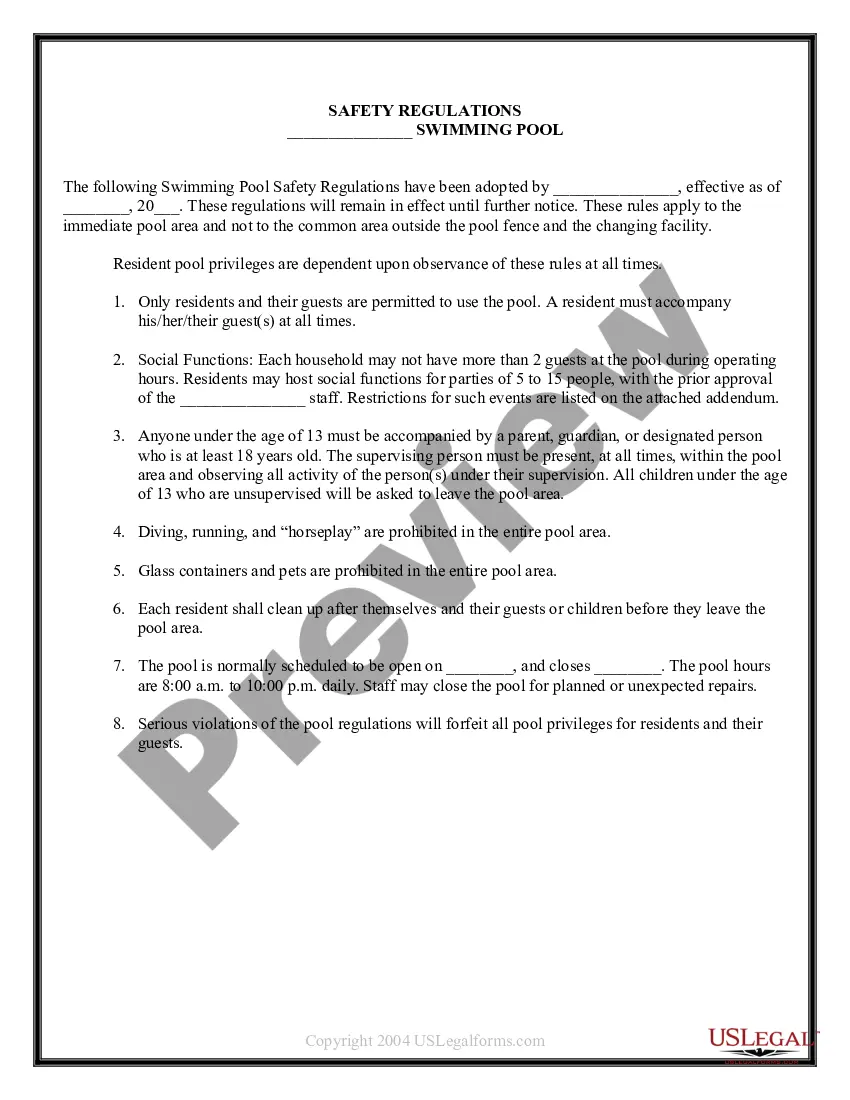
Apartment policy concerning the use of the complex swimming pool.
Nevada Apartment Complex Swimming Pool Policy
Category:
State:
Multi-State
Control #:
US-898LT
Format:
Word;
Rich Text
Instant download
Description
Get your form ready online
Our built-in tools help you complete, sign, share, and store your documents in one place.
Built-in online Word editor
Make edits, fill in missing information, and update formatting in US Legal Forms—just like you would in MS Word.
Export easily
Download a copy, print it, send it by email, or mail it via USPS—whatever works best for your next step.
E-sign your document
Sign and collect signatures with our SignNow integration. Send to multiple recipients, set reminders, and more. Go Premium to unlock E-Sign.
Notarize online 24/7
If this form requires notarization, complete it online through a secure video call—no need to meet a notary in person or wait for an appointment.
Store your document securely
We protect your documents and personal data by following strict security and privacy standards.

Make edits, fill in missing information, and update formatting in US Legal Forms—just like you would in MS Word.

Download a copy, print it, send it by email, or mail it via USPS—whatever works best for your next step.

Sign and collect signatures with our SignNow integration. Send to multiple recipients, set reminders, and more. Go Premium to unlock E-Sign.

If this form requires notarization, complete it online through a secure video call—no need to meet a notary in person or wait for an appointment.

We protect your documents and personal data by following strict security and privacy standards.
Looking for another form?



How to fill out Apartment Complex Swimming Pool Policy?
Are you currently in a situation where you require paperwork for both business or personal purposes almost all the time.
There are numerous legitimate document templates accessible online, but finding forms you can trust is challenging.
US Legal Forms provides thousands of template forms, such as the Nevada Apartment Complex Swimming Pool Policy, that are crafted to comply with federal and state regulations.
Once you find the correct form, click Purchase now.
Choose the payment plan you prefer, fill in the required information to create your account, and complete the transaction using your PayPal or credit card. Select a convenient document format and download your copy. Find all the document templates you’ve purchased in the My documents menu. You can obtain another copy of the Nevada Apartment Complex Swimming Pool Policy at any time, if necessary. Click the desired form to download or print the document template. Utilize US Legal Forms, the largest collection of legitimate forms, to save time and avoid mistakes. The service offers well-prepared legal document templates that you can use for various purposes. Create an account on US Legal Forms and start making your life a bit easier.
- If you are already familiar with the US Legal Forms website and possess an account, simply Log In.
- After that, you can download the Nevada Apartment Complex Swimming Pool Policy template.
- If you do not have an account and wish to start using US Legal Forms, follow these instructions.
- Locate the form you need and ensure it corresponds to the correct region/state.
- Utilize the Preview button to examine the form.
- Review the description to ensure you have selected the correct document.
- If the form is not what you're looking for, use the Search field to find the form that suits your requirements and preferences.
Form popularity
FAQ
Clark County's rules for swimming pools emphasize safety and compliance with state laws. These rules typically require specific fencing heights, safety features, and regular maintenance practices. To ensure you meet all necessary requirements, review the Nevada Apartment Complex Swimming Pool Policy for comprehensive information and practical guidance.
A swimming pool area in an apartment or condo complex must adhere to the Nevada Apartment Complex Swimming Pool Policy for safety and accessibility. This typically includes proper fencing to prevent unauthorized access, clear signage regarding pool rules, and adequate cleaning and maintenance protocols. Additionally, the area should provide emergency equipment, such as life rings and a phone for emergencies. By ensuring these features, property managers can enhance the safety and enjoyment of residents.
If you don't have a fence around your pool, the home inspector will direct you to install one within a certain timeframe, typically 30 days. Insurers require pool fences to help lower the risk of accidental drownings and injury.
Calculate the Maximum Number of People The rest of the calculation is straightforward. For example, suppose your pool has a total area of 1,600 square feet. You have one diving board, leaving 1,300 square feet for bathers. If the maximum depth of the pool is 5 feet, it can accommodate: 1,300 ÷ 20 = 65 people.
Isolation fences must separate the pool/spa from the residence with more openings no more than 4 inches wide so children cannot squeeze through spaces. They must be non-climbable, four-sided and a minimum of 48 inches high. A 60-inch high fence is recommended.
Swimming pools that are in ground, completely or partially, must be enclosed by a fence. Above ground pool installations may need fencing, depending on water depth. (Check exact depth per your local code. It's usually a minimum of 18-24 inches.)
Swimming pools that are in ground, completely or partially, must be enclosed by a fence. Above ground pool installations may need fencing, depending on water depth. (Check exact depth per your local code. It's usually a minimum of 18-24 inches.)
Fencing In almost all cases, public-use pools are required to have some kind of fencing around the pool. States, cities, and counties usually specify exactly what is required of these fences in terms of material, spacing, gates, locks, and more.
What Counts as a Pool Barrier? According to the safety guidelines from the U.S. Consumer Product Safety Commission, pool barriers and fences should be a minimum of 4 feet tall and should surround all sides of a swimming pool.
Installed pool fences should be at least 48-inches high from finished ground level, as measured along the outside of the fence and should have no more than a two-inch gap from the bottom of the fence to the ground.