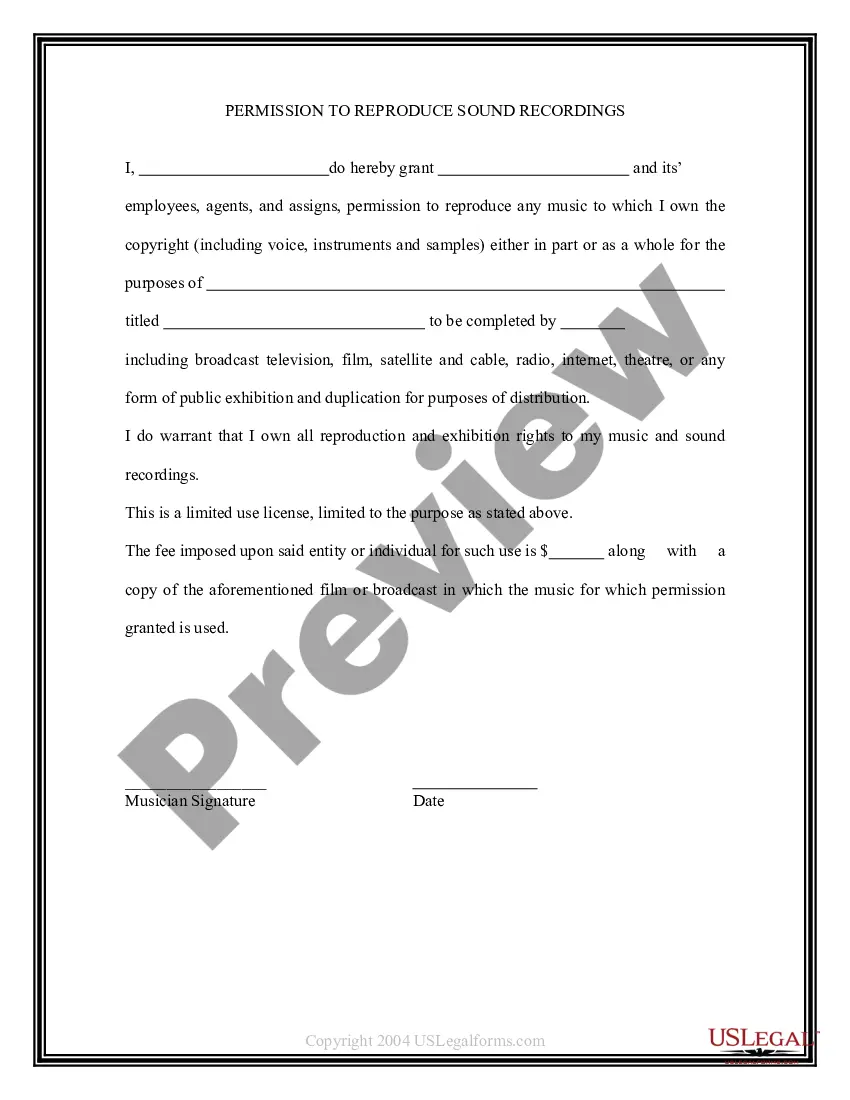
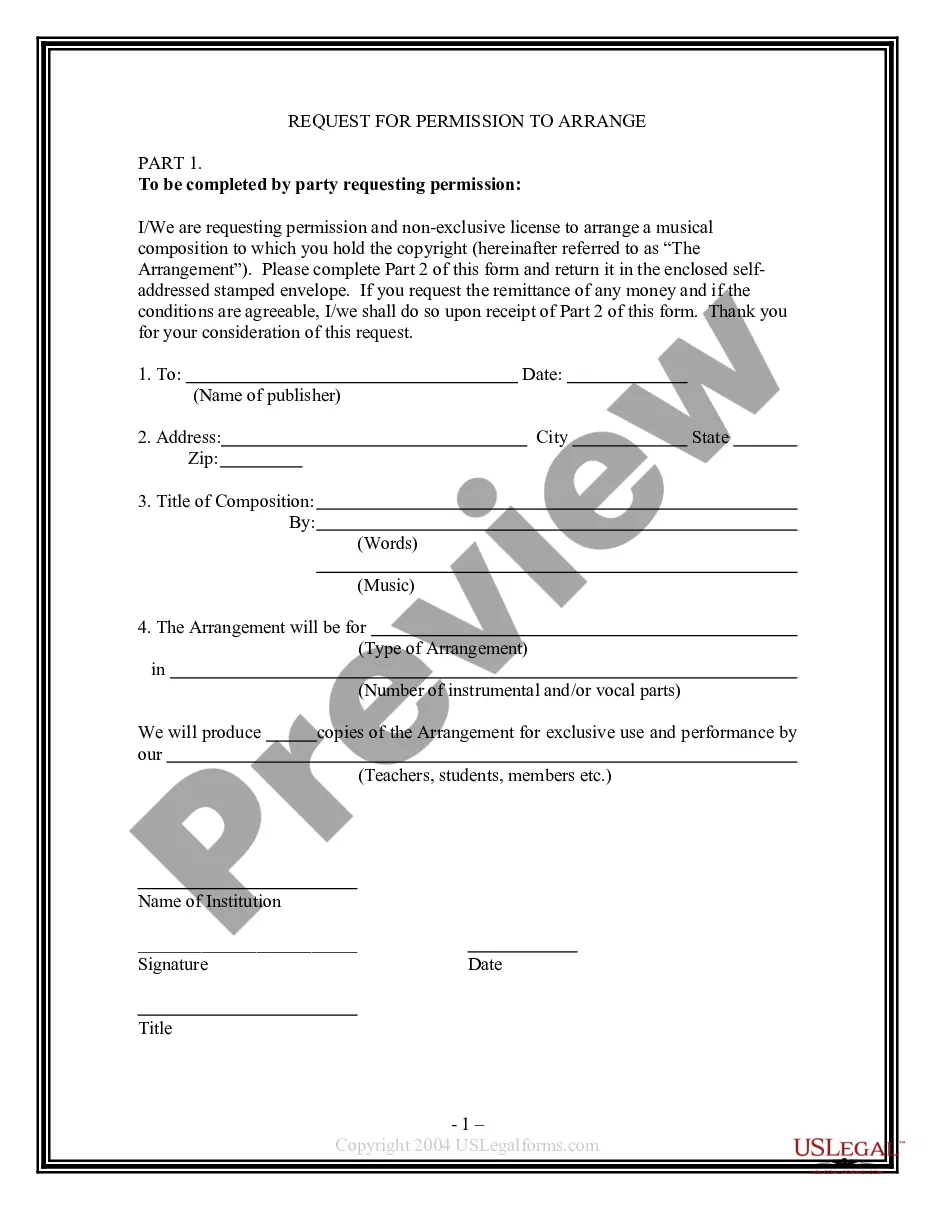
This is a form signed by a musician or owner of music granting permission to reproduce copyrighted music for use in a film, television, Internet, radio etc.
New Mexico Permission To Reproduce Sound Recordings
State:
Multi-State
Control #:
US-PRM-23
Format:
Word;
Rich Text
Instant download
Description


How to fill out Permission To Reproduce Sound Recordings?
Have you ever found yourself in a scenario where you need documents for various organizational or personal reasons almost every workday.
There are numerous authentic document templates accessible online, but locating ones you can rely on isn't easy.
US Legal Forms offers a vast array of form templates, including the New Mexico Permission To Reproduce Sound Recordings, designed to comply with state and federal regulations.
Utilize US Legal Forms, the most extensive collection of authentic forms, to save time and avoid mistakes.
The service provides professionally crafted legal document templates that can be used for various purposes. Create an account on US Legal Forms and start simplifying your life.
- If you are already familiar with the US Legal Forms website and hold an account, simply Log In.
- Then, you can download the New Mexico Permission To Reproduce Sound Recordings template.
- If you do not have an account and wish to start using US Legal Forms, follow these steps.
- Select the form you need and ensure it matches the correct city/region.
- Utilize the Review feature to evaluate the form.
- Check the description to confirm that you have selected the right form.
- If the form isn't what you're looking for, use the Search field to find the form that meets your needs.
- Once you find the correct form, click on Acquire now.
- Choose the payment plan you prefer, fill in the required information to create your account, and complete the payment using your PayPal or credit card.
- Select a convenient document format and download your copy.
- View all the document templates you have purchased in the My documents section. You can obtain an additional copy of New Mexico Permission To Reproduce Sound Recordings at any time, if necessary. Just click on the desired form to download or print the document template.
Form popularity
FAQ
In New Mexico, someone can voice record you without your consent if they are participating in the conversation. This aligns with the one-party consent law, which allows the person recording to do so legally. However, always be mindful of the nuances surrounding New Mexico Permission To Reproduce Sound Recordings. For further assistance and to understand your rights, explore the resources available on US Legal Forms.
Different states have varying laws regarding audio recording, with some being all-party consent states. These states require everyone involved in the conversation to agree to the recording. It is essential to be aware of these laws if you are considering New Mexico Permission To Reproduce Sound Recordings. US Legal Forms offers detailed information on recording laws in different states to help you stay compliant.
Whether it is illegal for someone to voice record you depends on the context and the specific laws in your state. In New Mexico, as mentioned, the law allows one-party consent, so your consent is not necessary if the person recording is part of the conversation. Understanding the legal framework of New Mexico Permission To Reproduce Sound Recordings helps you recognize your rights. If you have concerns, consult legal resources like US Legal Forms for clarity.
In New Mexico, recording audio without consent can lead to legal complications. Generally, New Mexico is a one-party consent state, meaning if you are part of the conversation, you can record it without obtaining permission from the other party. However, it is crucial to understand the specific context and limitations surrounding New Mexico Permission To Reproduce Sound Recordings. To ensure you comply with the law, consider using resources from US Legal Forms for guidance.
No, New Mexico is not a two-party state; it follows the one-party consent rule. This means that only one participant in a conversation needs to provide consent for a recording to be legal. Understanding this distinction is vital for anyone looking to reproduce sound recordings, as it directly relates to securing New Mexico Permission To Reproduce Sound Recordings.
To record a deed in New Mexico, you must first prepare the deed document according to state requirements. Next, you should submit the signed deed to the county clerk's office in the county where the property is located. Recording a deed is important for establishing legal ownership, and it can be beneficial for sound recording creators to understand these processes when dealing with New Mexico Permission To Reproduce Sound Recordings.
Yes, New Mexico is classified as an open records state. This means that many records are accessible to the public, enhancing transparency and accountability. For those interested in sound recordings, knowing the state’s open records laws can aid in understanding how to secure New Mexico Permission To Reproduce Sound Recordings and utilize public records effectively.
Several states in the U.S. allow one-party recording, including California, Texas, and Illinois, among others. These states permit individuals to record conversations as long as one person involved in the conversation agrees to the recording. If you are navigating sound recording laws in various states, understanding these laws is crucial for obtaining New Mexico Permission To Reproduce Sound Recordings and ensuring your work is protected.
Yes, New Mexico operates as a one-party record state. This means that only one party involved in a conversation needs to give consent for the recording to take place. Consequently, if you are planning to reproduce sound recordings in New Mexico, you should be aware that you only need permission from one individual. This is beneficial for creators looking to ensure compliance with the New Mexico Permission To Reproduce Sound Recordings.