New Mexico Complaint for Negligence and Negligence as Matter of Law
About this form
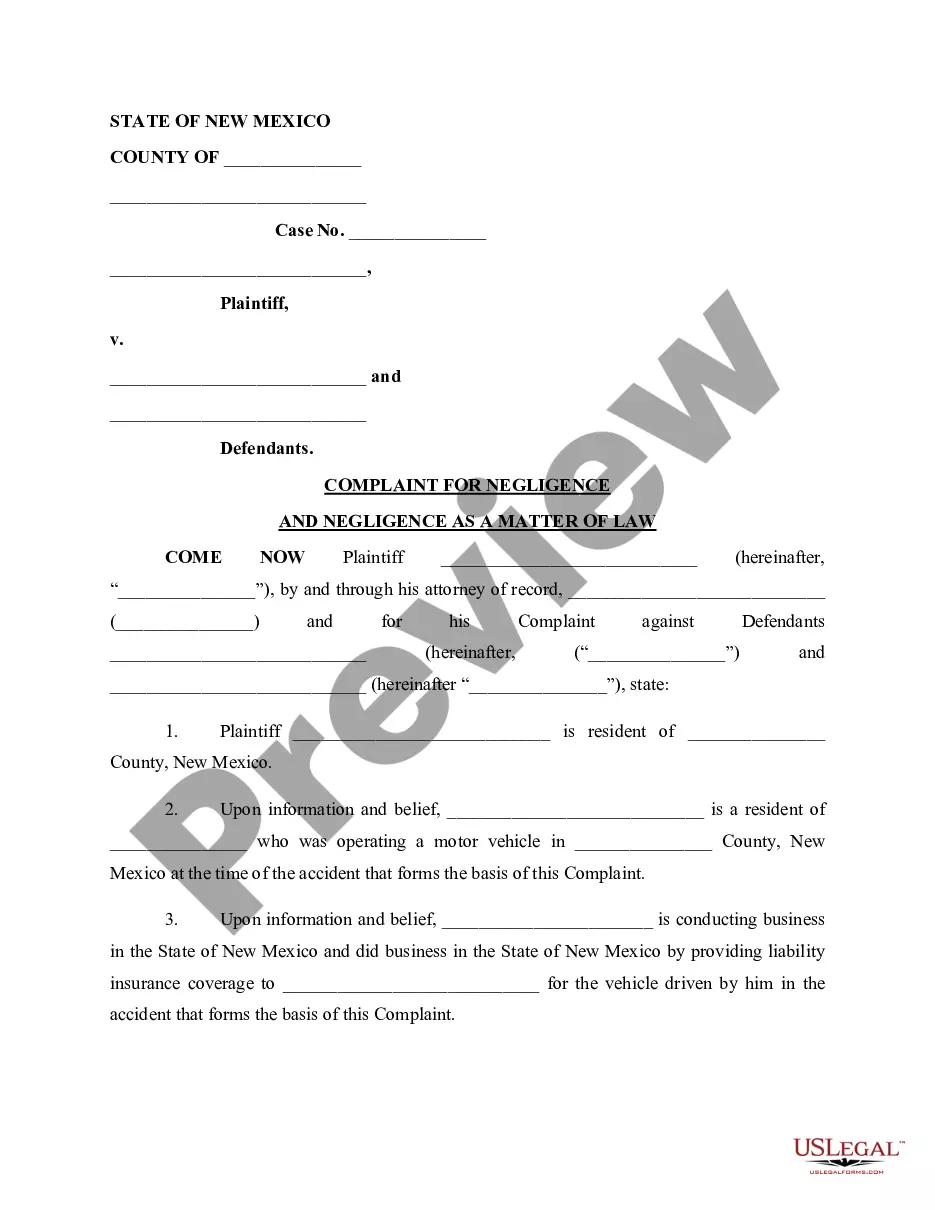
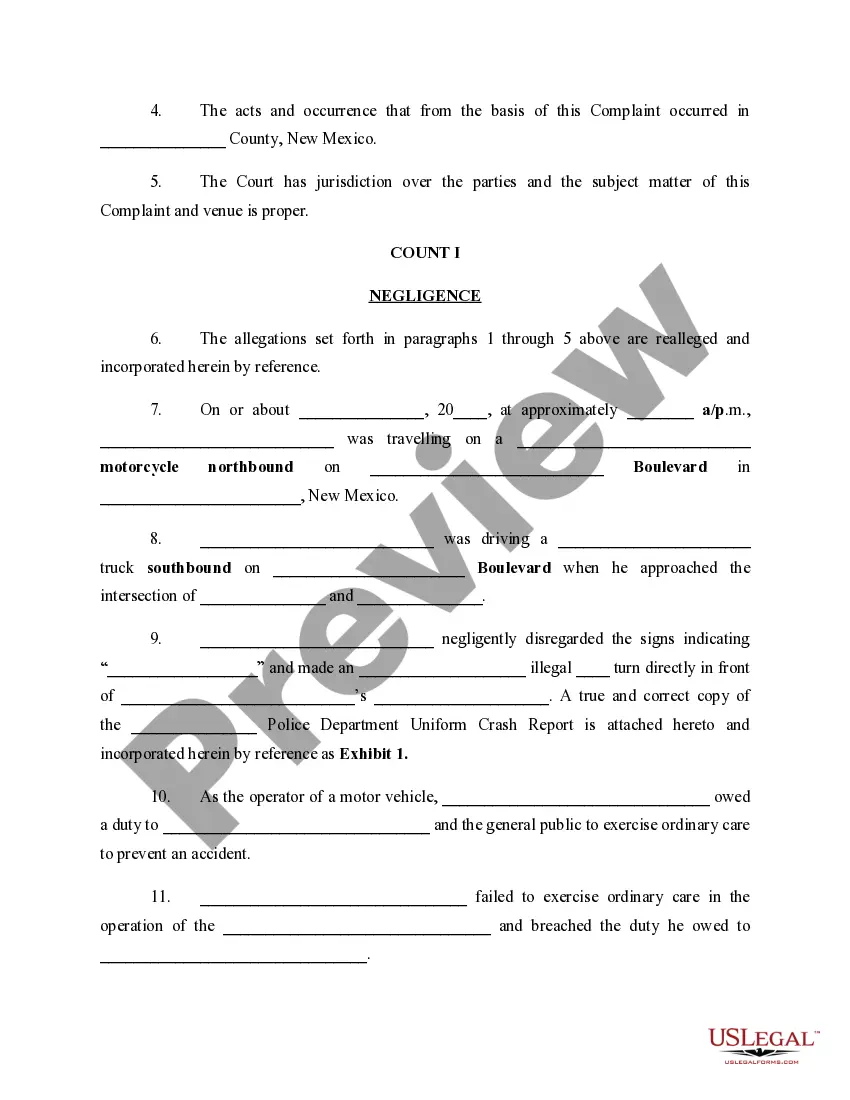
The Complaint for Negligence and Negligence as a Matter of Law is a legal document used to initiate a lawsuit against one or more defendants in connection with a motor vehicle accident. This form outlines the plaintiff's claims of negligence, detailing the parties involved, the nature of the incident, and the resulting damages. It is specifically designed for situations where the plaintiff seeks compensation for personal injuries caused by the defendant's negligent actions, differentiating it from other forms that may address different legal issues or types of claims.
Main sections of this form
- Identification of the plaintiff and defendants.
- Statement of the jurisdiction and venue.
- Allegation of facts leading to the claim of negligence.
- Specification of damages incurred by the plaintiff.
- Claims for negligence and negligence as a matter of law.
- Request for damages, including interest and costs.




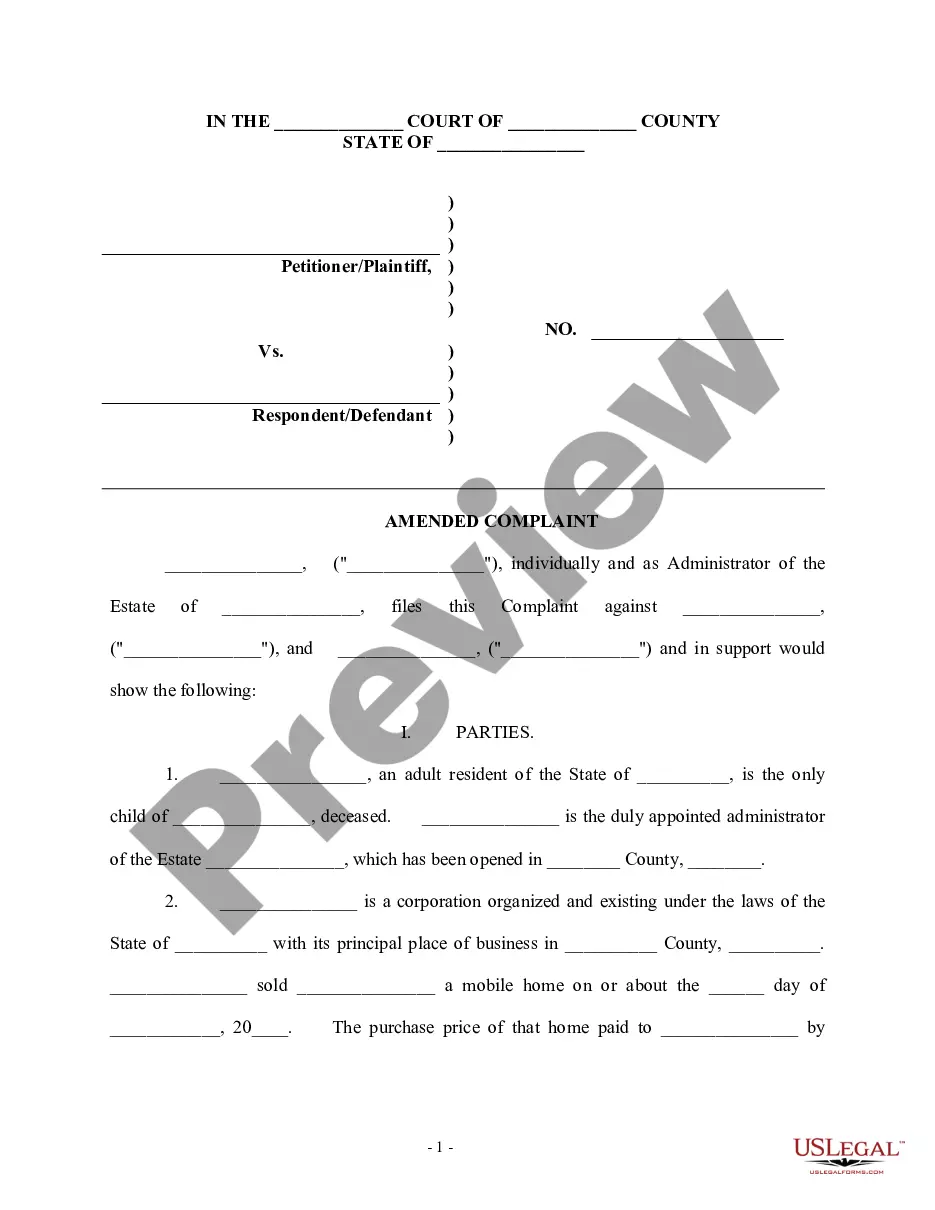
Situations where this form applies
You should use the Complaint for Negligence when you seek to hold another party accountable for injuries resulting from a car accident. This form is appropriate if you believe the other driver acted carelessly or irresponsibly, leading to an accident that caused you harm. It can be utilized in scenarios involving personal injury, medical expenses, lost wages, and emotional distress resulting from the collision.
Who needs this form
This form is intended for:
- Individuals who have been injured in a motor vehicle accident due to another party's negligence.
- Individuals seeking to file a lawsuit to recover damages for their injuries.
- Legal representatives acting on behalf of injured clients in negligence claims.
How to complete this form
- Identify and fill in the names of the plaintiff and defendants.
- Insert the jurisdiction and venue details, including the county where the incident occurred.
- Provide a detailed account of the events leading to the accident, including dates, times, and locations.
- Specify the nature and extent of the damages suffered as a result of the accident.
- Sign the document and provide the contact information for the attorney, if applicable.
Is notarization required?
Notarization is generally not required for this form. However, certain states or situations might demand it. You can complete notarization online through US Legal Forms, powered by Notarize, using a verified video call available anytime.
Get your form ready online
Our built-in tools help you complete, sign, share, and store your documents in one place.
Make edits, fill in missing information, and update formatting in US Legal Forms—just like you would in MS Word.
Download a copy, print it, send it by email, or mail it via USPS—whatever works best for your next step.
Sign and collect signatures with our SignNow integration. Send to multiple recipients, set reminders, and more. Go Premium to unlock E-Sign.
If this form requires notarization, complete it online through a secure video call—no need to meet a notary in person or wait for an appointment.
We protect your documents and personal data by following strict security and privacy standards.

Make edits, fill in missing information, and update formatting in US Legal Forms—just like you would in MS Word.

Download a copy, print it, send it by email, or mail it via USPS—whatever works best for your next step.

Sign and collect signatures with our SignNow integration. Send to multiple recipients, set reminders, and more. Go Premium to unlock E-Sign.

If this form requires notarization, complete it online through a secure video call—no need to meet a notary in person or wait for an appointment.

We protect your documents and personal data by following strict security and privacy standards.
Mistakes to watch out for
- Failing to include all parties involved in the accident.
- Neglecting to provide specific details about the accident and damages.
- Not stating the correct jurisdiction or venue for the lawsuit.
- Omitting necessary signatures or attorney information.
Benefits of completing this form online
- Convenient access: Download and fill out the form at your convenience.
- Editability: Easily modify and update information as needed.
- Reliability: Access professionally drafted forms that meet legal standards.
Legal use & context
- This form is legally valid in New Mexico for filing claims of negligence.
- Complaints filed must adhere to local court rules and timelines.
- Ensure you have sufficient evidence to support your claims of negligence for effective legal action.
Looking for another form?
Form popularity
FAQ
To successfully defend against a negligence suit, the defendant will try to negate one of the elements of the plaintiff's cause of action. In other words, the defendant introduces evidence that he or she did not owe a duty to the plaintiff; exercised reasonable care; did not cause the plaintiff's damages; and so forth.
The law of negligence requires individuals to conduct themselves in a way that conforms to certain standards of conduct. If a person doesn't conform to that standard, the person can be held liable for harm he or she causes to another person or property.
In a case based upon negligence the plaintiff, under code or com- mon law pleading, must plead facts in his petition showing (1) that the defendant owed a duty to the plaintiff, (2) that the defendant breached the duty, and (3) that as a result of such breach of duty the plaintiff suffered damage.
Negligence claims must prove four things in court: duty, breach, causation, and damages/harm. Generally speaking, when someone acts in a careless way and causes an injury to another person, under the legal principle of "negligence" the careless person will be legally liable for any resulting harm.
Unlike many other states, New Mexico is a pure comparative negligence state. Under this legal theory, the amount that you would be entitled to in a claim settlement is reduced by the percentage of your fault in causing your injuries.
If you're a victim of negligence and are seeking compensation, it can be hard to prove negligence. However, it is possible to do so if you take the right steps to build your case.
Contributory Negligence Many states developed and adopted comparative negligence laws. Today, the jurisdictions that still use contributory negligence are Alabama, Maryland, North Carolina, Virginia, and Washington, D.C.
New Mexico is a comparative negligence state.Under contributory negligence, if an injured party is found to be at all responsible for the accident or the resulting injuries, recovery of damages is completely barred.