New Mexico Warranty Deed - Individual to Two Individuals as Joint Tenants with the Right of Survivorship
What this document covers
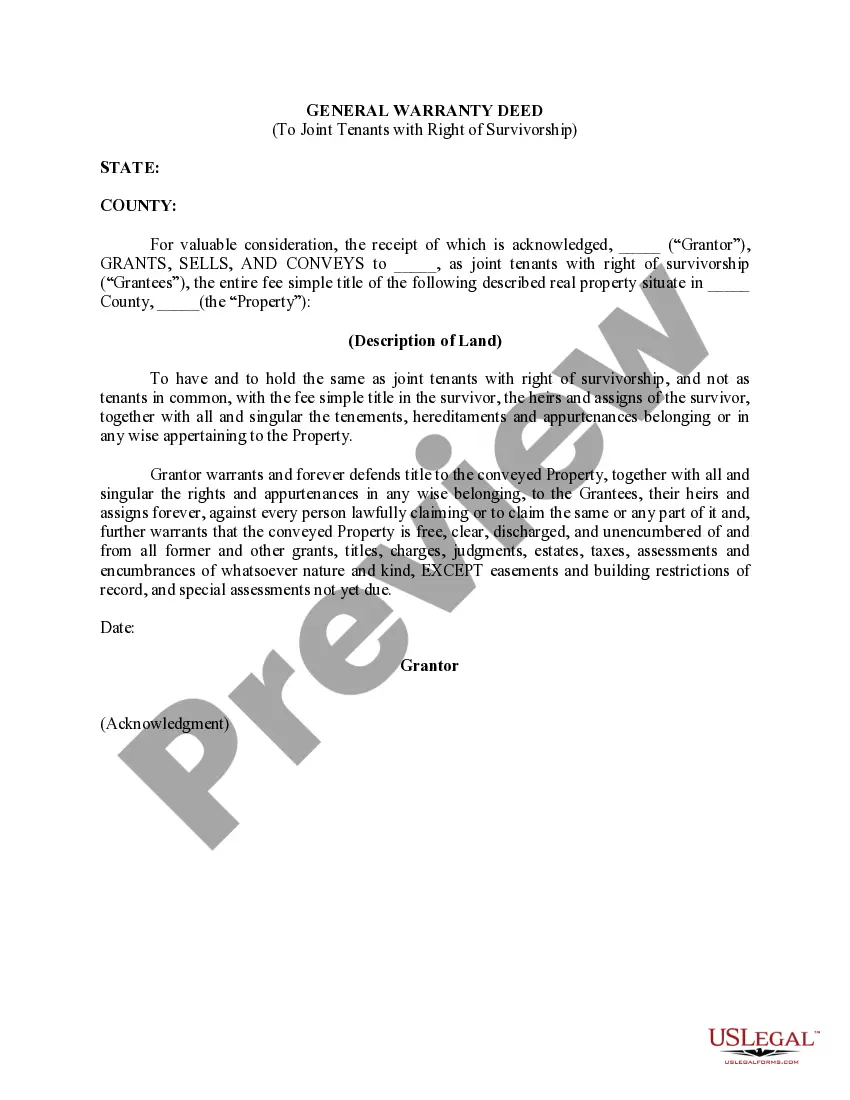
The Warranty Deed - Individual to Two Individuals as Joint Tenants with the Right of Survivorship is a legal document that facilitates the transfer of real property from one individual (the grantor) to two other individuals (the grantees). This form ensures that both grantees hold equal rights to the property and automatically inherit the otherâs share in the event of death, thanks to the right of survivorship. This differs from other deeds by specifically establishing joint tenancy with survivorship rights, which affects how ownership is treated in the event of a grantee's death.
Key components of this form
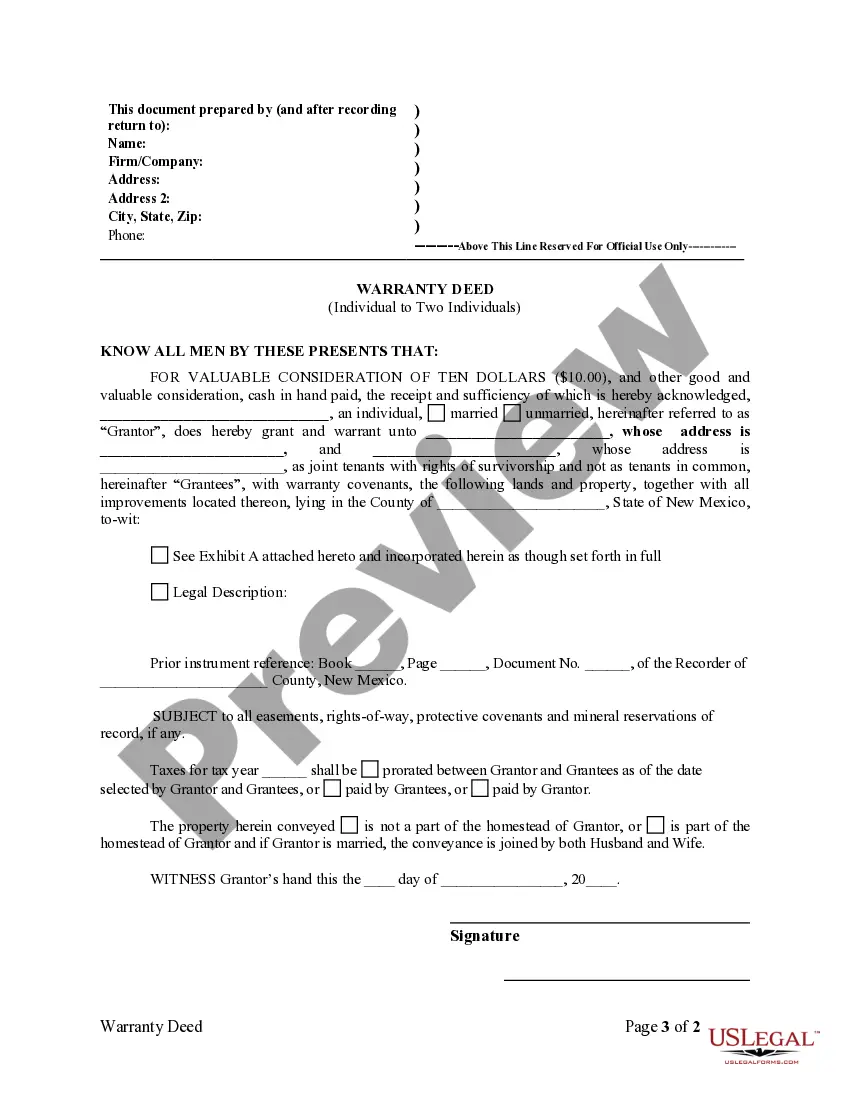
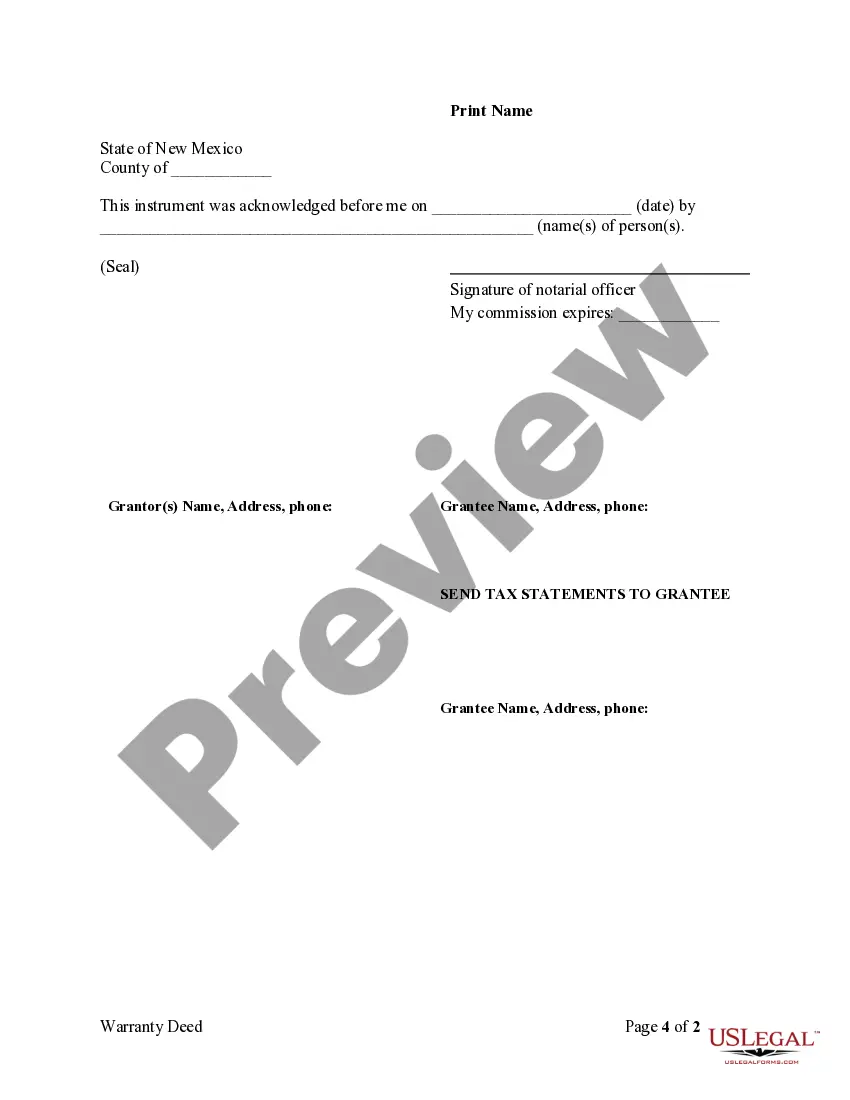
- Grantor's information: includes the name and address of the individual transferring the property.
- Grantees' details: lists the two individuals receiving the property along with their respective rights.
- Legal description of the property: outlines the exact location and boundaries of the real estate being conveyed.
- Terms of transfer: includes clauses regarding the warranty and rights affecting the property.
- Signatures: spaces for the grantor and grantees to sign and date the document.



When to use this form
This warranty deed is appropriate when an individual wishes to transfer ownership of a property to two other individuals who intend to own the property together as joint tenants. Common scenarios include transferring family property to adult children, placing property in joint ownership between partners, or ensuring that ownership transfers smoothly upon the death of one of the joint tenants.
Intended users of this form
- Individuals transferring property to two co-owners.
- Families looking to consolidate property ownership.
- Partners wanting to clarify property rights in a joint tenancy arrangement.
- Anyone preparing for estate planning by ensuring property passes to a survivor upon death.
How to prepare this document
- Identify the parties involved: enter the grantor's information and the names of the grantees.
- Specify the property: provide a detailed legal description of the property being transferred.
- Fill in the terms of the transfer: include any relevant clauses about warranties and rights.
- Sign and date the form: ensure all parties sign the document to make it official.
- Consult local requirements: verify that the completed deed meets any additional local formality.
Notarization requirements for this form
This form does not typically require notarization unless specified by local law. It is advisable to check local regulations to ensure compliance with property transfer requirements in your jurisdiction.
Get your form ready online
Our built-in tools help you complete, sign, share, and store your documents in one place.
Make edits, fill in missing information, and update formatting in US Legal Forms—just like you would in MS Word.
Download a copy, print it, send it by email, or mail it via USPS—whatever works best for your next step.
Sign and collect signatures with our SignNow integration. Send to multiple recipients, set reminders, and more. Go Premium to unlock E-Sign.
If this form requires notarization, complete it online through a secure video call—no need to meet a notary in person or wait for an appointment.
We protect your documents and personal data by following strict security and privacy standards.

Make edits, fill in missing information, and update formatting in US Legal Forms—just like you would in MS Word.

Download a copy, print it, send it by email, or mail it via USPS—whatever works best for your next step.

Sign and collect signatures with our SignNow integration. Send to multiple recipients, set reminders, and more. Go Premium to unlock E-Sign.

If this form requires notarization, complete it online through a secure video call—no need to meet a notary in person or wait for an appointment.

We protect your documents and personal data by following strict security and privacy standards.
Avoid these common issues
- Failing to include a complete legal description of the property.
- Missing signatures from one or both grantees, which could invalidate the deed.
- Not specifying the right of survivorship in the form.
- Incorrectly filling out the names of the individuals, leading to ownership disputes.
Benefits of using this form online
- Convenience: download and complete the form from anywhere at any time.
- Editability: easily fill in form fields digitally or print for handwritten completion.
- Efficiency: save time with a structured format that guides you through the process.
- Compliance: ensures that the form aligns with current legal standards and regulations.
Legal use & context
- This warranty deed is legally binding and transfers ownership effectively when completed correctly.
- It provides assurance that the property is free of liens, protecting the grantees.
- The right of survivorship ensures seamless transfer of ownership without probate, simplifying estate management.
Quick recap
- A Warranty Deed is vital for establishing joint ownership and survivorship rights.
- The form must be correctly completed to avoid future legal complications.
- Consult local laws to ensure compliance and validity of the deed.
Looking for another form?


Form popularity
FAQ
What Is the Difference Between a Warranty Deed & a Survivorship Deed?A warranty deed is the most comprehensive and provides the most guarantees. Survivorship isn't so much a deed as a title. It's a way to co-own property where, upon the death of one owner, ownership automatically passes to the survivor.
If you look at the registered title to your own jointly owned property and the text isn't shown on it, you own it as joint tenants. If it is there, you own it as tenants-in-common.This title is dealt with by Land Registry, Sample Town Office.
In order to terminate a joint tenancy, one of the four unities must be destroyed. You may do this by conveying your joint tenancy interest to any third person. This can be done through gift or sale. Upon termination, a tenancy in common is formed between the third person and the remaining co-tenant(s).
You can apply to court to change your ex-partner's tenancy to your name, or remove their name from a joint tenancy. You can apply for a 'transfer of tenancy' if: your landlord refuses to change your tenancy. your tenancy doesn't allow a transfer.
The General Rule. In the great majority of states, if you and the other owners call yourselves "joint tenants with the right of survivorship," or put the abbreviation "JT WROS" after your names on the title document, you create a joint tenancy. A car salesman or bank staffer may assure you that other words are enough.
With a Survivorship Deed in place, when one of the parties in a joint tenancy dies, the other party (or parties) takes over the deceased party's interest in the property instead of it passing to the deceased's heirs or beneficiaries.
Serve a written notice of the change (a 'notice of severance') on the other owners - a conveyancer can help you do this. Download and fill in form SEV to register a restriction without the other owners' agreement. Prepare any supporting documents you need to include.
The name and address of the seller (called the grantor) The name and address of the buyer (called the grantee) A legal description of the property (found on the previous deed) A statement that the grantor is transferring the property to the grantee.
To hold a real estate property in joint tenancy, you and the co-owners have to write the abbreviation for joint tenants with the right of survivorship, or JTWROS, on the official real estate deed or title. This creates a legally binding joint tenancy.