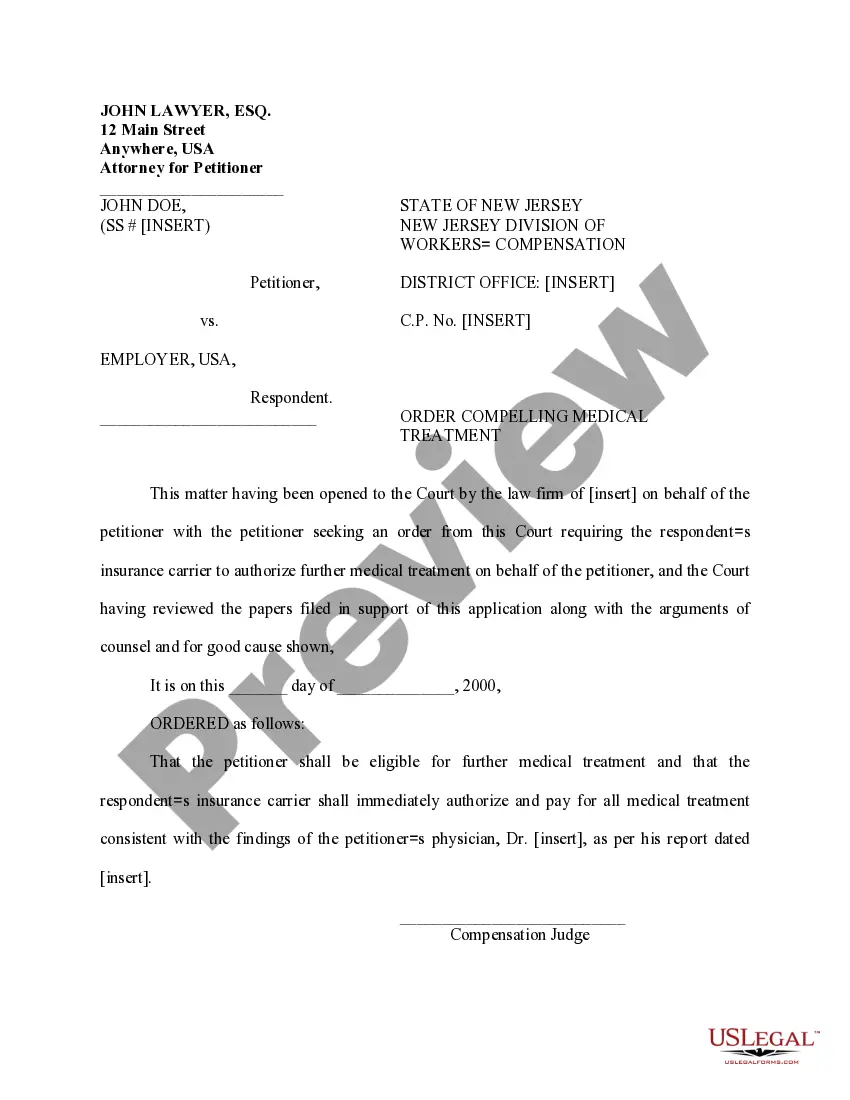
New Jersey Workers Compensation Order Compelling Treatment
Overview of this form
The Workers Compensation Order Compelling Treatment is a legal document that requests a court order for a workers' compensation insurance carrier to authorize necessary medical treatment for an injured employee. This form sets it apart from other workers' compensation documents by specifically focusing on compelling insurance companies to fulfill their obligation to cover medical treatment as deemed necessary by the employee's physician.
Key components of this form
- Petitioner information: Details about the injured employee or claimant.
- Respondent information: Details about the employer and their insurance carrier.
- Claim number: Unique identification for the workers' compensation case.
- Court order: A directive from the court compelling the insurance carrier to approve medical treatment.
- Physician's report: Reference to the medical professional's findings supporting the need for treatment.
When to use this form
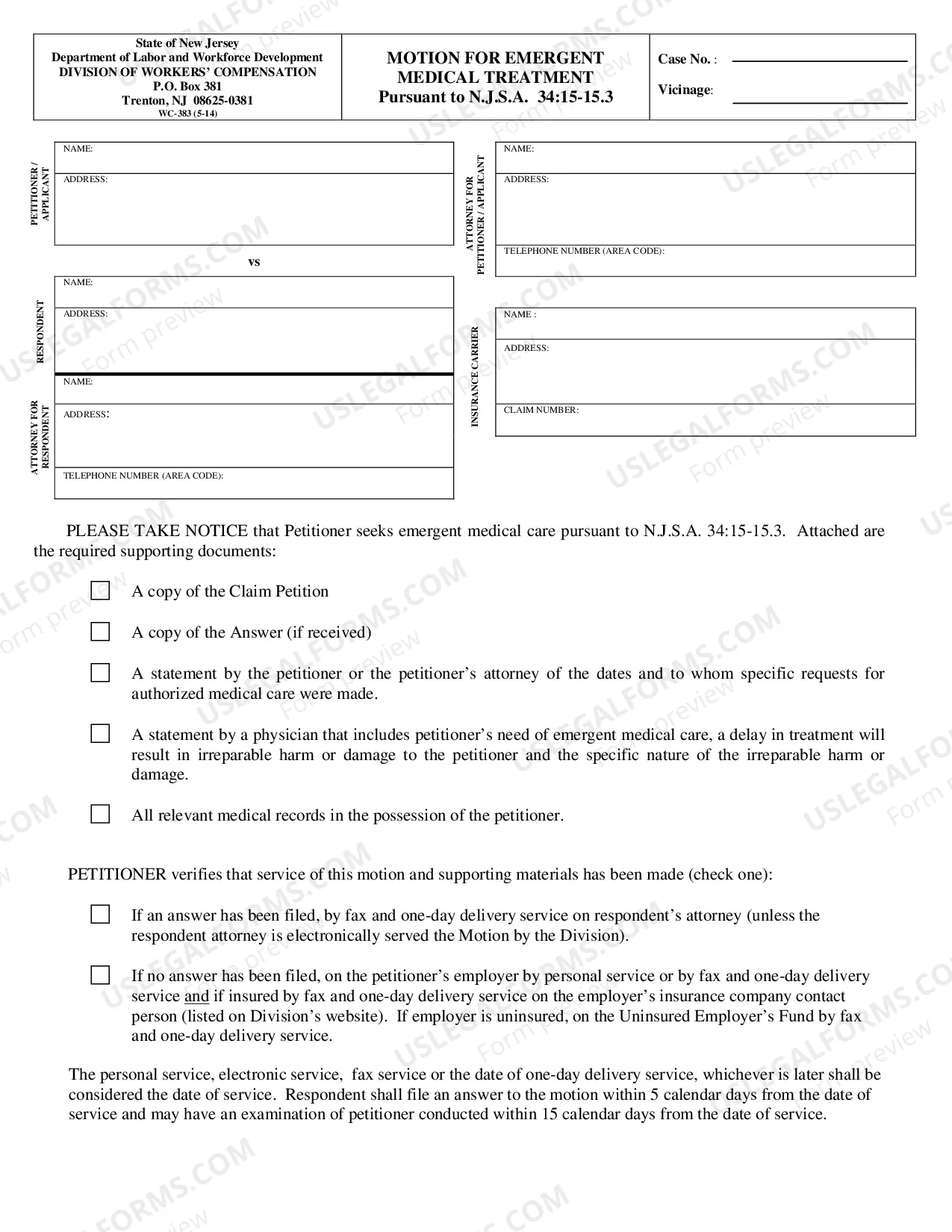
This form is typically used when an injured worker requires additional medical treatment that has not been authorized by their employer's insurance carrier. It is appropriate in cases where there is a disagreement about the necessity of treatment or when the insurance provider is delaying authorization, impacting the recovery of the injured party.
Who can use this document
- Injured workers seeking additional medical treatment through workers' compensation.
- Legal representatives or attorneys filing on behalf of injured workers.
- Employers who are involved in a dispute regarding medical treatment authorization for an employee.
Instructions for completing this form
- Identify the injured worker as the petitioner and provide their details.
- Fill in the employer's information and the insurance carrier's name as the respondent.
- Enter the claim number associated with the workers' compensation case.
- Obtain and reference the physician's report that justifies the need for additional treatment.
- Sign and date the form before submission to the appropriate court.
Does this document require notarization?
In most cases, this form does not require notarization. However, some jurisdictions or signing circumstances might. US Legal Forms offers online notarization powered by Notarize, accessible 24/7 for a quick, remote process.
Get your form ready online
Our built-in tools help you complete, sign, share, and store your documents in one place.
Make edits, fill in missing information, and update formatting in US Legal Forms—just like you would in MS Word.
Download a copy, print it, send it by email, or mail it via USPS—whatever works best for your next step.
Sign and collect signatures with our SignNow integration. Send to multiple recipients, set reminders, and more. Go Premium to unlock E-Sign.
If this form requires notarization, complete it online through a secure video call—no need to meet a notary in person or wait for an appointment.
We protect your documents and personal data by following strict security and privacy standards.

Make edits, fill in missing information, and update formatting in US Legal Forms—just like you would in MS Word.

Download a copy, print it, send it by email, or mail it via USPS—whatever works best for your next step.

Sign and collect signatures with our SignNow integration. Send to multiple recipients, set reminders, and more. Go Premium to unlock E-Sign.

If this form requires notarization, complete it online through a secure video call—no need to meet a notary in person or wait for an appointment.

We protect your documents and personal data by following strict security and privacy standards.
Typical mistakes to avoid
- Failing to include the claim number, which is essential for processing.
- Omitting necessary signatures, leading to delays in the court's ruling.
- Not providing sufficient medical documentation to support treatment requests.
Benefits of using this form online
- Convenience: Easily access and download the form at any time.
- Editability: Customize the form with your details before printing.
- Reliability: Ensure compliance with the latest legal standards and formats.
Key takeaways
- The Workers Compensation Order Compelling Treatment is essential for requesting medical treatment authorization.
- It is mainly used in instances of disputes between injured workers and insurance carriers.
- Complete the form accurately and include all relevant medical documentation to ensure validity.
Looking for another form?

Form popularity
FAQ
Temporary Total Disability: For example, if the medical provider has stated that the injured worker has temporary total disability ; it would not be advisable to partake in activities such as mowing the lawn, shoveling snow, or any recreational activity.
Asking You to Give a Signed or Recorded Statement Soon After the Work-Related Accident. Asking You to Sign a Medical Authorization Form. Tell You that Hiring an Attorney Will Cost You Money or Slow Down Your Claim.
To date, the largest settlement payment in a workers' comp case came in March of 2017, with a $10 million settlement agreement.
Mental Health Conditions May Be Covered Under Workers' Comp In the workers' compensation system, any type of work-related illness or injury may entitle you to receive benefits. This includes emotional and/or mental stress injuries that a worker suffers as a result of their job.
Before you talk to an insurance adjuster, understand their role. Avoid giving lots of details about the accident or your material damages. Avoid giving a lot of details about the injury. Do not sign anything or give a recorded statement. Don't settle on the first offer. With all that in mind2026
As a general rule of thumb, you should never discuss anything except the basic facts of the accident, including where it occurred, the date and time it occurred, what type of accident it was, and which body parts were injured.
The exclusive remedy provision in a workers' compensation insurance policy states that a worker cannot sue an employer for a work-related injury as long as they are receiving benefits from workers' comp.
Get your weekly disability check started, if you're not receiving it already. Maximize your weekly benefit check. Report all super-added injuries. Seek psychological care, when appropriate. Seek pain management care, when appropriate. Don't refuse medical procedures. Be very careful what you tell the doctor.