Plaintiff seeks to recover damages for violation of the First Amendment of the United States Constitution. Plaintiff states that she was unlawfully terminated and treated differently because of her gender.
New Hampshire Complaint for Violation of Civil Rights and for Wrongful Discharge for Reporting Illegal Acts - 1st, 14th Amendments, US Constitution - Jury Trial Demand
Category:
State:
Multi-State
Control #:
US-000284
Format:
Word;
Rich Text
Instant download
Description
Free preview

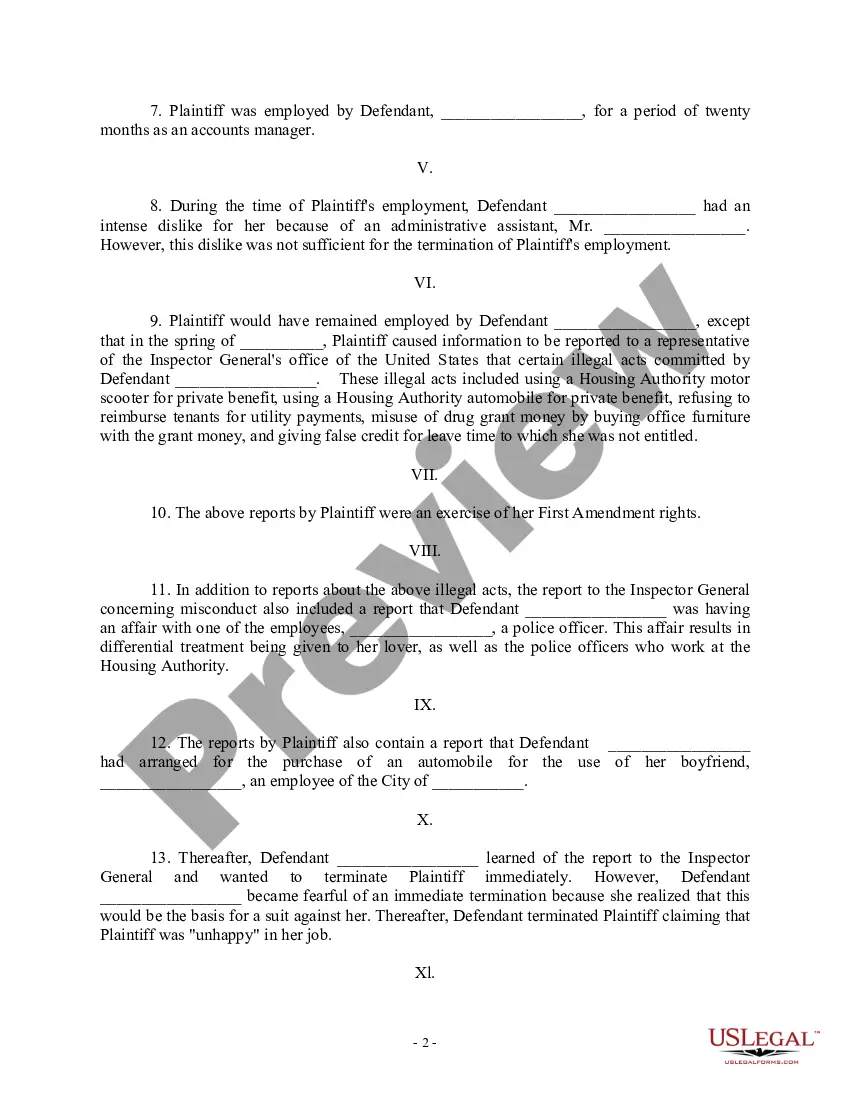
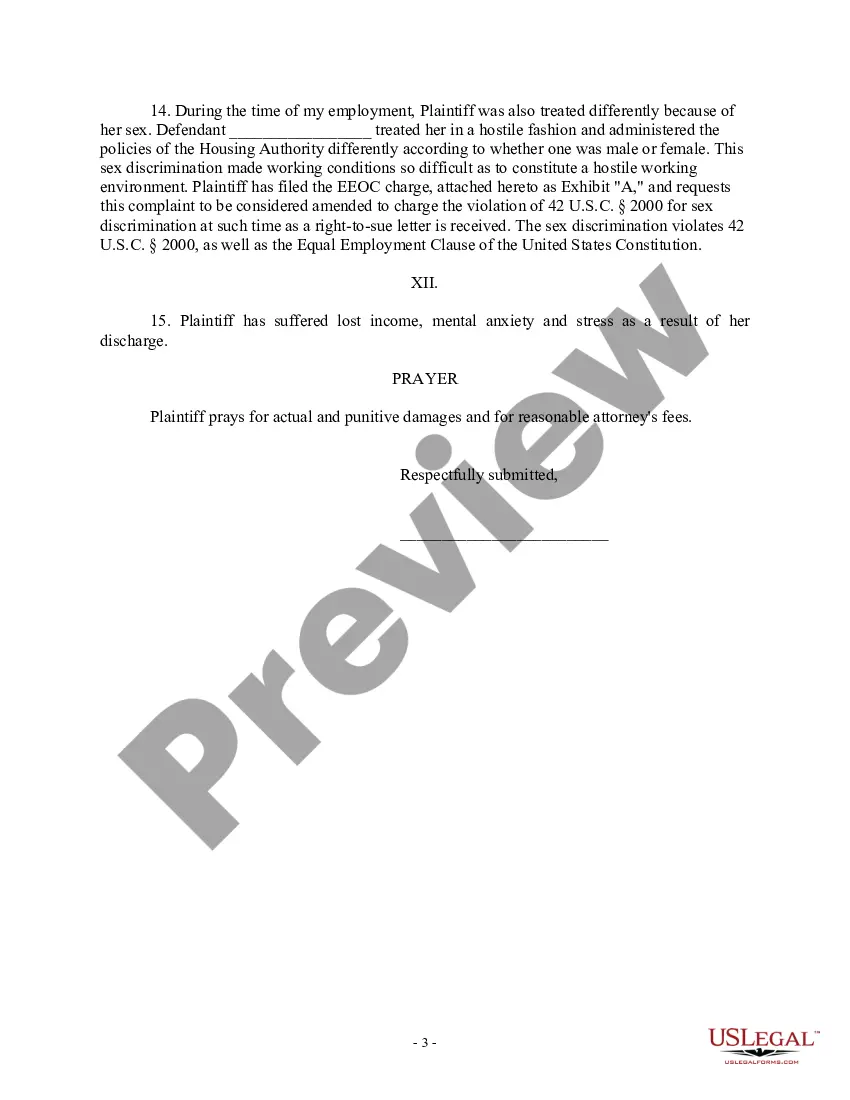






How to fill out Complaint For Violation Of Civil Rights And For Wrongful Discharge For Reporting Illegal Acts - 1st, 14th Amendments, US Constitution - Jury Trial Demand?
Are you presently in a position where you need documents for occasional organizations or specific objectives almost every business day.
There are numerous legal document templates accessible online, but obtaining forms you can trust is not straightforward.
US Legal Forms offers a vast array of form templates, such as the New Hampshire Complaint for Violation of Civil Rights and for Wrongful Discharge for Reporting Illegal Acts - 1st, 14th Amendments, US Constitution - Jury Trial Demand, which are designed to satisfy federal and state requirements.
Choose a suitable file format and download your copy.
Access all the document templates you have purchased in the My documents menu. You can obtain an additional copy of the New Hampshire Complaint for Violation of Civil Rights and for Wrongful Discharge for Reporting Illegal Acts - 1st, 14th Amendments, US Constitution - Jury Trial Demand at any time if needed. Just click the required form to download or print the document template. Utilize US Legal Forms, the most extensive collection of legal forms, to save time and avoid mistakes. The service provides professionally crafted legal document templates that you can use for various purposes. Create an account on US Legal Forms and start making your life a bit easier.
- If you are already familiar with the US Legal Forms website and have an account, simply Log In.
- Then, you can download the New Hampshire Complaint for Violation of Civil Rights and for Wrongful Discharge for Reporting Illegal Acts - 1st, 14th Amendments, US Constitution - Jury Trial Demand template.
- If you do not have an account and wish to start using US Legal Forms, follow these steps.
- Locate the form you need and ensure it is for the correct city/area.
- Use the Preview button to review the document.
- Check the outline to confirm that you have chosen the right form.
- If the form is not what you are looking for, use the Search section to find the form that suits your needs and requirements.
- After you find the appropriate form, click on Get now.
- Select the payment plan you prefer, fill in the necessary details to create your account, and finalize the transaction with your PayPal or credit card.
Form popularity
FAQ
A civil rights violation occurs when an individual's rights, as protected by law, are infringed upon. Common examples include discrimination based on race, gender, or disability, as well as wrongful termination for reporting illegal acts. In the context of a New Hampshire Complaint for Violation of Civil Rights and for Wrongful Discharge for Reporting Illegal Acts - 1st, 14th Amendments, US Constitution - Jury Trial Demand, you may have a case if your rights were violated under these amendments. To better understand your situation, explore the resources on the UsLegalForms platform.
In New Hampshire, the statute of limitations for civil cases is generally three years. This means you have three years from the date of the incident to file a New Hampshire Complaint for Violation of Civil Rights and for Wrongful Discharge for Reporting Illegal Acts - 1st, 14th Amendments, US Constitution - Jury Trial Demand. It is essential to act promptly, as missing this deadline may bar your ability to seek justice. For precise guidance, consider consulting resources available on the UsLegalForms platform.
In New Hampshire, wrongful termination occurs when an employee is fired for illegal reasons, such as retaliation for reporting illegal acts or for exercising their rights under the 1st and 14th Amendments of the US Constitution. Factors like discrimination based on race, gender, or other protected characteristics also fall under wrongful termination. If you believe you have been wrongfully discharged, filing a New Hampshire Complaint for Violation of Civil Rights and for Wrongful Discharge for Reporting Illegal Acts - 1st, 14th Amendments, US Constitution - Jury Trial Demand can be an essential step. USLegalForms provides templates and guidance to streamline this process, making it easier for you to present your case.
To support your New Hampshire Complaint for Violation of Civil Rights and for Wrongful Discharge for Reporting Illegal Acts - 1st, 14th Amendments, US Constitution - Jury Trial Demand, you need to gather various forms of evidence. This can include documentation of your employment, records of the illegal acts you reported, and any correspondence related to your termination. Witness statements can also strengthen your case, as they provide additional context and credibility. Consider using the resources available on USLegalForms to help you compile and organize this evidence effectively.
Equal Employment Opportunity Commission Title VII of the Civil Rights Act of 1964. ... Equal Pay Act of 1963. ... Age Discrimination in Employment Act of 1967. ... Rehabilitation Act of 1973. ... The Civil Rights Act of 1991.
Rule 6. No other pleading shall be allowed as of right. (b) Demurrers, Pleas, and Exceptions for insufficiency of a pleading shall not be used. Rule 6(a) is part of the restructuring of the civil rules intended to eliminate the distinction between law and equity.
California law protects individuals from illegal discrimination by employers based on the following: Race, color. Ancestry, national origin. Religion, creed. Age (40 and over) Disability, mental and physical. Sex, gender (including pregnancy, childbirth, breastfeeding or related medical conditions) Sexual orientation.
New Hampshire's employment non-discrimination laws forbid discriminating against someone because of gender identity or sexual orientation as well as age, sex, race, color, marital status, physical or mental disability, religious creed, or national origin (NH RSA 354-A:7).
It is illegal for an employer to discriminate against a job applicant because of his or her race, color, religion, sex (including gender identity, sexual orientation, and pregnancy), national origin, age (40 or older), disability or genetic information.
(a) An Answer or other responsive pleading shall be filed with the court within 30 days after the person filing said pleading has been served with the pleading to which the Answer or response is made.