New Hampshire First Appearance Highlights
Overview of this form
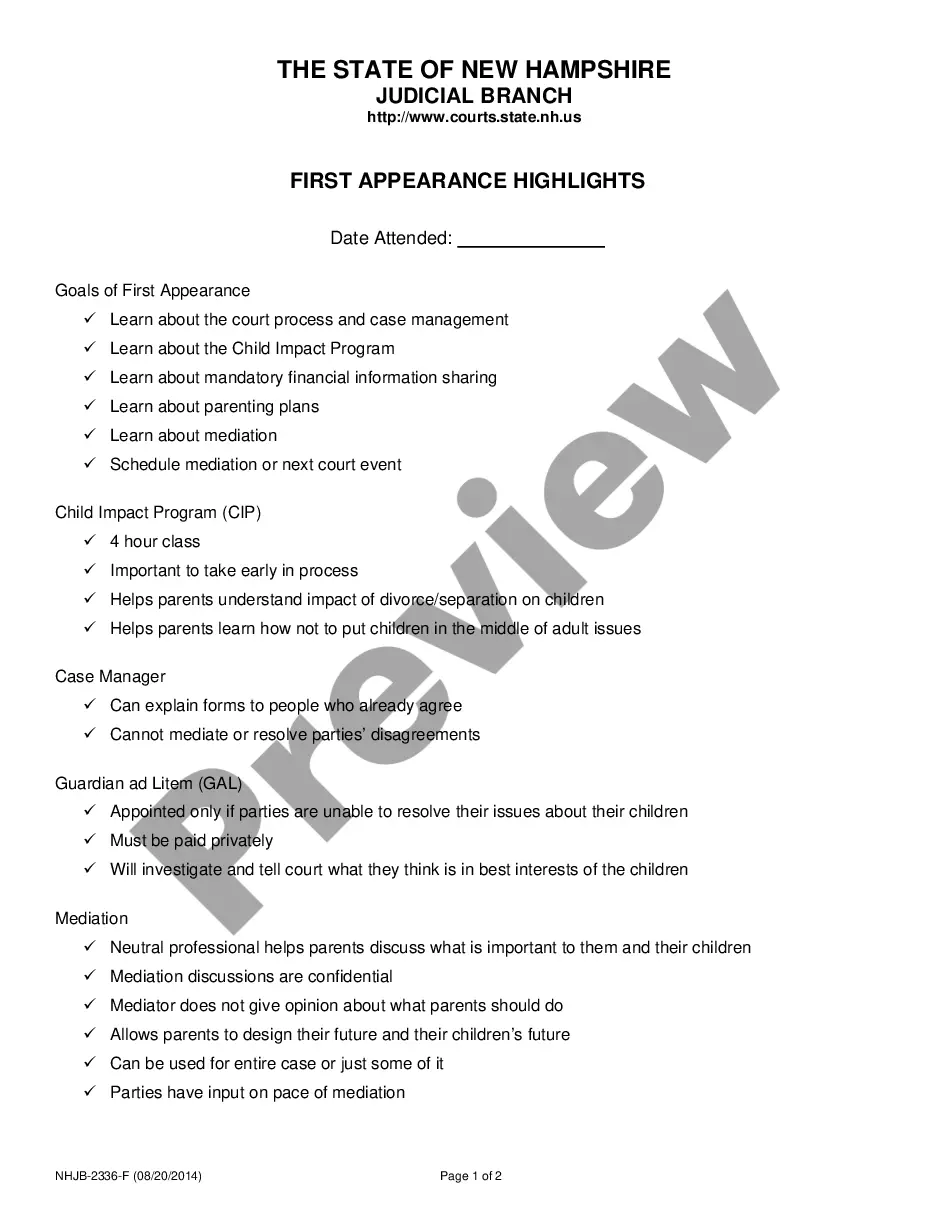
The First Appearance Highlights form is an official document provided by the New Hampshire Judicial Branch. It serves to summarize essential information presented during the initial court appearance. This form outlines important aspects of the court process, including mediation, financial information sharing, and the Child Impact Program. Unlike other legal forms, it specifically focuses on the preliminary proceedings involving family matters.
Form components explained
- Date attended for the first appearance.
- Goals of the first appearance, such as learning about the court process.
- Child Impact Program details, including class requirements.
- Information on case managers and their roles.
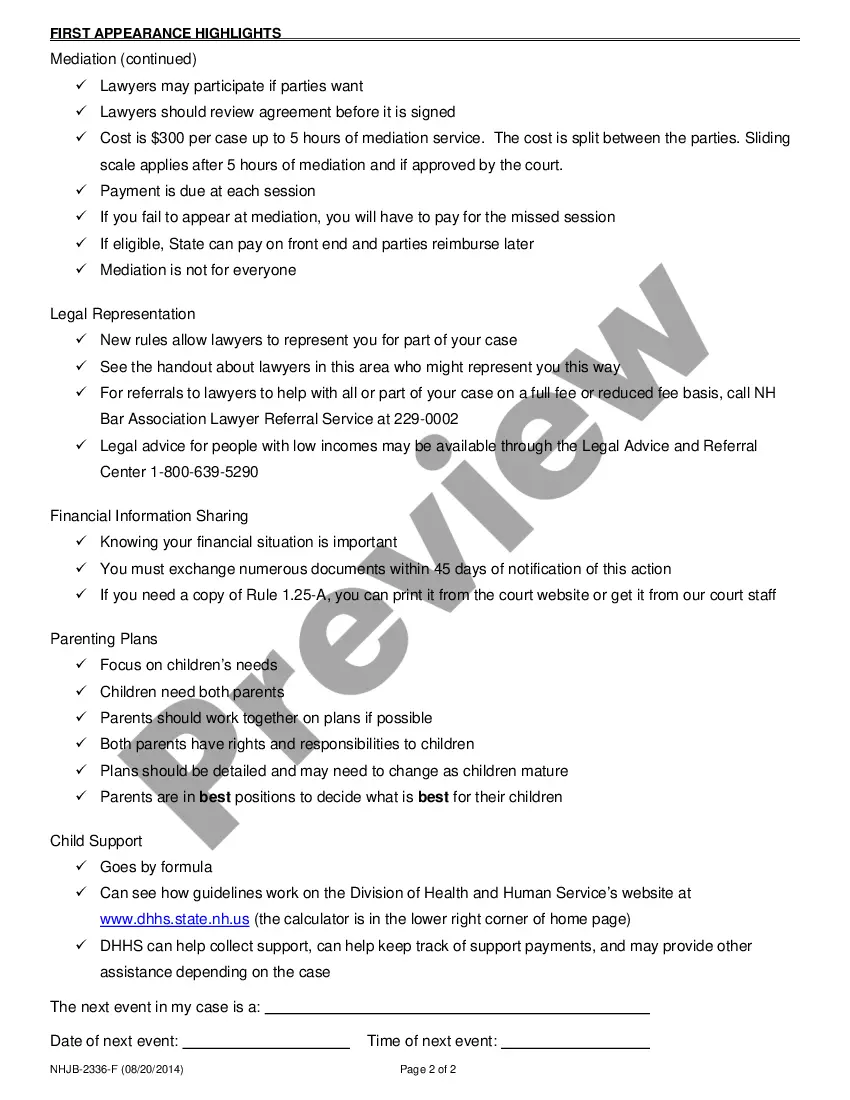
- Mediation guidelines and costs involved.
- Requirements for financial information sharing.
- Parenting plan overview and child support guidelines.
When to use this form
This form is needed when attending a first appearance in court regarding family matters in New Hampshire. It is an essential tool for understanding the court's expectations, available resources, and procedural steps that must be followed during divorce, custody disputes, or related cases.
Who this form is for
- Individuals involved in family court cases in New Hampshire.
- Parents seeking to establish parenting plans or resolve custody issues.
- Parties required to provide financial information for court proceedings.
- Anyone interested in mediation services as an alternative to litigation.
How to prepare this document
- Enter the date on which you attended the first appearance.
- Review and understand the goals outlined in the form.
- Fill in information regarding your Child Impact Program attendance if applicable.
- Specify your next scheduled court event and its timing.
- Ensure that both parents' rights and responsibilities are reflected in the parenting plan.
Notarization requirements for this form
Notarization is generally not required for this form. However, certain states or situations might demand it. You can complete notarization online through US Legal Forms, powered by Notarize, using a verified video call available anytime.
Get your form ready online
Our built-in tools help you complete, sign, share, and store your documents in one place.
Make edits, fill in missing information, and update formatting in US Legal Forms—just like you would in MS Word.
Download a copy, print it, send it by email, or mail it via USPS—whatever works best for your next step.
Sign and collect signatures with our SignNow integration. Send to multiple recipients, set reminders, and more. Go Premium to unlock E-Sign.
If this form requires notarization, complete it online through a secure video call—no need to meet a notary in person or wait for an appointment.
We protect your documents and personal data by following strict security and privacy standards.

Make edits, fill in missing information, and update formatting in US Legal Forms—just like you would in MS Word.

Download a copy, print it, send it by email, or mail it via USPS—whatever works best for your next step.

Sign and collect signatures with our SignNow integration. Send to multiple recipients, set reminders, and more. Go Premium to unlock E-Sign.

If this form requires notarization, complete it online through a secure video call—no need to meet a notary in person or wait for an appointment.

We protect your documents and personal data by following strict security and privacy standards.
Avoid these common issues
- Failing to provide accurate dates and times for court appearances.
- Not understanding the importance of financial information sharing.
- Neglecting to schedule mediation sessions if suggested.
- Omitting details necessary for the development of a parenting plan.
Benefits of using this form online
- Instant access to the latest version of the form, ensuring compliance with current laws.
- Convenience of completing the form at your own pace without needing to visit a legal office.
- Editable fields that allow customization to fit your specific case.
- Easy download and printing options for your records or court submission.
Main things to remember
- The First Appearance Highlights form is crucial for navigating initial court proceedings in family law cases.
- Understanding mediation and financial obligations can ease the court process.
- The form emphasizes the importance of generating a comprehensive parenting plan.
Looking for another form?


Form popularity
FAQ
Although the law specifically permits children at least 14-years-old to express an opinion, there is no specific age when a judge will listen to a child's opinion. California statutes also permit a child younger than 14 years old to testify regarding a custodial preference, unless the court decides it's not in the
It's commonly known as the Granite State for its extensive granite formations and quarries, but also has three other nicknames: Mother of River, the White Mountain State and Switzerland of America. 3.
The law doesn't specify an age at which the court must take into consideration a child's preference. That's because age doesn't determine maturity level. So it's conceivable that a judge might take into account the wishes of a young, mature child, but not those of an older, less responsible one.
Both spouses live in New Hampshire. The spouse initiating the separation has lived in New Hampshire for at least one year. The spouse initiating the separation lives in New Hampshire and their partner can be served in New Hampshire.
In its simplest sense, fair market value (FMV) is the price that an asset would sell for on the open market.
The procedure is straightforward. A claim may be filed either in the district court where the plaintiff lives, where the defendant lives, or where the legal wrong arose. The small claim is filed with the district or municipal court clerk.
1 attorney answer Although a child's wishes are one factor among many the court must consider in determining the child's best interests, a minor child never gets to "decide" which parent to live with.
Fathers in the state of New Hampshire have an equal right to child support as mothers, and they also have equal access to the services provided by the Division of Child Support Services.
What Is a Financial Affidavit? A financial affidavit, which has different names in each state, is a statement showing your income, expenses, debts and assets. It allows a court to figure out how much spousal support and child support it should award.