Nebraska Codicil to Will Form for Amending Your Will - Will Changes or Amendments
About this form
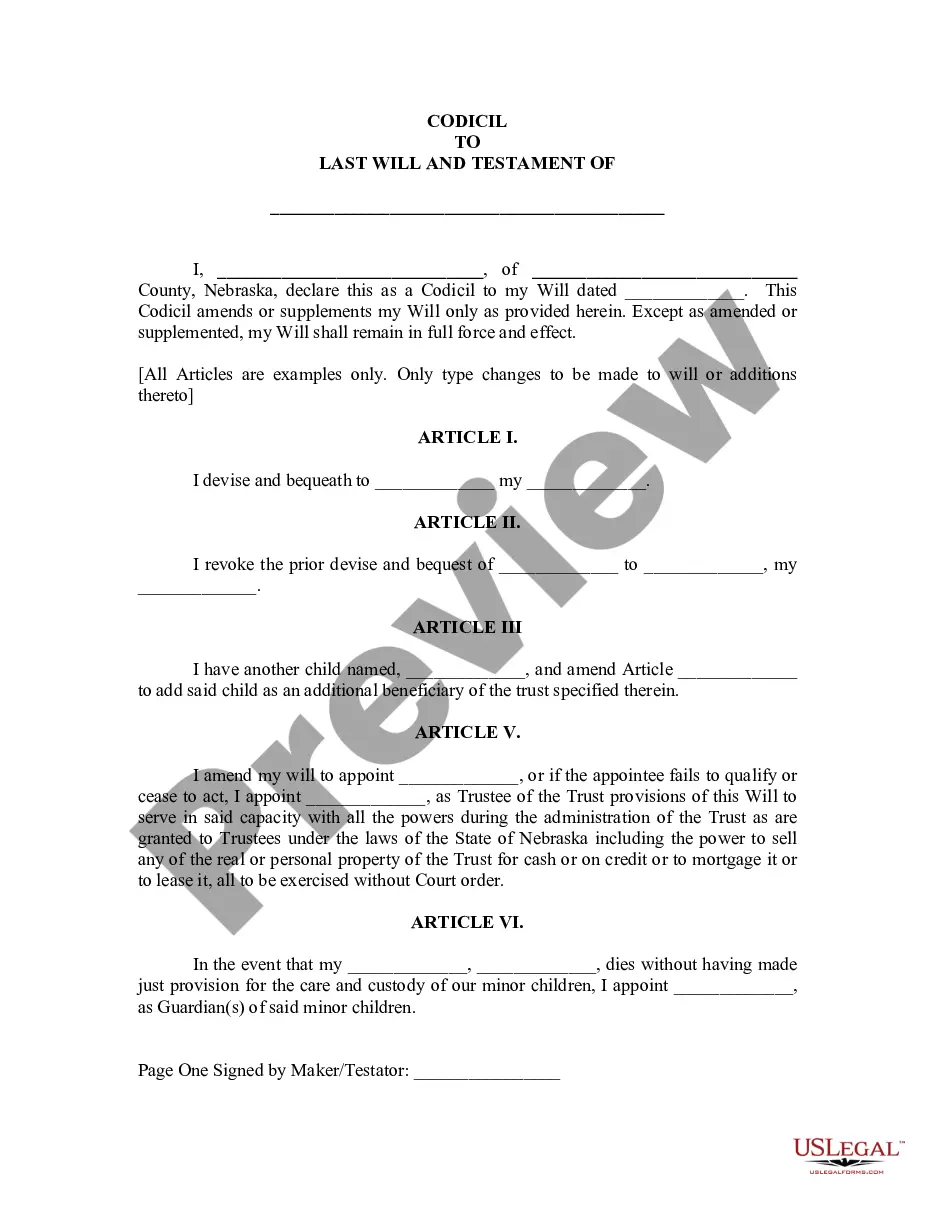
The Codicil to Will Form is a legal document used to amend an existing will without creating a completely new one. This form allows you to make changes to your current will, ensuring that the original document remains valid except for the modifications specified in the codicil. It is particularly useful for individuals looking to update beneficiaries, change executors, or make other specific alterations to their estate plans without starting from scratch. Within the realm of estate planning, this form provides a streamlined approach to managing your last will and testament.
Key parts of this document
- Identification of the testator and reference to the original will.
- Specific articles for modifying bequests, executorship, trusteeship, and guardianship.
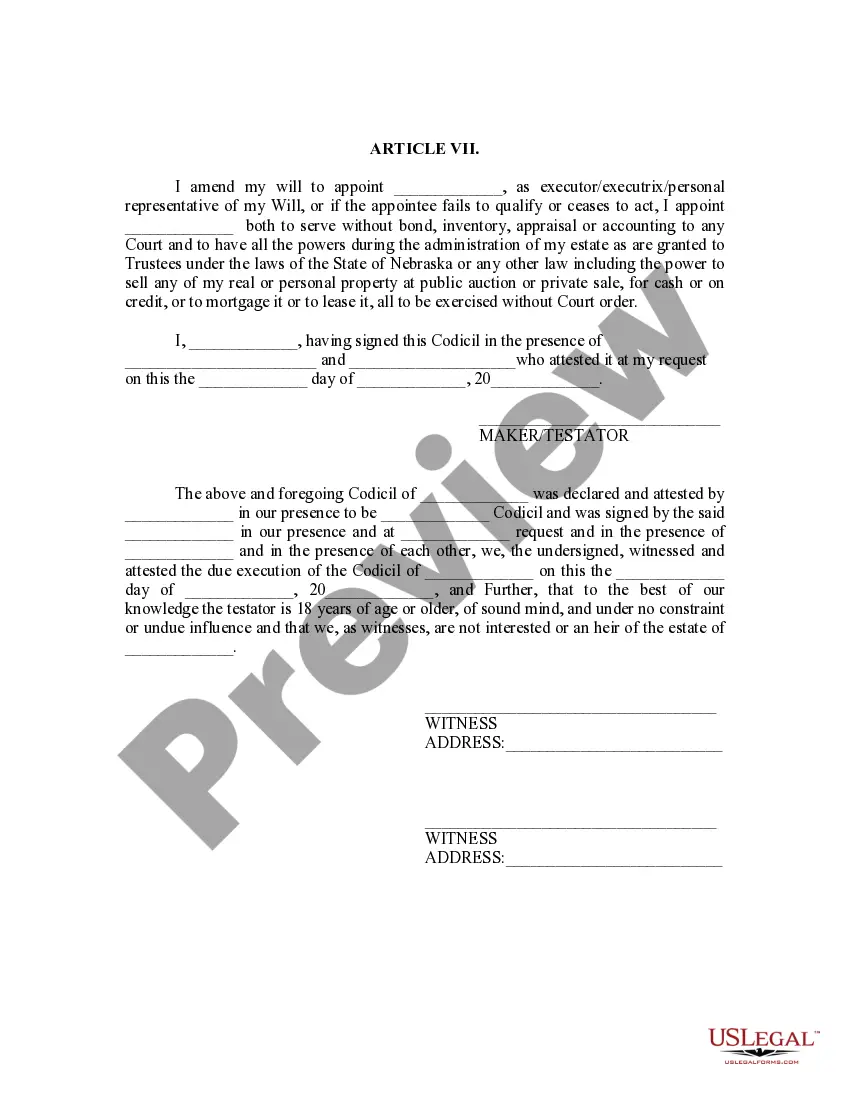
- Attestation clauses for witnesses to verify the testator's signing of the codicil.
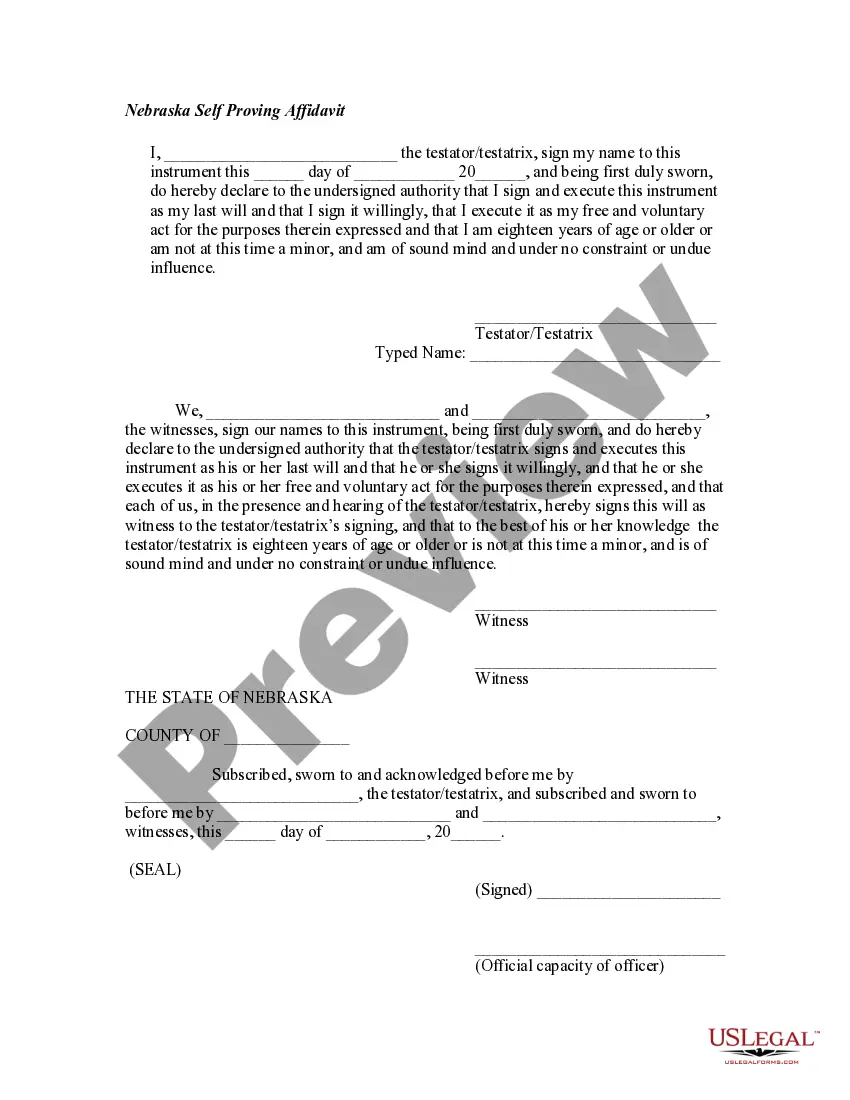
- Self-proving affidavit section for added legal assurance.

Situations where this form applies
This form should be used when you need to make specific changes to your will without rewriting the entire document. Common scenarios for using a codicil include adding or removing beneficiaries, changing executors or trustees, and updating guardian designations for minor children. It is an efficient way to ensure your estate planning reflects your current wishes.
Who should use this form
- Individuals who have an existing will and want to make minor adjustments.
- People who experience significant life changes, such as marriage, divorce, or the birth of a child.
- Those looking to update beneficiary designations or executor appointments.
- Residents of Nebraska who wish to comply with state-specific legal requirements.
Steps to complete this form
- Enter your name and county where you reside.
- Reference the date of your original will that you are amending.
- Specify the changes you want to make in the designated articles, including additions or revocations.
- Ensure that you and at least two witnesses sign and date the document.
- Complete the self-proving affidavit if required by the state.
Is notarization required?
To make this form legally binding, it must be notarized. Our online notarization service, powered by Notarize, lets you verify and sign documents remotely through an encrypted video session.
Get your form ready online
Our built-in tools help you complete, sign, share, and store your documents in one place.
Make edits, fill in missing information, and update formatting in US Legal Forms—just like you would in MS Word.
Download a copy, print it, send it by email, or mail it via USPS—whatever works best for your next step.
Sign and collect signatures with our SignNow integration. Send to multiple recipients, set reminders, and more. Go Premium to unlock E-Sign.
If this form requires notarization, complete it online through a secure video call—no need to meet a notary in person or wait for an appointment.
We protect your documents and personal data by following strict security and privacy standards.

Make edits, fill in missing information, and update formatting in US Legal Forms—just like you would in MS Word.

Download a copy, print it, send it by email, or mail it via USPS—whatever works best for your next step.

Sign and collect signatures with our SignNow integration. Send to multiple recipients, set reminders, and more. Go Premium to unlock E-Sign.

If this form requires notarization, complete it online through a secure video call—no need to meet a notary in person or wait for an appointment.

We protect your documents and personal data by following strict security and privacy standards.
Common mistakes to avoid
- Failing to include the original will's date for reference.
- Not having the form signed by two witnesses, which may invalidate it.
- Overlooking the completion of the self-proving affidavit if needed.
- Leaving sections incomplete or vague, leading to potential disputes.
Benefits of using this form online
- Convenience of downloading and printing the form at your own pace.
- Editability allows you to customize the form to suit your specific needs.
- Reliable templates drafted by licensed attorneys, ensuring legal adequacy.
- Access to guidance and sample provisions to help you through the process.
Legal use & context
- A codicil serves as a legally recognized method to amend a will without redrafting it completely.
- State laws govern the execution and validity of codicils; thus, compliance with Nebraska laws is crucial.
- Legal validity hinges on proper formulation and execution, including witness signatures.
What to keep in mind
- The Codicil to Will Form enables specific amendments without rewriting an entire will.
- Proper signing and witnessing are essential to ensure the codicil's legal effectiveness.
- Always refer to your original will when making amendments to maintain clarity and consistency.
Looking for another form?

Form popularity
FAQ
In most situations, a will template is an easy and inexpensive way to make sure your wishes are known and carried out. Most people can get everything they need by using a will template, with little cost or hassle.
To make a will self-proved in Nebraska, the testator and witnesses must sign a self proving affidavit before a notary public. An affidavit is a sworn statement, and a notary public is an officer of the court. Therefore, an affidavit before a notary public is like making a statement in court.
What Makes a Handwritten Will Legally Binding? A written will is valid if it is: (1) in writing; (2) signed by the testator, i.e., the person making the will; and (3) signed by at least two witnesses who saw the testator sign the will or acknowledge the signature on the will.
A. You don't have to have a lawyer to create a basic will you can prepare one yourself. It must meet your state's legal requirements and should be notarized.A do-it-yourself will that's poorly drafted can save you money but create a mess for your heirs when you're gone.
No, in Nebraska, you do not need to notarize your will to make it legal. However, Nebraska allows you to make your will "self-proving" and you'll need to go to a notary if you want to do that. A self-proving will speeds up probate because the court can accept the will without contacting the witnesses who signed it.
Nebraska recognizes holographic (handwritten) wills so long as the material provisions, signature, and date are in the testator's handwriting. In Nebraska, a holographic will does not need to have witnesses in order to be valid.