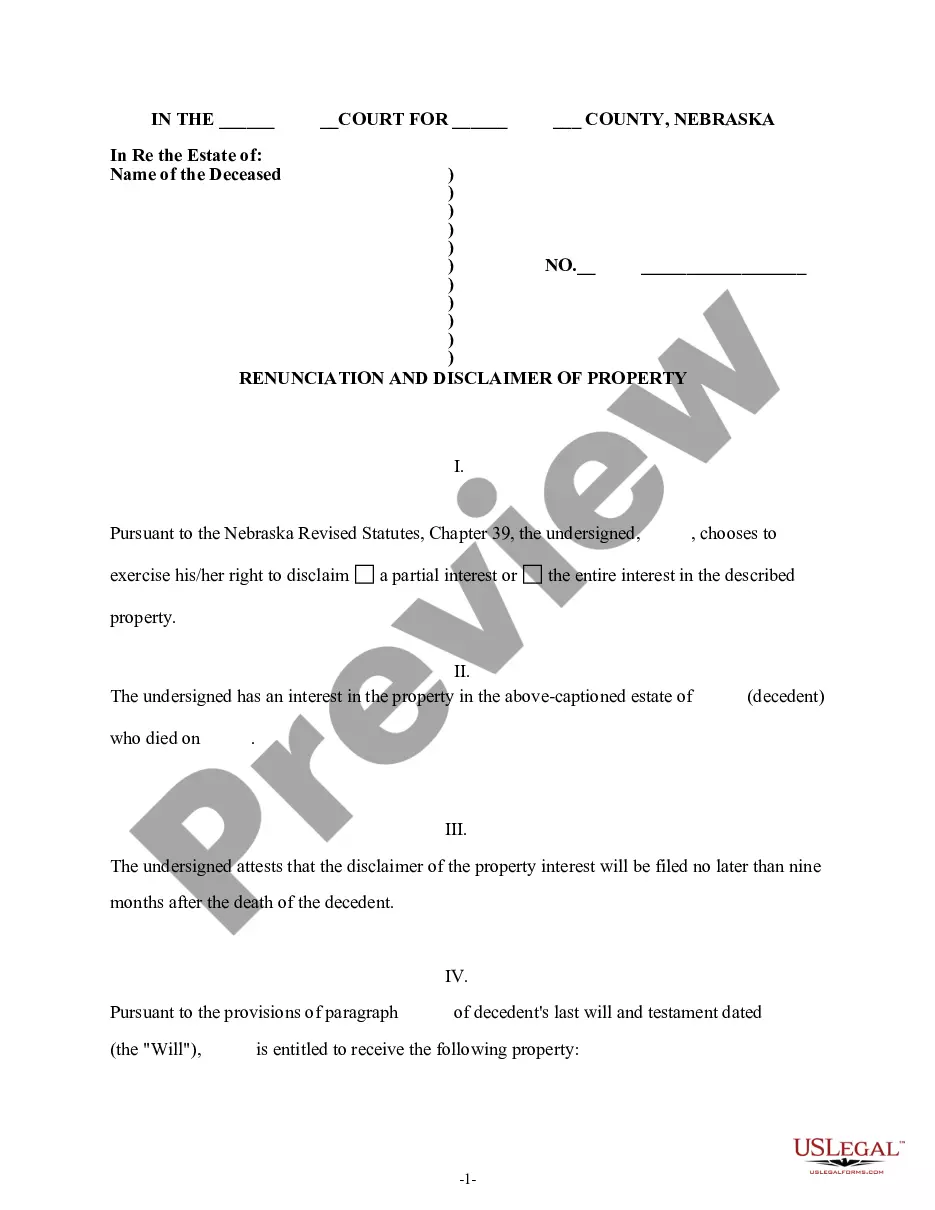
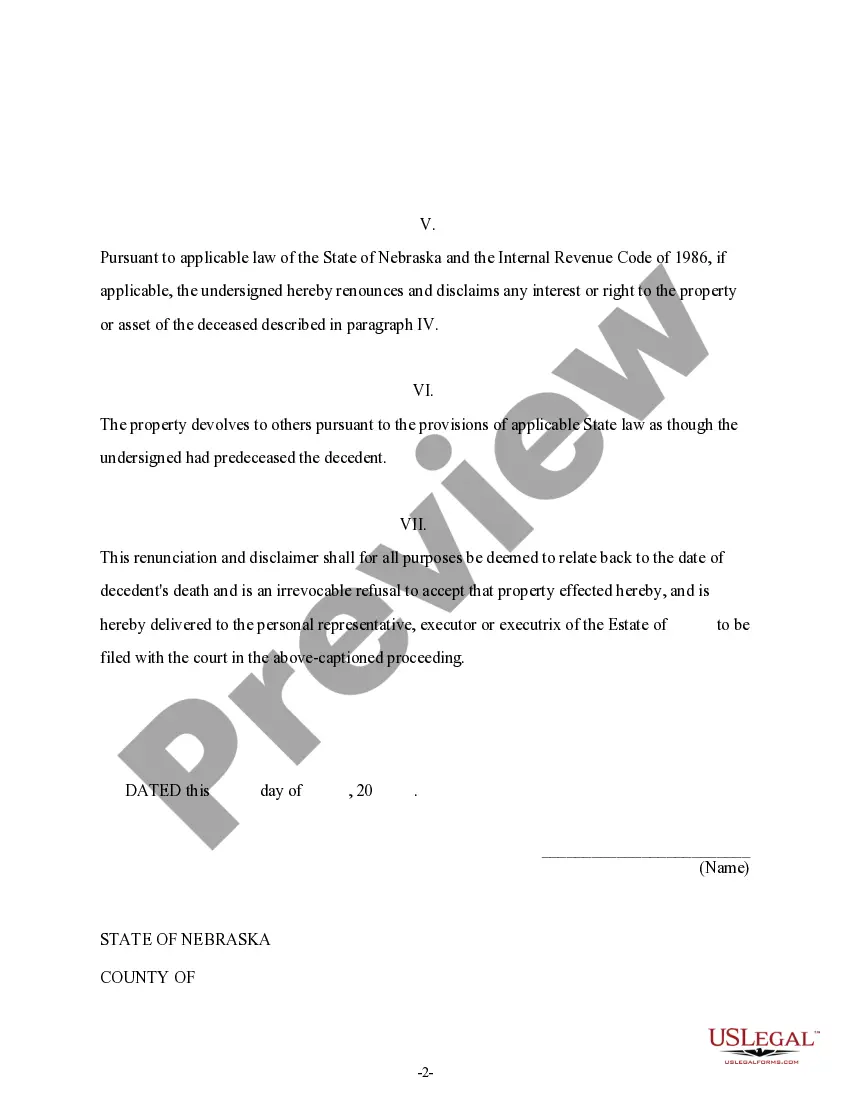
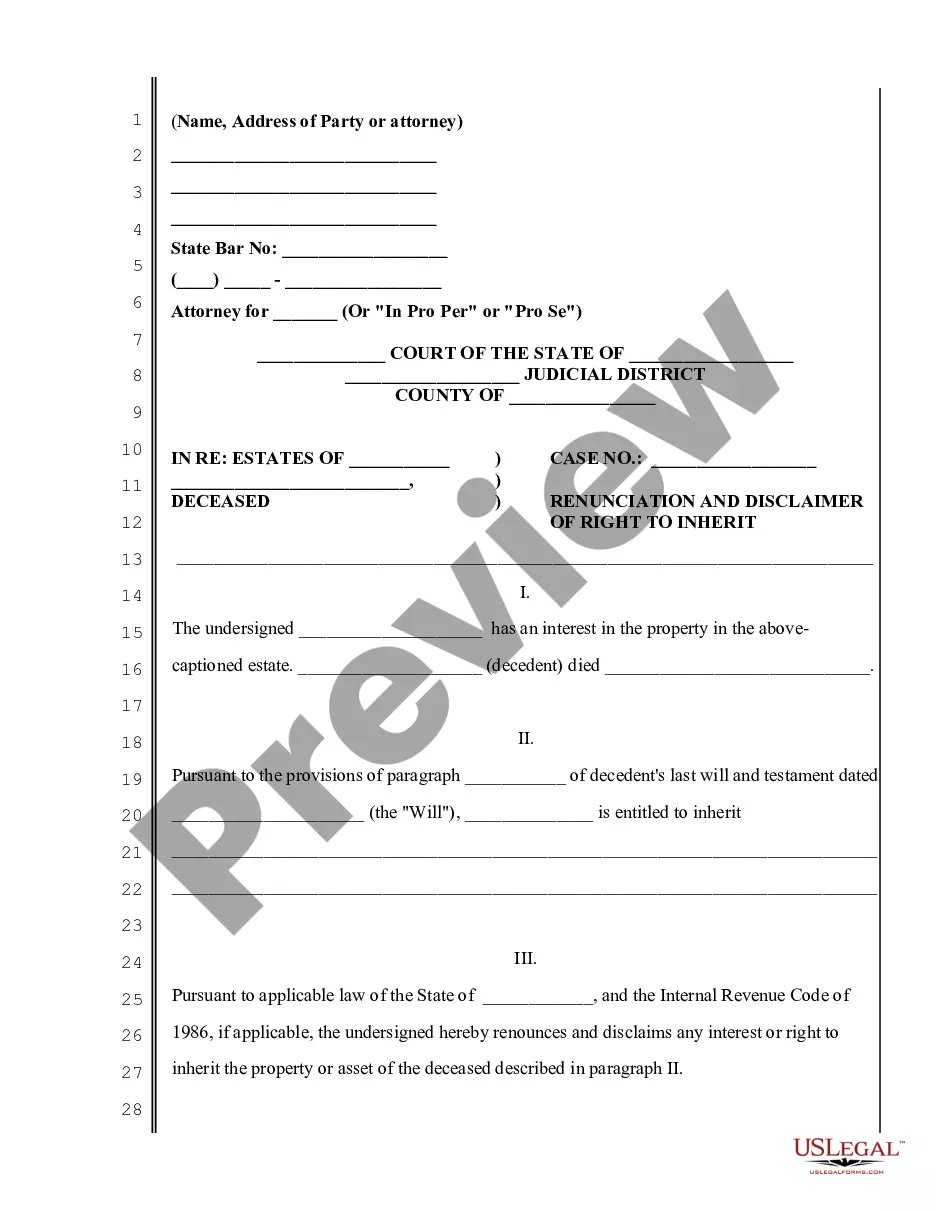
Renunciation And Disclaimer of Property from Will by Testate
Disclaimer of Property Interest-Nebraska
Nebraska Revised Statutes
Chapter 30. Decedents' Estates
Renunciation of succession.
(a)
(1) A person (or the representative of a deceased, incapacitated,
or protected person) who is an heir, devisee, person succeeding to a renounced
interest, donee, beneficiary under a testamentary or nontestamentary instrument,
donee of a power of appointment, grantee, surviving joint owner or surviving
joint tenant, beneficiary, or owner of an insurance contract or any incident
of ownership therein, beneficiary or person designated to take pursuant
to a power of appointment exercised by a testamentary or nontestamentary
instrument, person who has a statutory entitlement to or election with
respect to property pursuant to the Nebraska Probate Code, or recipient
of any beneficial interest under any testamentary or nontestamentary instrument,
may renounce in whole or in part, or with reference to specific parts,
fractional shares, undivided portions or assets thereof, by filing a written
instrument of renunciation within the time and at the place hereinafter
provided.
(2) The instrument shall (i) describe the property or part thereof
or the interest therein renounced, (ii) be signed and acknowledged by the
person renouncing in the manner provided for in the execution of deeds
of real estate, (iii) declare the renunciation and the extent thereof,
and (iv) declare that the renunciation is an irrevocable and unqualified
refusal to accept the renounced interest.
(3) The appropriate court in a proceeding under section 30-2806,
may direct or permit a trustee under a testamentary or nontestamentary
instrument to renounce, modify, amend, or otherwise deviate from any restriction
on or power of administration, management or allocation of benefit upon
finding that such restrictions on the exercise of such power may defeat
or impair the accomplishment of the purposes of the trust whether by the
imposition of tax or the allocation of beneficial interest inconsistent
with such purposes or by other reason. Such authority shall be exercised
after hearing and upon notice to all known persons beneficially interested
in such trust, in the manner directed by said court.
(b) The instrument specified in (a)(1) and (a)(2) must be received
by the transferor of the interest, his or her legal representative, the
personal representative of a deceased transferor, the trustee of any trust
in which the interest being renounced exists, or the holder of the legal
title to the property to which the interest relates. To be effective for
purposes of determining inheritance and estate taxes under articles 20
and 21 of Chapter 77, the instrument must be received not later than the
date which is nine months after the later of (i) the date on which the
transfer creating the interest in such person is made, or (ii) the date
on which such person attains age twenty-one. If the circumstances which
establish the right of a person to renounce an interest arise as a result
of the death of an individual, the instrument shall also be filed in the
court of the county where proceedings concerning the decedent's estate
are pending, or where they would be pending if commenced. If an interest
in real estate is renounced, a copy of the instrument shall also be recorded
in the office of the register of deeds in the county in which said real
estate lies. No person entitled to a copy of the instrument shall be liable
for any proper distribution or disposition made without actual notice of
the renunciation and no such person making a proper distribution or disposition
in reliance upon the renunciation shall be liable for any such distribution
or disposition in the absence of actual notice that an action has been
instituted contesting the validity of the renunciation.
(c) Unless the transferor of the interest has otherwise indicated
in the instrument creating the interest, the interest renounced, and any
future interest which is to take effect in possession or enjoyment at or
after the termination of the interest renounced, passes as if the person
renouncing had predeceased the decedent or had died prior to the date on
which the transfer creating the interest in such person is made, as the
case may be, if the renunciation is within the time periods set forth in
subsection (b) and if not within such time periods the interest renounced,
and any future interest which is to take effect in possession or enjoyment
at or after the termination of the interest renounced, passes as if the
person renouncing had died on the date the interest was renounced. The
person renouncing shall have no power to direct how the interest being
renounced shall pass, except that the renunciation of an interest for which
the right to renounce was established by the death of an individual shall,
in the case of the spouse of the decedent, relate only to that statutory
provision or that provision of the instrument creating the interest being
renounced and shall not preclude the spouse from receiving the benefits
of the renounced interest which may be derived as a result of the renounced
interest passing pursuant to other statutory provisions or pursuant to
other provisions of the instrument creating the interest unless such further
benefits are also renounced. In every case when the renunciation is within
the time periods set forth in subsection (b) the renunciation relates back
for all purposes to the date of death of the decedent or the date on which
the transfer creating the interest in such person is made, as the case
may be.
(d) Any (1) assignment, conveyance, encumbrance, pledge or transfer
of property therein or any contract therefor, (2) written waiver of the
right to renounce or any acceptance of property or benefits therefrom or
an interest therein by an heir, devisee, person succeeding to a renounced
interest, donee, beneficiary under a testamentary or nontestamentary instrument,
donee of a power of appointment, grantee, surviving joint owner or surviving
joint tenant, beneficiary or owner of an insurance contract or any incident
of ownership therein, beneficiary or person designated to take pursuant
to a power of appointment exercised by a testamentary or nontestamentary
instrument, person who has a statutory entitlement to or election with
respect to property pursuant to the Nebraska Probate Code, or recipient
of any beneficial interest under any testamentary or nontestamentary instrument,
or (3) sale or other disposition of property pursuant to judicial process,
made within the time periods set forth in subsection (b) shall not bar
the right to renounce, but shall make a subsequent renunciation within
the time period set forth in subsection (b) of this section ineffective
for purposes of determination of inheritance and estate taxes under articles
20 and 21 of Chapter 77.
(e) Within thirty days of receipt of a written instrument of renunciation
by the transferor of the interest, his or her legal representative, the
personal representative of the decedent, the trustee of any trust in which
the interest being renounced exists, or the holder of the legal title to
the property to which the interest relates, as the case may be, such person
shall attempt to notify in writing those persons who are known or ascertainable
with reasonable diligence who shall be recipients or potential recipients
of the renounced interest of the renunciation and the interest or potential
interest such recipient shall receive as a result of the renunciation.
(f) The right to renounce granted by this section exists irrespective
of any limitation on the interest of the person renouncing in the nature
of a spendthrift provision or similar restriction. A trust beneficiary
whose interest is subject to any limitation in the nature of a spendthrift
provision or similar restriction may assign, sell, or otherwise convey
such interest or any part thereof upon a finding by a court in a proceeding
under section 30-2806, that the rights of other beneficiaries would not
be impaired and that such assignment, sale, or other conveyance would not
result in any substantial benefit to nonbeneficiaries of the trust at the
expense of the trust or trust beneficiaries. Such finding may be made after
hearing and upon notice to all known persons beneficially interested in
such trust, in the manner directed by the court.
(g) This section does not abridge the right of any person to assign,
convey, release, or renounce any property arising under any other section
of this code or other statute.
(h) Any interest in property which exists on July 19, 1980, may
be renounced after July 19, 1980, as provided herein. An interest which
has arisen prior to July 19, 1980, in any person other than the person
renouncing is not destroyed or diminished by any action of the person renouncing
taken under this section.
Source: Laws 1974, LB 354, § 74, UPC § 2-801; Laws 1978,
LB 650, § 35; Laws 1980, LB 694, § 9.
An exception to the general rule that a renunciation
relates back "for all purposes" exists for individuals depriving themselves
of any property whatsoever for purposes of qualifying for public assistance.
Hoesly v. State, 243 Neb. 304, 498 N.W.2d 571 (1993).
There is nothing inconsistent in making claim
to the whole of an estate and at the same time accepting something less
than the whole under the will since property comprising a bequest of only
a part of an estate would be included within a claim to the entire estate.
Consequently, the claimant had no reason to renounce the will under the
terms of this section. In re Estate of Nicholson, 211 Neb. 805, 320 N.W.2d
739 (1982).
Chap. 30, §30-2352.