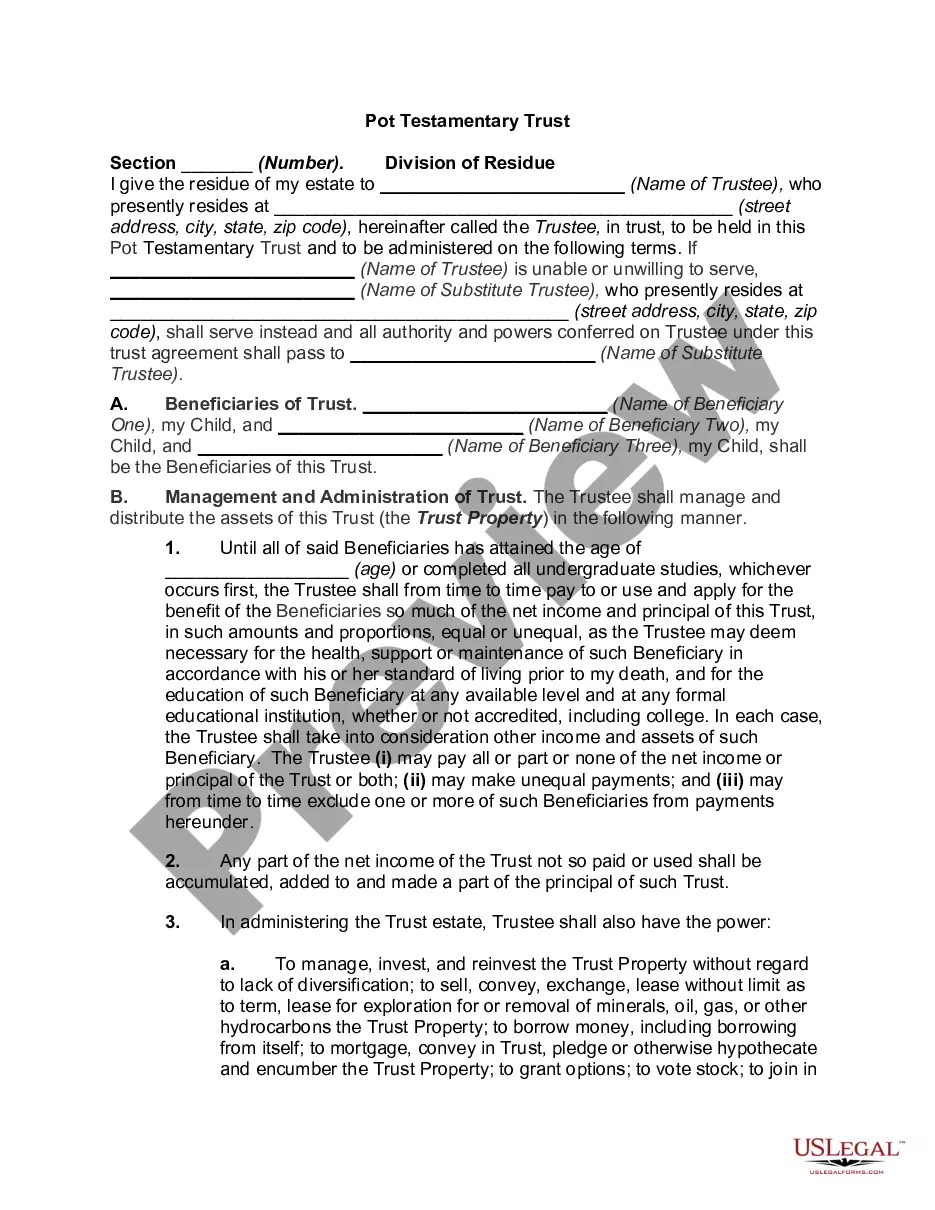
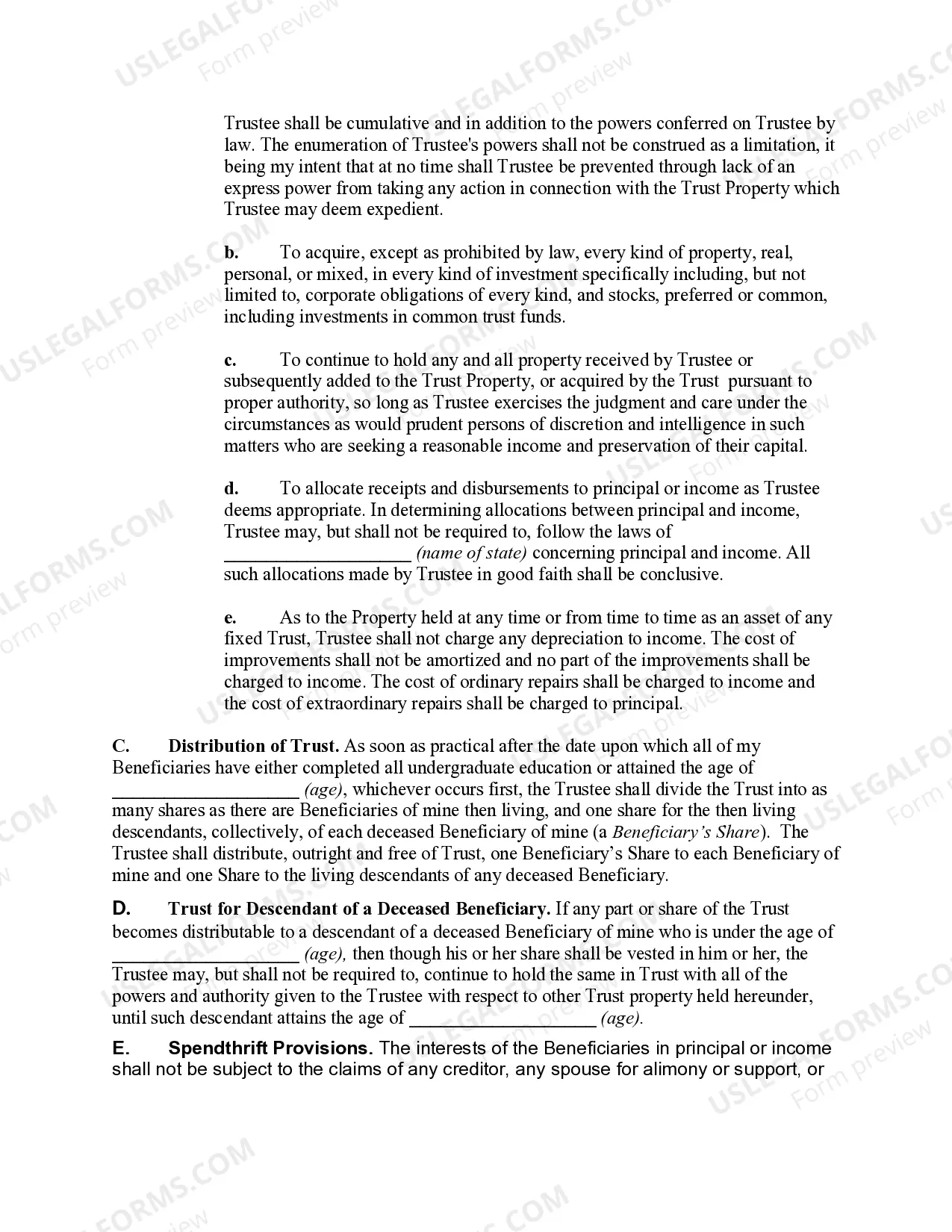
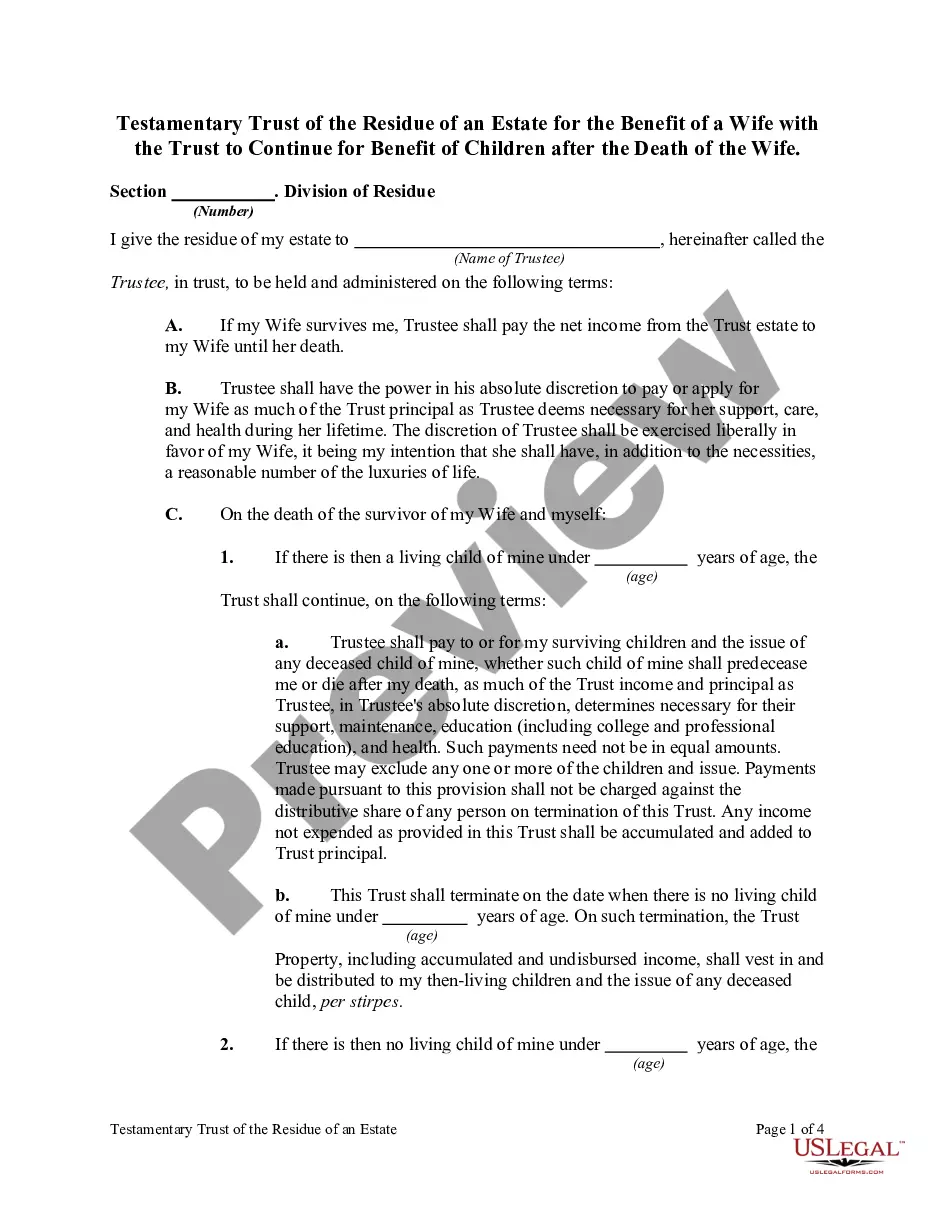
North Dakota Pot Testamentary Trust
Description


Get your form ready online
Our built-in tools help you complete, sign, share, and store your documents in one place.
Make edits, fill in missing information, and update formatting in US Legal Forms—just like you would in MS Word.
Download a copy, print it, send it by email, or mail it via USPS—whatever works best for your next step.
Sign and collect signatures with our SignNow integration. Send to multiple recipients, set reminders, and more. Go Premium to unlock E-Sign.
If this form requires notarization, complete it online through a secure video call—no need to meet a notary in person or wait for an appointment.
We protect your documents and personal data by following strict security and privacy standards.

Make edits, fill in missing information, and update formatting in US Legal Forms—just like you would in MS Word.

Download a copy, print it, send it by email, or mail it via USPS—whatever works best for your next step.

Sign and collect signatures with our SignNow integration. Send to multiple recipients, set reminders, and more. Go Premium to unlock E-Sign.

If this form requires notarization, complete it online through a secure video call—no need to meet a notary in person or wait for an appointment.

We protect your documents and personal data by following strict security and privacy standards.
Looking for another form?


How to fill out Pot Testamentary Trust?
US Legal Forms - one of the largest collections of legal documents in the United States - offers a broad selection of legal form templates that you can download or print.
While using the site, you can find thousands of forms for business and personal use, categorized by types, states, or keywords. You can access the latest versions of forms such as the North Dakota Pot Testamentary Trust in moments.
If you hold a membership, Log In to download the North Dakota Pot Testamentary Trust from the US Legal Forms library. The Download option will appear on every form you view. You can access all previously downloaded forms in the My documents tab of your account.
Process the payment. Utilize a credit card or PayPal account to complete the transaction.
Select the format and download the form onto your device. Edit. Complete, modify, print, and sign the downloaded North Dakota Pot Testamentary Trust. Every template you add to your account has no expiration date and is retained indefinitely. Thus, to download or print an additional copy, simply navigate to the My documents section and click on the form you wish to access. Get the North Dakota Pot Testamentary Trust using US Legal Forms, one of the most extensive collections of legal document templates. Utilize thousands of professional and state-specific templates that cater to your business or personal requirements.
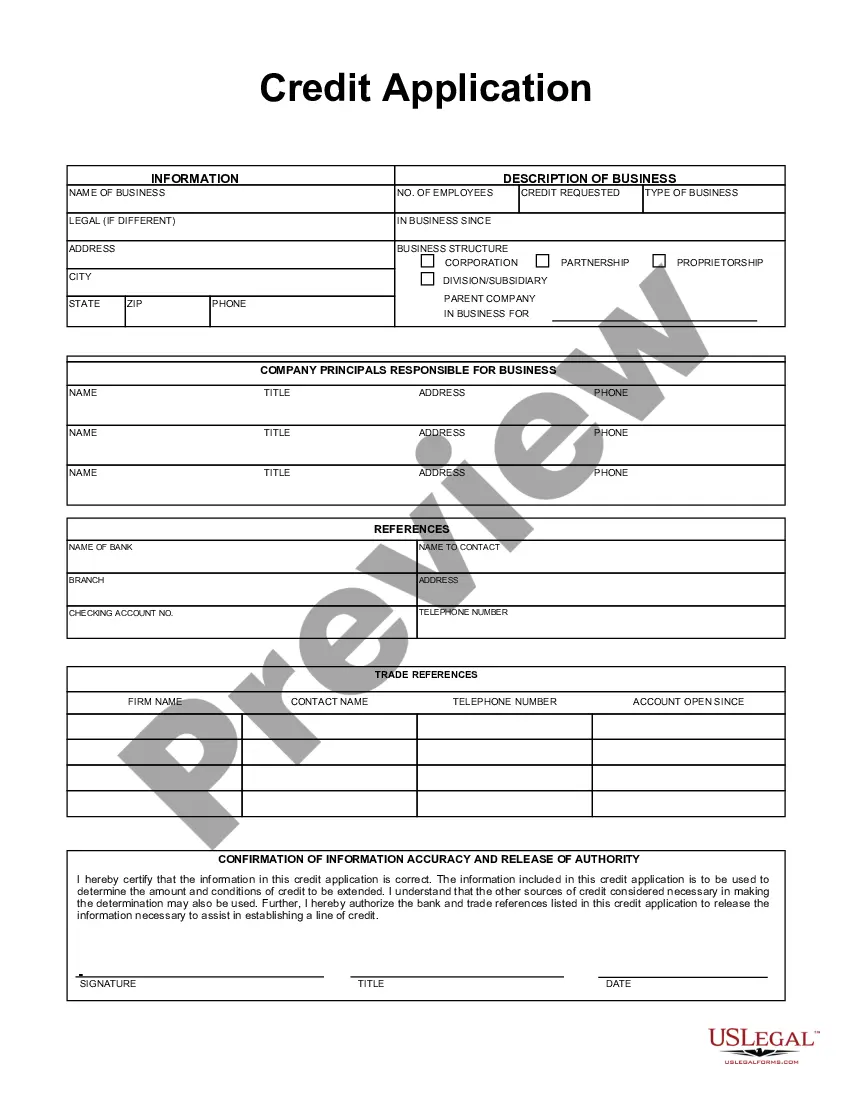
- Make sure you have selected the correct form for your city/state.
- Check the Review option to examine the content of the form.
- Read the form description to ensure that you have chosen the right form.
- If the form does not suit your requirements, utilize the Search field at the top of the screen to find one that does.
- If you are content with the form, confirm your choice by clicking on the Get now button.
- Then, select the pricing plan you prefer and provide your information to register for an account.
Form popularity
FAQ
There are several strategies you can use to avoid probate in North Dakota. Creating a North Dakota Pot Testamentary Trust is one effective method, as it allows you to transfer assets directly to beneficiaries without going through probate. Other options include naming beneficiaries on accounts or using joint ownership arrangements, which can simplify the estate transfer process.
The length of probate in North Dakota varies widely, often taking several months to over a year. This time frame can be affected by several factors, including estate complexity and court schedules. Establishing a North Dakota Pot Testamentary Trust can potentially shorten the probate process by allowing for more direct transfer of assets. Consulting with our platform, uslegalforms, can provide assistance in navigating probate effectively.
The probate process in North Dakota can vary in duration based on the complexity of the estate. Typically, it might take anywhere from a few months to more than a year to complete. Factors such as the type of assets involved and the cooperation of beneficiaries can influence this timeline. If you're considering setting up a North Dakota Pot Testamentary Trust, it can help streamline the process and reduce probate duration.
Probate is always needed to deal with a property after the owner dies. However, other organisations such as the deceased's bank, insurer, or pension provider may also request to see a Grant of Probate before releasing any money held in the deceased's name.
A testamentary trust is a trust that is established in accordance with the instructions contained in a last will and testament. A trust is a fiduciary relationship that allows a trustee, who is a third party, to manage assets on behalf of the beneficiaries of the trust.
If you are named in someone's will as an executor, you may have to apply for probate. This is a legal document which gives you the authority to share out the estate of the person who has died according to the instructions in the will. You do not always need probate to be able to deal with the estate.
To help you get started on understanding the options available, here's an overview the three primary classes of trusts.Revocable Trusts.Irrevocable Trusts.Testamentary Trusts.More items...?31-Aug-2015
Testamentary trusts are created by a will to provide a greater level of control over the distribution of assets to beneficiaries. There are also tax advantages available through testamentary trusts, making them an effective estate planning tool.
Living trusts and testamentary trustsA living trust (sometimes called an inter vivos trust) is one created by the grantor during his or her lifetime, while a testamentary trust is a trust created by the grantor's will. Only a funded living trust avoids probate court.
Testamentary trusts are discretionary trusts established in Wills, that allow the trustees of each trust to decide, from time to time, which of the nominated beneficiaries (if any) may receive the benefit of the distributions from that trust for any given period.