North Dakota Lien Claimant's Demand for Information - Individual
What this document covers
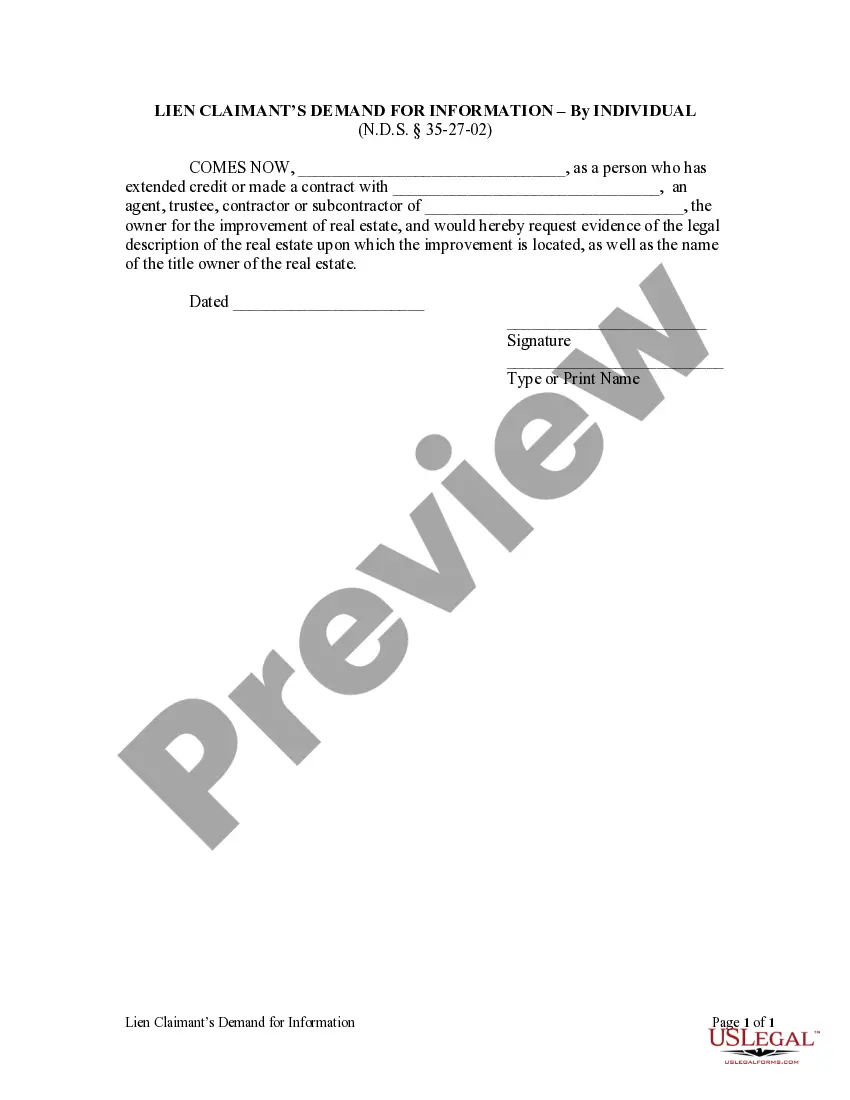
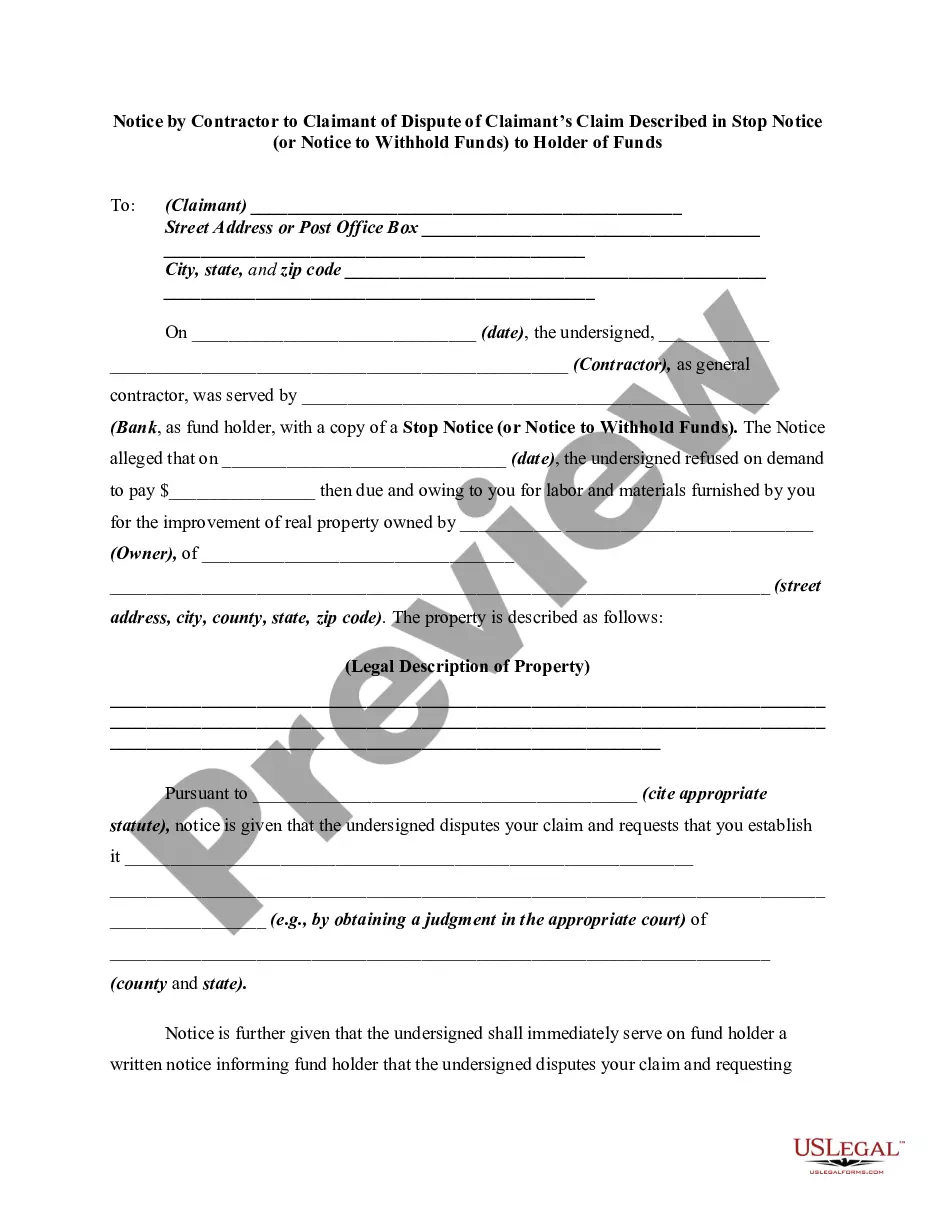
The Lien Claimant's Demand for Information form is a legal document used by individuals who have provided credit or entered into a contract with an agent, trustee, contractor, or subcontractor involved in the improvement of real estate. This form allows the claimant to request evidence regarding the legal description of the property and the name of the title owner. It is essential in ensuring that lien claimants have the necessary details to protect their interests when dealing with property improvements.
What’s included in this form
- Claimant's name: Input the name of the individual making the request.
- Contractor's name: Provide the name of the contractor or entity with whom the claimant has a contract.
- Owner's name: Enter the name of the property owner.
- Legal description request: A section to specify the request for evidence of the property's legal description.
- Date and signature: A space for the claimant to date and sign the document, confirming the request.
When to use this form
This form should be used when an individual has extended credit or entered into a contract related to real estate improvements and needs to verify the legal owner and property details. It is particularly useful when there is uncertainty regarding the title ownership or the legal description of the property, which are vital for establishing a lien.
Intended users of this form
- Homeowners who have hired contractors or subcontractors for home improvements.
- Individuals providing credit in the form of loans or contracts for real estate projects.
- Contractors or subcontractors seeking to secure payment for their services.
Steps to complete this form
- Identify the parties: Clearly state your name as the claimant, the contractor's name, and the ownerâs name.
- Specify the request: Indicate that you are requesting evidence of the legal description of the property.
- Enter the date: Fill in the date when the form is being completed.
- Sign the document: Provide your signature along with your typed or printed name to validate the request.
Does this document require notarization?
This form does not typically require notarization unless specified by local law. However, users should verify local regulations to ensure compliance with any additional requirements.
Get your form ready online
Our built-in tools help you complete, sign, share, and store your documents in one place.
Make edits, fill in missing information, and update formatting in US Legal Forms—just like you would in MS Word.
Download a copy, print it, send it by email, or mail it via USPS—whatever works best for your next step.
Sign and collect signatures with our SignNow integration. Send to multiple recipients, set reminders, and more. Go Premium to unlock E-Sign.
If this form requires notarization, complete it online through a secure video call—no need to meet a notary in person or wait for an appointment.
We protect your documents and personal data by following strict security and privacy standards.

Make edits, fill in missing information, and update formatting in US Legal Forms—just like you would in MS Word.

Download a copy, print it, send it by email, or mail it via USPS—whatever works best for your next step.

Sign and collect signatures with our SignNow integration. Send to multiple recipients, set reminders, and more. Go Premium to unlock E-Sign.

If this form requires notarization, complete it online through a secure video call—no need to meet a notary in person or wait for an appointment.

We protect your documents and personal data by following strict security and privacy standards.
Avoid these common issues
- Failing to include the correct names of all parties involved.
- Not providing a complete legal property description.
- Leaving out the date or signature which may invalidate the request.
Advantages of online completion
- Convenience of immediate download and completion.
- Editability allows you to customize the form to fit your specific needs.
- Access to templates drafted by licensed attorneys ensures legal compliance.
Looking for another form?
Form popularity
FAQ
Prime contractor in direct contract with the owner must record his or her lien within sixty (60) days of the recording of the Notice of Completion (Civil Code C§ 3115-3116). All others must record their liens within thirty (30) days of the date the Notice of Completion is recorded. (Civil Code §3116).
California's deadline to file a mechanics lien is 90 days after the completion of the project as a whole. However, if a notice of completion or cessation was filed, the deadline for subcontractors, suppliers, and other sub-tier parties is shortened to 30 days from the date the notice was filed.
If a creditor puts a lien on your property, you may make an offer to settle the amount for less than you owe. As part of the negotiations, get the creditor to agree to release the lien. If you need help in the negotiations, consider hiring a debt settlement lawyer to help you.
If a creditor gets a judgment against you, it can then place a lien on your property. The lien gives the creditor an interest in your property so that it can get paid for the debt you owe.And in some cases, the lien gives the creditor the right to force a sale of your property in order to get paid.
The simplest way to prevent liens and ensure that subcontractors and suppliers are paid is to pay with joint checks. This is when both parties endorse the check. Compare the contractor's materials or labor bill to the schedule of payments in your contract and the Preliminary Notices.
To place a lien, you must first demonstrate that you have a valid debt that has not been paid by the property holder for example if you performed construction work as a contractor or subcontractor at company headquarters and the business did not pay your bill.
A North Dakota mechanics lien must be filed in the county recorder's office of the county where the property is located.
What Is a Fraudulent Lien?the claimant is owed money on another job by the same general contractor or property owner, but didn't file a lien on that project before time expired; or. the claimant wants to file a lien because of personal reasons generally related to the identity of the property owner.
Formalize a defense for disputing the amount of the lien. Gather supporting documentation for your rebuttal, depending on the type of lien. Contact the agent representing the creditor to dispute the amount of the claim. Negotiate a payment settlement with the creditor if you cannot pay the amount you owe in full.