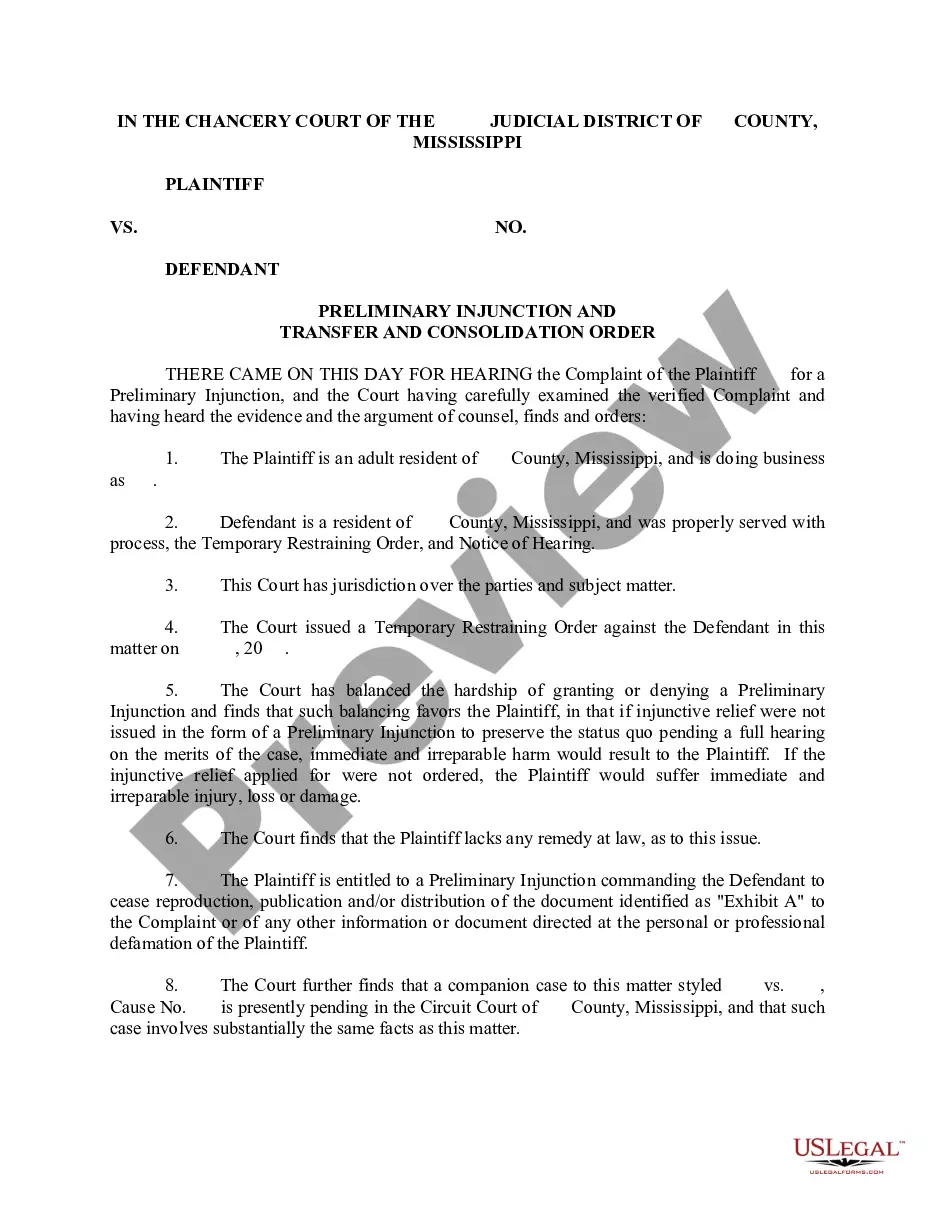
North Dakota Renunciation And Disclaimer of Property from Will by Testate
Understanding this form
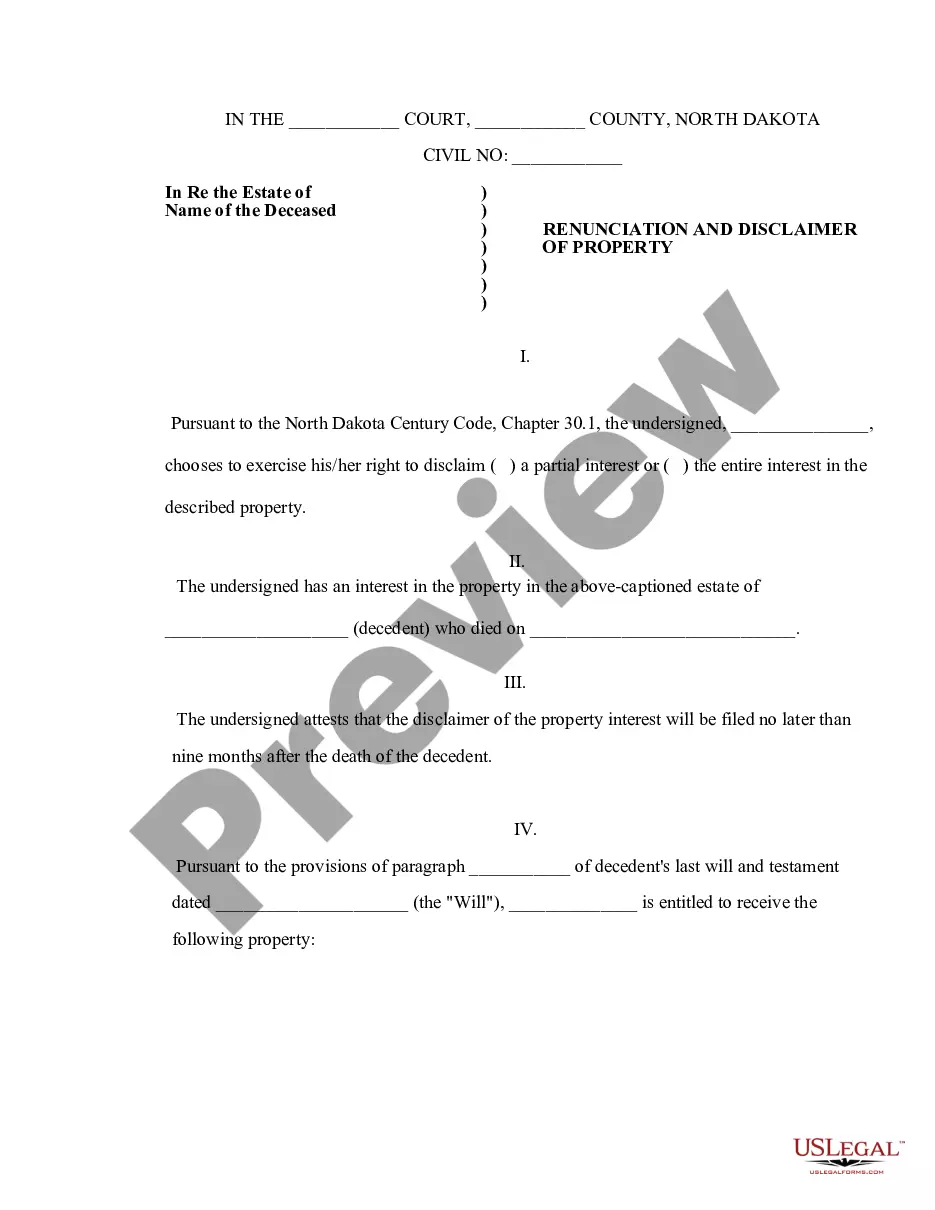
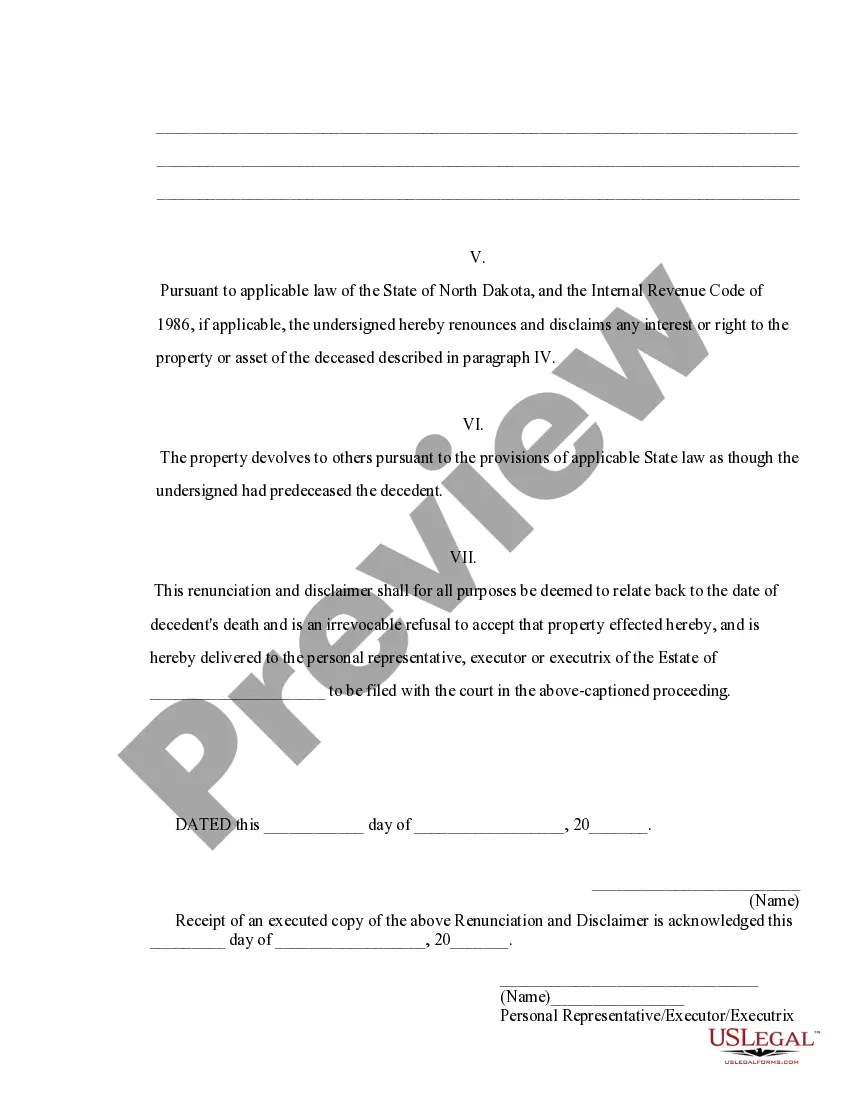
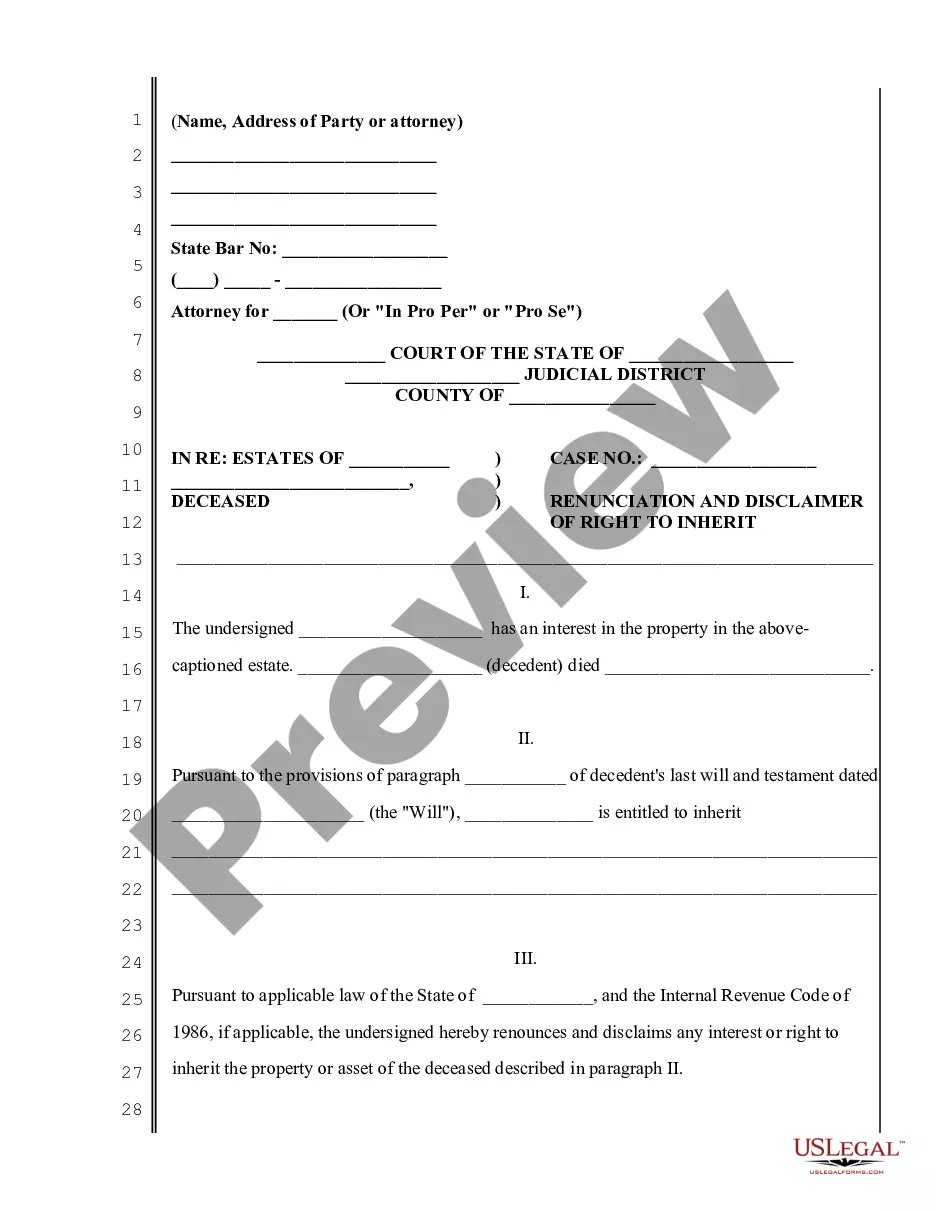
This Renunciation and Disclaimer of Property allows a beneficiary to formally refuse any interest in property acquired through a will. This is particularly relevant for those who may not want to accept their inheritance, whether it is for personal, financial, or legal reasons. Unlike other legal documents, this form specifically addresses disavowing an inheritance in compliance with North Dakota law, ensuring that the refusal is irrevocable and relates back to the decedent's death.
Main sections of this form
- Identification of the undersigned and their relationship to the decedent.
- Confirmation of the decedent's date of death and the specific property interest being disclaimed.
- A declaration that the disclaimer will be filed within nine months of the decedent's death.
- Legal acknowledgment stating the disclaimer will apply retrospectively to the date of death.
- Signature and notary acknowledgement to validate the document.



When to use this document
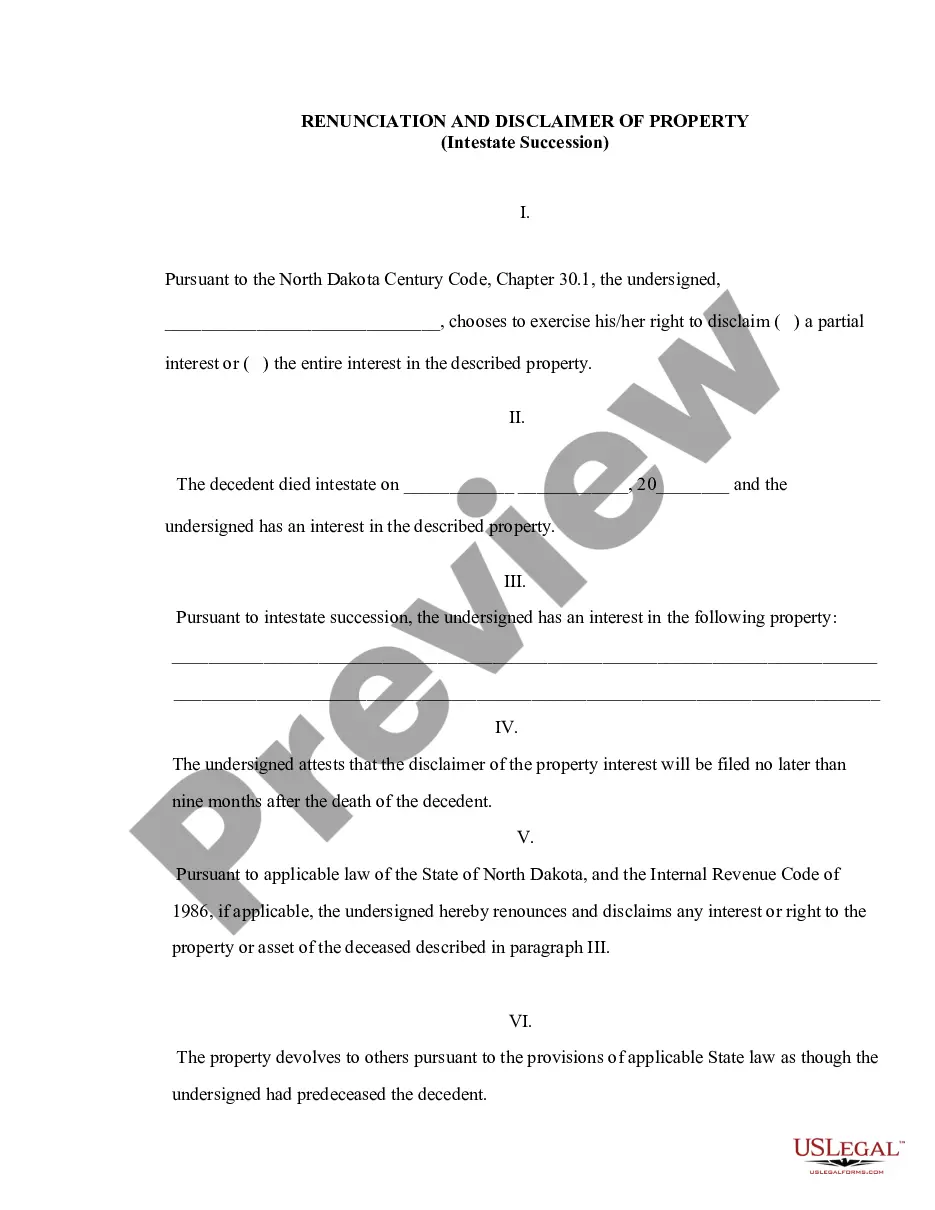
This form is useful in scenarios where an individual named as a beneficiary in a will decides to decline their inheritance, either entirely or partially. Common situations include personal financial planning, tax considerations, or family dynamics that may make acceptance of an inheritance undesirable. It ensures that the property will pass to other beneficiaries as if the disclaimant had predeceased the decedent.
Who should use this form
- Individuals designated as beneficiaries in a will who want to renounce their interest in the inherited property.
- Persons seeking to avoid potential tax implications from inherited assets.
- Heirs who wish to ensure that their share of an inheritance is transferred to other beneficiaries without complications.
- Anyone who is advised by legal counsel to formally decline acceptance of their inheritance.
Instructions for completing this form
- Identify yourself as the undersigned and provide your relationship to the decedent.
- Enter the name of the deceased and their date of death.
- Specify whether you intend to disclaim a partial interest or the entire interest in the property.
- Complete details about the property as described in the last will.
- Sign the form in the presence of a notary public.
- File the completed form with the court within the required timeframe.
Does this document require notarization?
This form needs to be notarized to ensure legal validity. US Legal Forms provides secure online notarization powered by Notarize, allowing you to complete the process through a verified video call, available anytime.
Get your form ready online
Our built-in tools help you complete, sign, share, and store your documents in one place.
Make edits, fill in missing information, and update formatting in US Legal Forms—just like you would in MS Word.
Download a copy, print it, send it by email, or mail it via USPS—whatever works best for your next step.
Sign and collect signatures with our SignNow integration. Send to multiple recipients, set reminders, and more. Go Premium to unlock E-Sign.
If this form requires notarization, complete it online through a secure video call—no need to meet a notary in person or wait for an appointment.
We protect your documents and personal data by following strict security and privacy standards.

Make edits, fill in missing information, and update formatting in US Legal Forms—just like you would in MS Word.

Download a copy, print it, send it by email, or mail it via USPS—whatever works best for your next step.

Sign and collect signatures with our SignNow integration. Send to multiple recipients, set reminders, and more. Go Premium to unlock E-Sign.

If this form requires notarization, complete it online through a secure video call—no need to meet a notary in person or wait for an appointment.

We protect your documents and personal data by following strict security and privacy standards.
Typical mistakes to avoid
- Failing to file the disclaimer within nine months of the decedent's death.
- Not providing complete information about the property involved.
- Missing signatures or not having the form notarized if required.
- Confusing a partial disclaimer with a full disclaimer, leading to ambiguous intentions.
Benefits of completing this form online
- Immediate access to a professionally prepared legal form, saving time and effort.
- Editable templates that allow for personalization based on your specific circumstances.
- Secure online storage options for ease of access and future reference.
- Guidance through the completion process, ensuring all legal requirements are met.
What to keep in mind
- The Renunciation and Disclaimer of Property is a vital document for beneficiaries who wish to reject an inheritance.
- It is essential to comply with state-specific laws, particularly in North Dakota.
- Notarization is a requirement for this form to ensure validity.
- Completing the disclaimer in a timely manner is critical to its enforceability.
Looking for another form?
Form popularity
FAQ
1a : a denial or disavowal of legal claim : relinquishment of or formal refusal to accept an interest or estate. b : a writing that embodies a legal disclaimer. 2a : denial, disavowal. b : repudiation.
What is a Deed of Disclaimer? A Deed of Disclaimer is a document that you can execute if you wish to Disclaim an inheritance due via the Rules of Intestacy and you are not applying for probate. A typical example of this is if a spouse of a deceased would prefer the estate passes to the children.
In North Dakota, you can make a living trust to avoid probate for virtually any asset you ownreal estate, bank accounts, vehicles, and so on. You need to create a trust document (it's similar to a will), naming someone to take over as trustee after your death (called a successor trustee).
Yes, a fiduciary can disclaim an interest in property if the will, trust or power of attorney gives the fiduciary that authority or if the appropriate probate court authorizes the disclaimer.The primary reason an executor or trustee might disclaim property passing to an estate or trust is to save death taxes.
A disclaimer is essentially a refusal of a gift or bequest.Disclaimers typically arise in the context of postmortem estate planning where a beneficiary may desire to make a qualified disclaimer under Sec. 2518 to achieve certain tax results such as qualifying for a marital deduction.
The disclaimer deed is a legal document that has legal consequences. Further, the disclaimer deed will clearly state that the spouse signing it is waiving (disclaiming) any interest in the house being purchased.
Get appointed as administrator or personal representative of the estate. Identify, record and gather all the decedent's assets. Pay the decedent's outstanding debts and taxes. Distribute the remaining assets to family, heirs or beneficiaries. Terminate or close the estate.
Some banks and building societies will release quite large amounts without the need for probate or letters of administration.If the organisation refuses to release money without probate or letters of administration, you must apply for probate or letters of administration even if it is not otherwise needed.
Disclaim, in a legal sense, refers to the renunciation of an interest in, or an acceptance of, inherited assets, such as property, by way of a legal instrument. A person disclaiming an interest, right, or obligation is known as a disclaimant.