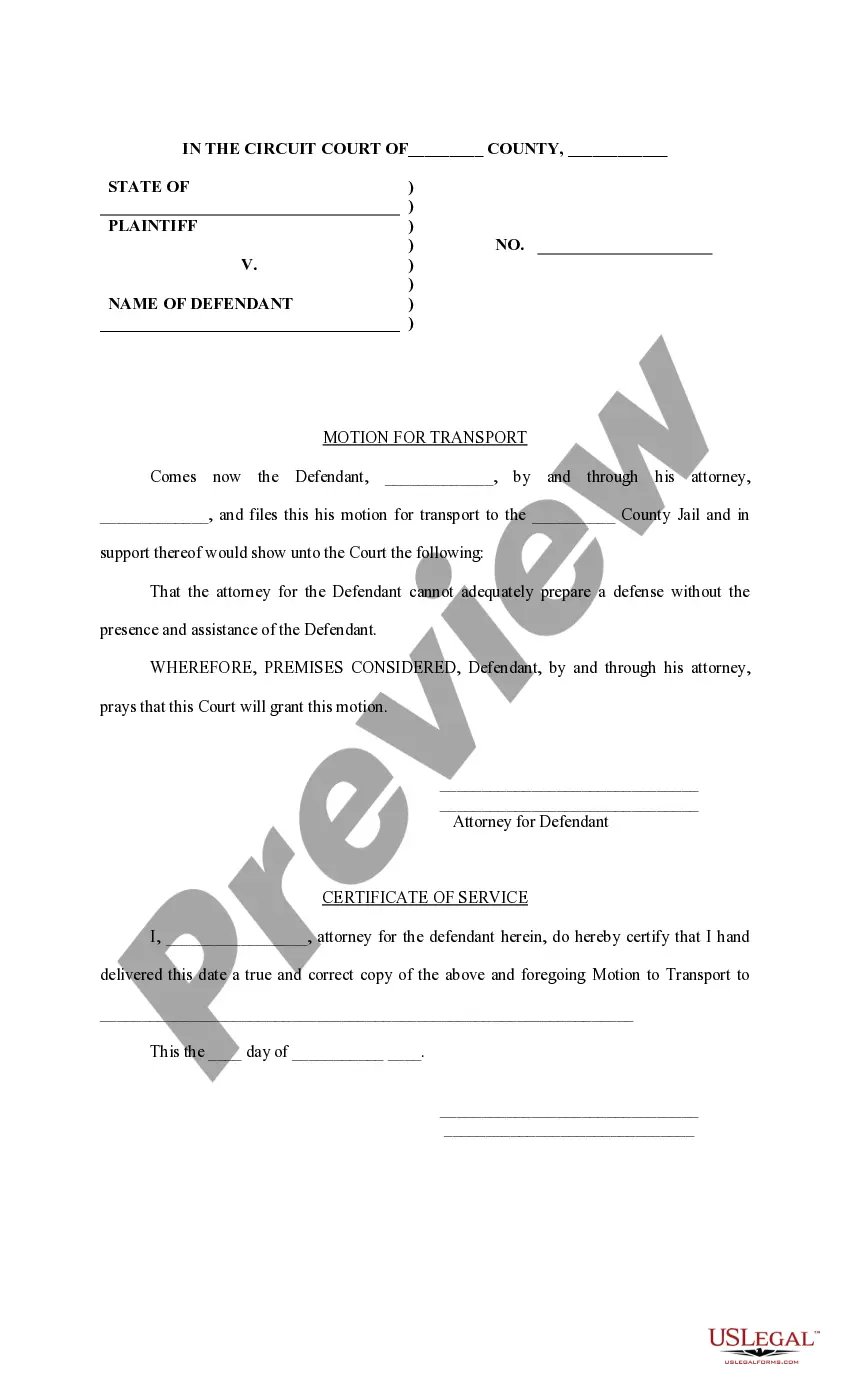
North Carolina Motion for Transport
Description
Get your form ready online
Our built-in tools help you complete, sign, share, and store your documents in one place.
Make edits, fill in missing information, and update formatting in US Legal Forms—just like you would in MS Word.
Download a copy, print it, send it by email, or mail it via USPS—whatever works best for your next step.
Sign and collect signatures with our SignNow integration. Send to multiple recipients, set reminders, and more. Go Premium to unlock E-Sign.
If this form requires notarization, complete it online through a secure video call—no need to meet a notary in person or wait for an appointment.
We protect your documents and personal data by following strict security and privacy standards.

Make edits, fill in missing information, and update formatting in US Legal Forms—just like you would in MS Word.

Download a copy, print it, send it by email, or mail it via USPS—whatever works best for your next step.

Sign and collect signatures with our SignNow integration. Send to multiple recipients, set reminders, and more. Go Premium to unlock E-Sign.

If this form requires notarization, complete it online through a secure video call—no need to meet a notary in person or wait for an appointment.

We protect your documents and personal data by following strict security and privacy standards.
Looking for another form?




How to fill out Motion For Transport?
If you need to aggregate, acquire, or generate sanctioned document templates, utilize US Legal Forms, the foremost collection of legal forms, which are available online.
Take advantage of the site's straightforward and user-friendly search to find the documents you require.
Various templates for business and personal applications are organized by categories and states, or keywords. Use US Legal Forms to obtain the North Carolina Motion for Transport in just a few clicks.
Every legal document template you purchase is yours forever. You have access to every form you saved in your account. Click on the My documents section and select a form to print or download again.
Be proactive and obtain, and print the North Carolina Motion for Transport with US Legal Forms. There are numerous professional and state-specific forms you can use for your business or personal needs.
- In case you are already a US Legal Forms user, Log In to your account and click the Download button to retrieve the North Carolina Motion for Transport.
- You can also access forms you previously saved from the My documents tab of your account.
- If you are utilizing US Legal Forms for the first time, follow the steps below.
- Step 1. Ensure you have selected the form for your appropriate city/state.
- Step 2. Take advantage of the Review option to inspect the form’s content. Don’t forget to read the description.
- Step 3. If you are not satisfied with the form, use the Search field at the top of the screen to find alternative versions of the legal form format.
- Step 4. Once you have located the form you need, click the Buy now button. Choose the pricing option you prefer and enter your details to register for an account.
- Step 5. Complete the transaction. You can use your credit card or PayPal account to finalize the purchase.
- Step 6. Select the format of the legal form and download it to your device.
- Step 7. Complete, modify, and print or sign the North Carolina Motion for Transport.
Form popularity
FAQ
Procedural Requirements With a Motion for Appropriate Relief The defendant must file the Motion in the district court that originally indicted the defendant with a North Carolina criminal charge. The court clerk will put the matter on the court calendar and the senior judge will assign the motion to a trial judge.
Filing the Documents Take the original and two (2) copies of the Motion to the Civil Division of the Clerk of Superior Court's office in the county where your case is filed. The Clerk will stamp each Motion ?filed,? place the original in the Court file and return two (2) copies of the ?filed? document to you.
The court may change the place of trial in the following cases: (1) When the county designated for that purpose is not the proper one. (2) When the convenience of witnesses and the ends of justice would be promoted by the change. (3) When the judge has, at any time, been interested as party or counsel.
Reasons for changes of venue include pretrial publicity, bias, political atmosphere, and any other circumstance that the parties believe would prevent them from obtaining a fair trial in the county in which the case was originally filed.
Service by publication requires a plaintiff to publish a notice once a week for three successive weeks in a newspaper that is qualified for legal advertising in ance with N.C. Gen. Stat.
To achieve a change of venue, defendants typically have to show a reasonable likelihood that they can't receive a fair trial. That reasonable likelihood is usually due to pretrial publicity, but it could have to do with some other event making it almost impossible to find an impartial jury.
Change of venue. noun. law the removal of a trial out of one jurisdiction into another.
Section 1404(a) of Title 28 provides that: "for the convenience of parties and witnesses, in the interest of justice, a district may transfer any civil action to any other district where it might have been brought." Any party, including plaintiff, may move for a transfer under 28 U.S.C. § 1404(a).