North Carolina Notice to Lessor Exercising Option to Purchase
What this document covers
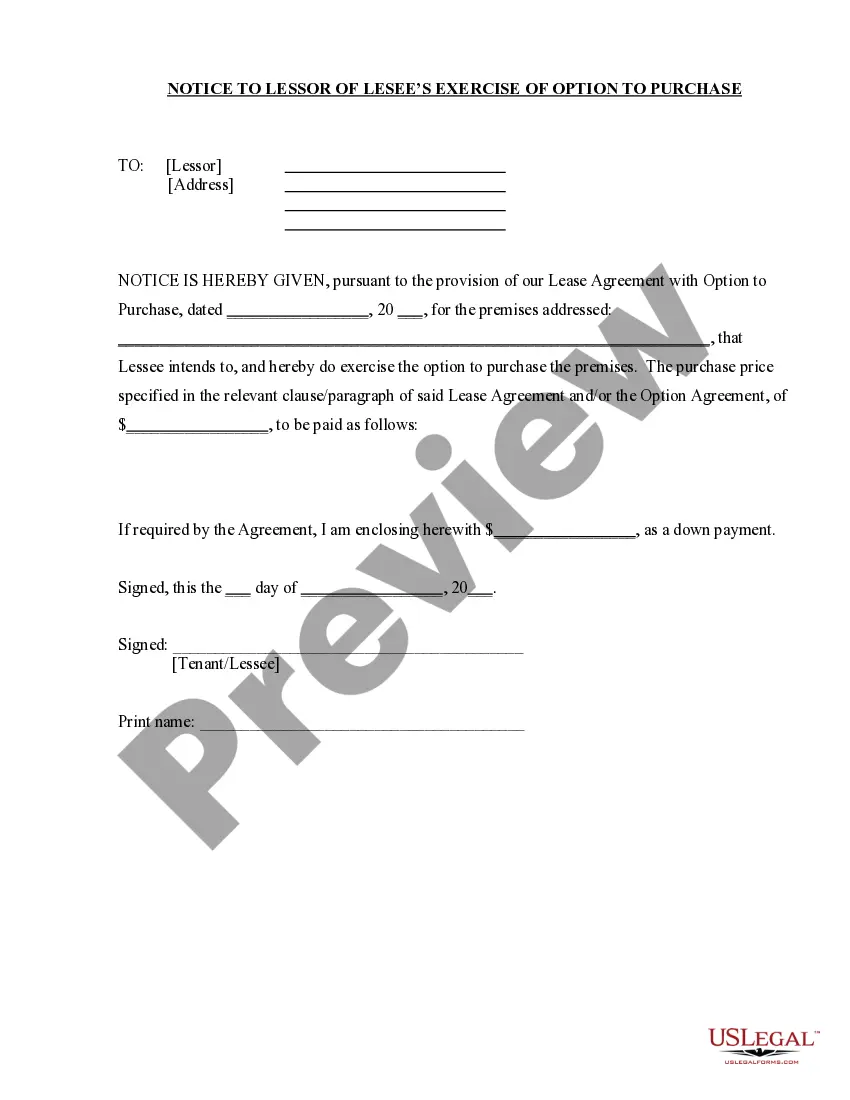
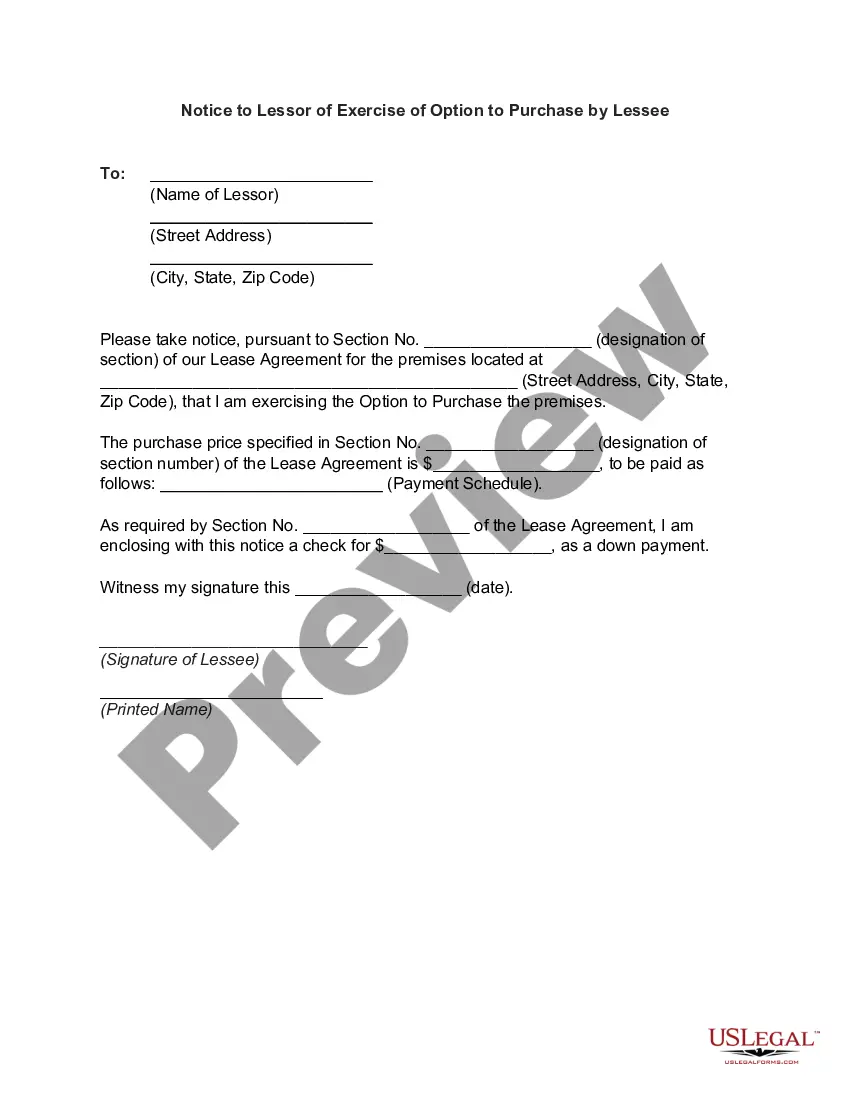
The Notice to Lessor Exercising Option to Purchase is a legal notice from a tenant to their landlord, indicating the tenant's decision to exercise their right to purchase the property as outlined in the lease or option agreement. This form establishes a formal record of the tenant's intent and is crucial for ensuring compliance with state laws regarding property transactions. Unlike other notices or agreements, this form specifically serves to activate a previously negotiated purchase option within a lease, making it an essential document for tenants looking to own the property they are renting.
Key components of this form
- Identification of the tenant (Lessee) exercising the purchase option.
- Statement of intent to exercise the option to purchase the property.
- Specification of the purchase price as outlined in the lease or option agreement.
- Instructions for the payment method of the purchase price.

When to use this form
This form is utilized when a tenant desires to purchase the property they are currently leasing. It is particularly necessary when the lease or option agreement grants the tenant the right to buy the property at a specified price within a defined timeframe. Using this form ensures that the tenant's intention to purchase is communicated legally to the landlord, thereby activating the purchase option effectively.
Who this form is for
- Tenants who want to exercise their right to purchase the property they are leasing.
- Landlords who require formal notification of the tenant's intent to purchase.
- Real estate agents involved in lease-option agreements on behalf of tenants or landlords.
Steps to complete this form
- Identify the parties involved, including the tenant and landlord.
- Clearly state the tenant's intention to exercise the option to purchase.
- Fill in the purchase price as specified in the lease or option agreement.
- Detail the method and terms of payment for the purchase price.
- Obtain the signatures of the tenant and, if necessary, the landlord for confirmation.
Does this document require notarization?
Notarization is required for this form to take effect. Our online notarization service, powered by Notarize, lets you verify and sign documents remotely through an encrypted video session, available 24/7.
Get your form ready online
Our built-in tools help you complete, sign, share, and store your documents in one place.
Make edits, fill in missing information, and update formatting in US Legal Forms—just like you would in MS Word.
Download a copy, print it, send it by email, or mail it via USPS—whatever works best for your next step.
Sign and collect signatures with our SignNow integration. Send to multiple recipients, set reminders, and more. Go Premium to unlock E-Sign.
If this form requires notarization, complete it online through a secure video call—no need to meet a notary in person or wait for an appointment.
We protect your documents and personal data by following strict security and privacy standards.

Make edits, fill in missing information, and update formatting in US Legal Forms—just like you would in MS Word.

Download a copy, print it, send it by email, or mail it via USPS—whatever works best for your next step.

Sign and collect signatures with our SignNow integration. Send to multiple recipients, set reminders, and more. Go Premium to unlock E-Sign.

If this form requires notarization, complete it online through a secure video call—no need to meet a notary in person or wait for an appointment.

We protect your documents and personal data by following strict security and privacy standards.
Typical mistakes to avoid
- Failing to specify the purchase price accurately as outlined in the agreement.
- Not providing necessary signatures which can lead to disputes.
- Missing the deadline to exercise the purchase option, rendering it void.
- Not keeping a copy of the notice for personal records.
Benefits of using this form online
- Convenient access to a legal form that can be completed and downloaded quickly.
- Editability allows customization to fit specific situations or requirements.
- Reliability of using attorney-drafted templates that comply with legal standards.
Looking for another form?
Form popularity
FAQ
In options trading, "to exercise" means to put into effect the right to buy or sell the underlying security that is specified in the options contract.If the holder of a call option exercises the contract, they will buy the underlying security at a stated price within a specific timeframe.
Selling the Call Options In other words, there really is no need to exercise the option, receive the shares and quickly sell them. A better reason to exercise a call would be to obtain the shares as a longer term investment, but if you do not have the money to pay for the shares, that is not an option.
If you buy an options contract, it grants you the right, but not the obligation to buy or sell an underlying asset at a set price on or before a certain date. A call option gives the holder the right to buy a stock and a put option gives the holder the right to sell a stock.
A better reason to exercise a call would be to obtain the shares as a longer term investment, but if you do not have the money to pay for the shares, that is not an option. If you choose to sell, you can sell your call options at any time until the market closes on the expiration Friday.
A naked call option is when an option seller sells a call option without owning the underlying stock.When a call option buyer exercises his right, the naked option seller is obligated to buy the stock at the current market price to provide the shares to the option holder.
The exercise price is the price at which an underlying security can be purchased or sold when trading a call or put option, respectively.An option gets its value from the difference between the fixed exercise price and the market price of the underlying security.
The short answer is that options rarely get exercised before expiration. To fully understand why this happens we need to first understand what the terms 'exercise' and 'assignment' mean in relation to options. Then we will work through an example to evaluate when a call or put option may be exercised early.
In options trading, "to exercise" means to put into effect the right to buy or sell the underlying security that is specified in the options contract.If the holder of a call option exercises the contract, they will buy the underlying security at a stated price within a specific timeframe.
When you exercise an option, you usually pay a fee to exercise and a second commission to sell the shares. This combination is likely to cost more than simply selling the option, and there is no need to give the broker more money when you gain nothing from the transaction.