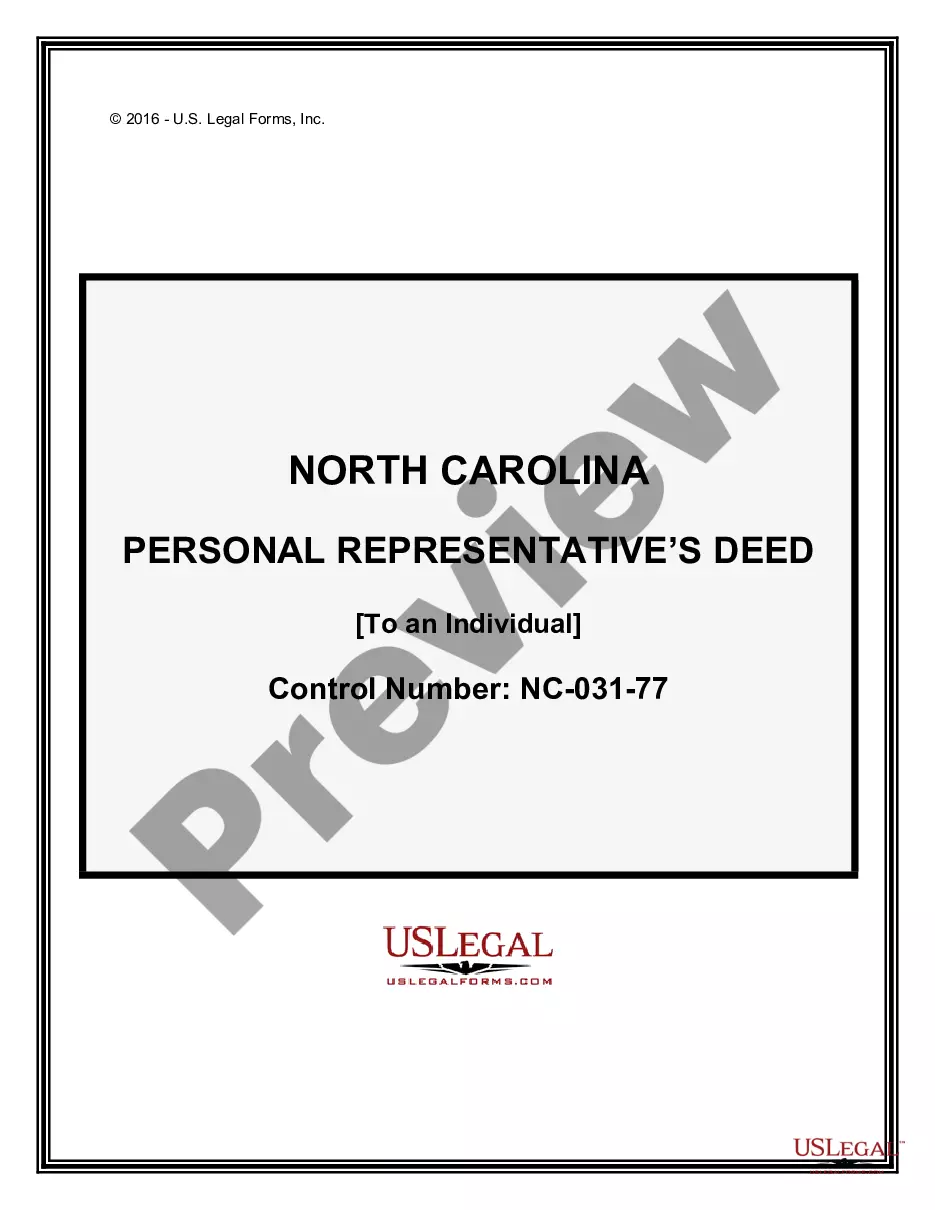
North Carolina Personal Representative's Deed to a Trust
About this form
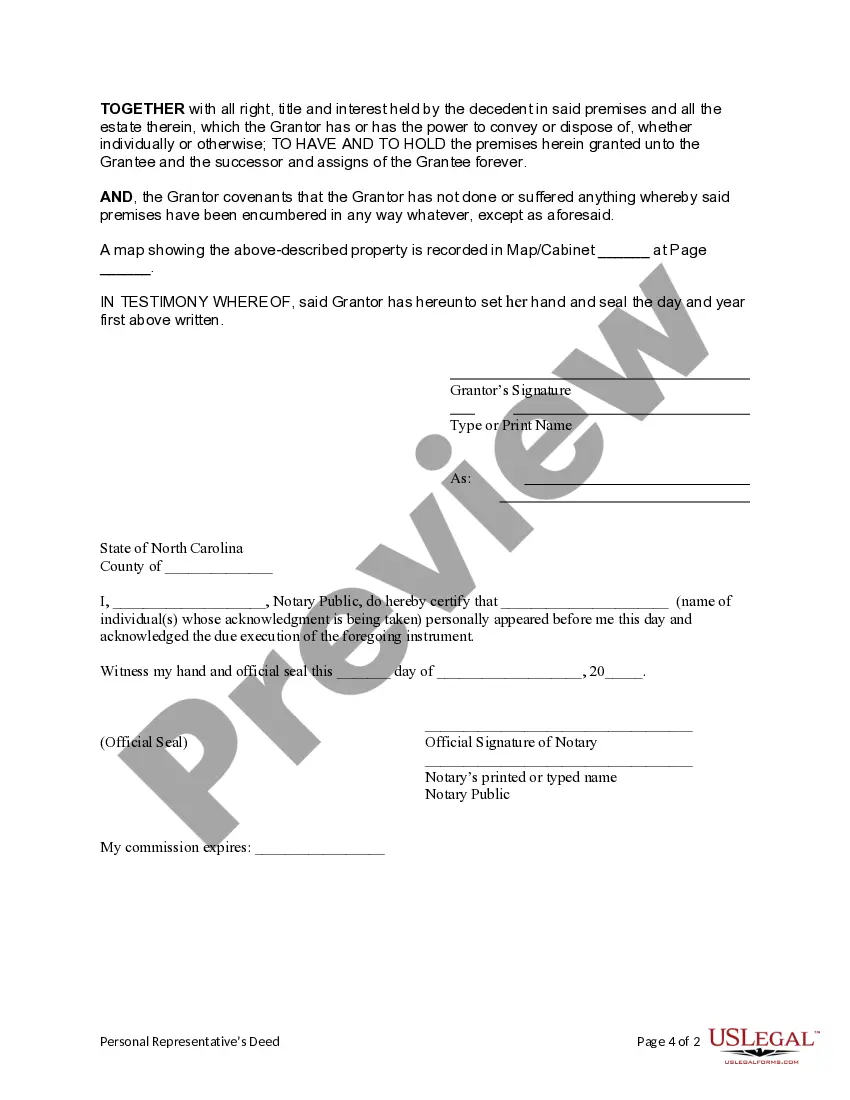
The Personal Representative's Deed to a Trust is a legal document used by the Personal Representative of an estate to transfer property to a trust for the benefit of designated beneficiaries. This form is unique because it conveys property based on the authority granted through court approval, ensuring the transaction adheres to state laws. It is essential when managing estate assets and establishing a trust, distinguishing it from standard property deeds that may not involve estate representatives or trusts.
Main sections of this form
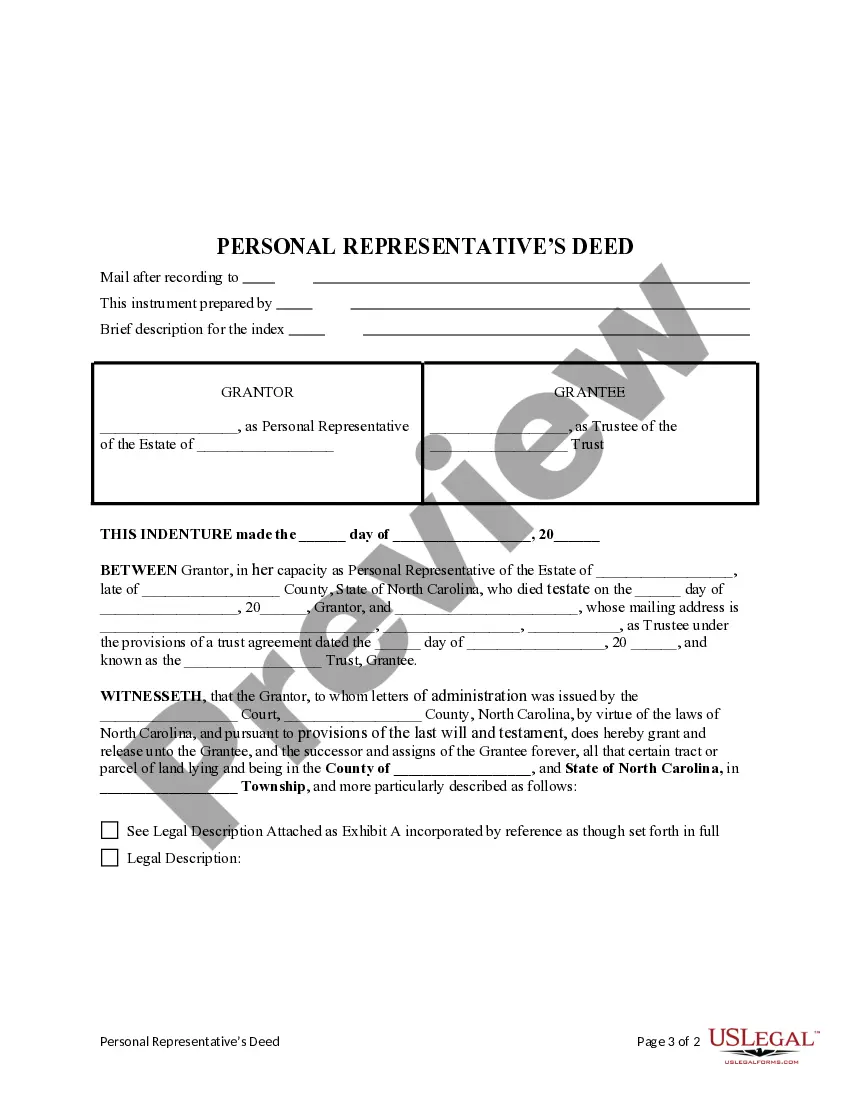
- Identification of the Grantor as the Personal Representative of the estate.
- Details of the Grantee, including the trust name and trustee information.
- Legal description of the property being transferred.
- Covenant by the Grantor confirming that the property has not been previously encumbered.
- Notary public section for verification and official processing of the deed.




When to use this document
This form should be used when the Personal Representative of an estate is transferring property to a trust as part of the estate settlement process. This often occurs after the death of an individual, when assets need to be allocated to ensure they are distributed according to the decedent's wishes. It is essential to have this deed as part of the estate planning and asset distribution process.
Intended users of this form
- Personal Representatives or Executors appointed to manage a deceased individual's estate.
- Trustees who are responsible for managing trust assets for the benefit of beneficiaries.
- Attorneys or legal practitioners assisting clients in the estate planning process.
Steps to complete this form
- Identify yourself as the Grantor and enter your capacity as the Personal Representative.
- Provide specific information about the decedent, including their name and date of death.
- Fill in the details of the trust, including the trust name and the Trustee's name and address.
- Clearly describe the property being transferred, ensuring all legal descriptions are accurate.
- Sign the deed in the presence of a notary public to validate the transfer.
Does this document require notarization?
Yes, this form must be notarized to be legally valid. The presence of a notary public ensures the authenticity of the signatures and the integrity of the transaction. US Legal Forms offers integrated online notarization, allowing you to complete this process via secure video call, providing flexibility and eliminating the need for in-person visits.
Get your form ready online
Our built-in tools help you complete, sign, share, and store your documents in one place.
Make edits, fill in missing information, and update formatting in US Legal Forms—just like you would in MS Word.
Download a copy, print it, send it by email, or mail it via USPS—whatever works best for your next step.
Sign and collect signatures with our SignNow integration. Send to multiple recipients, set reminders, and more. Go Premium to unlock E-Sign.
If this form requires notarization, complete it online through a secure video call—no need to meet a notary in person or wait for an appointment.
We protect your documents and personal data by following strict security and privacy standards.

Make edits, fill in missing information, and update formatting in US Legal Forms—just like you would in MS Word.

Download a copy, print it, send it by email, or mail it via USPS—whatever works best for your next step.

Sign and collect signatures with our SignNow integration. Send to multiple recipients, set reminders, and more. Go Premium to unlock E-Sign.

If this form requires notarization, complete it online through a secure video call—no need to meet a notary in person or wait for an appointment.

We protect your documents and personal data by following strict security and privacy standards.
Typical mistakes to avoid
- Failing to provide a complete legal description of the property, which can lead to issues in ownership verification.
- Not having the deed notarized, which is crucial for legal validity.
- Providing incorrect information about the trustee or the trust itself.
- Neglecting to confirm that the Grantor has not encumbered the property during their service as Personal Representative.
Benefits of using this form online
- Convenience in completing the form from anywhere, saving time and effort.
- Editability allows users to easily make changes without needing to start over.
- Access to templates drafted by licensed attorneys, ensuring legal compliance.
- Instant availability eliminates delays typically associated with paper forms.
Looking for another form?
Form popularity
FAQ
Before distributing assets to beneficiaries, the executor must pay valid debts and expenses, subject to any exclusions provided under state probate laws.The executor must maintain receipts and related documents and provide a detailed accounting to estate beneficiaries.
In most cases, the surviving owner or heir obtains the title to the home, the former owner's death certificate, a notarized affidavit of death, and a preliminary change of ownership report form. When all these are gathered, the transfer gets recorded, the fees are paid, and the county issues a new title deed.
In most states, an executor's deed must be signed by a witness and notarized. An executor's deed should be recorded in the real estate records of the county in which the property being conveyed is located.
When a joint owner dies, the process is relatively simple you just need to inform the Land Registry of the death. You should complete a 'Deceased joint proprietor' form on the government's website and then send the form to the Land Registry, with an official copy of the death certificate.
A personal representative is appointed by a judge to oversee the administration of a probate estate. It can be a person, an institution such as a bank or trust company, or a combination of both. If the decedent left a last will and testament, it most likely names the individual he wanted to handle this responsibility.
A beneficiary, or heir, is someone to which the deceased person has left assets, and a personal representative, sometimes called an executor or administrator, is the person in charge of handling the distribution of assets.
You can do this by simply signing your name and putting your title of executor of the estate afterward. One example of an acceptable signature would be Signed by Jane Doe, Executor of the Estate of John Doe, Deceased. Of course, many institutions may not simply take your word that you are the executor of the estate.
A personal representative is appointed by a judge to oversee the administration of a probate estate.In most cases, the judge will honor the decedent's wishes and appoint this person. When a personal representative is nominated to the position in a will, he's commonly called the executor of the estate.
When signing on behalf of the estate the proper signature is Name, Title with regard to the estate. Depending on the language you want to use or the language the the document appointing you use it could be John Smith, Personal Representative; John Smith, Executor; Jane Smith Executrix; John Smith, Administrator; or