North Carolina HVAC Contract for Contractor
Understanding this form
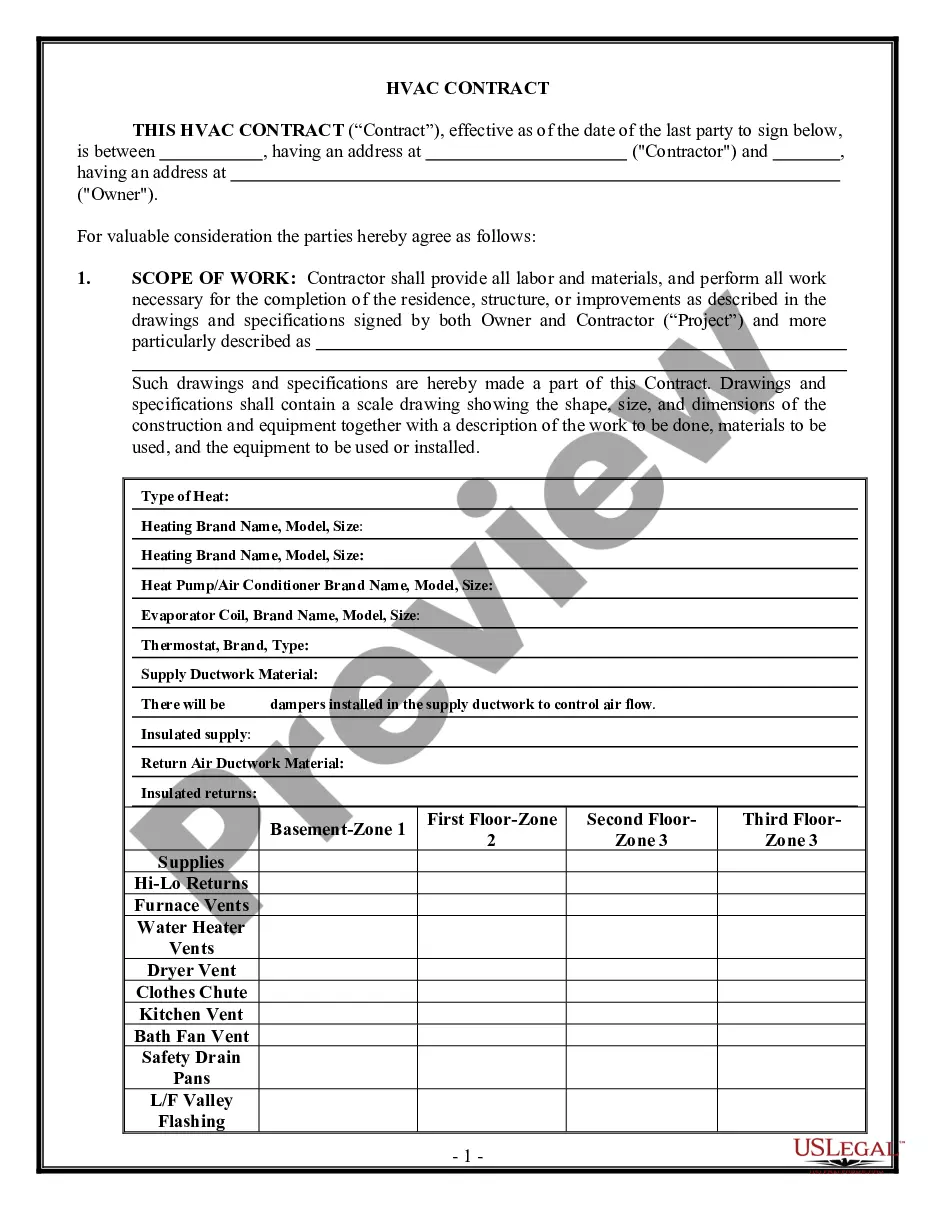
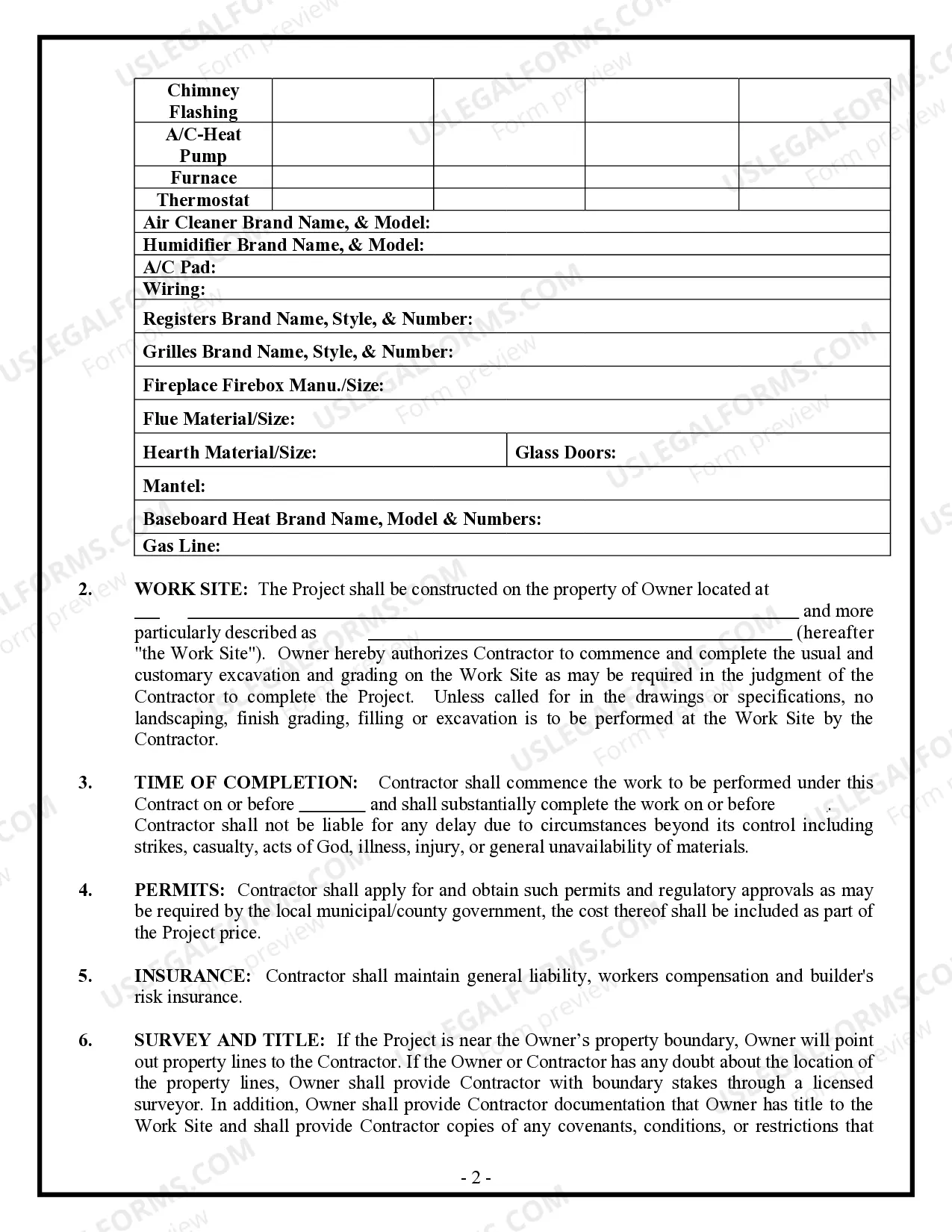
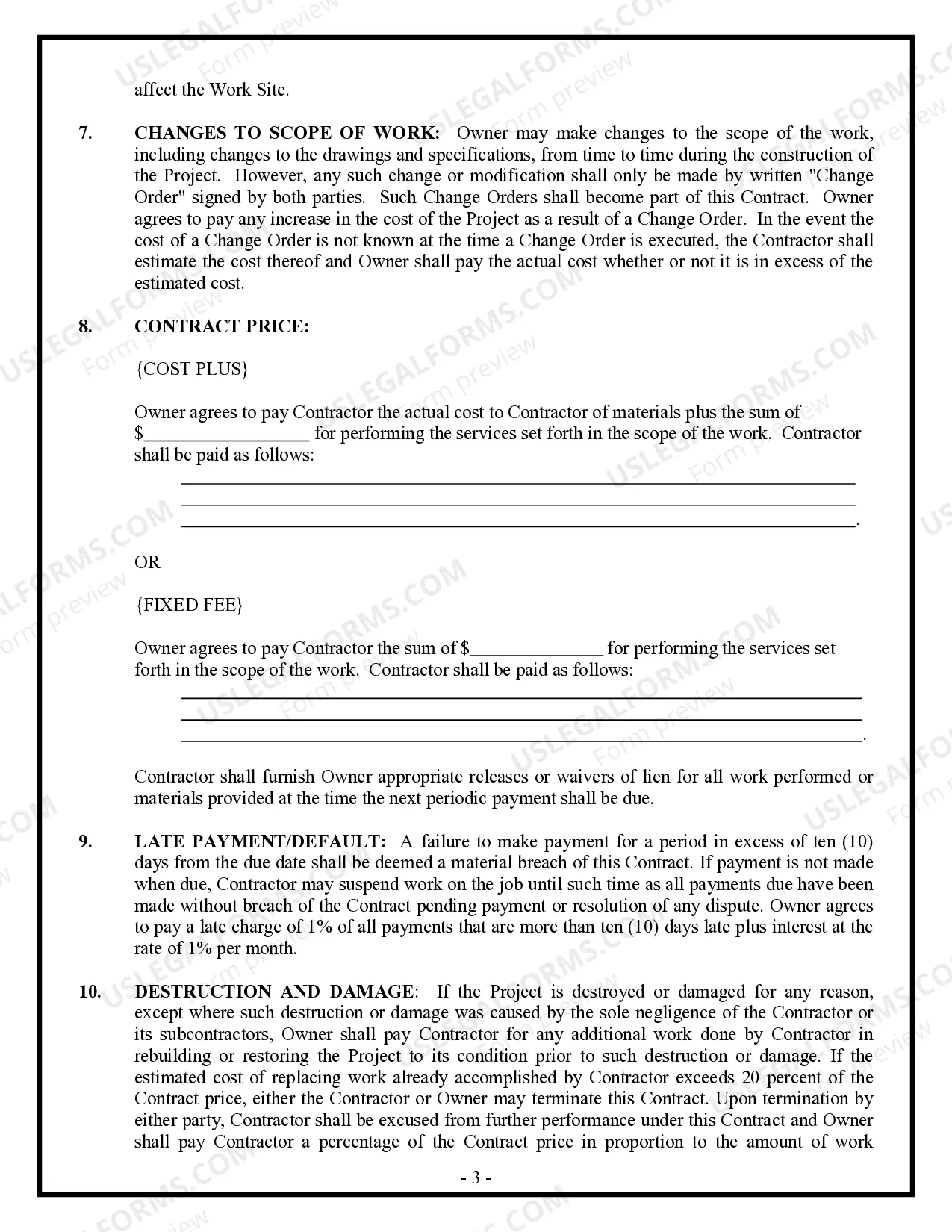
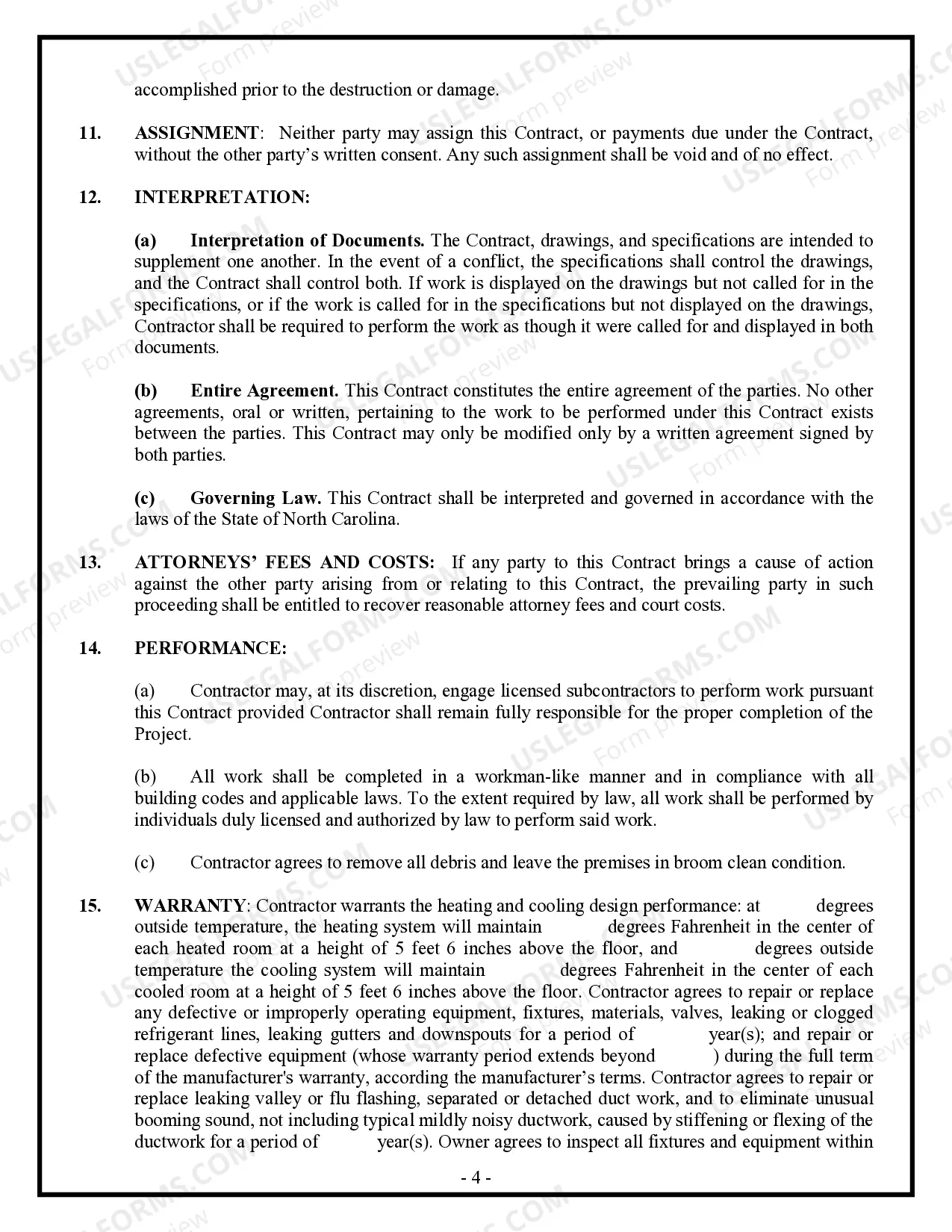
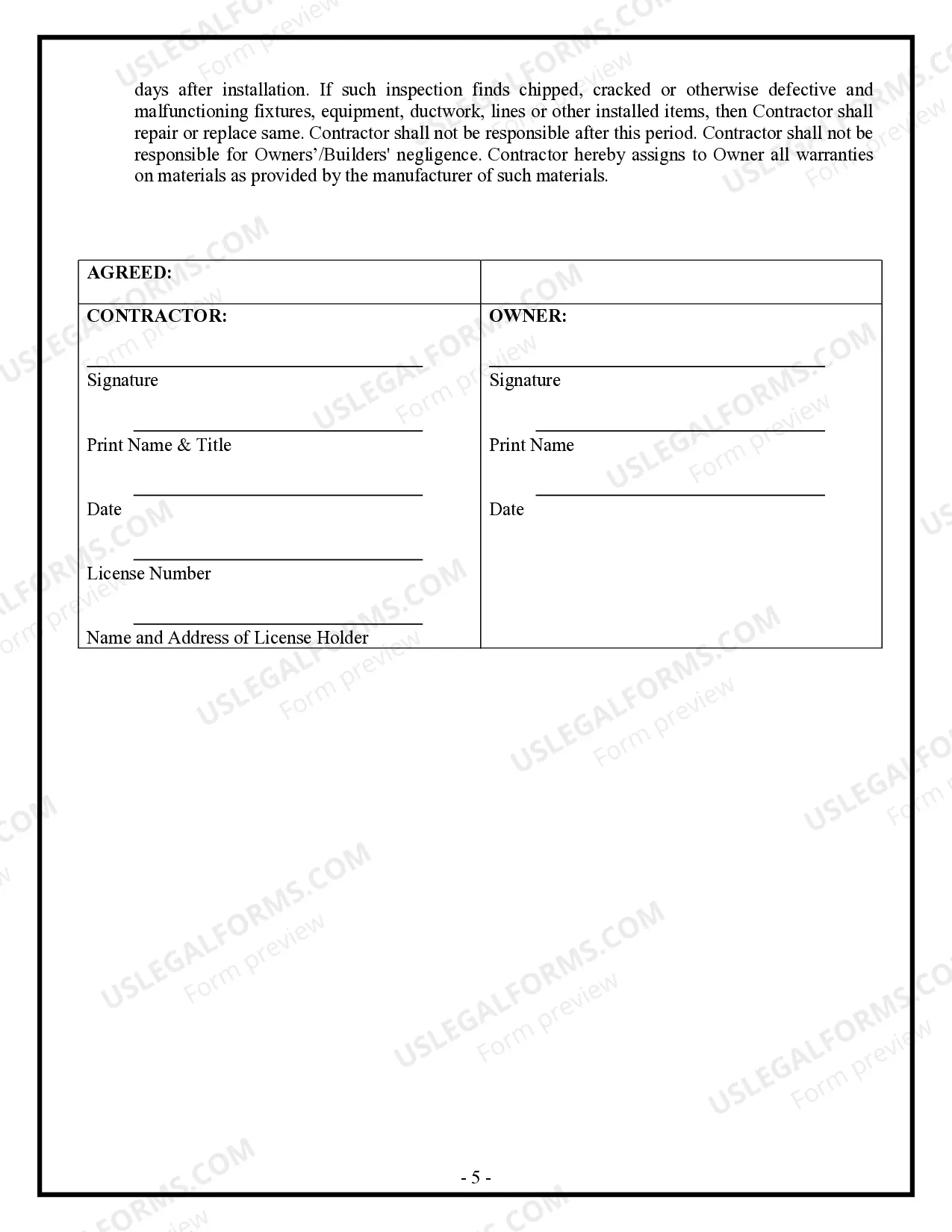
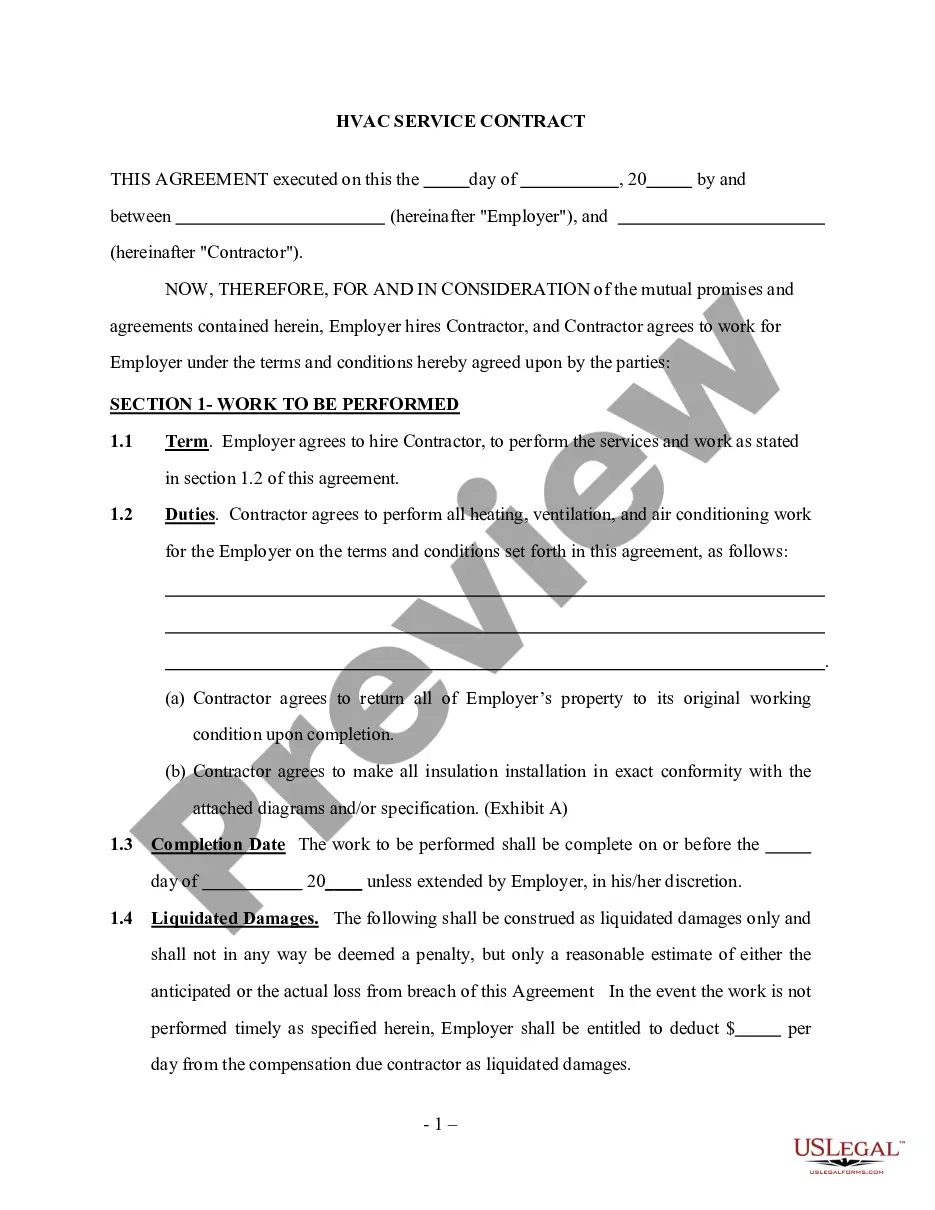
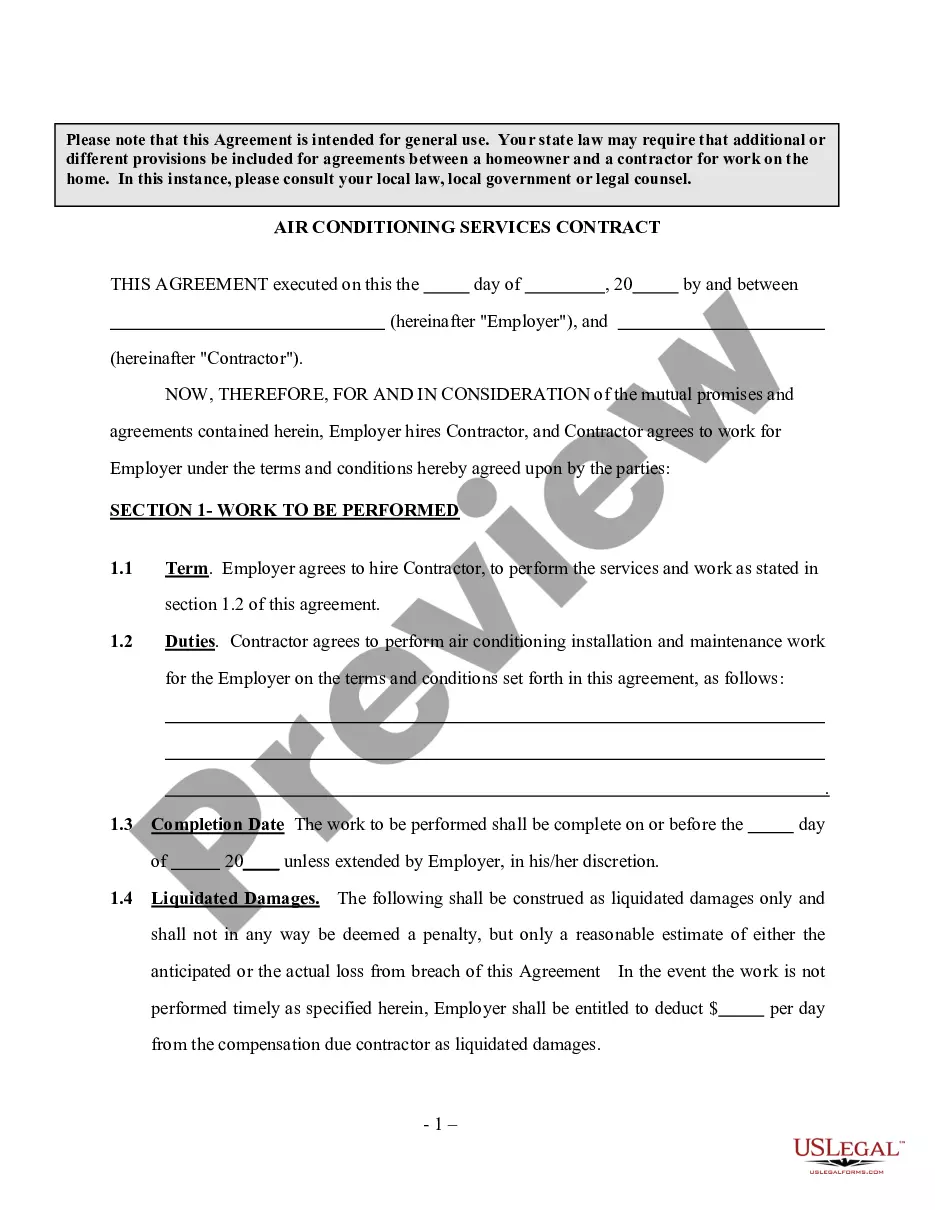
The HVAC Contract for Contractor is an essential legal document that establishes a formal agreement between HVAC contractors and property owners. This contract outlines the terms and conditions under which HVAC services will be performed, covering payment arrangements, project scope, permit requirements, and insurance obligations. Unlike informal agreements, this contract is specifically crafted to comply with the laws of North Carolina, ensuring that both parties are protected during the execution of HVAC services.
Key parts of this document
- Permits: Clarifies that the contractor is responsible for obtaining necessary permits at the project's cost.
- Insurance: Requires the contractor to maintain essential insurance coverages, including general liability and workers' compensation.
- Survey and Title: Outlines the owner's responsibilities in identifying property boundaries and verifying title to the work site.
- Changes to Scope of Work: Specifies how changes to the project can be made through written change orders, ensuring mutual consent.

Common use cases
This HVAC Contract for Contractor should be used when entering into an agreement for HVAC installations, repairs, or maintenance services. It is particularly useful when the project requires adherence to local regulations, and a clear understanding of the work scope, payment structure, and responsibilities is essential to avoid disputes.
Intended users of this form
- HVAC Contractors who offer installation or maintenance services.
- Property Owners looking to outline their agreements with HVAC professionals.
- Parties seeking a structured approach to HVAC services that includes compliance with local laws.
Steps to complete this form
- Identify the parties involved, including the contractor and property owner.
- Specify the scope of work, including detailed descriptions of the HVAC services to be provided.
- Determine the payment structure (cost plus or fixed fee) and enter agreed-upon amounts.
- Ensure all necessary permits and insurance data are included in the agreement.
- Have both parties review the document and sign to formalize the contract.
Notarization requirements for this form
This form does not typically require notarization to be legally valid. However, some jurisdictions or document types may still require it. US Legal Forms provides secure online notarization powered by Notarize, available 24/7 for added convenience.
Get your form ready online
Our built-in tools help you complete, sign, share, and store your documents in one place.
Make edits, fill in missing information, and update formatting in US Legal Forms—just like you would in MS Word.
Download a copy, print it, send it by email, or mail it via USPS—whatever works best for your next step.
Sign and collect signatures with our SignNow integration. Send to multiple recipients, set reminders, and more. Go Premium to unlock E-Sign.
If this form requires notarization, complete it online through a secure video call—no need to meet a notary in person or wait for an appointment.
We protect your documents and personal data by following strict security and privacy standards.

Make edits, fill in missing information, and update formatting in US Legal Forms—just like you would in MS Word.

Download a copy, print it, send it by email, or mail it via USPS—whatever works best for your next step.

Sign and collect signatures with our SignNow integration. Send to multiple recipients, set reminders, and more. Go Premium to unlock E-Sign.

If this form requires notarization, complete it online through a secure video call—no need to meet a notary in person or wait for an appointment.

We protect your documents and personal data by following strict security and privacy standards.
Avoid these common issues
- Failing to specify detailed project scopes, leading to misunderstandings.
- Not obtaining necessary permits before project commencement.
- Neglecting to have written change orders for modifications to the work.
- Overlooking required insurance coverage, which can lead to financial liability.
Benefits of completing this form online
- Convenient access to professionally drafted contracts from anywhere.
- Edit and customize the form to fit specific project needs easily.
- Reliable and up-to-date legal language ensuring compliance with state laws.
Legal use & context
- Serves as a binding agreement between parties, establishing rights and obligations.
- Protects both contractors and property owners in case of disputes.
- Ensures compliance with local laws governing HVAC installations and repairs.
Key takeaways
- The HVAC Contract for Contractor is essential for formalizing agreements between property owners and contractors.
- It is tailored to meet North Carolina's legal standards.
- Proper completion and understanding of the form can prevent disputes and ensure project success.
Looking for another form?
Form popularity
FAQ
The NASCLA-Accredited Examination Program was designed to assist contractors who need to be licensed in multiple jurisdictions. The following states accept the NASCLA Accredited Examination: AL, AR, AZ, GA, LA, MS, NV, NC, OR, SC, TN, UT, US Virgin Islands, VA, and WV.
The local building inspector is required to submit the affidavit to the North Carolina Licensing Board for General Contractors for verification that the property owner is eligible to act as his own general contractor under the exemption to G.S. 87-1.
Each state has different licensing requirements. You cannot use your California contractors license in other states; however, you may use your work experience in California for your application.
Current Law: North Carolina law currently requires any building construction or alteration project costing $30,000 or more to be superintended (supervised and managed) by a general contractor licensed in this state.This duty can only be delegated to a general contractor licensed in this state.
You need a general contractor license in North Carolina if you want to bid, construct, superintend or manage the construction of buildings, highways, public utilities and other types of projects over $30,000. To get licensed, you must apply to the North Carolina Licensing Board for General Contractors (NCLBGC).
The North Carolina Licensing Board does not have full reciprocity with any other state. We currently have examination waiver agreements with South Carolina, Tennessee, Louisiana, Georgia, and Mississippi (see details regarding exam waivers).
7. Set a payment schedule in the contract. You never want to pay a contractor more than 50% up front. Depending on the size of the job, your initial payment is ideally going to be no more than roughly 30% of the total cost of the project.
North Carolina requires that anyone who contracts with another person or entity to construct or make improvements to any building, highway, or public utilities, including grading, or who undertakes to superintend or manage such activities, be licensed as a general contractor if the work costs $30,000 or more.