Montana Codicil to Will Form for Amending Your Will - Will Changes or Amendments
What is this form?
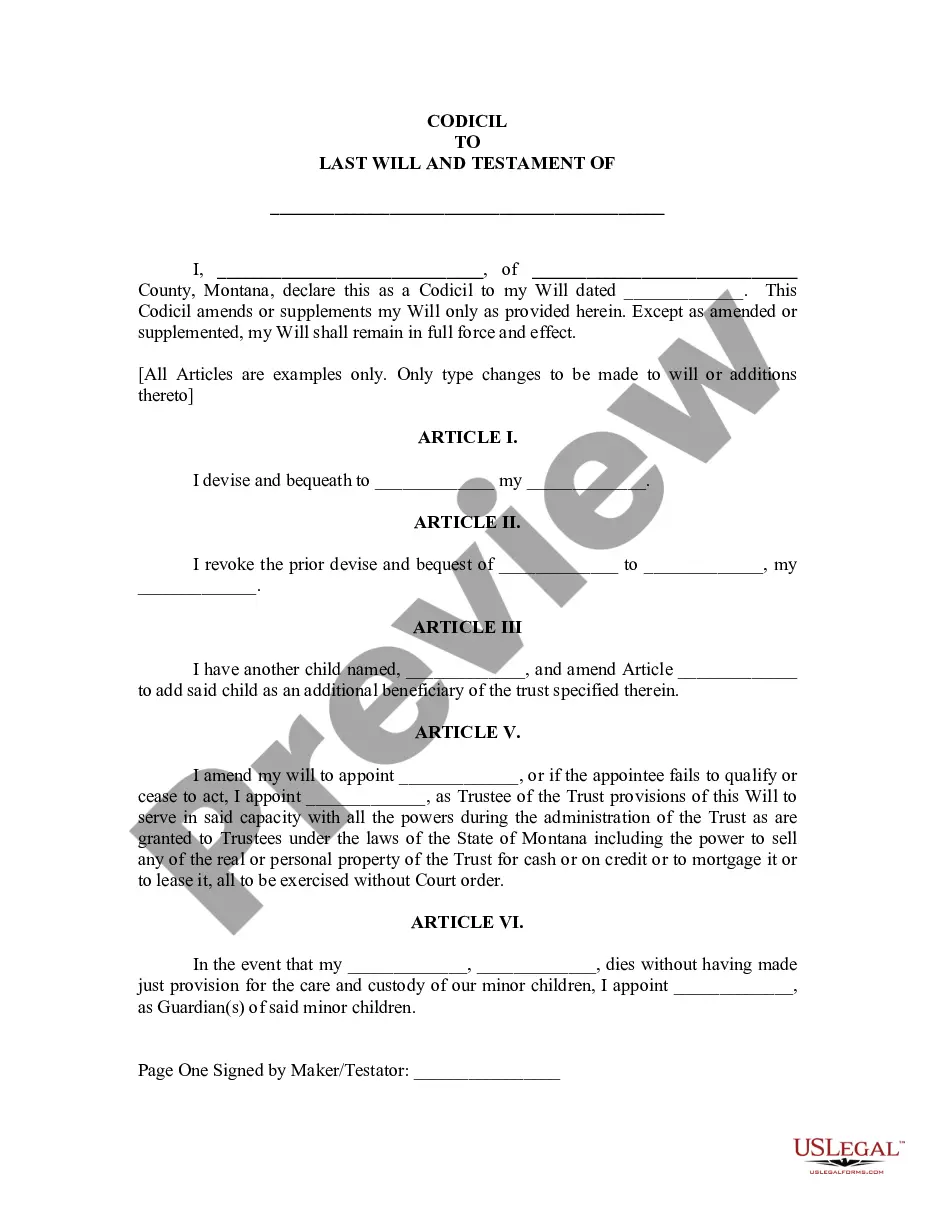
The Codicil to Will Form is a legal document that allows an individual to amend their existing will without creating an entirely new one. By using this codicil, the testator can make specific changes to their will while ensuring that the original document remains valid except for the alterations made. This form is particularly useful for anyone needing to update their beneficiaries or other details in their Last Will and Testament without the need for a complete revision.
Key parts of this document
- Identification of the testator, including their name and county.
- Declaration that the codicil amends the previous will.
- Specific articles for details about beneficiaries, property, and appointments.
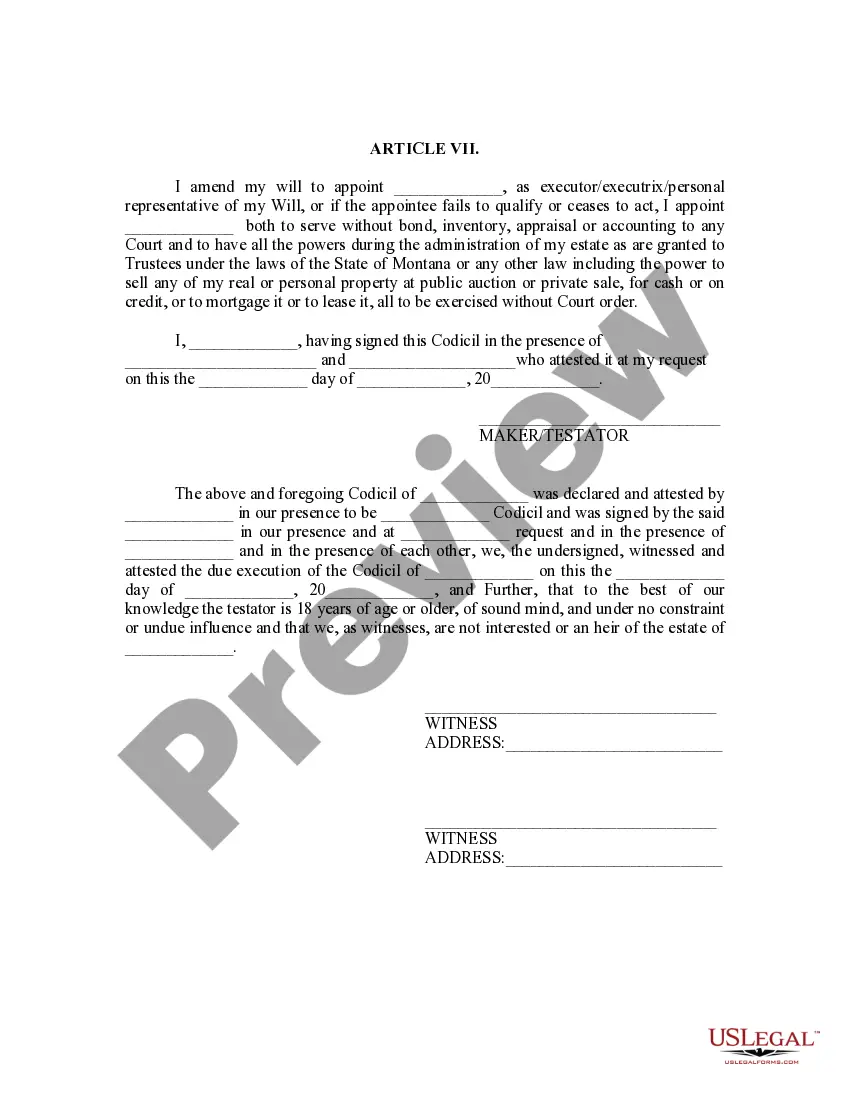
- Execution format with signature lines for witnesses.
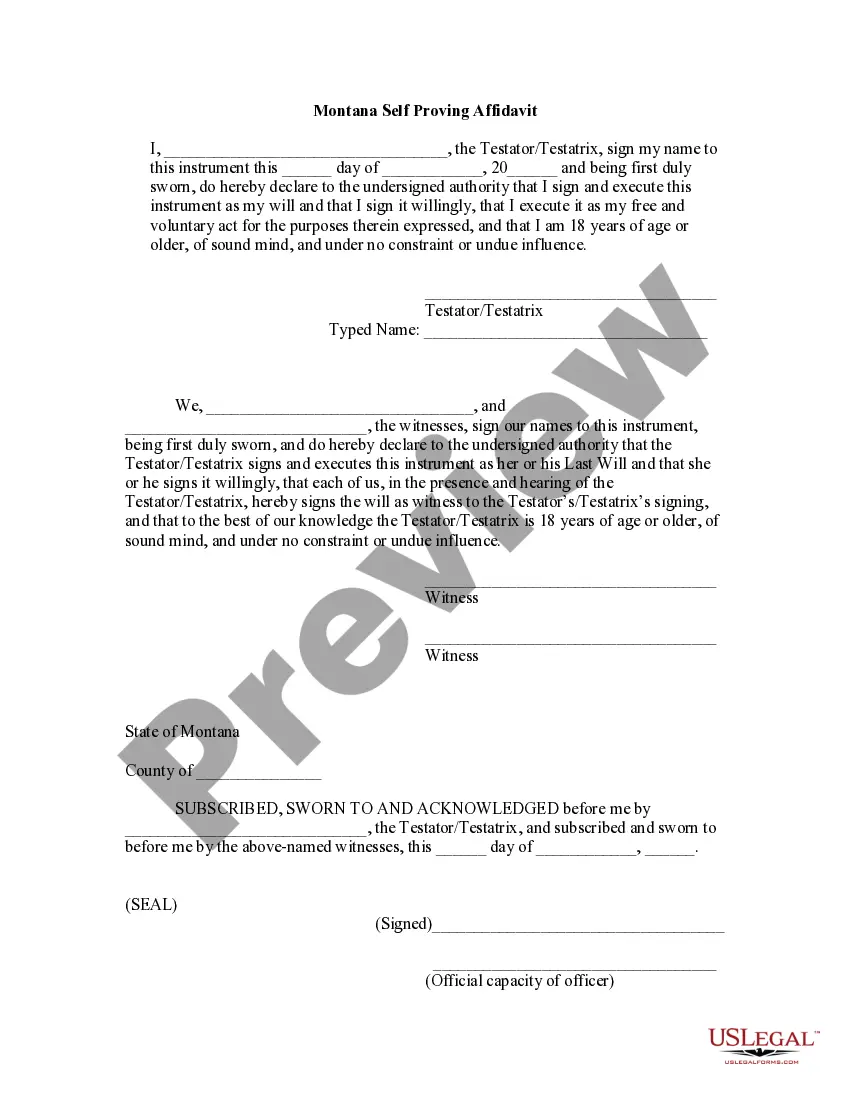
- Self-proving affidavit for validating the codicil.

Situations where this form applies
This form should be used when an individual wishes to make changes to an existing will without rewriting it entirely. Examples include adding new beneficiaries, revoking prior bequests, or updating the appointment of an executor. It is ideal for situations where minor adjustments are needed due to changes in personal circumstances, such as marriage, divorce, or the birth of a child.
Who this form is for
- Individuals who have an existing will they wish to amend.
- Testators who need to update beneficiary information.
- People wanting to address changes in family circumstances, such as the birth of a child or changes in relationships.
- Anyone looking to maintain the validity of their previous will while making specific changes.
Instructions for completing this form
- Identify yourself as the testator, including your name and county.
- Reference the original will by its date to clarify what is being amended.
- Detail the specific changes you wish to make by filling out the articles.
- Sign the codicil in front of at least two witnesses who will also sign the document.
- Complete the self-proving affidavit to verify your mental capacity and voluntary intent.
Notarization requirements for this form
This form must be notarized to be legally valid. US Legal Forms provides secure online notarization powered by Notarize, allowing you to complete the process through a verified video call.
Get your form ready online
Our built-in tools help you complete, sign, share, and store your documents in one place.
Make edits, fill in missing information, and update formatting in US Legal Forms—just like you would in MS Word.
Download a copy, print it, send it by email, or mail it via USPS—whatever works best for your next step.
Sign and collect signatures with our SignNow integration. Send to multiple recipients, set reminders, and more. Go Premium to unlock E-Sign.
If this form requires notarization, complete it online through a secure video call—no need to meet a notary in person or wait for an appointment.
We protect your documents and personal data by following strict security and privacy standards.

Make edits, fill in missing information, and update formatting in US Legal Forms—just like you would in MS Word.

Download a copy, print it, send it by email, or mail it via USPS—whatever works best for your next step.

Sign and collect signatures with our SignNow integration. Send to multiple recipients, set reminders, and more. Go Premium to unlock E-Sign.

If this form requires notarization, complete it online through a secure video call—no need to meet a notary in person or wait for an appointment.

We protect your documents and personal data by following strict security and privacy standards.
Typical mistakes to avoid
- Not dating the codicil correctly, which can create confusion about its validity.
- Failing to have the codicil witnessed, leading to potential legal challenges.
- Making changes that contradict the original will rather than supplementing it.
- Not signing the self-proving affidavit, which can complicate its enforcement.
Why complete this form online
- Convenience of downloading and completing the form at your own pace.
- Easy editing to customize the codicil to your specific needs.
- Access to legally vetted documents drafted by licensed attorneys.
- Immediate availability without the need for an in-person appointment.
Legal use & context
- A codicil serves as a legally recognized amendment to an existing will.
- It must be executed with proper witnessing to be enforceable.
- Changes made must comply with state laws to be valid and effective.
- Using a codicil simplifies updating a will without the need for a full rewrite.
Quick recap
- The Codicil to Will Form enables simple amendments to an existing will.
- Proper execution and witnessing are essential for legality.
- This form adapts to changes in personal circumstances efficiently.
- Ensure compliance with Montana laws for effectiveness.
Looking for another form?
Form popularity
FAQ
If you are unmarried and die without a valid will and last testament in Montana, then your entire estate goes to any surviving children in equal shares, or grandchildren if you don't have any surviving children. If you die intestate unmarried and with no children, then by law, your parents inherit your entire estate.
The will of a decedent must be filed with the Clerk of Court so the personal representative may proceed with the administration of the estate. Montana has both formal (court-directed) and informal probate as well as a simplified probate process for small estates.
A. You don't have to have a lawyer to create a basic will you can prepare one yourself. It must meet your state's legal requirements and should be notarized.A do-it-yourself will that's poorly drafted can save you money but create a mess for your heirs when you're gone.
No, in Montana, you do not need to notarize your will to make it legal. However, Montana allows you to make your will "self-proving" and you'll need to go to a notary if you want to do that. A self-proving will speeds up probate because the court can accept the will without contacting the witnesses who signed it.
You can legally prepare your own will, it can even be handwritten. This type of will is known as a "holographic will." In Montana, your handwritten will must be signed by you. Your signature must also be located on any material provisions, and no witnesses will need to be present for the signing of your will.
Yes, a person can make his or her own will, but it must be in the testator's own handwriting. This type of will is called a holographic will. Such a will is valid if the signature and the material provisions are in the handwriting of the testator.
You can legally prepare your own will, it can even be handwritten. This type of will is known as a "holographic will." In Montana, your handwritten will must be signed by you. Your signature must also be located on any material provisions, and no witnesses will need to be present for the signing of your will.