Montana Counterclaim
Understanding this form
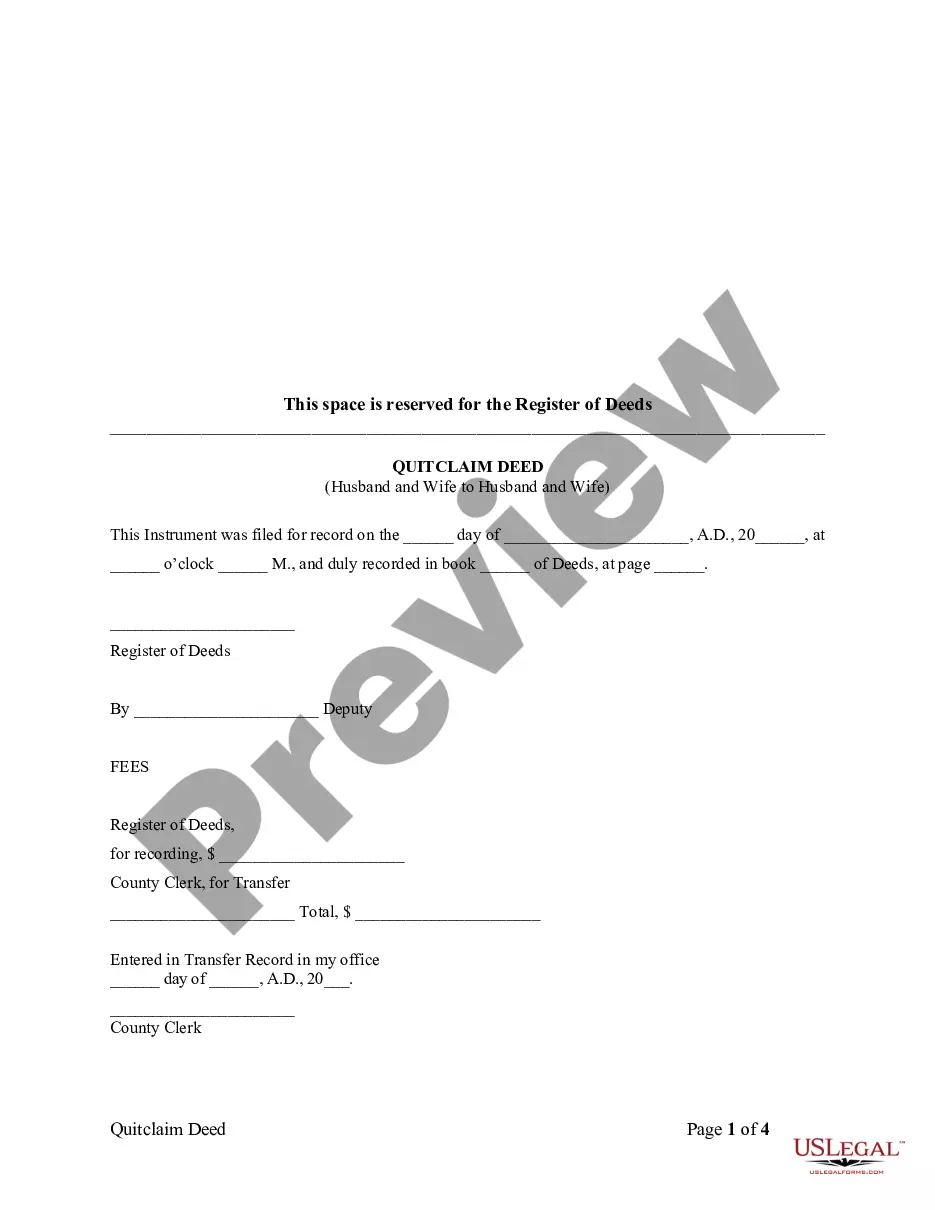
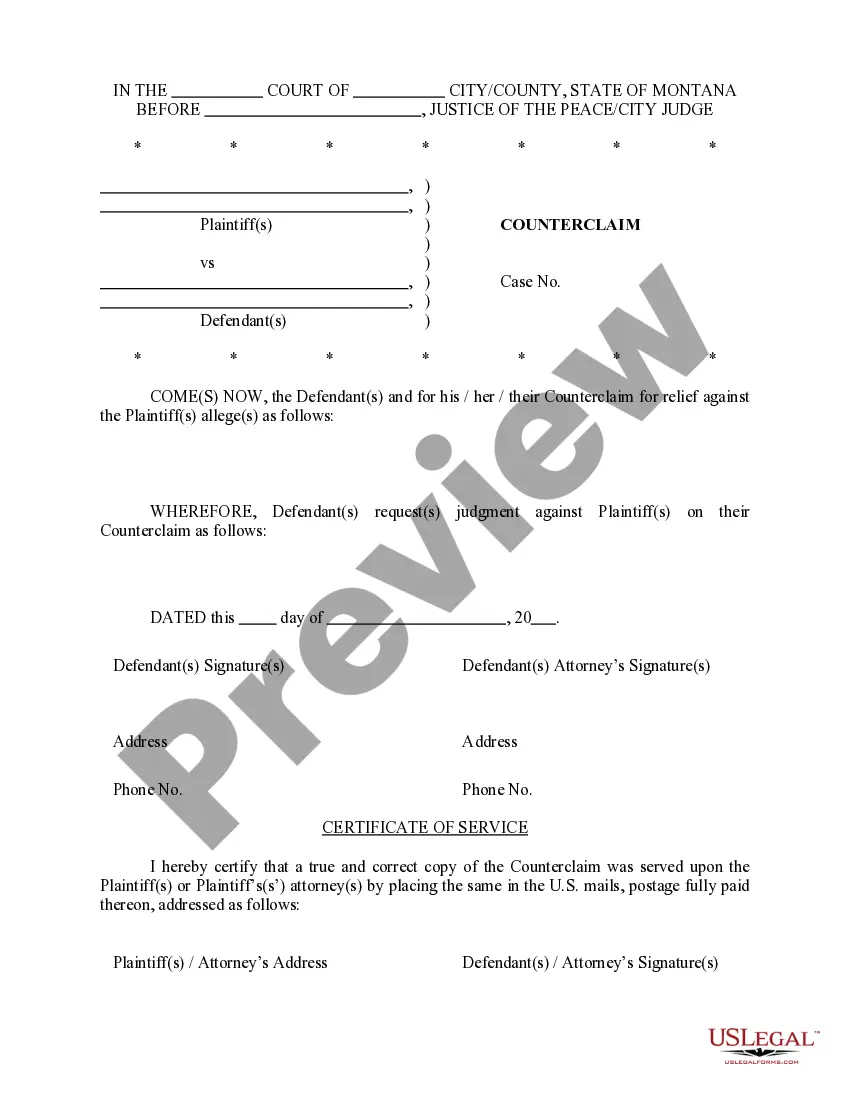
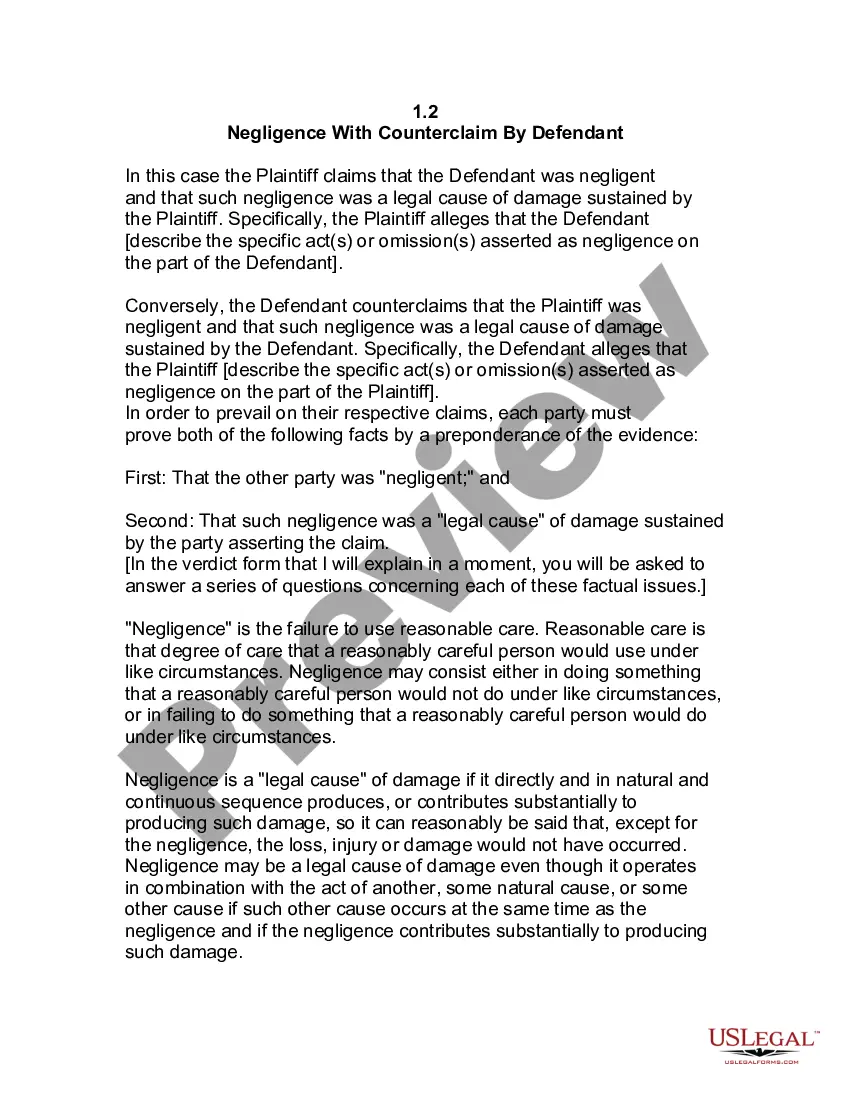
The Counterclaim form is an official document used in Montana that allows a defendant to assert claims against the plaintiff in an ongoing legal dispute. This form is essential for defendants who wish to counteract the plaintiff's claims with their own, providing a structured way to seek damages or resolutions within the context of the same case. This differs from a regular claim, as it specifically addresses issues raised during the ongoing lawsuit, allowing for both parties' arguments to be presented in one court action.
Key components of this form
- Defendant's identification: Information about the party filing the counterclaim.
- Amount claimed: The sum of money the defendant seeks as part of their counterclaim.
- Details of the claim: A clear statement of the reasons for the counterclaim, including any relevant facts.
- Signature section: Where the defendant signs the form to affirm the claims made.
- Notarization statement: This includes a line for the signature of a notary public, if required.
When to use this form
You should use the Counterclaim form when you are a defendant in a legal case and wish to respond to the plaintiff's claims with your own allegations or demands for compensation. This form is particularly useful in cases where the defendant believes they have suffered losses due to the plaintiff's actions, and they want to include their claims in the same legal proceedings, thereby streamlining the process.
Who this form is for
- Defendants involved in small claims or civil litigation in Montana.
- Individuals or businesses seeking to assert a counterclaim against a plaintiff in an ongoing case.
- Legal representatives handling cases where a counterclaim is appropriate.
Instructions for completing this form
- Identify the defendant: Fill in the defendant's name and address at the top of the form.
- Enter case information: Write the case number and relevant details pertaining to the original claim.
- Specify the counterclaim amount: Indicate the monetary amount the defendant is claiming from the plaintiff.
- Detail the basis for the counterclaim: Clearly provide reasons for the counterclaim and any supporting facts.
- Sign and date the form: The defendant must sign the document and include the date of signing.
- If required, obtain a notarization: Ensure the form is signed in the presence of a notary public, if necessary.
Does this form need to be notarized?
This form does not typically require notarization unless specified by local law. However, having the signature of a notary public may enhance its legitimacy in court.
Get your form ready online
Our built-in tools help you complete, sign, share, and store your documents in one place.
Make edits, fill in missing information, and update formatting in US Legal Forms—just like you would in MS Word.
Download a copy, print it, send it by email, or mail it via USPS—whatever works best for your next step.
Sign and collect signatures with our SignNow integration. Send to multiple recipients, set reminders, and more. Go Premium to unlock E-Sign.
If this form requires notarization, complete it online through a secure video call—no need to meet a notary in person or wait for an appointment.
We protect your documents and personal data by following strict security and privacy standards.

Make edits, fill in missing information, and update formatting in US Legal Forms—just like you would in MS Word.

Download a copy, print it, send it by email, or mail it via USPS—whatever works best for your next step.

Sign and collect signatures with our SignNow integration. Send to multiple recipients, set reminders, and more. Go Premium to unlock E-Sign.

If this form requires notarization, complete it online through a secure video call—no need to meet a notary in person or wait for an appointment.

We protect your documents and personal data by following strict security and privacy standards.
Typical mistakes to avoid
- Failing to provide a clear explanation of the grounds for the counterclaim.
- Omitting the required signature or date.
- Not including the correct case information, such as the case number or details about the original plaintiff's claims.
- Forgetting to verify whether notarization is needed in your case.
Advantages of online completion
- Immediate access: Download the Counterclaim form instantly without waiting for shipping.
- Easy editing: Fill out the form at your convenience with options to save and modify your responses.
- Accuracy and compliance: The form is drafted by licensed attorneys, ensuring it meets state requirements.
Looking for another form?
Form popularity
FAQ
In a court of law, a party's claim is a counterclaim if one party asserts claims in response to the claims of another. In other words, if a plaintiff initiates a lawsuit and a defendant responds to the lawsuit with claims of his or her own against the plaintiff, the defendant's claims are counterclaims.
Definition. A claim for relief filed against an opposing party after the original claim is filed. Most commonly, a claim by the defendant against the plaintiff.
To file your complaint, request a complaint form from the justice of the piece or clerk. There's a small fee to process and deliver the order to the defendant, but you may be able to request a waiver if you can't afford it. Pay your fee, fill out the form, and sign in front of the clerk or the justice.
A claim is the main argument. A counterclaim is the opposite of the claim, or argument.
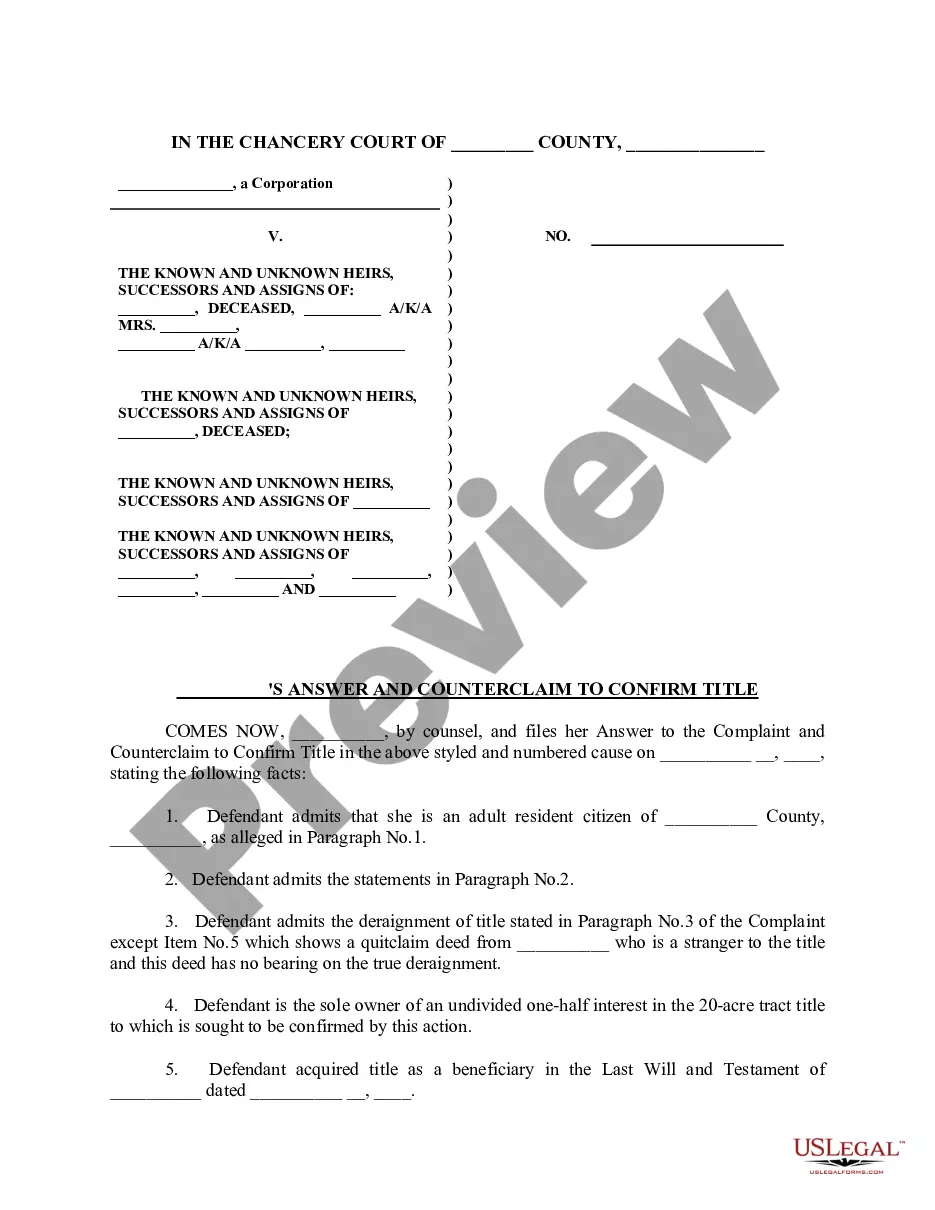
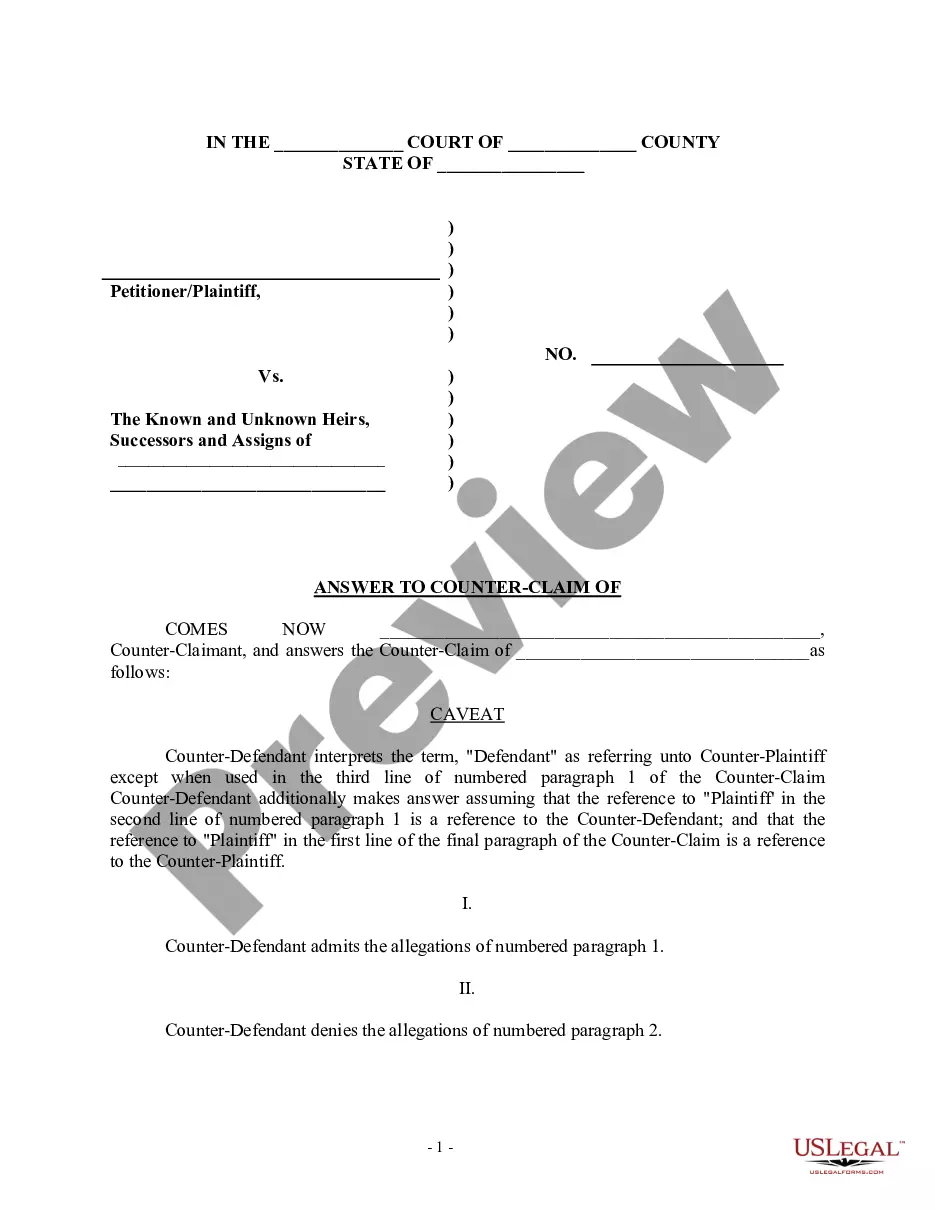
The defendant may also raise counterclaims or affirmative defenses. If a defendant does raise counterclaims in her answer, the plaintiff must respond to those counterclaims with a pleading called an "answer to a counterclaim." The form and content of an "answer to a counterclaim" is similar to that of an answer.
Counterclaim can contain a variety of material ranging from accusation of fraudulent activity to claims which would preempt any attempt at suit. The goal of counterclaim is to turn the table on the plaintiff by bringing up more issues in the case and demanding redress.
TIME TO RESPOND In addition, a party must respond to a counterclaim or cross-claim within 21 days of being served with the pleading that states the claim(s) (FRCP 12(a)(1)(B)).
Do I need to serve my counterclaim? After you file your counterclaim, a copy of the counterclaim must be delivered to each counterdefendant. This is called "service of process." The court applies the same rules to serving a counterclaim as it applies to serving the initial Small Claims Complaint.
A claim by a defendant opposing the claim of the plaintiff and seeking some relief from the plaintiff for the defendant. These facts may refer to the same event that gave rise to the plaintiff's Cause of Action or they may refer to an entirely different claim that the defendant has against the plaintiff.