Mississippi Name Change Instructions and Forms Package for an Adult

Overview of this form package
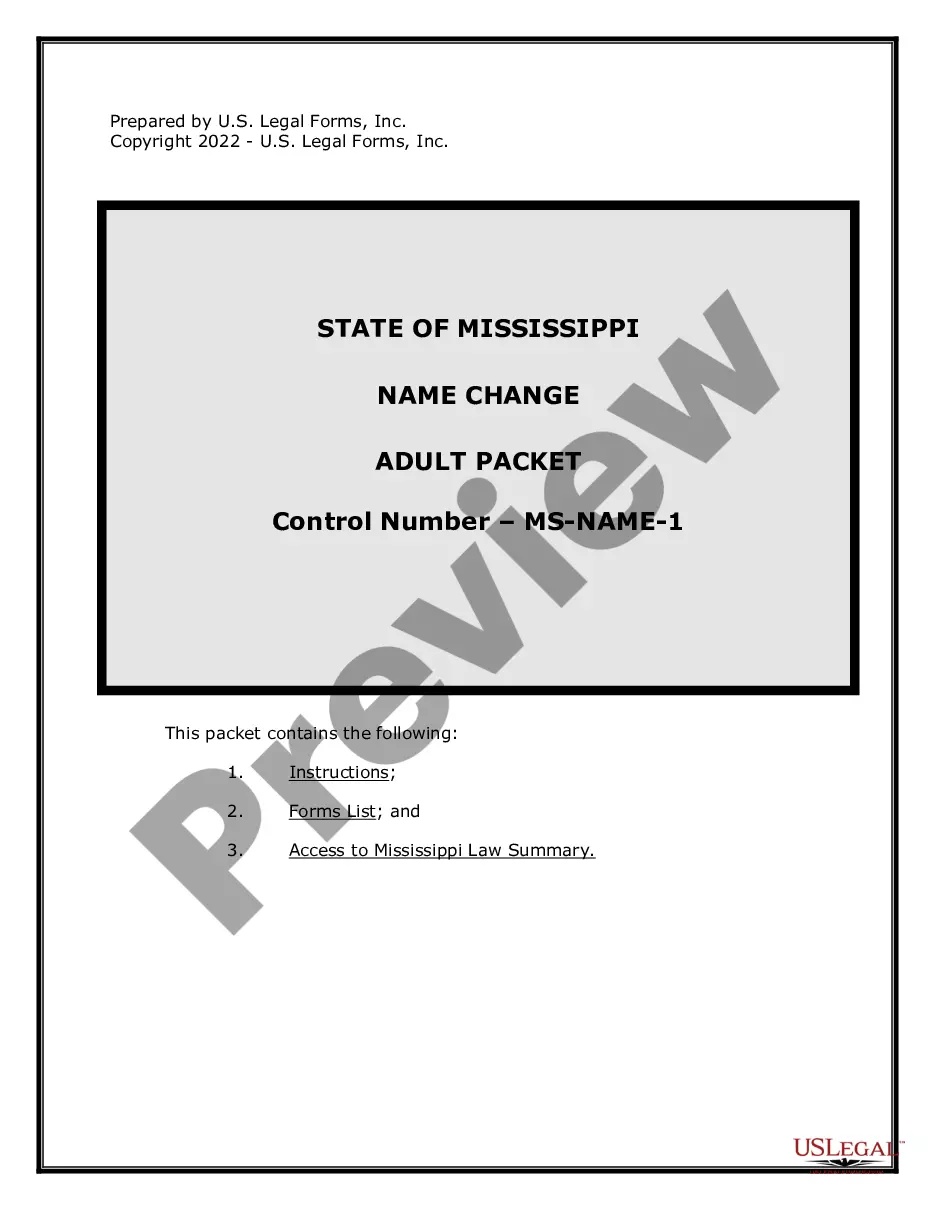
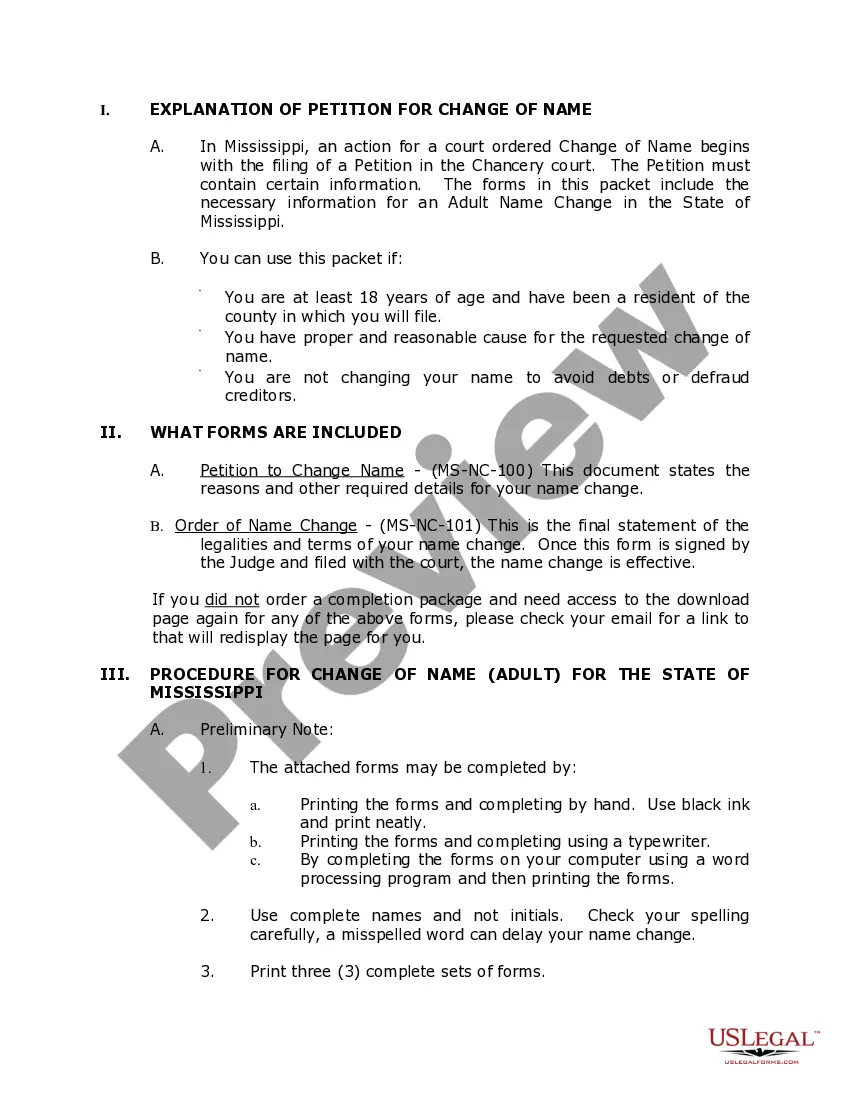
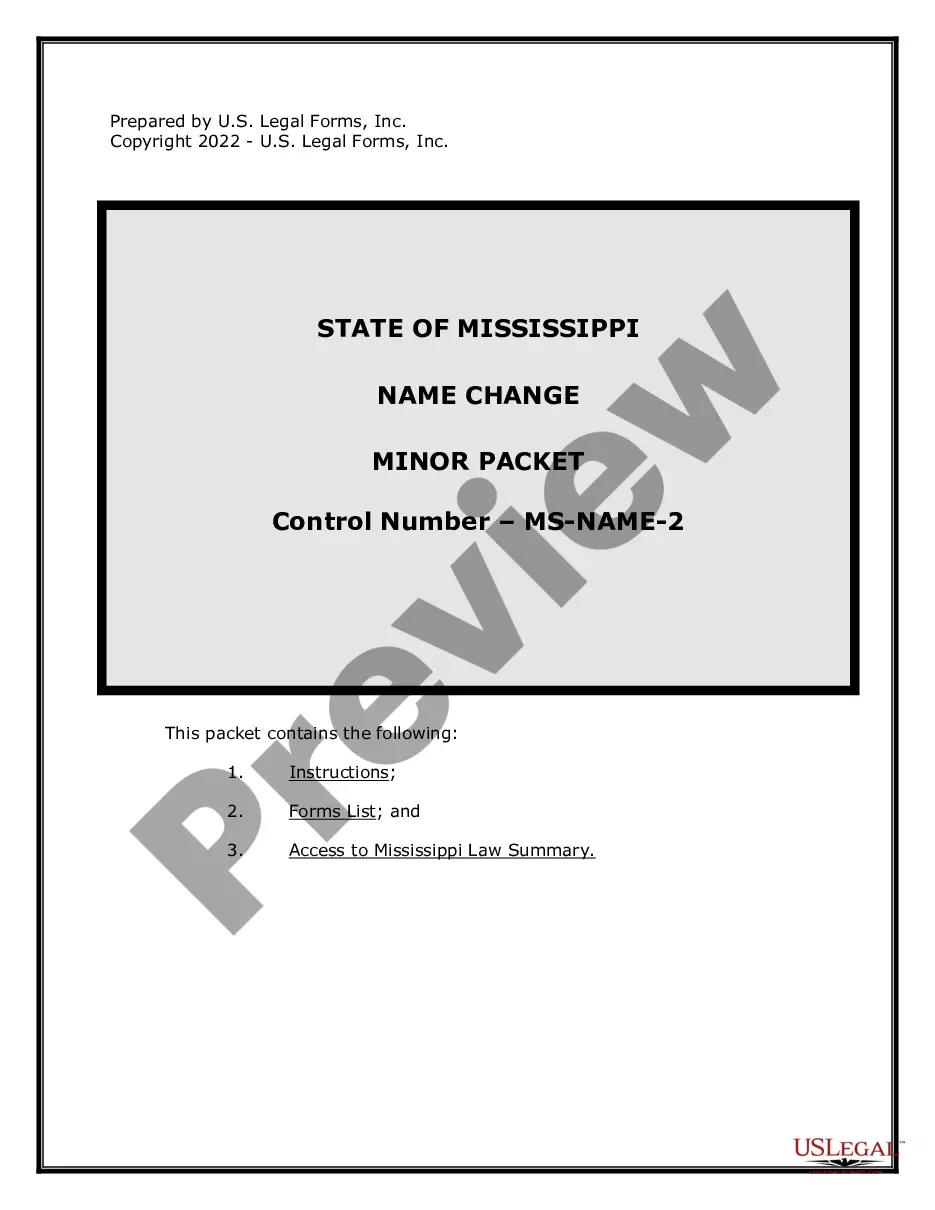
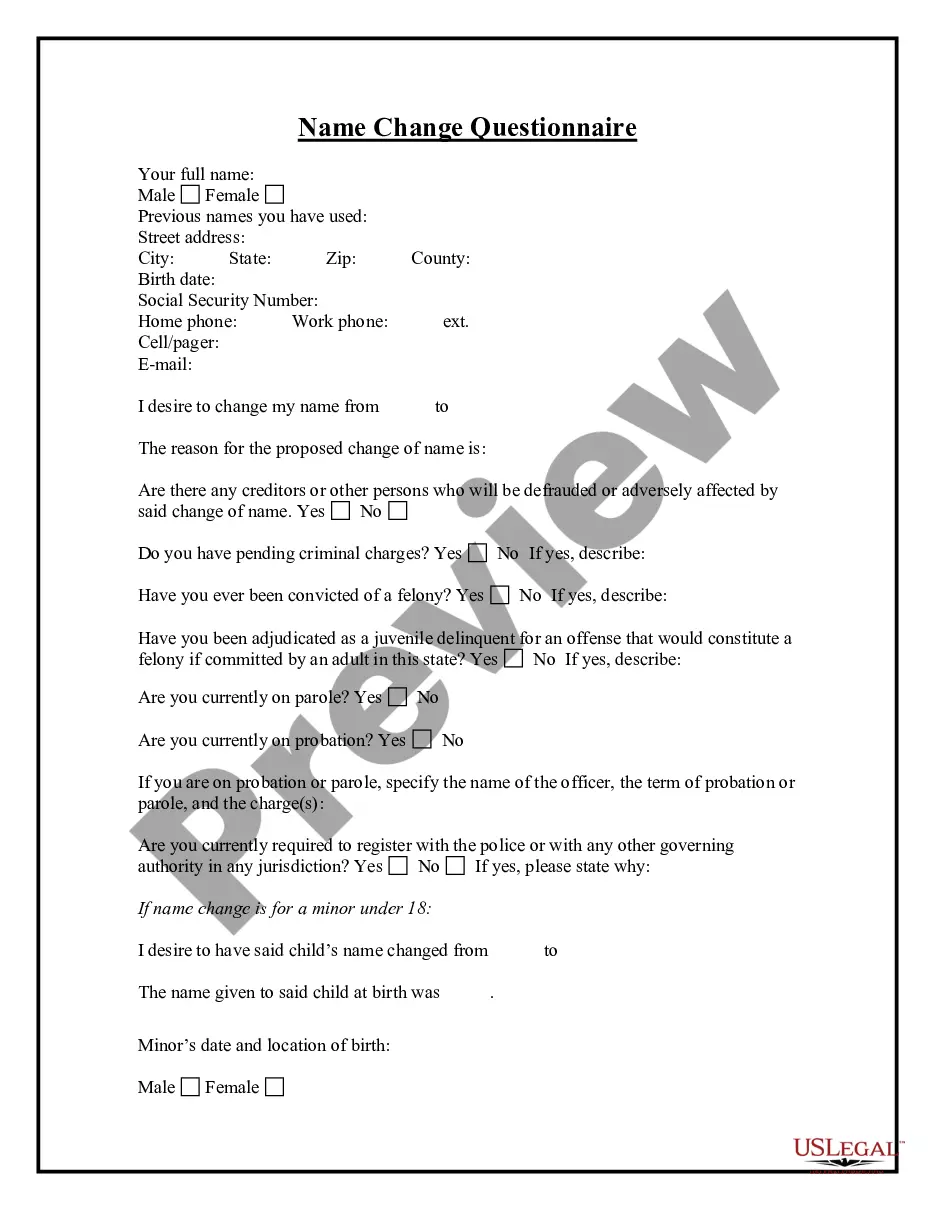
The Mississippi Name Change Instructions and Forms Package for an Adult is designed to assist individuals seeking to legally change their name in the state of Mississippi. This comprehensive package includes specific forms and instructions necessary for filing a name change petition in the Chancery court. Unlike generic name change forms, this package is tailored to meet Mississippi state legal requirements, providing clear guidance through each step of the process.
Forms provided in this package


Common use cases
This form package is essential when you wish to change your name for reasons that may include:
- Personal preference, such as marriage or divorce.
- Reclaiming a birth name or cultural name.
- A desire to unify family names in cases of adoption or blended families.
- Any situation where a name change is required for legal or professional reasons.
Who needs this form package
- Adults who are at least 18 years of age.
- Residents of Mississippi looking to officially change their name.
- Individuals who have proper and reasonable cause for the name change.
- Those who are not attempting to change their name to evade debts or defraud creditors.
How to prepare this document
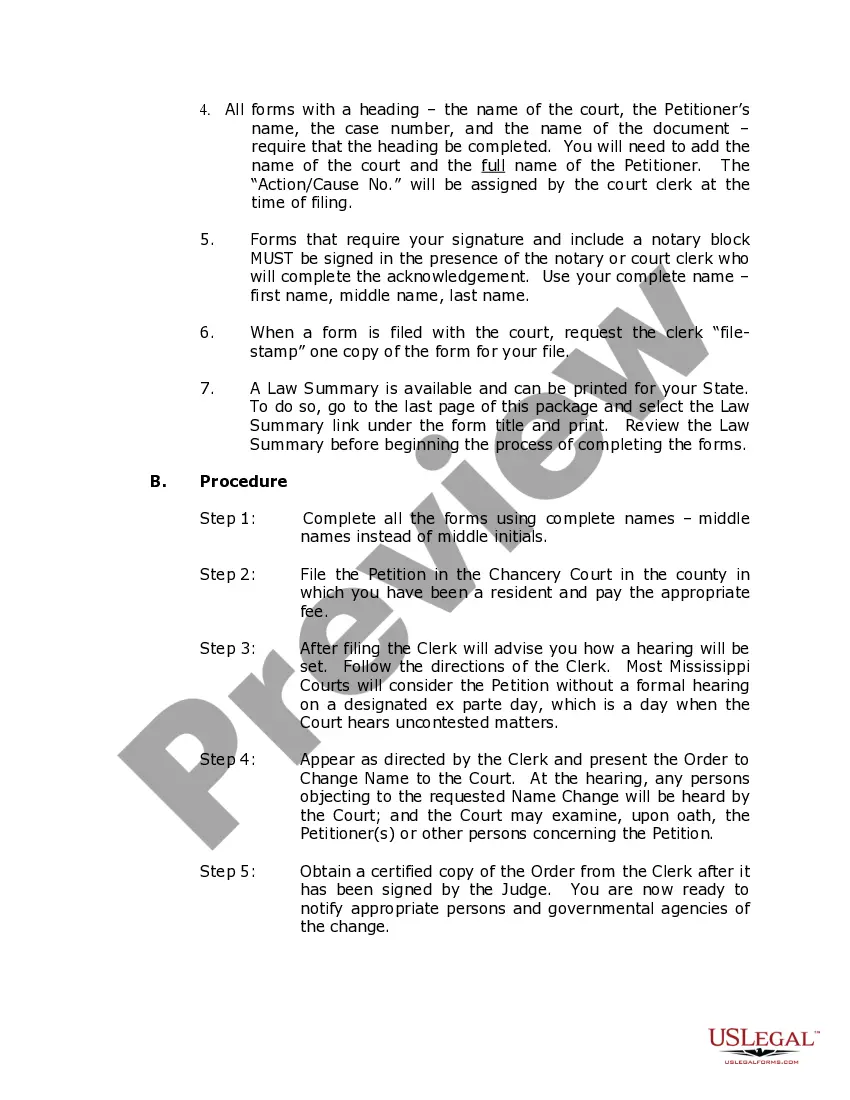
- Review the included forms and instructions carefully.
- Complete all forms using your full name, avoiding initials.
- File the Petition to Change Name in the appropriate Chancery court and pay the required fee.
- Follow the Clerk's instructions to schedule any necessary hearings.
- Obtain a certified copy of the signed Order of Name Change from the court after approval.
Notarization details for included forms
Notarization is required for one or more forms in this package. US Legal Forms provides secure online notarization powered by Notarize, allowing you to complete the process through a verified video call.
Get your form ready online
Our built-in tools help you complete, sign, share, and store your documents in one place.
Make edits, fill in missing information, and update formatting in US Legal Forms—just like you would in MS Word.
Download a copy, print it, send it by email, or mail it via USPS—whatever works best for your next step.
Sign and collect signatures with our SignNow integration. Send to multiple recipients, set reminders, and more. Go Premium to unlock E-Sign.
If this form requires notarization, complete it online through a secure video call—no need to meet a notary in person or wait for an appointment.
We protect your documents and personal data by following strict security and privacy standards.

Make edits, fill in missing information, and update formatting in US Legal Forms—just like you would in MS Word.

Download a copy, print it, send it by email, or mail it via USPS—whatever works best for your next step.

Sign and collect signatures with our SignNow integration. Send to multiple recipients, set reminders, and more. Go Premium to unlock E-Sign.

If this form requires notarization, complete it online through a secure video call—no need to meet a notary in person or wait for an appointment.

We protect your documents and personal data by following strict security and privacy standards.
Common mistakes to avoid
- Failing to use complete names instead of initials.
- Omitting important information from the Petition.
- Not obtaining a certified copy of the signed Order after approval.
- Missing the requirement for notarization on specific forms.
Benefits of using this package online
- Convenient access to forms that can be downloaded and printed at your convenience.
- Integrated instructions that guide you through the filing process step-by-step.
- Forms are created by licensed attorneys, ensuring compliance with state laws.
- Edit and finalize your forms easily on your computer before printing.
Legal use & context
- The forms provided in this package are designed to comply with Mississippi law governing name changes.
- Using these forms correctly is essential to ensure the legality of your name change.
- It is advisable to consult an attorney if you encounter complications or have specific legal questions regarding your case.
Quick recap
- This package provides detailed instructions and state-specific forms for legally changing your name in Mississippi.
- Follow the outlined steps to ensure a smooth and compliant name change process.
- Ensure that all forms are notarized and that you understand the legal implications of changing your name.
Looking for another form?



Form popularity
FAQ
An exacerbation of MS (also known as a relapse, attack or flare-up) is the occurence new symptoms or the worsening of old symptoms. It can be very mild, or severe enough to interfere with a person's ability to function. No two exacerbations are alike.
MS can cause significant anxiety, distress, anger, and frustration from the moment of its very first symptoms. The uncertainty and unpredictability associated with MS is one of its most distressing aspects. In fact, anxiety is at least as common in MS as depression.
MS can affect mood worry, fear, moodiness, irritability and anxiety: normal in the face of unpredictability; anyone can become a bit irritable when faced with difficult challenges. depression is one of the most common symptoms of MS and a major risk factor for suicide.
Yes, they can. Brain tumors often cause personality changes and sudden mood swings. Although these mood changes and their severity will vary from one person to another, it's relatively common for someone with a brain tumor to experience increased: Aggression.
Sometimes people with MS have problems with memory, concentration, problem-solving, and/or other cognitive functions. These symptoms are usually caused directly by the disease's damage to myelin and the nerve cells. However, cognitive symptoms can also be indirectly affected by depression, anxiety, stress, or fatigue.
Vision problems, including blurriness or blindness.Muscle weakness.Difficulty with coordination and balance.Problems with walking and standing.Feelings of numbness, prickling, or pain.Partial or complete paralysis.Difficulty speaking.Multiple Sclerosis Final Stages: What to Expect - Samaritan\nsamaritannj.org > hospice-blog-and-events > hospice-palliative-care-blog
When it comes to the brain, changes due to MS can contribute to fatigue and other symptoms. MS brain lesions can produce difficulty with thinking and memory. MS brain changes may also contribute to mood disorders such as depression.
Cognitive dysfunction can occur with any disease course, but is slightly more likely in progressive MS. You are more likely to experience cognitive dysfunction (the first signs or new changes) during an exacerbation. Cognitive changes generally progress slowly.
Four disease courses have been identified in multiple sclerosis: clinically isolated syndrome (CIS), relapsing-remitting MS (RRMS), primary progressive MS (PPMS), and secondary progressive MS (SPMS).