Mississippi Attorney Fee Letter - Contingency
What is this form?
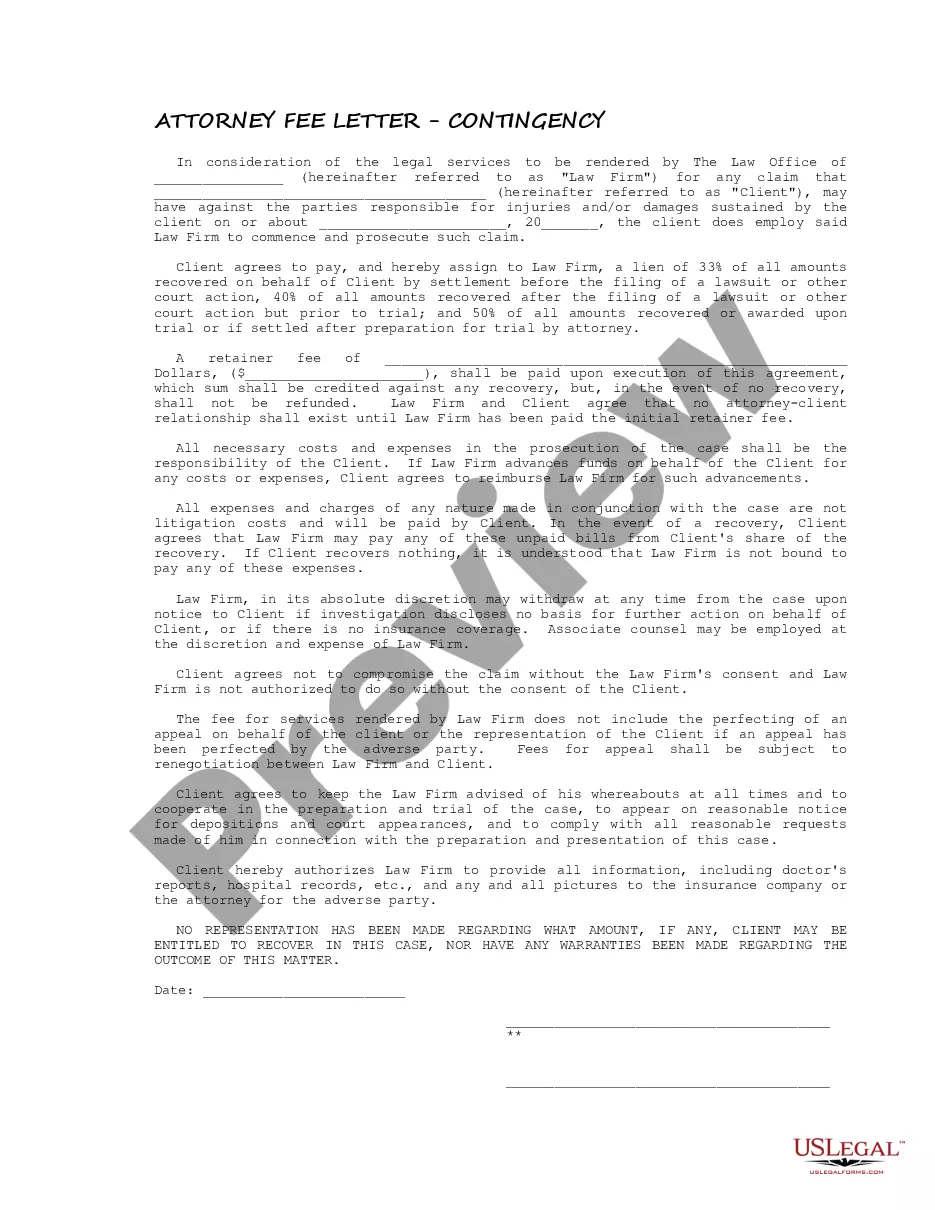
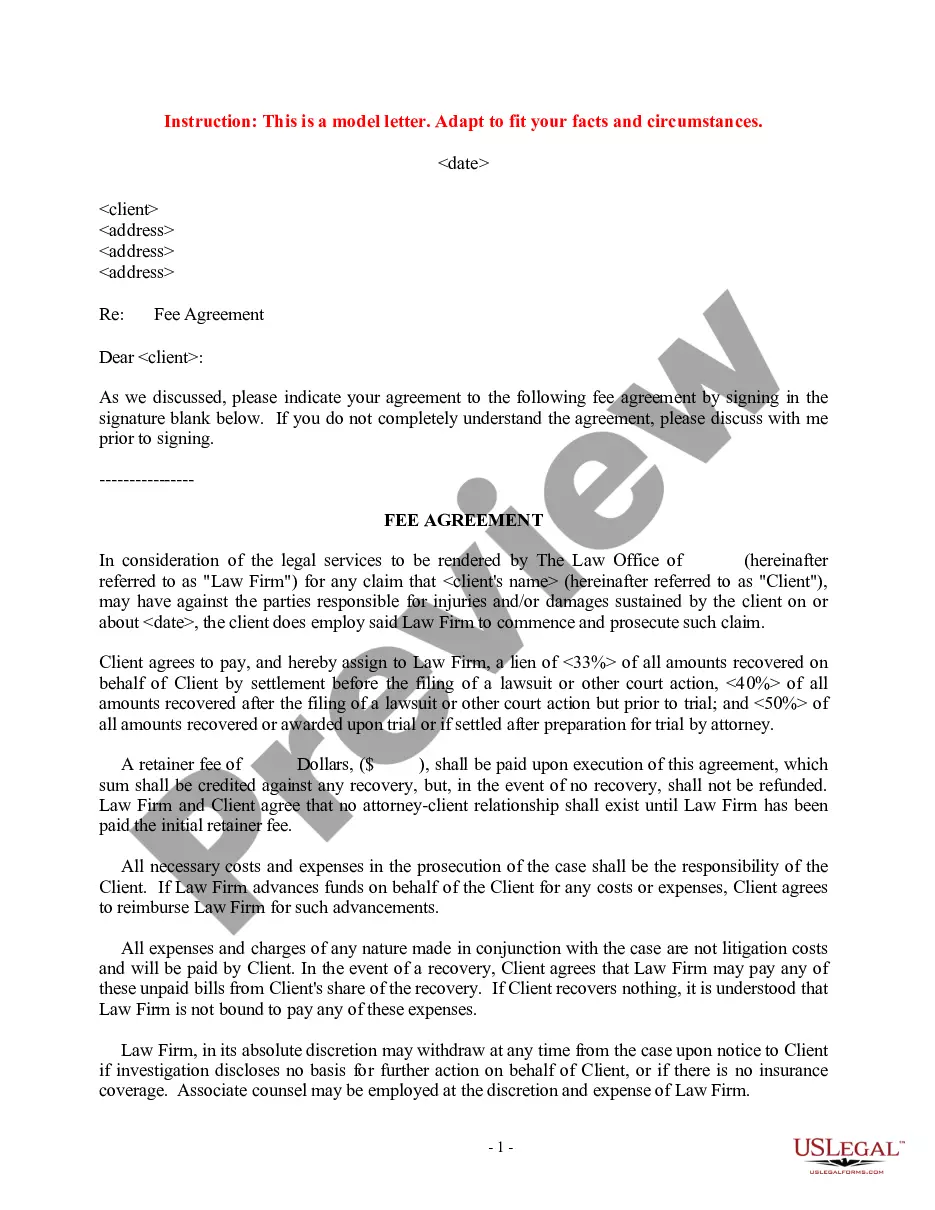
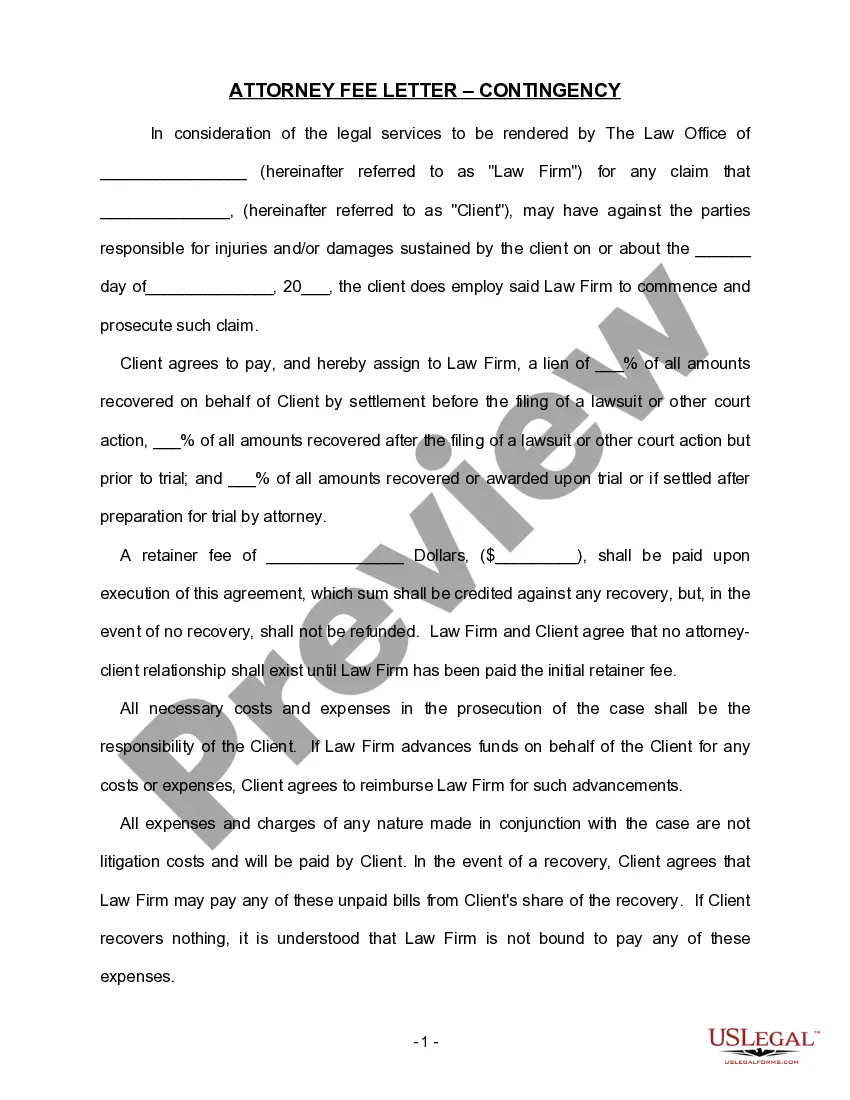
The Attorney Fee Letter - Contingency is a legal document that establishes an agreement between a client and their attorney regarding fees based on a contingency arrangement. Unlike hourly billing, this form specifies that the attorney will receive a percentage of any recovery obtained on behalf of the client. It ensures clarity in the financial terms agreed upon and protects the interests of both parties in a legal claim.
Form components explained
- Identification of the Law Firm and Client
- Details of the agreed contingency fee percentages based on the recovery stage
- Specification of a retainer fee and its conditions
- Client's responsibility for costs and expenses associated with the case
- Client obligations regarding communication and cooperation
- Legal disclaimers regarding the outcome of the case


Common use cases
This form should be used when a client hires an attorney under a contingency fee arrangement, typically in cases involving personal injury or other civil claims. It is essential when a client wishes to clarify the payment structure and responsibilities prior to initiating legal action. Use this form to ensure both the client and attorney have a mutual understanding of the financial arrangement before proceeding.
Intended users of this form
- Clients seeking legal representation on a contingency basis
- Attorneys outlining their fees and obligations to clients
- Individuals involved in personal injury or civil litigation
- Anyone needing clarity on financial agreements with legal counsel
How to prepare this document
- Identify and enter the full name of the Law Firm and Client.
- Specify the claim or issue the client is pursuing.
- Fill in the date of the incident and the date of the agreement.
- Clearly state the percentages for the contingency fee based on recovery stages.
- Indicate the amount of the retainer fee and obtain signatures from both parties.
Notarization requirements for this form
This form does not typically require notarization unless specified by local law. It is advisable to check with a legal professional to confirm any local requirements that may apply.
Get your form ready online
Our built-in tools help you complete, sign, share, and store your documents in one place.
Make edits, fill in missing information, and update formatting in US Legal Forms—just like you would in MS Word.
Download a copy, print it, send it by email, or mail it via USPS—whatever works best for your next step.
Sign and collect signatures with our SignNow integration. Send to multiple recipients, set reminders, and more. Go Premium to unlock E-Sign.
If this form requires notarization, complete it online through a secure video call—no need to meet a notary in person or wait for an appointment.
We protect your documents and personal data by following strict security and privacy standards.

Make edits, fill in missing information, and update formatting in US Legal Forms—just like you would in MS Word.

Download a copy, print it, send it by email, or mail it via USPS—whatever works best for your next step.

Sign and collect signatures with our SignNow integration. Send to multiple recipients, set reminders, and more. Go Premium to unlock E-Sign.

If this form requires notarization, complete it online through a secure video call—no need to meet a notary in person or wait for an appointment.

We protect your documents and personal data by following strict security and privacy standards.
Typical mistakes to avoid
- Failing to specify the retainer fee amount clearly.
- Not detailing the exact percentages for the contingency fees.
- Leaving out the clientâs responsibilities during the legal process.
- Not obtaining signatures or dates on the agreement.
Why complete this form online
- Convenient access to templates drafted by licensed attorneys.
- Easy download and customizable to fit specific needs.
- Time-saving compared to drafting documents from scratch.
- Confidence in the legality and enforceability of the form.
Legal use & context
- This form establishes a legal contract between a client and an attorney.
- It is enforceable in court, provided it follows state laws on contingency agreements.
- Both parties must adhere to the terms outlined to avoid disputes later.
Looking for another form?
Form popularity
FAQ
From 1 April 2013 contingency fees, or damages-based agreements (DBAs), have been permitted for contentious work (ie litigation or arbitration proceedings) in England and Wales. This means that lawyers can conduct litigation and arbitration in this jurisdiction in return for a share of any damages.
When to Negotiate Attorney Fees Rarely will an attorney, or any other professional, offer to reduce their fees.You can successfully negotiate contingency fees for injury cases if you are well organized and ready to give the attorney a good reason for the reduction.
The standard contingency fee for an attorney is a percentage amount rather than a fixed amount. Most personal injury lawyers charge 33 1/3 percent if the case settles without filing a lawsuit and 40% if a lawsuit is filed. Most employment lawyers charge a 40% fee.
What is a typical percentage for contingency fees? In general, contingency fee percentages range from 33% to 40%, depending on the amount the client could potentially win, the strength of the case, and other factors. I have seen contingency fees as high as 50% (for small cases) and 15% (for very large cases).
Contingency fee arrangements can be helpful in some cases, especially when a client may need financial assistance. However, they are prohibited by law in certain cases.
In the majority of cases, a personal injury lawyer will receive 33 percent (or one third) of any settlement or award. For example, if you receive a settlement offer of $30,000 from the at fault party's insurance company, you will receive $20,000 and your lawyer will receive $10,000.
If your attorney does secure a settlement on your behalf, he or she will take an agreed-upon percentage of the final settlement amount as payment. Most contingency fee agreements are between 33% and 40% of the final settlement amount.
In a contingent fee arrangement, the lawyer agrees to accept a fixed percentage (often one third) of the recovery, which is the amount finally paid to the client. If you win the case, the lawyer's fee comes out of the money awarded to you.
Under ABA Model Rule 1.5(d), contingency fees are not allowed for the following cases: Divorce cases in which the fee is contingent on the securing of a divorce or the amount of alimoney, support, or property settlement to be obtained.