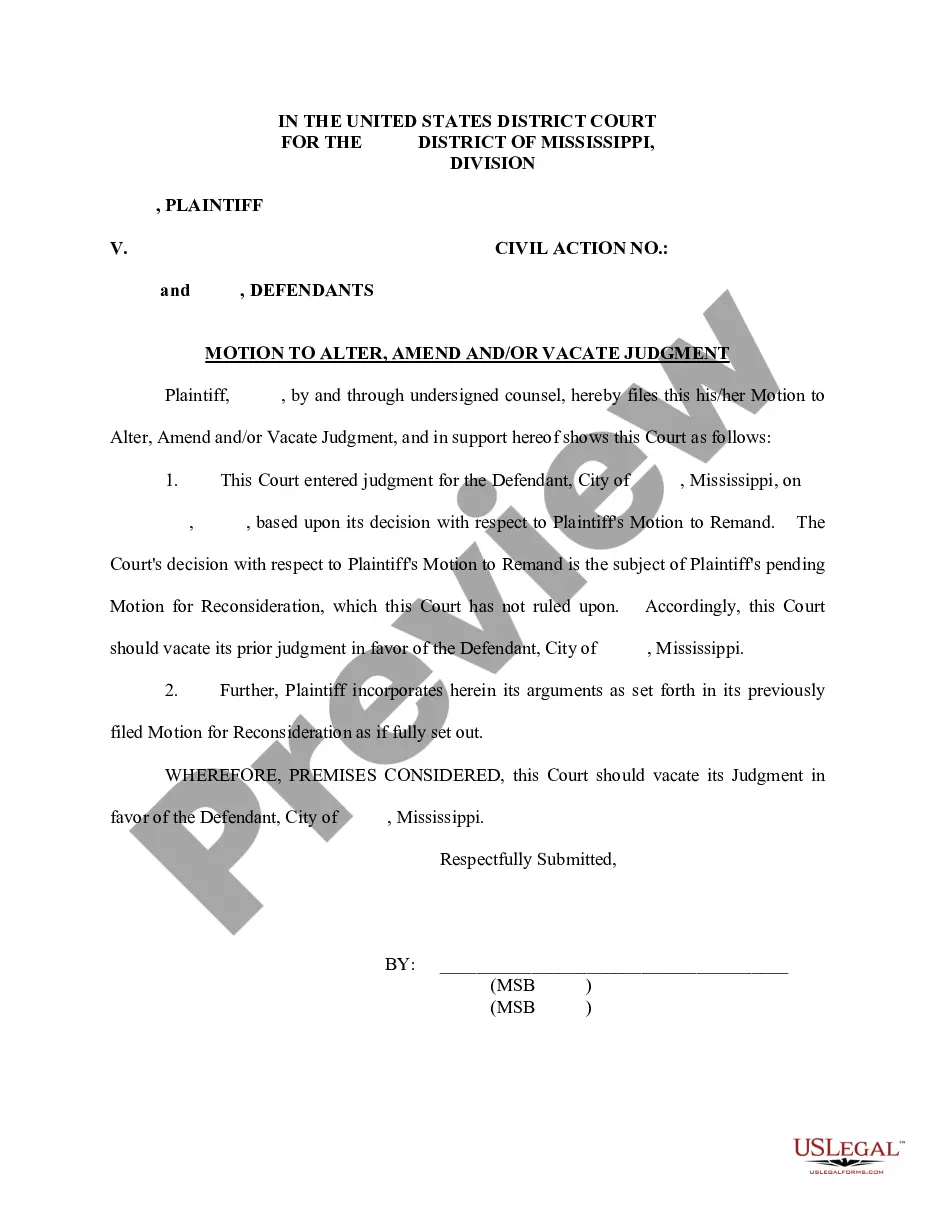
Mississippi Motion to Alter, Amend and / or Vacate Judgment
Understanding this form
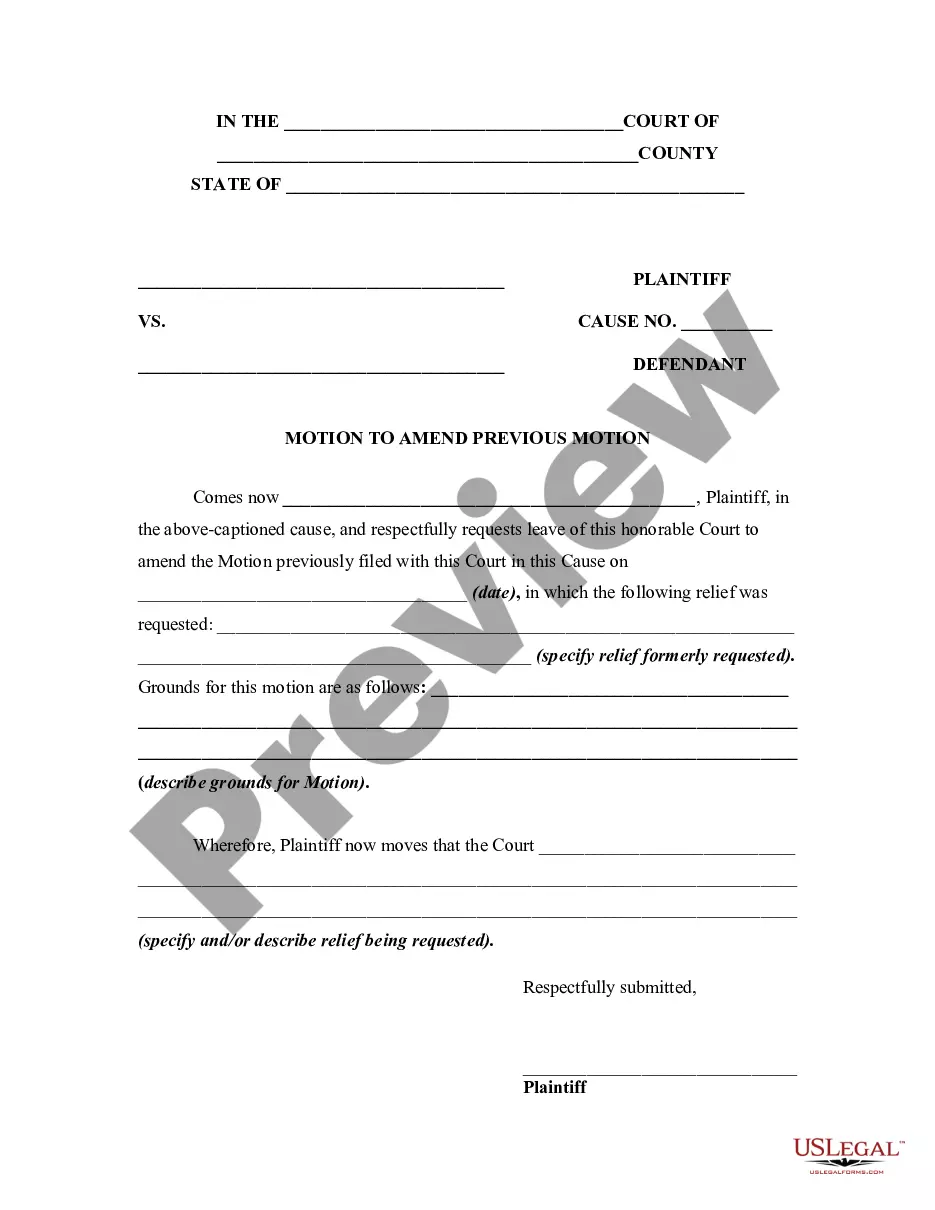
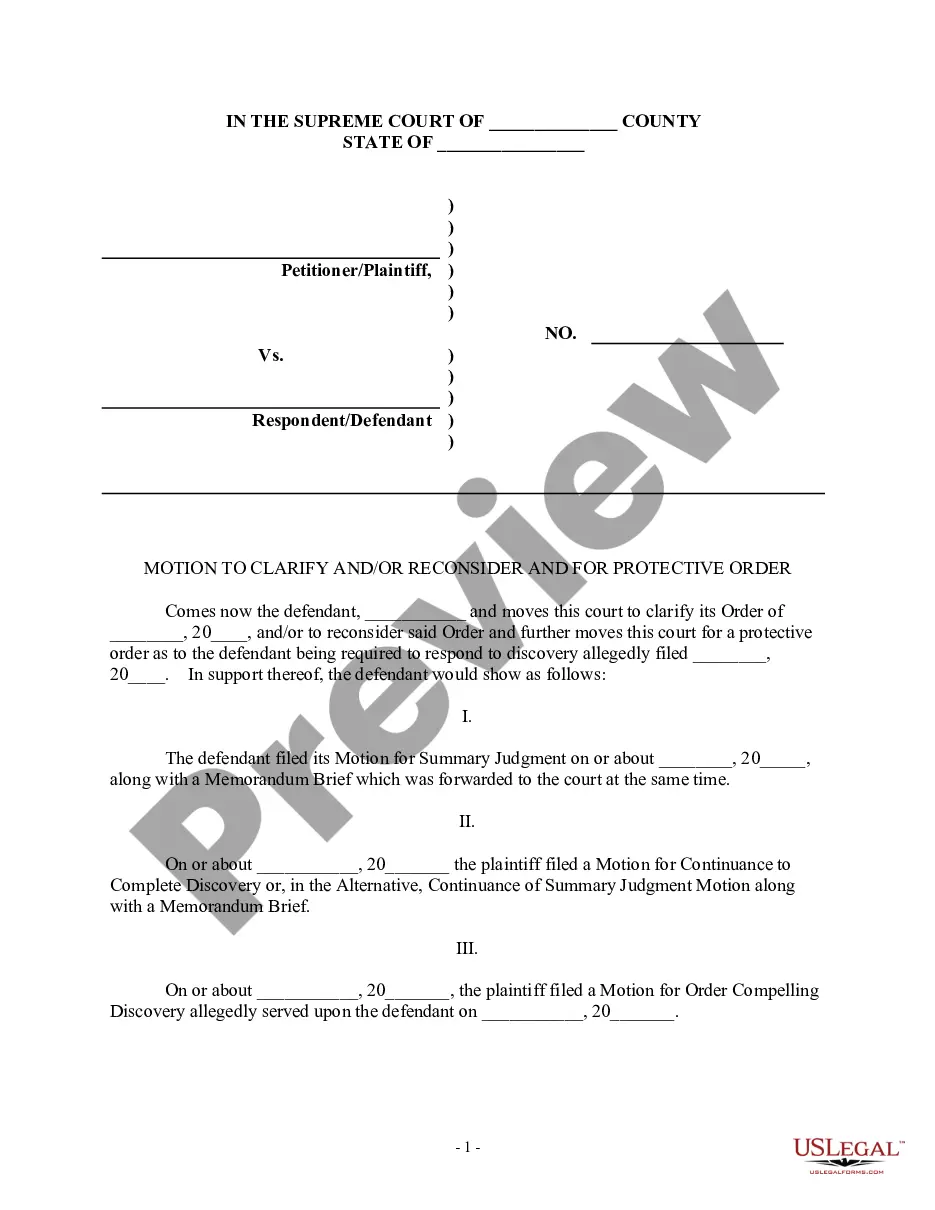
The Motion to Alter, Amend and/or Vacate Judgment is a formal request made to a court to reconsider or change a judgment previously issued. This document allows parties to seek modifications based on new evidence, legal arguments, or other factors justifying a revision. Unlike other motions, such as motions for new trials, this motion specifically targets the alteration or vacating of a judgment itself.
Main sections of this form
- Overview and purpose: Explains the intent of the motion to seek changes.
- Incorporation of previous arguments: Allows the inclusion of arguments from earlier motions.
- Request section: Specifies what the party is asking the court to do regarding the judgment.
- Signatures: Requires the signatures of the parties submitting the motion.



When this form is needed
This form is commonly used when a party believes that a court's previous judgment was flawed due to errors in law or fact. It is applicable in scenarios such as discovering new evidence, changes in law that may affect the case, or errors that significantly impacted the judgment outcome. Using this form allows the aggrieved party to formally request the court to reconsider its decision.
Who this form is for
- Individuals who have been a party in a court case and received an unfavorable judgment.
- Attorneys representing clients seeking to alter or vacate a judgment.
- Parties with new evidence or legal arguments pertinent to the prior ruling.
Instructions for completing this form
- Identify the parties involved in the case, including the petitioner and respondent.
- Specify the judgment you are seeking to alter, amend, or vacate.
- Include all relevant facts and arguments that justify your request.
- Incorporate arguments from previous motions if applicable.
- Date and sign the motion before submitting it to the court.
Does this form need to be notarized?
Notarization is generally not required for this form. However, certain states or situations might demand it. You can complete notarization online through US Legal Forms, powered by Notarize, using a verified video call available anytime.
Get your form ready online
Our built-in tools help you complete, sign, share, and store your documents in one place.
Make edits, fill in missing information, and update formatting in US Legal Forms—just like you would in MS Word.
Download a copy, print it, send it by email, or mail it via USPS—whatever works best for your next step.
Sign and collect signatures with our SignNow integration. Send to multiple recipients, set reminders, and more. Go Premium to unlock E-Sign.
If this form requires notarization, complete it online through a secure video call—no need to meet a notary in person or wait for an appointment.
We protect your documents and personal data by following strict security and privacy standards.

Make edits, fill in missing information, and update formatting in US Legal Forms—just like you would in MS Word.

Download a copy, print it, send it by email, or mail it via USPS—whatever works best for your next step.

Sign and collect signatures with our SignNow integration. Send to multiple recipients, set reminders, and more. Go Premium to unlock E-Sign.

If this form requires notarization, complete it online through a secure video call—no need to meet a notary in person or wait for an appointment.

We protect your documents and personal data by following strict security and privacy standards.
Common mistakes
- Failing to provide sufficient evidence or legal basis for changes.
- Missing deadlines for filing the motion.
- Forgetting to sign the document before submission.
Why complete this form online
- Easy access and convenient download options for immediate use.
- Edit the form to suit specific circumstances without hassle.
- Reliability, as forms are drafted and reviewed by licensed attorneys.
Summary of main points
- A Motion to Alter, Amend, and/or Vacate Judgment is essential for challenging an existing court decision.
- It is vital to clearly state your request and provide supporting arguments.
- Filing procedures may differ by state and should be reviewed before submission.
Looking for another form?
Form popularity
FAQ
The Mississippi Motion to Alter, Amend and / or Vacate Judgment is a post-judgment request to reconsider or modify a judgment already entered. It targets changing the judgment itself (not a new trial) based on new evidence or new legal arguments. Use it when the prior ruling appears flawed and a revision is warranted under the form’s guidelines.
A motion to alter or amend judgment is a formal post-judgment request asking the court to modify a judgment already entered. The Mississippi form provides sections for the overview and purpose, the incorporation of previous arguments, the specific relief requested, and signatures. It is distinct from requesting a new trial, which seeks a fresh trial of the case.
The form itself describes the motion’s structure but does not list specific grounds for rejection. It is a vehicle to present new evidence and legal arguments and to incorporate arguments from earlier filings. The court reviews those materials and decides whether the revision to the judgment is warranted, based on Mississippi procedure and the merits presented.
There is no guaranteed success rate for Mississippi motions to alter, amend, and / or vacate judgments. Outcomes depend on the merits, the strength of new evidence or law, and how effectively the motion is argued within the form’s sections—overview, incorporation of prior arguments, the relief requested, and signatures. Consult an attorney for case-specific guidance.
The form is used after a judgment has been entered to seek alteration, amendment, or vacatur and does not provide a list of judgment types. The document focuses on presenting the motion’s purpose, incorporating prior arguments, specifying the requested change, and obtaining signatures, and is applicable to judgments entered in Mississippi courts.
This form targets changing the judgment itself—altering, amending, or vacating what has been entered—rather than ordering a new trial on the merits. It includes sections for an overview, incorporating previous arguments, a specific relief request, and signatures, whereas a motion for a new trial seeks a fresh trial rather than revising the judgment already issued in Mississippi.