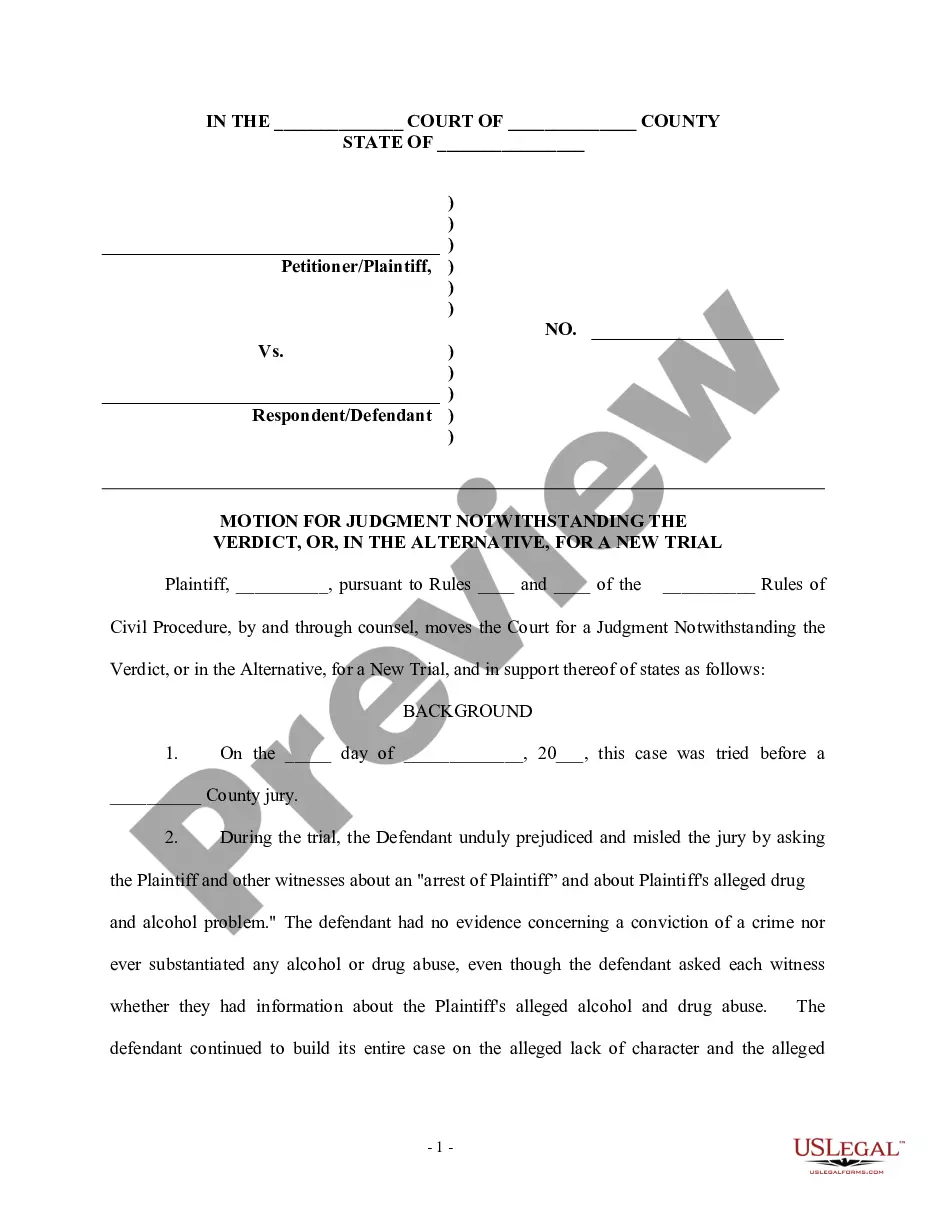
Mississippi Motion for Judgment notwithstanding the Verdict, or, in the Alternative, for New Trial, or, in the Alternative, for Remittitur
What this document covers
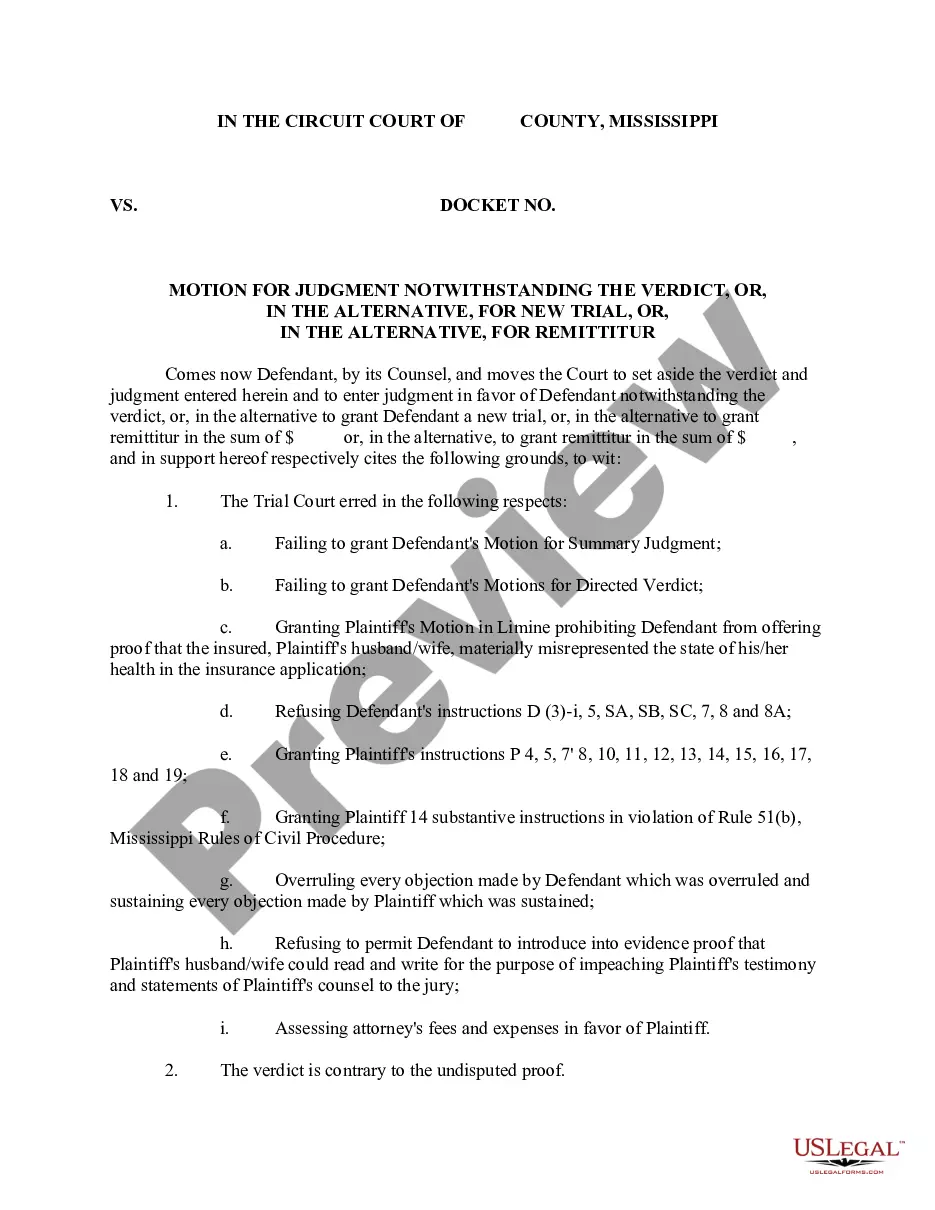
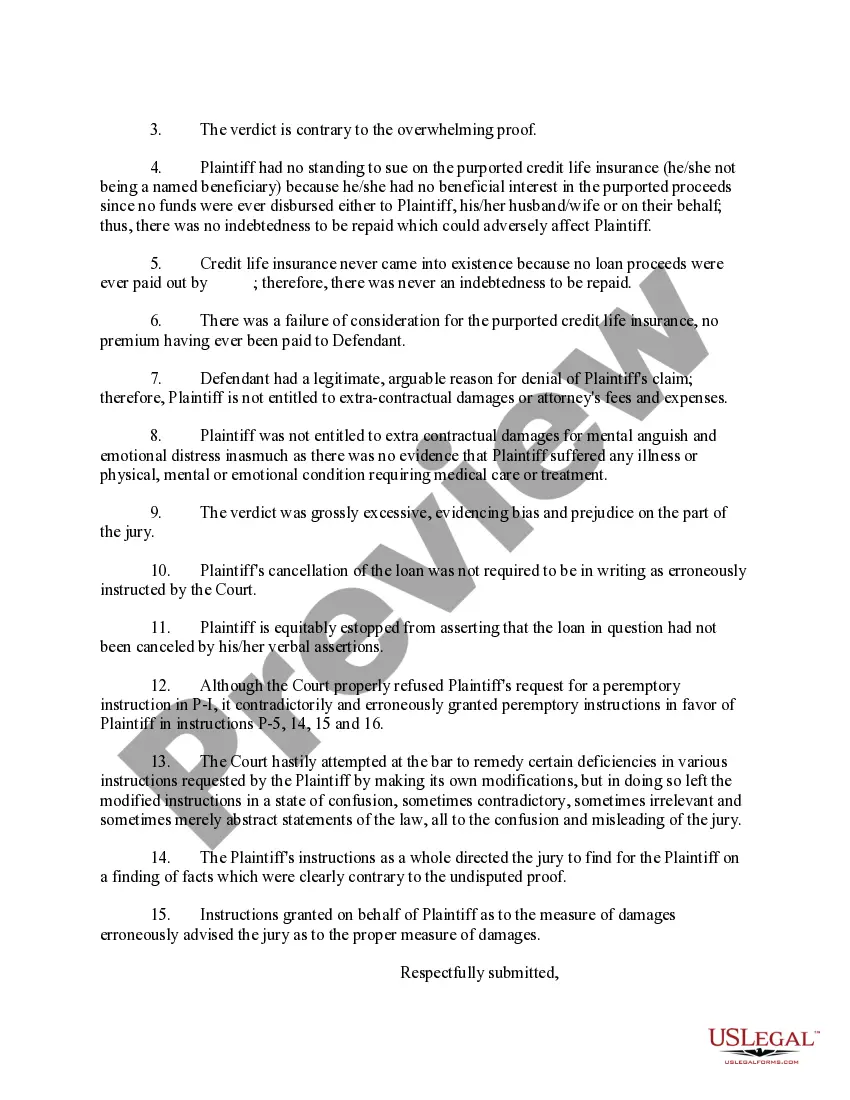
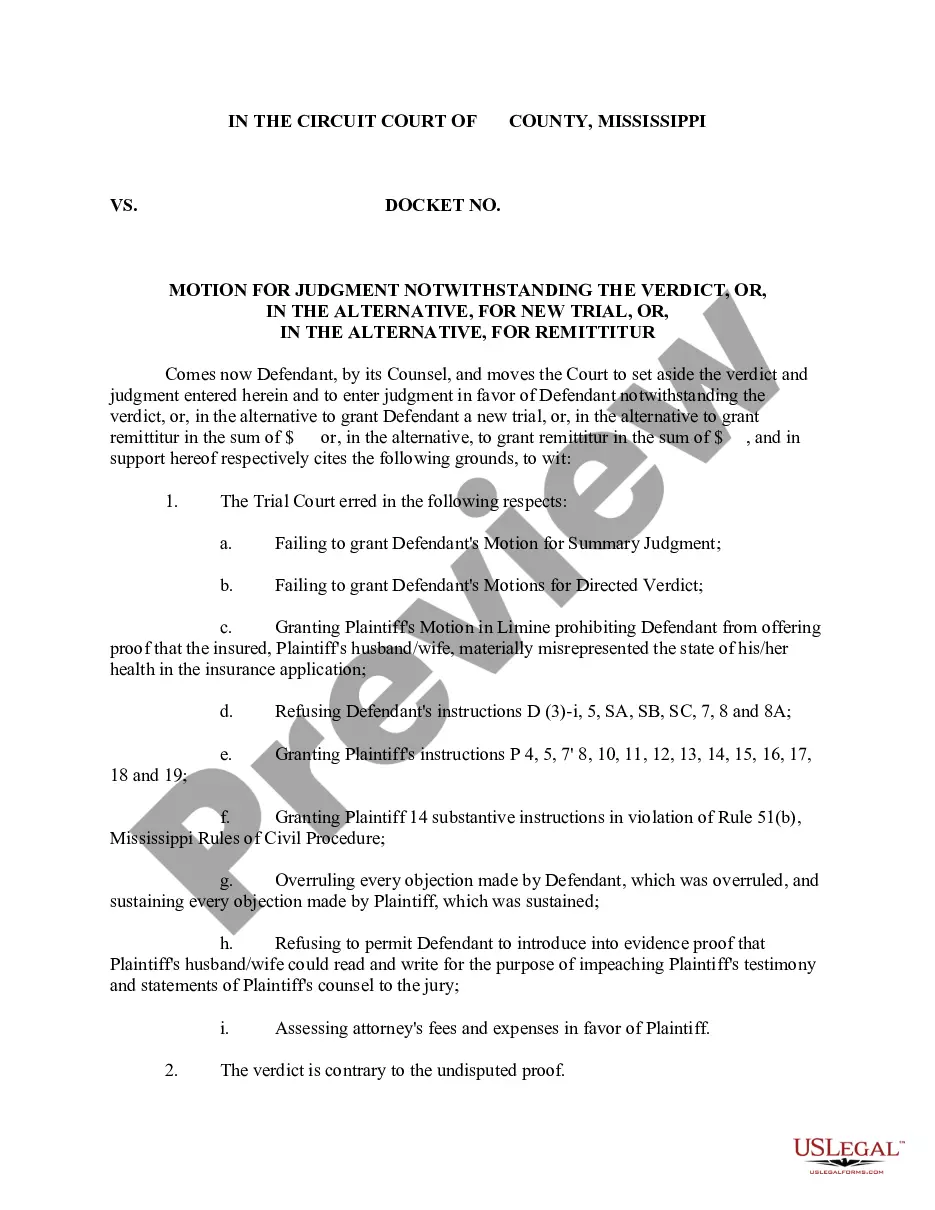
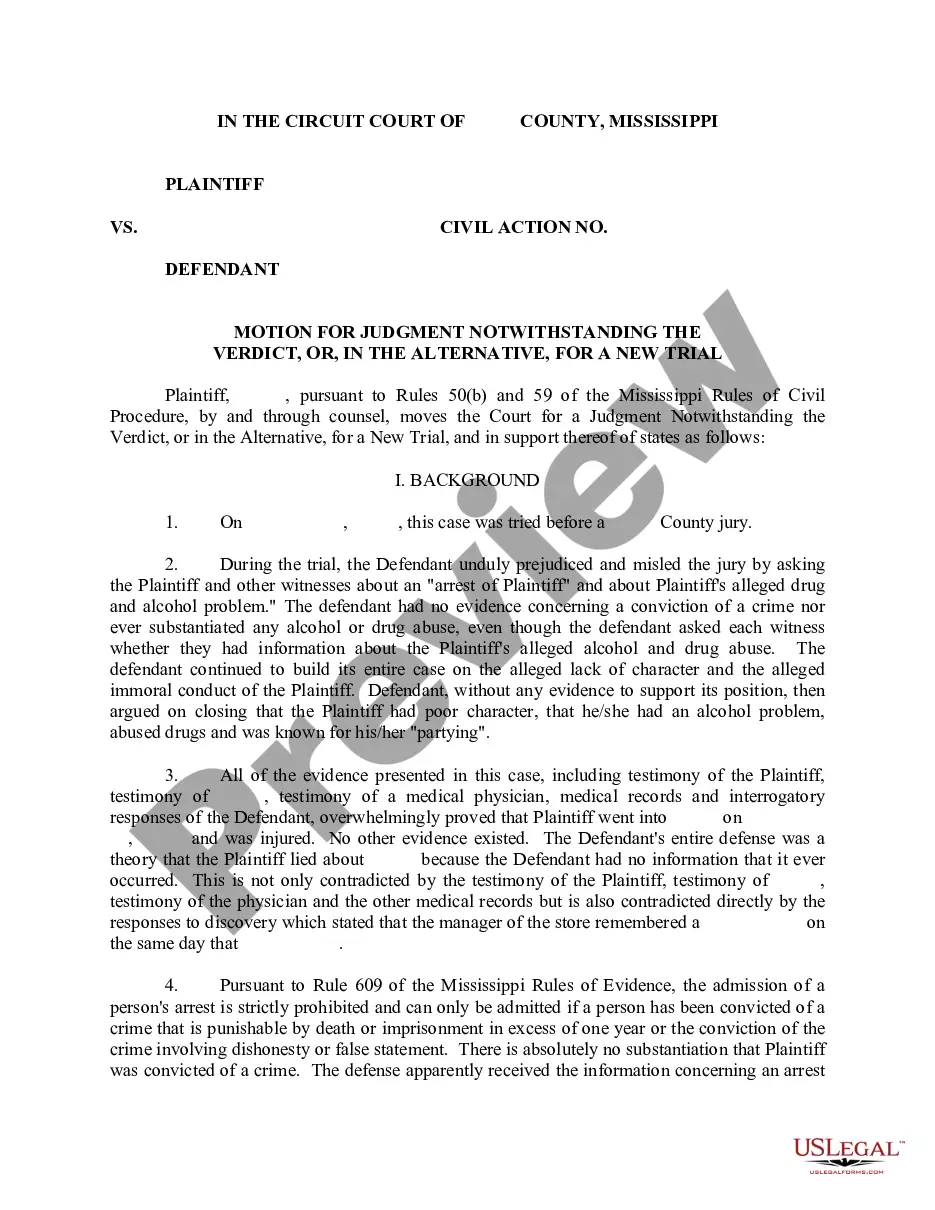
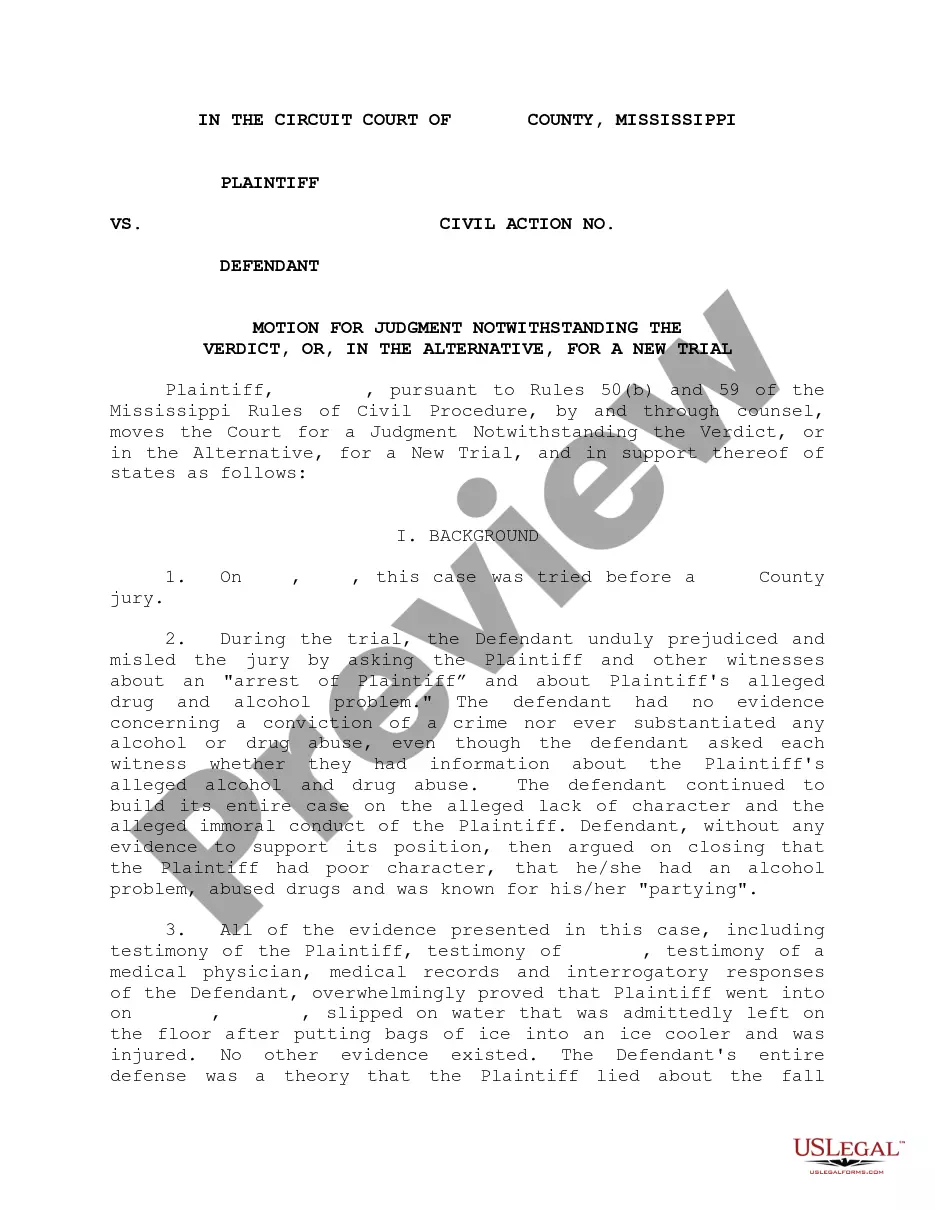
The Motion for Judgment Notwithstanding the Verdict, or, in the Alternative, for New Trial, or, in the Alternative, for Remittitur, is a legal document used to request a judge to overturn a jury's verdict or to order a new trial. This form is essential in situations where the party believes the jury's decision was erroneous based on the evidence presented during the trial. Unlike a simple appeal, this motion seeks immediate relief from the court regarding the verdict reached by the jury. It is crucial for ensuring that justice is achieved when the verdict is found contrary to clear and overwhelming evidence.
Key parts of this document
- Identification of the case and parties involved
- Grounds for the motion, including alleged errors during the trial
- Arguments supporting the request for a new trial or remittitur
- Legal basis for overturning the jury's verdict
- Request for remedies, such as fees and expenses assessment

Situations where this form applies
This form is used when a party to a trial believes that the jury's verdict does not align with the evidence presented. Scenarios include instances where:
- The jury's decision is viewed as excessive or unfairly biased.
- The court's instructions to the jury were improper, leading to a flawed verdict.
- Significant errors were made during the trial that may have affected the outcome.
- There is new evidence that could significantly alter the jury's verdict.
Who needs this form
This form is primarily intended for:
- Defendants or plaintiffs who have received a jury verdict they wish to contest.
- Parties involved in civil litigation who believe their trial was unjustly decided.
- Attorneys representing clients in scenarios where a motion is a viable option for relief.
Steps to complete this form
- Identify the parties involved and the case number at the top of the document.
- Clearly articulate the grounds for the motion, citing relevant errors that occurred during the trial.
- Provide detailed arguments that support the request for judgment notwithstanding the verdict or for a new trial.
- Include any necessary legal references that substantiate your claims.
- Sign and date the motion before submission to the appropriate court.
Is notarization required?
This form does not typically require notarization unless specified by local law. However, confirming any local requirements before submission is advisable for compliance.
Get your form ready online
Our built-in tools help you complete, sign, share, and store your documents in one place.
Make edits, fill in missing information, and update formatting in US Legal Forms—just like you would in MS Word.
Download a copy, print it, send it by email, or mail it via USPS—whatever works best for your next step.
Sign and collect signatures with our SignNow integration. Send to multiple recipients, set reminders, and more. Go Premium to unlock E-Sign.
If this form requires notarization, complete it online through a secure video call—no need to meet a notary in person or wait for an appointment.
We protect your documents and personal data by following strict security and privacy standards.

Make edits, fill in missing information, and update formatting in US Legal Forms—just like you would in MS Word.

Download a copy, print it, send it by email, or mail it via USPS—whatever works best for your next step.

Sign and collect signatures with our SignNow integration. Send to multiple recipients, set reminders, and more. Go Premium to unlock E-Sign.

If this form requires notarization, complete it online through a secure video call—no need to meet a notary in person or wait for an appointment.

We protect your documents and personal data by following strict security and privacy standards.
Avoid these common issues
- Failing to cite specific grounds for the motion clearly.
- Not including necessary legal references to support claims.
- Missing the filing deadline for submitting the motion.
- Using vague language that does not fully describe the alleged errors.
Benefits of completing this form online
- Immediate access to a legally vetted template drafted by licensed attorneys.
- Convenience of downloading and printing at your convenience.
- Edit and adapt the form easily to fit your specific circumstances.
- Guidance on completing the form correctly, reducing the risk of errors.
Legal use & context
- This motion serves as an important tool for ensuring fair trial rights are upheld.
- It is often used in conjunction with other motions, such as a motion for new trial.
- The courtâs decision on this motion can significantly impact the outcome of the case.
What to keep in mind
- The motion addresses errors in a jury verdict and seeks relief from the court.
- It is essential to provide clear and specific reasons for your motion.
- Utilizing this form can significantly streamline the process of seeking legal remedies post-verdict.
Looking for another form?

Form popularity
FAQ
Judgment - The official decision of a court finally determining the respective rights and claims of the parties to a suit. jurisdiction - (1) The legal authority of a court to hear and decide a case.
To ask a court to set aside (cancel) a court order or judgment, you have to file a request for order to set aside, sometimes called a motion to set aside or motion to vacate. The terms set aside or vacate a court order basically mean to cancel or undo that order to start over on a particular issue.
In federal court, the jury decides the verdict. It's the judge's job to act as referee, ruling on issues of law before and during the trial. Federal judges keep up to date on many laws and rules such as: Federal Laws.
A verdict of guilty in a criminal case is generally followed by a judgment of conviction rendered by judge, which in turn be followed by sentencing. In U.S. legal nomenclature, the verdict is the finding of the jury on the questions of fact submitted to it.The judgment of the court is the final order in the case.
To overturn a guilty verdict, the judge must look at all evidence presented most favorable to the prosecution. The judge can only grant judgment to overturn the verdict if the evidence clearly fails to establish guilt.A judge will never interfere with a jury's decision and process unless there is a legitimate reason.
In other words, she has ruled in favour of the plaintiff/against the defendant.
A JNOV is proper when the court finds that the party bearing the BURDEN OF PROOF fails to make out a PRIMA FACIE case (a case that on first appearance will prevail unless contradicted by evidence). To be granted relief by a JNOV, a party must make a motion seeking that relief.
Verdict: The official decision or finding of the jury which is reported to the court.
Most often, it is a judgment in favor of a plaintiff when the defendant has not responded to a summons or has failed to appear before a court of law.A party can have a default judgment vacated, or set aside, by filing a motion, after the judgment is entered, by showing of a proper excuse.