Mississippi Jury Instruction - Preponderance of Evidence - Damages
What this document covers
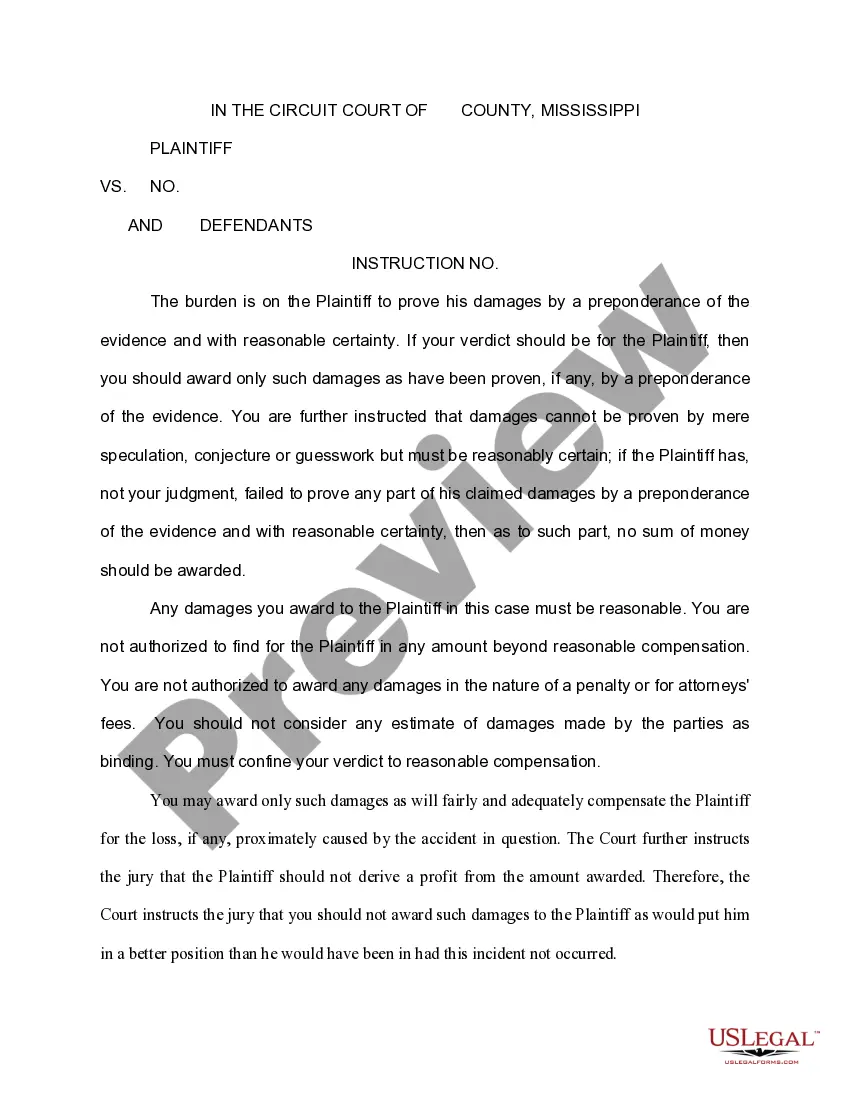
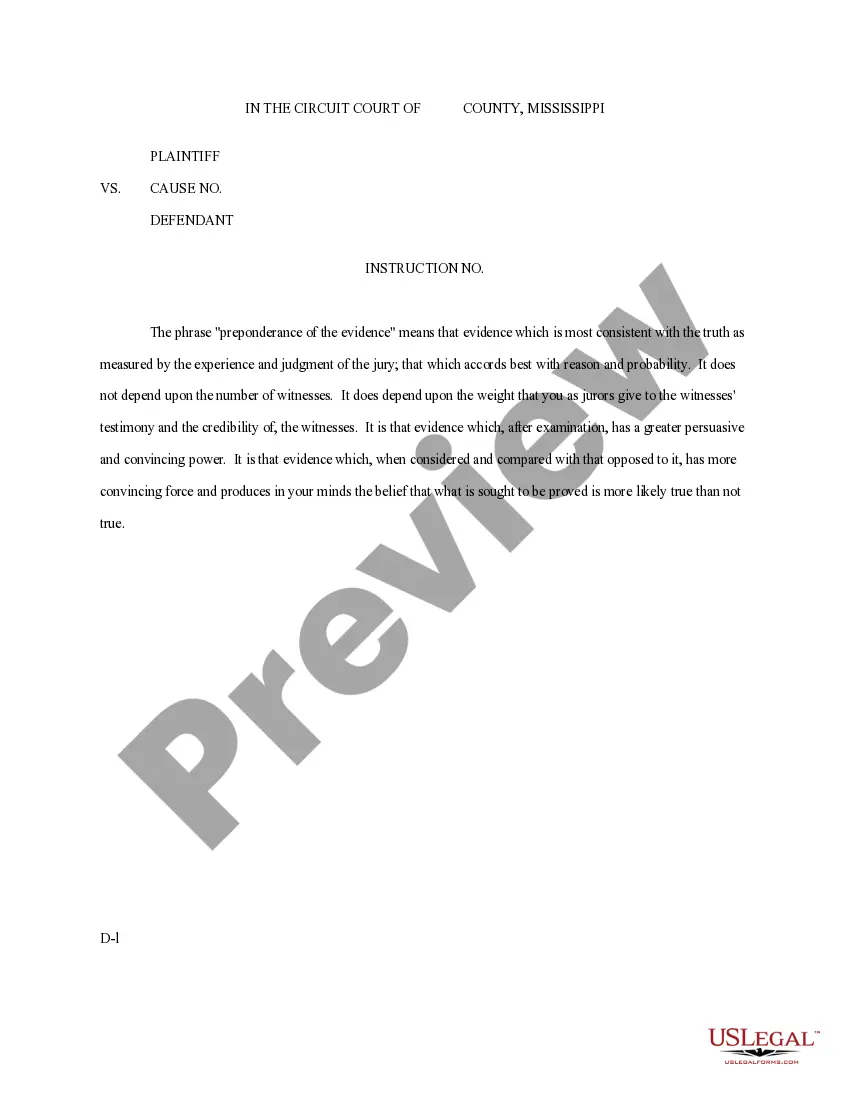
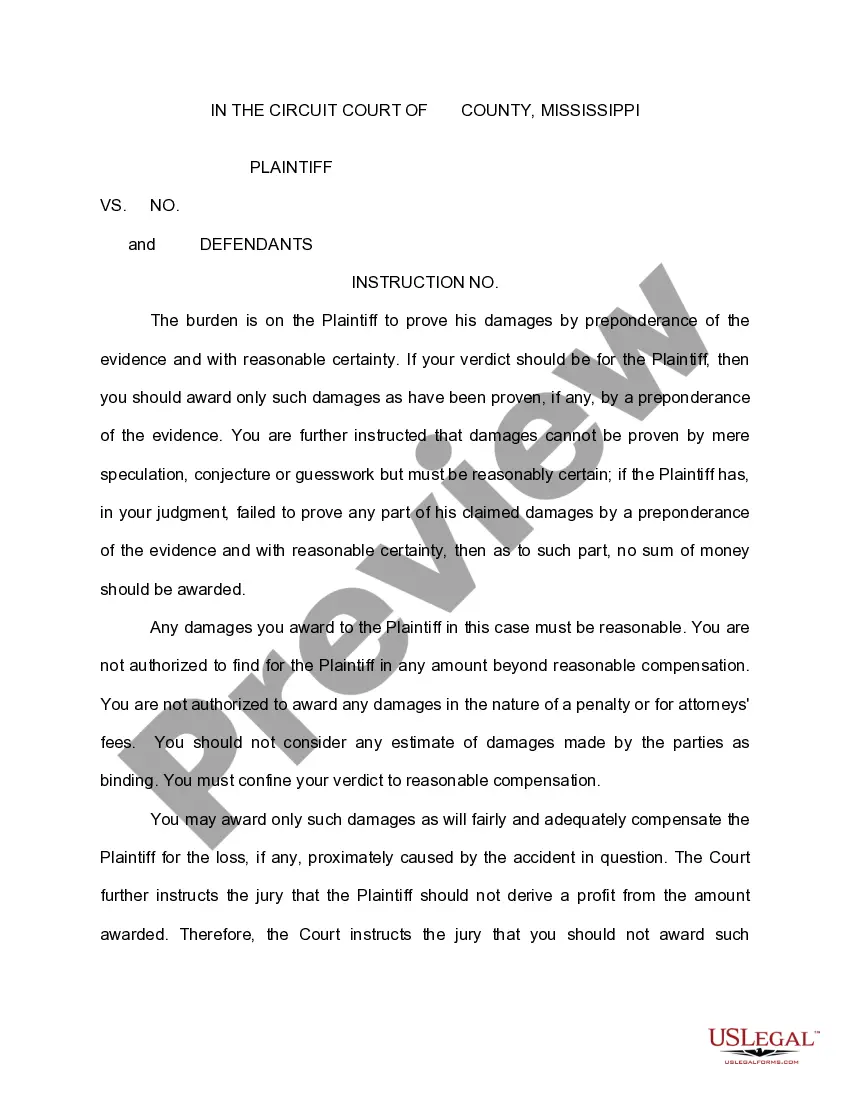
The Jury Instruction - Preponderance of Evidence - Damages form is a sample legal document used in Mississippi that guides juries in determining the appropriate standards for evaluating damages in a civil trial. This form specifically addresses how jurors should approach the burden of proof regarding damages claimed by the Plaintiff, distinguishing it from other jury instructions by focusing on the concept of "preponderance of the evidence."
Main sections of this form
- Instructions on the Plaintiff's burden to prove damages by a preponderance of the evidence.
- Clarification that damages must be proven with reasonable certainty, not speculation or conjecture.
- Directions to award only reasonable compensation and not to exceed what is necessary to rectify actual losses.
- Emphasis that the jury's decision on damages should not benefit the Plaintiff beyond restoring their rightful position.
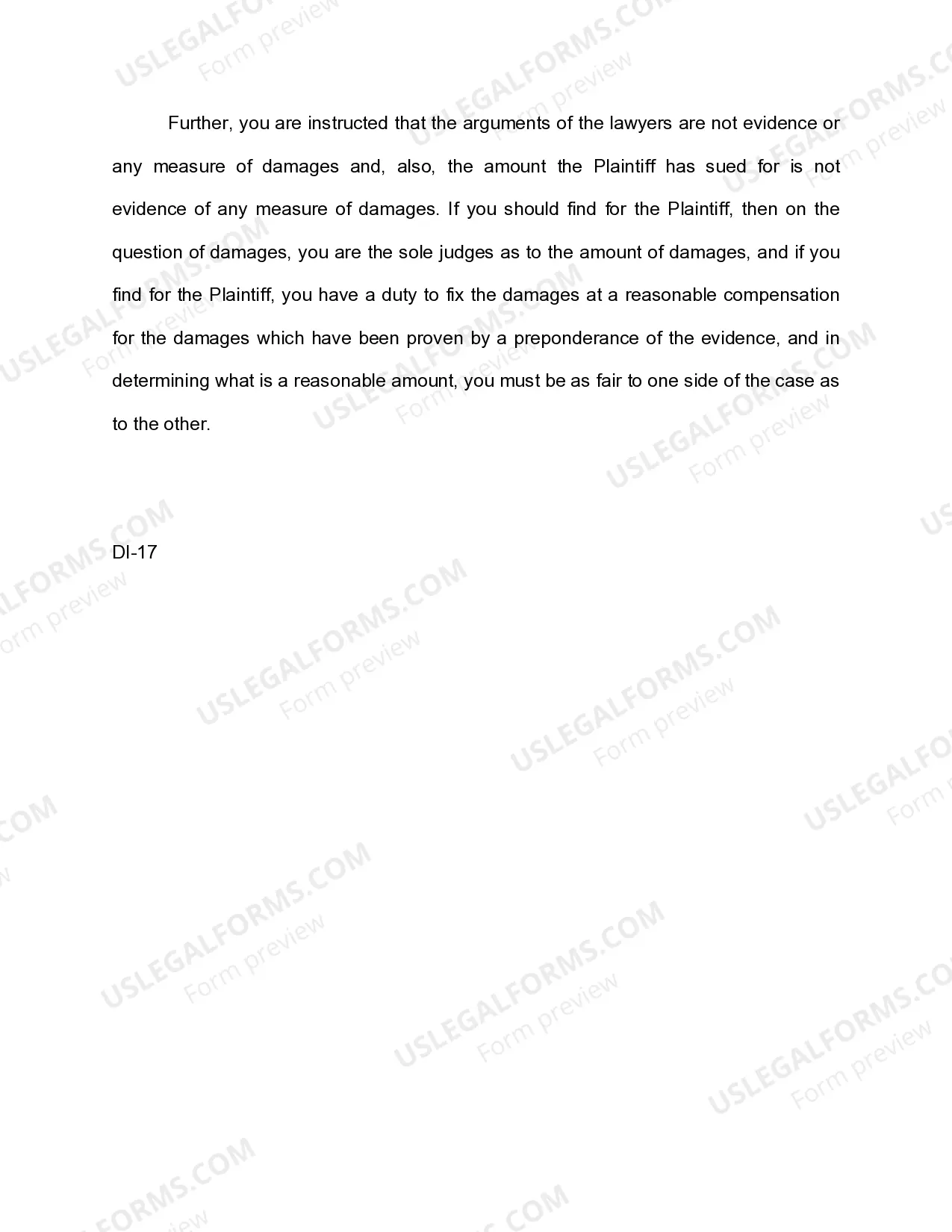
- Statement regarding the lack of evidence based on lawyers' arguments or the amount claimed in the lawsuit.
When to use this form
This jury instruction form should be utilized when a civil case in Mississippi involves claims for damages by a Plaintiff. It is particularly important in trials where the jury needs clear guidance on how to assess the evidence and the reasonable amount of damages to award, should they find in favor of the Plaintiff. Use this form to ensure jurors understand their role in determining damages accurately and fairly.
Who should use this form
- Judges presiding over civil trials in Mississippi that require jury instructions on damages.
- Attorneys representing Plaintiffs or Defendants seeking clarity on the standard for proving damages.
- Court clerks who manage jury-related documents and instructions for legal proceedings.
Completing this form step by step
- Enter the names of the parties involved in the case.
- Specify the case number to ensure proper identification of the trial.
- Provide accurate details concerning the Plaintiff's claimed damages.
- Include instructions for the jury regarding how to evaluate evidence presented during the trial.
- Review the form for compliance with existing Mississippi jury instruction guidelines.
Notarization requirements for this form
Notarization is generally not required for this form. However, certain states or situations might demand it. You can complete notarization online through US Legal Forms, powered by Notarize, using a verified video call available anytime.
Get your form ready online
Our built-in tools help you complete, sign, share, and store your documents in one place.
Make edits, fill in missing information, and update formatting in US Legal Forms—just like you would in MS Word.
Download a copy, print it, send it by email, or mail it via USPS—whatever works best for your next step.
Sign and collect signatures with our SignNow integration. Send to multiple recipients, set reminders, and more. Go Premium to unlock E-Sign.
If this form requires notarization, complete it online through a secure video call—no need to meet a notary in person or wait for an appointment.
We protect your documents and personal data by following strict security and privacy standards.

Make edits, fill in missing information, and update formatting in US Legal Forms—just like you would in MS Word.

Download a copy, print it, send it by email, or mail it via USPS—whatever works best for your next step.

Sign and collect signatures with our SignNow integration. Send to multiple recipients, set reminders, and more. Go Premium to unlock E-Sign.

If this form requires notarization, complete it online through a secure video call—no need to meet a notary in person or wait for an appointment.

We protect your documents and personal data by following strict security and privacy standards.
Common mistakes
- Failing to ensure that the form complies with current Mississippi law.
- Using vague language that does not clearly outline the burden of proof.
- Overcomplicating instructions which may confuse the jury.
Benefits of completing this form online
- Immediate access to a professionally developed jury instruction template.
- Easy customization to fit specific case details and requirements.
- Peace of mind knowing the form is created with input from licensed attorneys.
Legal use & context
- This instruction helps frame the jury's decision-making process regarding damages in civil trials.
- It establishes a standard of proof that the jury must adhere to when evaluating evidence related to damages.
- Jurors are instructed to confine their awards strictly to reasonable compensation, preventing excessive or punitive damages.
What to keep in mind
- The Jury Instruction - Preponderance of Evidence - Damages form is crucial for guiding jurors in assessing claims for damages.
- It is essential to follow Mississippi-specific legal standards when using this form.
- Clear and reasonable instructions can significantly affect outcomes in civil trials.
Looking for another form?
Form popularity
FAQ
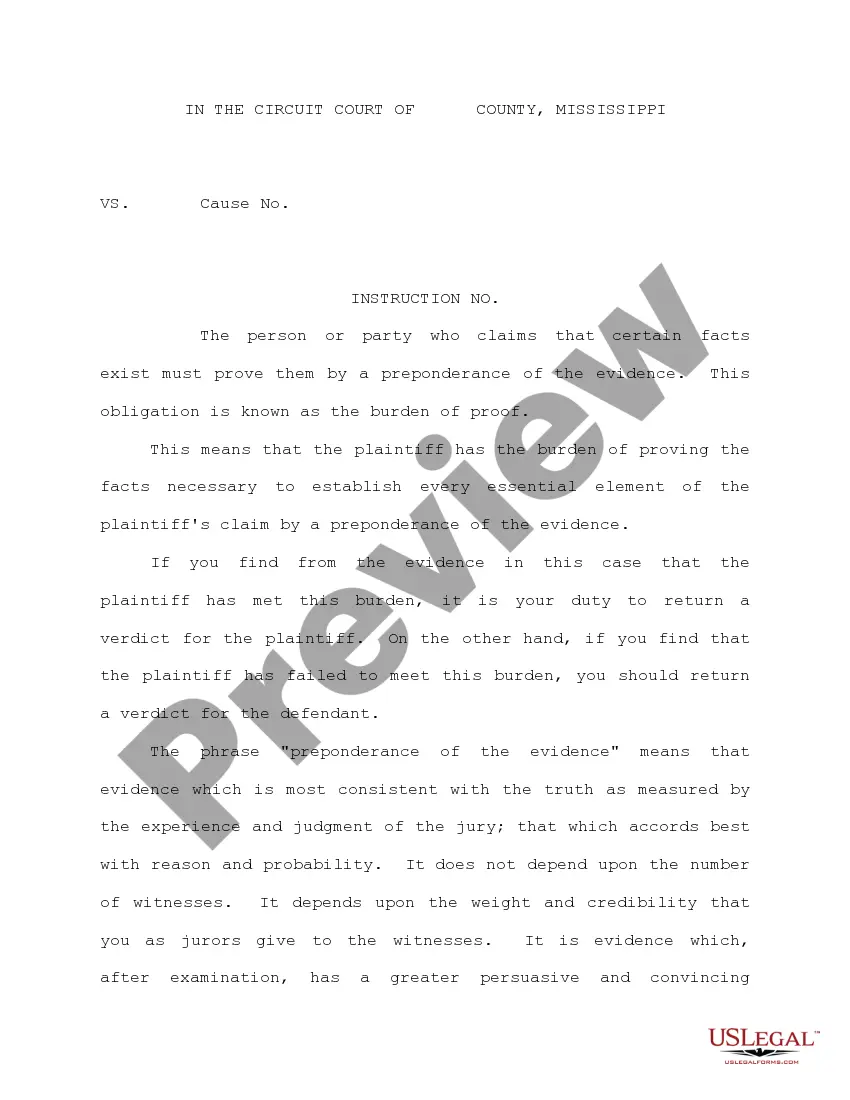
The preponderance-of-the-evidence standard is the default for most civil lawsuits. In these cases a plaintiff is typically suing a defendant for lost money because of acts like breaking a contract or causing a car accident (the money loss might be due to vehicle damage and medical bills, for example).
Jury lists are compiled from voter registrations and driver license or ID renewals. From those lists, summonses are mailed. A panel of jurors is then assigned to a courtroom.
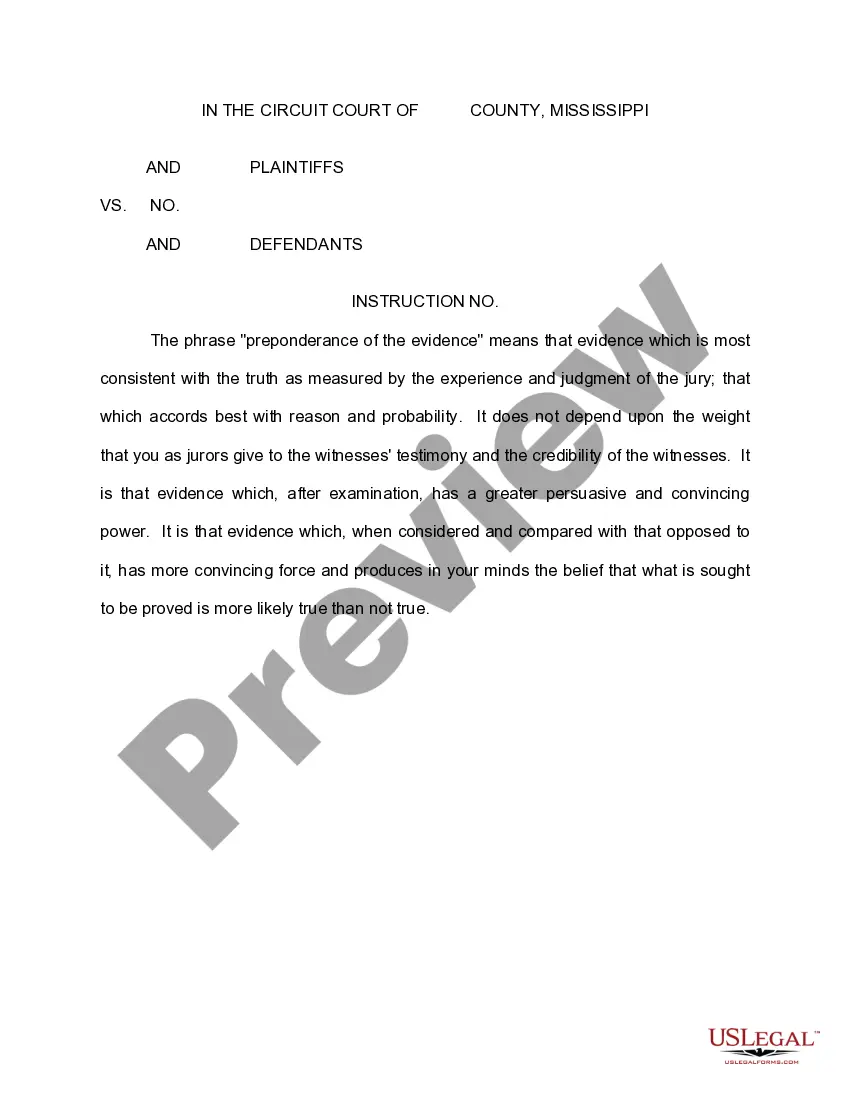
Preponderance of the evidence is one type of evidentiary standard used in a burden of proof analysis. Under the preponderance standard, the burden of proof is met when the party with the burden convinces the fact finder that there is a greater than 50% chance that the claim is true.
Jury Instructions. instructions that are given by the trial judge that specifically state what the defendant can be found guilty of and what the prosecution or plaintiff has to prove in order for a guilty verdict.
Preponderance of the evidence is required in a civil case and is contrasted with "beyond a reasonable doubt," which is the more severe test of evidence required to convict in a criminal trial.
They will review the evidence and arguments made by both sides, and frame the legal principles on which the jury has to make its decision. These remarks from the judge are known as jury directions. Jury directions have become more and more frequent as the criminal process has developed over the generations.
"Preponderance of the evidence means evidence that has more convincing force than that opposed to it. If the evidence is so evenly balanced that you are unable to say that the evidence on either side of the issue preponderates, your finding on that issue must be against the party who had the burden of proving it.
The lowest standard of proof is known as the 'preponderance of evidence. ' The preponderance of evidence standard comes into play when the plaintiff satisfies the burden of proof by offering evidence that demonstrates their claims have a greater than 50% chance to be true.
These are civil or criminal jury instructions approved by a state court, bench committee, or bar association. They are commonly used by courts in the relevant jurisdiction, as they ease the process of drafting fair jury instructions and theoretically do not have errors.