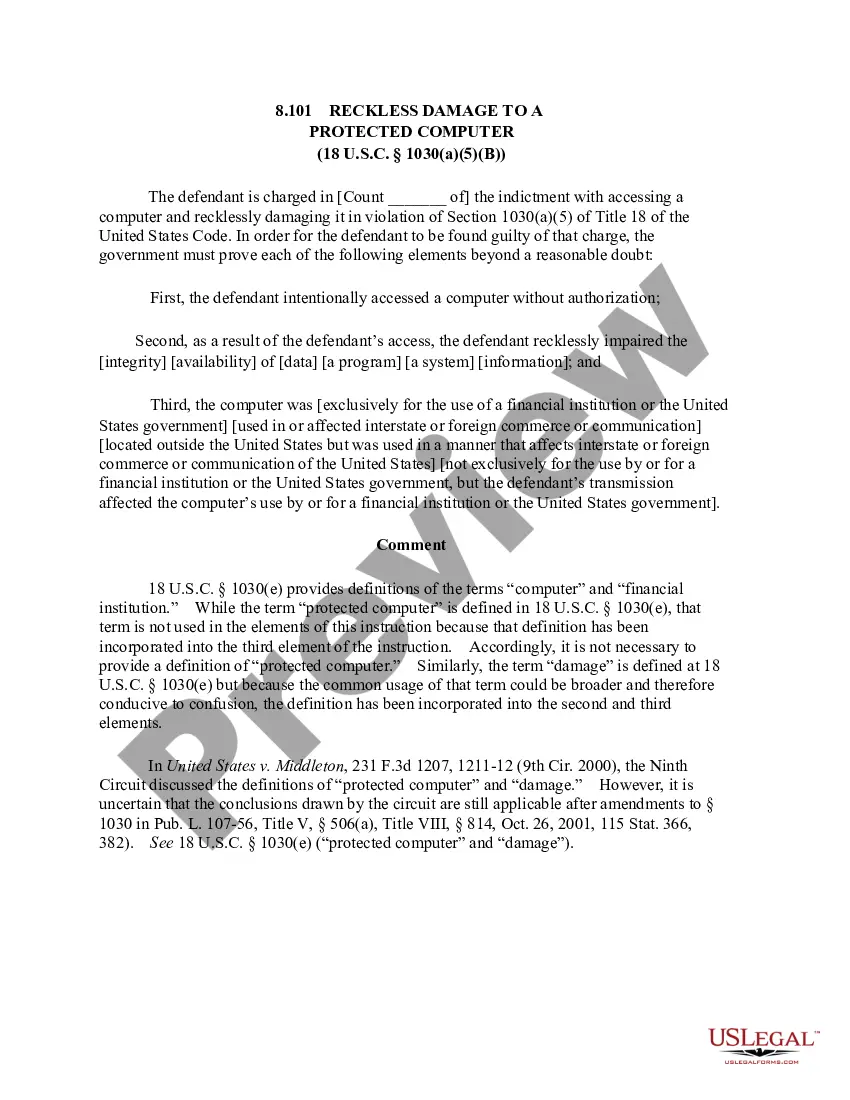
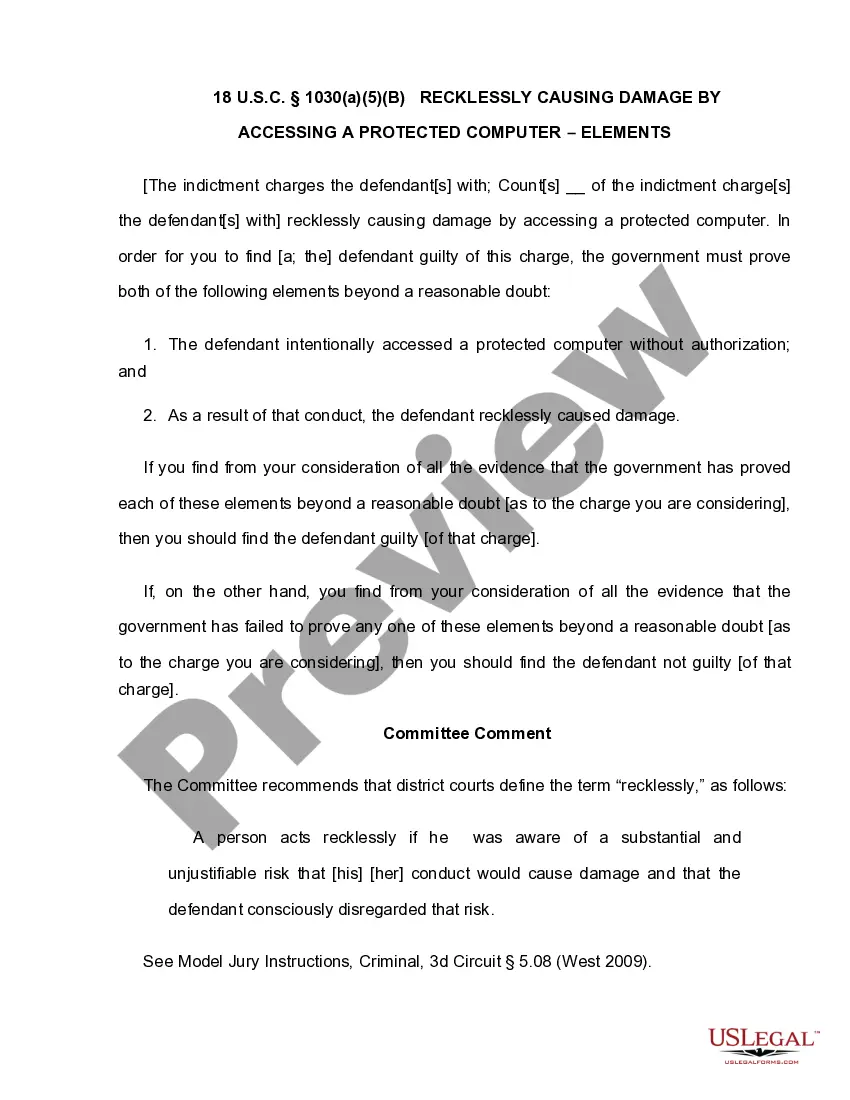
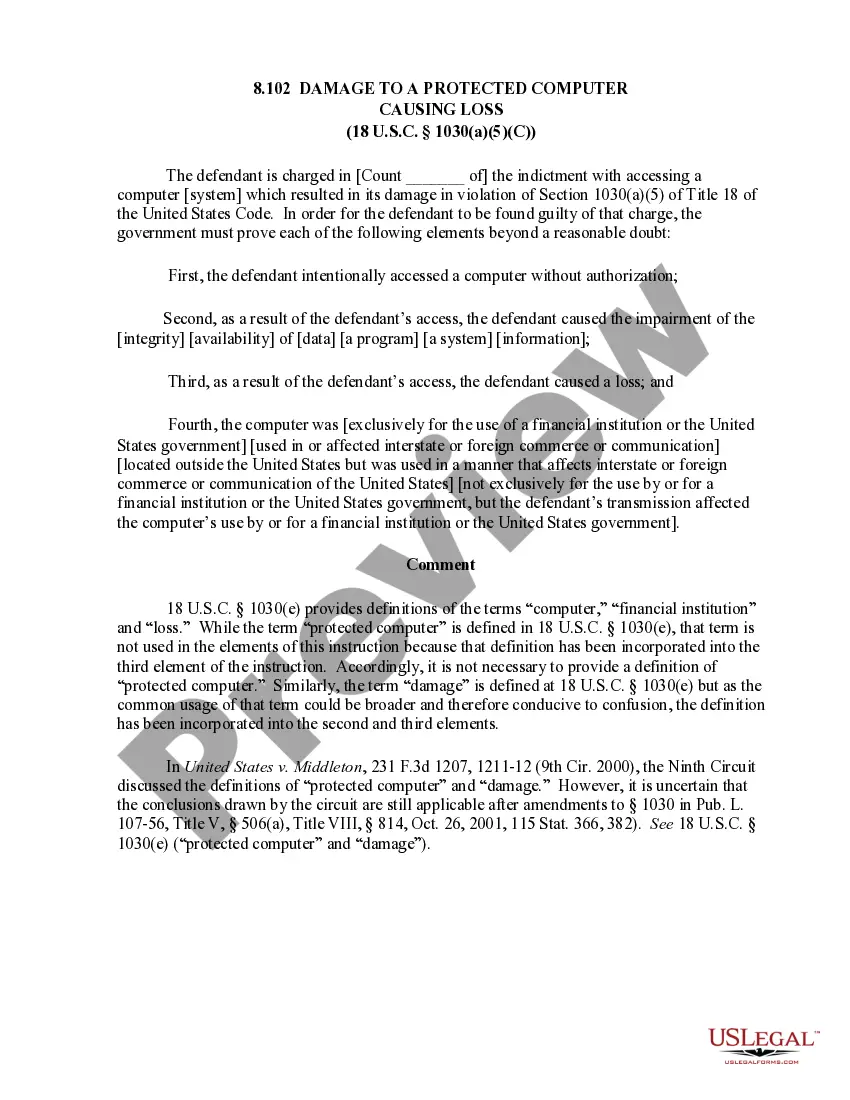
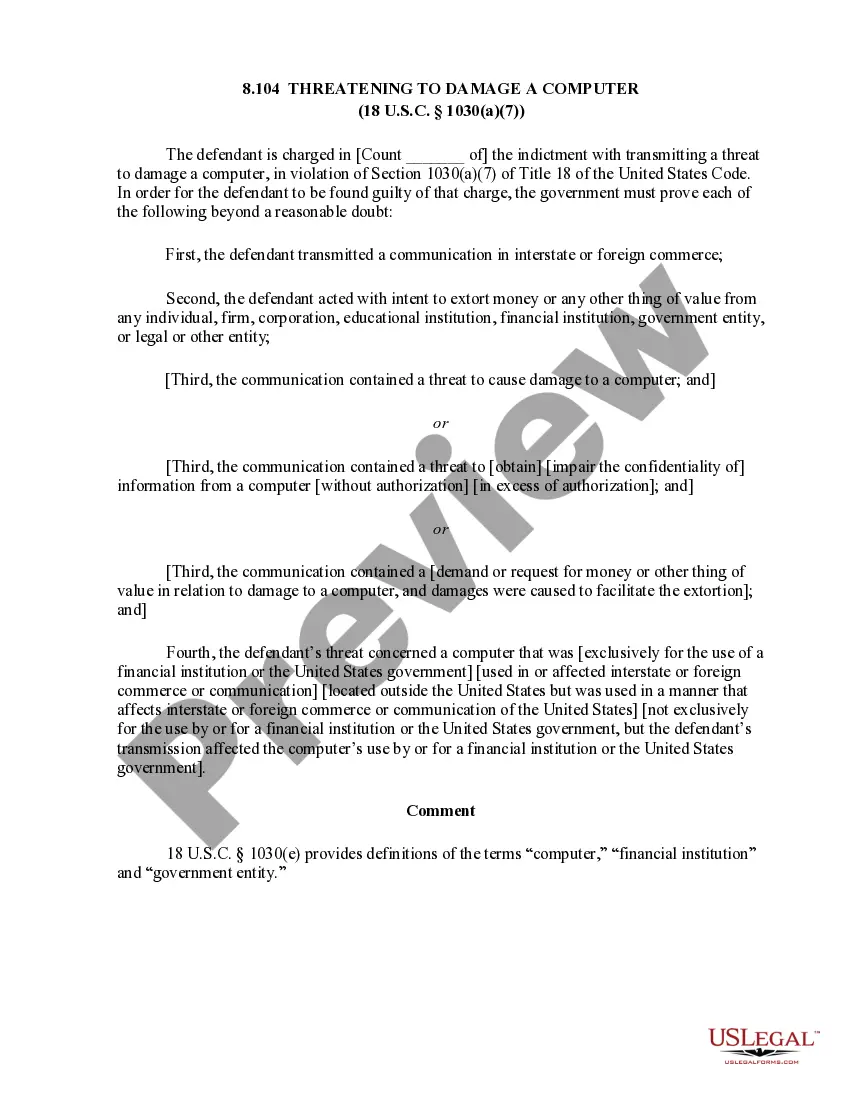
8.101 Reckless Damage to a Protected Computer (18 U.S.C. Sec. 1030(a)(5)(B))

Notarization guidance
Notarization is generally not required for this form. However, certain states or situations might demand it. You can complete notarization online through US Legal Forms, powered by Notarize, using a verified video call available anytime.
Get your form ready online
Our built-in tools help you complete, sign, share, and store your documents in one place.
Make edits, fill in missing information, and update formatting in US Legal Forms—just like you would in MS Word.
Download a copy, print it, send it by email, or mail it via USPS—whatever works best for your next step.
Sign and collect signatures with our SignNow integration. Send to multiple recipients, set reminders, and more. Go Premium to unlock E-Sign.
If this form requires notarization, complete it online through a secure video call—no need to meet a notary in person or wait for an appointment.
We protect your documents and personal data by following strict security and privacy standards.

Make edits, fill in missing information, and update formatting in US Legal Forms—just like you would in MS Word.

Download a copy, print it, send it by email, or mail it via USPS—whatever works best for your next step.

Sign and collect signatures with our SignNow integration. Send to multiple recipients, set reminders, and more. Go Premium to unlock E-Sign.

If this form requires notarization, complete it online through a secure video call—no need to meet a notary in person or wait for an appointment.

We protect your documents and personal data by following strict security and privacy standards.
Looking for another form?
Form popularity
FAQ
Computer Fraud and Abuse Act. In 1986, Congress passed the Computer Fraud and Abuse Act (CFAA), now codified under Title 18 U.S. Code § 1030. This law makes it a federal crime to gain unauthorized access to ?protected? computers (otherwise known as ?hacking?) with the intent to defraud or do damage.
Most federal computer hacking offenses are pursued under 18 U.S.C. § 1030 which covers a wide variety of illegal computer crimes. This statute makes it a federal crime to access a protected computer without consent with intent to cause harm or commit a fraud crime.
Federal Law In 1986, Congress passed the Computer Fraud and Abuse Act (CFAA), the federal statute that prohibits unauthorized computer access. Under federal law, unauthorized computer access describes the act of: Knowingly accessing a computer without authorization to obtain: Financial information.
In 1986, Congress passed the Computer Fraud and Abuse Act (CFAA), now codified under Title 18 U.S. Code § 1030. This law makes it a federal crime to gain unauthorized access to ?protected? computers (otherwise known as ?hacking?) with the intent to defraud or do damage.
Federal law provides that first time offenders caught violating the CFAA may be punished with criminal fines of up to $5,000 per crime, imprisonment from 1 to 10 years, or a combination of both.
The Computer Fraud and Abuse Act (18 U.S.C. § 1030) (CFAA) imposes criminal and civil liability for unauthorized access or damage to a protected computer. The law reaches every computer connected to the internet and non-networked computers used by the US government or financial institutions.
§1030. Fraud and related activity in connection with computers. (C) intentionally accesses a protected computer without authorization, and as a result of such conduct, causes damage and loss.
Computer Fraud & Abuse Act The CFAA essentially states that, whoever intentionally accesses a computer without authorization or exceeds authorized access, and thereby obtains information from any protected computer if the conduct involved an interstate or foreign communication shall be punished under the Act.